The Greeks who put to sea did so knowing their lives belonged to one god above all others — a god as changeable as the water itself, generous and beautiful one hour, annihilating the next. Poseidon, lord of the sea, earth-shaker, tamer and maker of horses, was perhaps the most feared of all the Olympians, because his domain was the one the Greeks could neither live without nor ever truly trust.
The Brother Who Drew the Sea
When the three sons of Cronus — Zeus, Hades and Poseidon — divided the cosmos by lot after the fall of the Titans, Poseidon drew the waters of the world. But to call him merely a sea-god undersells him. His older, deeper title is Enosichthon, the Earth-Shaker: the Greeks blamed earthquakes on the blow of his trident, and so his power reached far beyond the shoreline into the trembling ground itself.
Earth-Shaker, Storm-Bringer, Horse-Lord
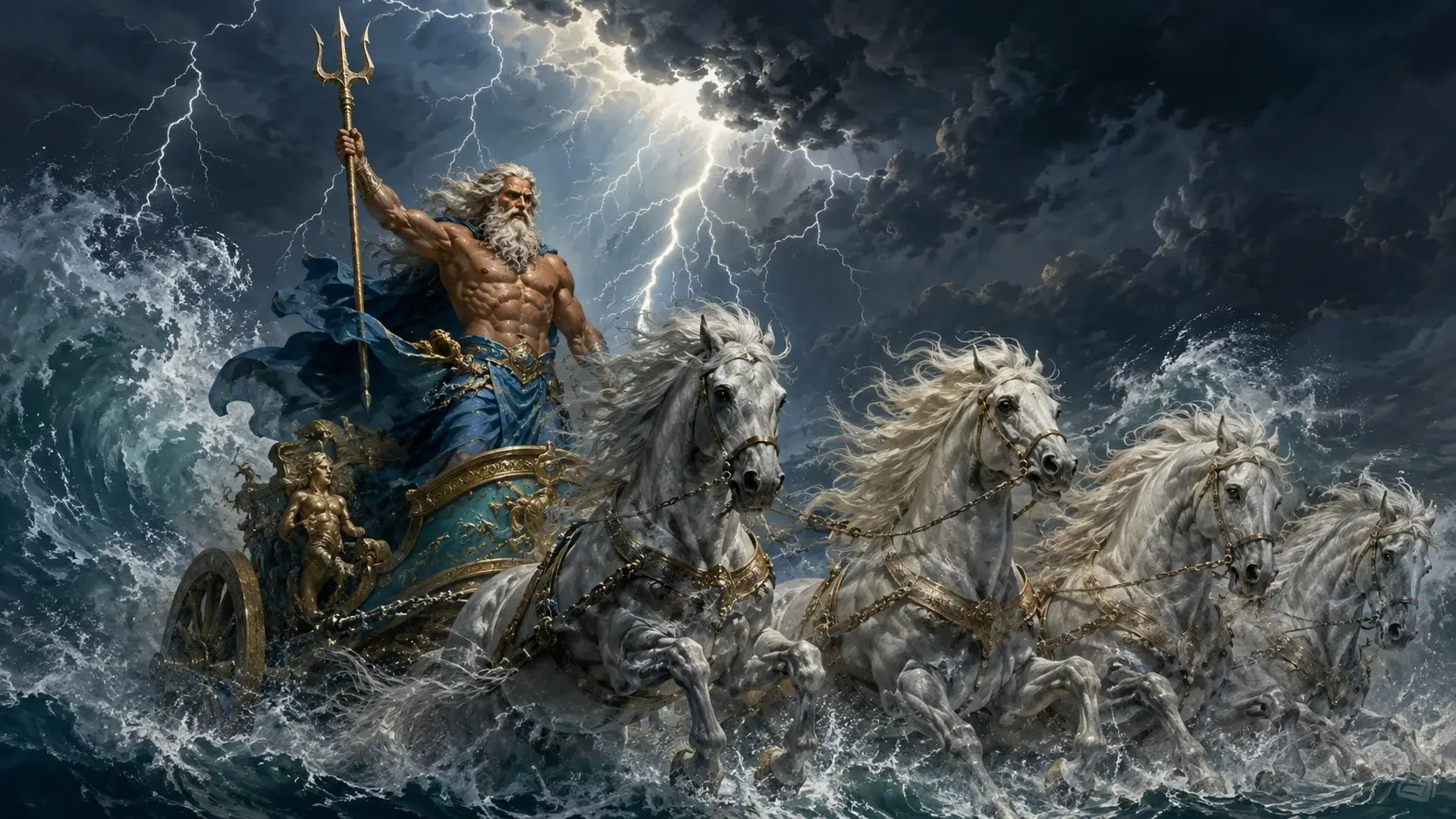
With a single gesture of his three-pronged trident, Poseidon could raise storms that shattered fleets or calm the water to glass. He was also, strangely and wonderfully, the god of horses — Poseidon Hippios — said to have created the first horse and to father divine steeds. The Greeks linked the surge of breaking waves to the gallop of white horses, and in that image sea and stallion became one.
The Contests and the Grudges
Poseidon's pride made him a dangerous rival. When he and Athena both desired the great city of Attica, each offered a gift: Poseidon struck the Acropolis and brought forth a saltwater spring (or a horse), but Athena's olive tree won the people, and the city became Athens. He never quite forgave the slight.
His grudges could doom a man for a generation. When the hero Odysseus blinded the Cyclops Polyphemus — Poseidon's own son — the sea-god scattered his ships and kept him from home for ten long years. It was in a temple of Poseidon, too, that Medusa drew Athena's curse. To cross the Earth-Shaker, or even to be caught in his orbit, was to invite the sea to swallow you.
The Untrustworthy Deep
Poseidon endures because he is the face the Greeks gave to the sea's double nature: the road to every island and colony, the source of food and trade and empire — and the vast, indifferent thing that could erase a ship and its crew without a ripple of remorse. To honour Poseidon was not to love him. It was to bargain, carefully, with a power you could never command.
Sailors poured wine into the waves before every voyage — not in worship, but in the oldest kind of prayer: please, let me cross, and let me come home.
Older Than Olympus
Poseidon is not a latecomer to Greek religion. His name survives in Linear B, the syllabic script of the Mycenaean palaces that burned around 1200 BC — four centuries before Homer, in an age the classical Greeks themselves remembered only as legend. On the clay tablets of Pylos and Knossos he appears as po-se-da-o, and in the Pylos archive he receives more offerings, and richer ones, than any other deity on the tablets. Zeus is listed there too. Poseidon outranks him.
The Pylos tablets also record a po-si-da-e-ja — a feminine form of his name, a goddess receiving offerings in her own right, who then vanishes entirely from later Greek religion. We do not know who she was. It is one of the sharpest reminders available that the Olympian family we inherited is a late edit of something older and stranger.
Even the name is unresolved. The most persistent proposal reads it as posis, “lord” or “husband”, joined to a second element understood as earth — the Lord of Earth, not of water at all. Others read the second element as something closer to water. Neither reading has won, and the honest position is that the etymology of the sea-god’s name is still open. What is striking is that the disagreement is not idle: it lands exactly on the fault line that runs through everything Poseidon is, between the sea above and the ground below.
There is a lovely convergence hiding in Homer. When Telemachus sails to Pylos at the start of the Odyssey’s third book, he finds Nestor and the whole population on the beach, slaughtering black bulls to Poseidon. Poets working half a millennium after the palace at Pylos fell still knew, correctly, whose city it had been.
Earth-Holder: The God Beneath the Ground
Greek cult titles are not decoration; they name the specific power being addressed. Poseidon’s include Gaieochos, the earth-holder or earth-carrier, and — most revealing of all — Asphaleios, the Securer, the one who keeps things from falling. The Spartans, living on one of the most seismically punished stretches of the Mediterranean, prayed to him under that name. You do not ask a sea-god to hold your walls up unless you already believe the ground is his.
At Tainaron, the middle finger of the Peloponnese’s southern hand, his sanctuary stood over a cave the Greeks took for a mouth of the underworld, and the precinct carried the absolute right of asylum. Thucydides records that Spartan authorities once coaxed helot suppliants out of that sanctuary and killed them — and that when the catastrophic earthquake of the 460s BC levelled Sparta, the Spartans themselves named the sacrilege at Tainaron as the cause. That is not a poet’s conceit. It is a state, in a historian’s account, reading a geological event as a bill coming due.
The same logic destroyed a city. In the winter of 373 BC the Achaean town of Helike, home to one of the most important sanctuaries of Poseidon in the Greek world, was struck by an earthquake and then swallowed by a wave from the Corinthian Gulf in a single night. Ancient writers, working backwards, found the offence: Helike had wronged suppliants and refused sacred property to Ionian kinsmen. The sea-god had simply taken his own city back. For generations afterwards visitors were shown the drowned site, and Strabo reports that a bronze Poseidon stood upright beneath the water there, fouling the nets of anyone who fished above it.
What Worship Actually Looked Like
Poseidon was not a god you visited only in emergencies. He anchored some of the largest recurring gatherings in the Greek calendar.
- The Isthmian Games, held at his sanctuary on the Isthmus of Corinth, were one of the four Panhellenic festivals — the crown circuit that included Olympia and Delphi. They ran every two years, drew competitors from across the Greek world, and crowned their victors with wild celery or with pine, the tree sacred to him there.
- The Panionion, on the promontory of Mykale in Asia Minor, was the federal sanctuary of the twelve Ionian cities, dedicated to Poseidon Helikonios. The one institution those cities held in common was a league that met at a shrine to the Earth-Shaker.
- Sounion, the cape at the tip of Attica, carried his temple on the cliff edge, deliberately visible far out to sea. Its surviving Doric columns are still the first thing a ship rounding the headland sees — a landfall marker and a warning in the same building.
- At Onchestos in Boeotia the Homeric Hymn to Apollo describes a grove of Poseidon where a newly broken chariot team was driven into the sacred wood with the driver leaping clear, the horses left to their own judgement. What exactly the rite meant is still argued over. That it was performed is not.
The offerings match the god. Bulls above all — he carries the epithet Taureos, of the bull, and when Homer needs an image for a man dying loudly he reaches for a bull bellowing as it is hauled to Poseidon’s altar. Horses too, sometimes in the most literal way imaginable: Pausanias records that the Argives threw bridled horses into the deep water called Deine as gifts to him. The Athenians named an entire month Poseideon, falling around the turn of midwinter, when the sailing season was shut and the sea was at its most murderous.
And there is the detail that says the most about how Greeks held two ideas at once. Poseidon lost Athens to Athena — and kept a shrine on the Acropolis anyway. Inside the Erechtheion, on the citadel of the goddess who beat him, the Athenians maintained the salt sea he had struck from the rock and pointed out the trident marks he had left in the stone. The loser of the contest was housed, permanently, in the winner’s temple. A god of the sea was not something a maritime empire could afford to leave outside.
Amphitrite, and a Court Beneath the Water
His queen is Amphitrite, a sea-goddess in her own right long before she was anyone’s consort. The courtship story is uncharacteristically gentle: she fled his attention, hid at the far edge of the world, and it was a dolphin that found her and talked her round — for which Poseidon set the dolphin among the stars as the constellation Delphinus. Their children include Triton, the merman herald whose conch-blast could raise or still the waves, along with Rhode and Benthesikyme.
Elsewhere his pursuits are much darker, and the Arcadians preserved the darkest. Demeter, hunting for her stolen daughter, turned herself into a mare to escape him; Poseidon became a stallion and took her anyway. From that violence came the immortal horse Arion and a daughter whose true name the Arcadians refused to say aloud to outsiders, calling her only Despoina, the Mistress. At Phigalia the outraged Demeter was worshipped as the Black One, and at Thelpousa as Erinys, the Fury. Two of the oldest powers in Greek religion — the grain and the earthquake — meet in a story with no comfort in it at all.
The Odyssey adds one more of his signature moves: to reach Tyro, who was in love with the river Enipeus, Poseidon simply became the river. Their sons, Pelias and Neleus, went on to found dynasties — and Pelias is the king who sends Jason after the Golden Fleece.
A Bloodline of Giants and Monsters
Line up Poseidon’s children beside Zeus’s and a pattern jumps out that the Greeks clearly noticed themselves. Zeus fathers heroes and civilising figures. Poseidon fathers things that have to be put down.
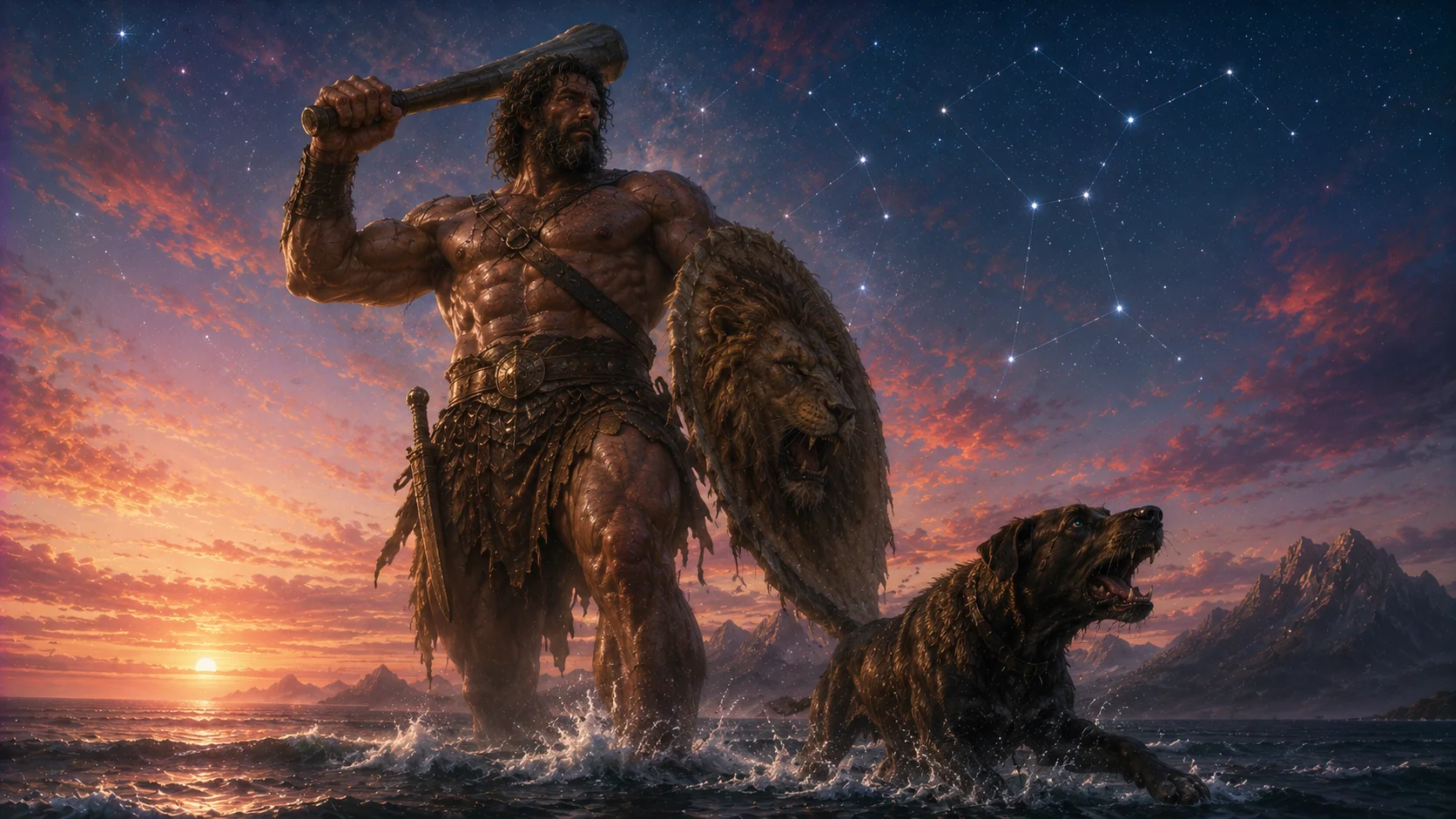
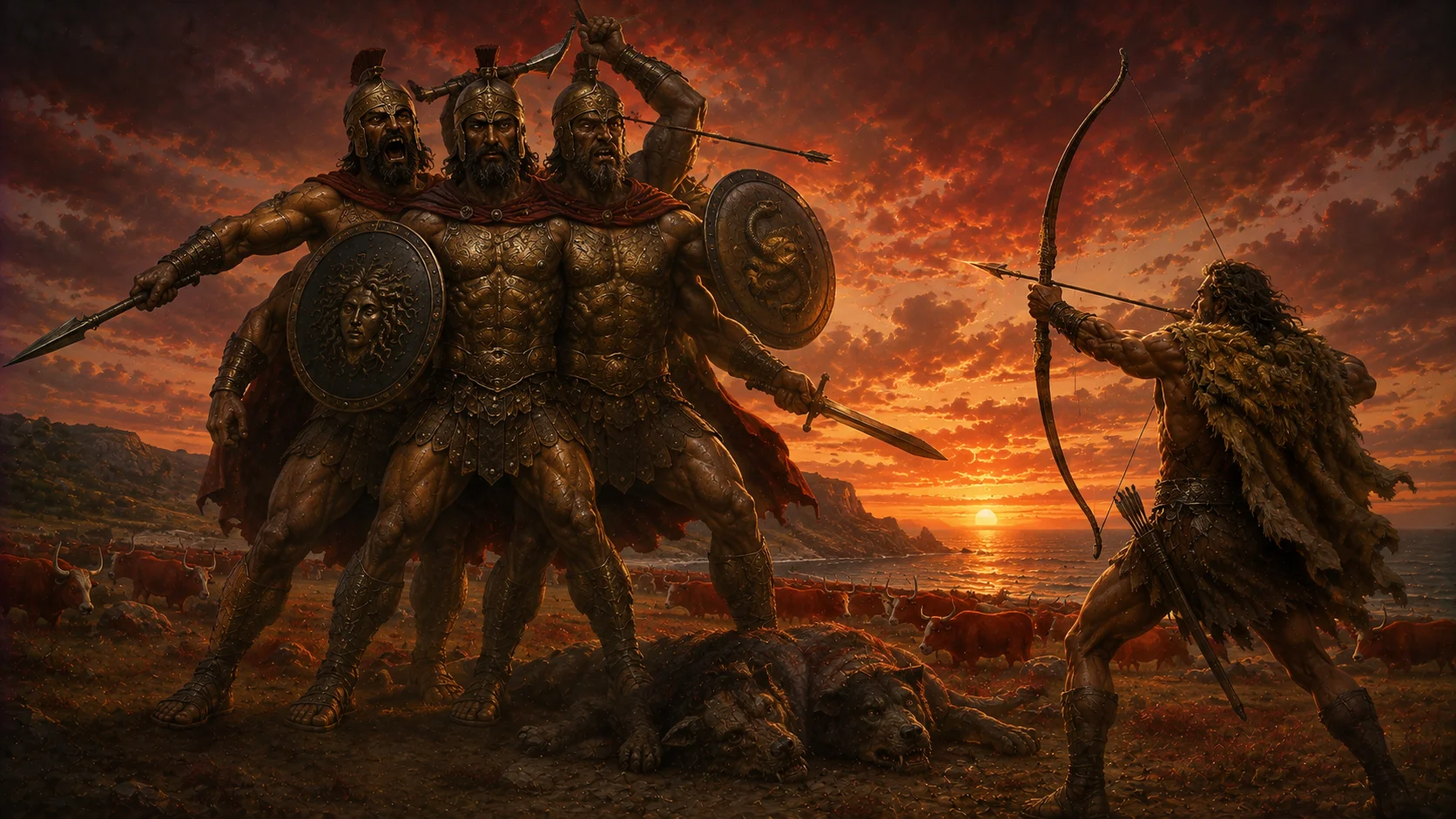
The Cyclops Polyphemus is his. So is Antaeus, the Libyan giant who could not be beaten while he touched the ground, until Heracles lifted him off it. So are the Aloadae, Otus and Ephialtes, who grew nine fingers’ breadth a month and tried to stack Ossa on Olympus to storm heaven. So are Chrysaor and the winged horse Pegasus, sprung from Medusa’s severed neck. So is Amycus, the boxing king of the Bebryces who forces every stranger who lands on his coast to fight him to the death, and Busiris of Egypt, who kills his guests on an altar.
It is a genealogy of raw, unshaped, oversized force: enormous strength with no restraint attached, exactly what the sea looks like when you are standing in it. And there is an irony folded into it, because Theseus — the hero whose early career is nothing but clearing the coast road of sons like these, Sciron among them, whom one strand of the tradition gives to Poseidon — was himself credited with two fathers, Aegeus of Athens and Poseidon of the sea. He proved the second, in one version, by diving to the seabed after a ring Minos had thrown in, and surfacing dry.
Four Myths the Sea-God Owns
The walls of Troy. Poseidon and Apollo were once bound to serve the Trojan king Laomedon for a year, and Poseidon built the great wall of the city with his own hands. Laomedon refused to pay them and threatened to sell them into slavery with their ears cut off. That unpaid bill is why, in the Iliad, the god who built Troy’s defences spends the war working to bring them down.
The bull from the sea, twice. Minos of Crete asked Poseidon for a bull from the waves as proof of his right to rule, promising to sacrifice it; when it came up magnificent, he kept it. Poseidon’s punishment was to make Minos’s wife Pasiphaë desire the animal — and the child of that union was the Minotaur. Later, Theseus spent one of the three curses Poseidon owed him on his own son Hippolytus, and a bull came out of the surf again; this time it panicked a chariot team and dragged a young horseman to death along the shore. The god of horses killing a horseman with a bull out of the sea is not a coincidence. It is the whole of Poseidon in a single image.
The ship turned to stone. The Phaeacians ferried Odysseus home in defiance of Poseidon’s grudge. As their ship came back into its own harbour, in sight of the whole city, the god struck it motionless and turned it to rock. The punishment is aimed less at the crew than at the watching population: hospitality to his enemy has a price, and it is paid in public.
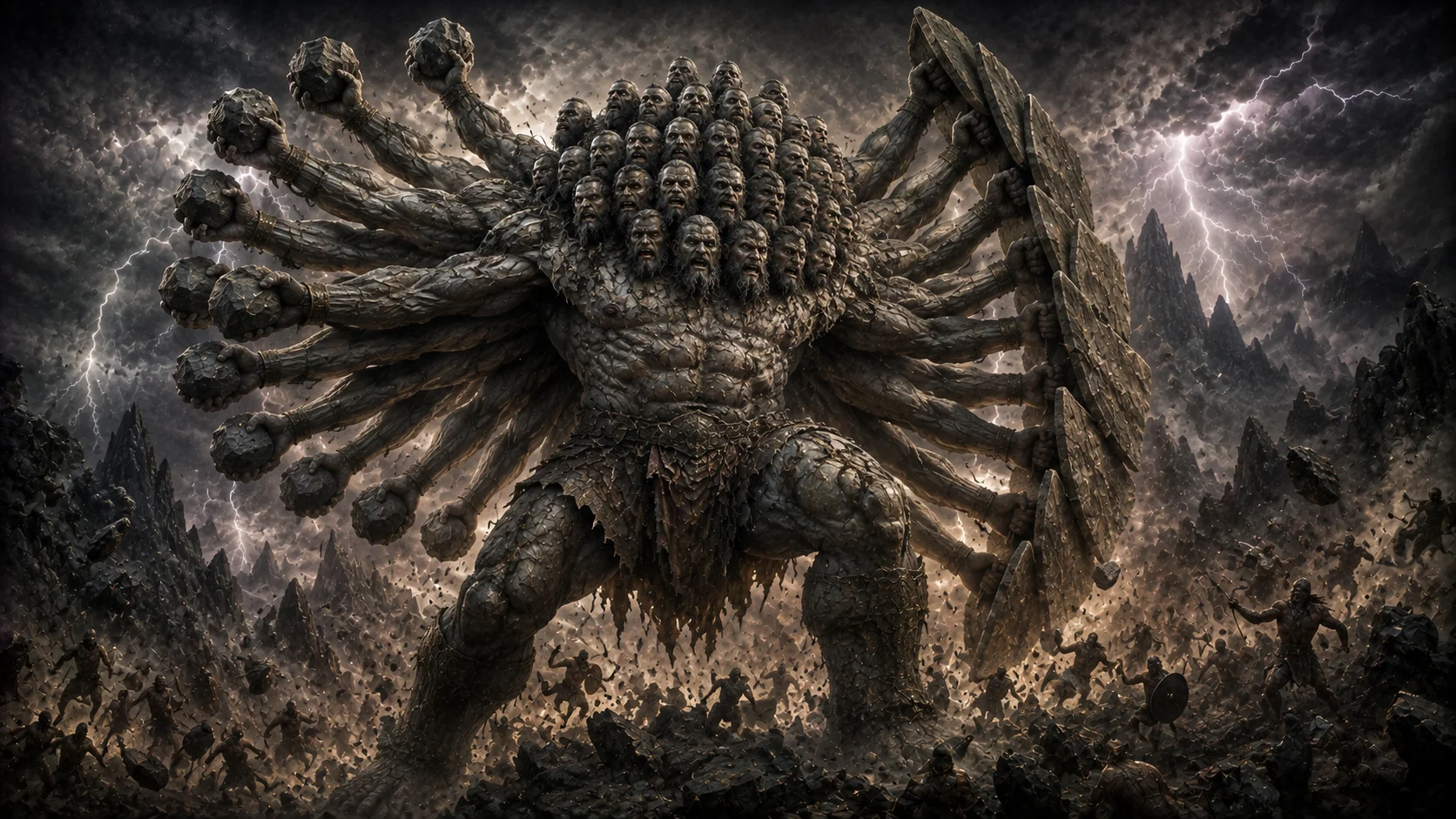
The near-mutiny. Alone among the Olympians, Poseidon openly disputes Zeus’s authority. In the Iliad he tells Zeus’s own messenger that the three brothers drew equal lots, that the earth and Olympus are held in common, and that he will not live by Zeus’s orders. Homer also remembers an earlier attempt in which Hera, Athena and Poseidon actually tried to bind Zeus in chains, and were stopped only when Thetis fetched up the hundred-handed Briareos from the sea. Poseidon backs down each time — but he is the only one who ever raises the question.
The God Who Built Atlantis
Plato’s Critias gives Poseidon the strangest afterlife of any Greek god. In it, when the gods divided the earth, the island of Atlantis fell to Poseidon. He loved a mortal woman, Cleito, and fortified her hill with alternating rings of land and water; their five pairs of twin sons became the island’s kings, the eldest being Atlas. At the centre stood his temple, and there the kings performed a rite that Plato describes in unnerving detail: bulls roamed free in the precinct, and the kings hunted them with staves and nooses, using no iron, before swearing their oaths over the blood.
Plato was making a philosophical argument, not reporting a lost civilisation. But he chose Poseidon deliberately — the god of the untrustworthy element, patron of a naval empire that grows arrogant and is then erased in a single day and night by earthquake and sea. Every modern Atlantis story descends from that choice, usually without knowing whose island it was.
Recognising Him in Art
Poseidon in Greek art is a mature, heavily bearded man with a powerful frame — almost indistinguishable from Zeus, which is precisely the problem. The famous Artemision Bronze, hauled from the sea off Euboea, has been argued over for a century: the figure is poised to throw something that no longer exists, and whether he is Zeus casting a thunderbolt or Poseidon casting a trident still divides opinion, because the pose fits both.
The reliable tell is the attribute. Look for the trident — a working fisherman’s spear promoted to a sceptre — and for the company he keeps: dolphins, tuna, horses, a chariot drawn by hippocamps with the forequarters of a horse and the coiling tail of a fish. On the west pediment of the Parthenon, the end that faced anyone walking onto the Acropolis, the contest for the city was carved at monumental scale, with Poseidon and Athena recoiling from each other at the moment of the strike.
Neptune Is Not Quite the Same God
Rome’s Neptune is usually treated as a straight translation, and he is not. The Roman god began as a power of fresh water — springs, streams, the supply that fails in a dry summer. His festival, the Neptunalia, fell on 23 July, at the parched height of the Italian year, and Romans marked it by building rough shelters of branches and leaves and drinking in the shade. That is a drought rite, not a sailor’s rite. His consort Salacia is a native Italian figure whom Romans only later matched up with Amphitrite.
Only when Rome went to sea, and Greek myth was absorbed wholesale, did Neptune inherit the trident, the storms and the earthquakes. The join still shows: a god of springs wearing a sea-god’s costume. It is a useful corrective to the idea that the Roman gods are simply the Greek ones renamed.
The Long Afterlife
Poseidon — usually under his Roman name — never went away. Renaissance city-states put him at the centre of their public fountains, Ammannati’s in Florence and Giambologna’s in Bologna, because a colossal Neptune presiding over running water was the most direct possible statement that a city had mastered its own supply. When an eighth planet was confirmed in 1846, the name that stuck to it was Neptune. Eighteenth-century geology had a school called Neptunism, which held that the rocks had precipitated out of a primordial ocean. Navies still stage a crossing-the-line ceremony in which a sailor dressed as King Neptune holds court on deck as the ship crosses the equator — a survival of the idea that entering new water requires the permission of whoever owns it.
Modern fiction has mostly made him a father. He is Percy Jackson’s absent, oceanic parent; he is the first boss fight in God of War III. What tends to be lost in translation is the earthquake. Strip that away and you get a benign old man with a fish-spear — which is the one thing the Greeks never thought he was.
The Prayer Addressed to the Breaker
One habit of his cult is worth carrying away, because it is neither sentimental nor obvious. When the ground in Laconia moved, the Spartans did not appeal to some steadier god for protection against Poseidon. They prayed to Poseidon, as Asphaleios, the Securer, and asked him to hold still. The title is an address to the very force doing the damage.
That instinct explains the shape of everything above — why the same god owns the harbour and the fault line, why he fathers monsters and also the horse, why his sanctuary at Tainaron sits on a hole in the world and offers absolute sanctuary. The Greeks did not split their danger from their safety, because in their experience the two arrived from the same direction. Plate tectonics needs no trident, and the grain fleets are gone. But the arrangement the Earth-Shaker was invented to describe has not been repealed: the thing holding you up is the thing that can drop you, and there was never a version where you got to keep only the first half.
Sources & traditions
- EncyclopediaWikipedia — Poseidon
- TraditionGreek texts, inscriptions and later retellings (Greece)
Myths change from area to area and from time to time. This chronicle follows the most widely told versions; tellings in other villages, regions and eras may differ.