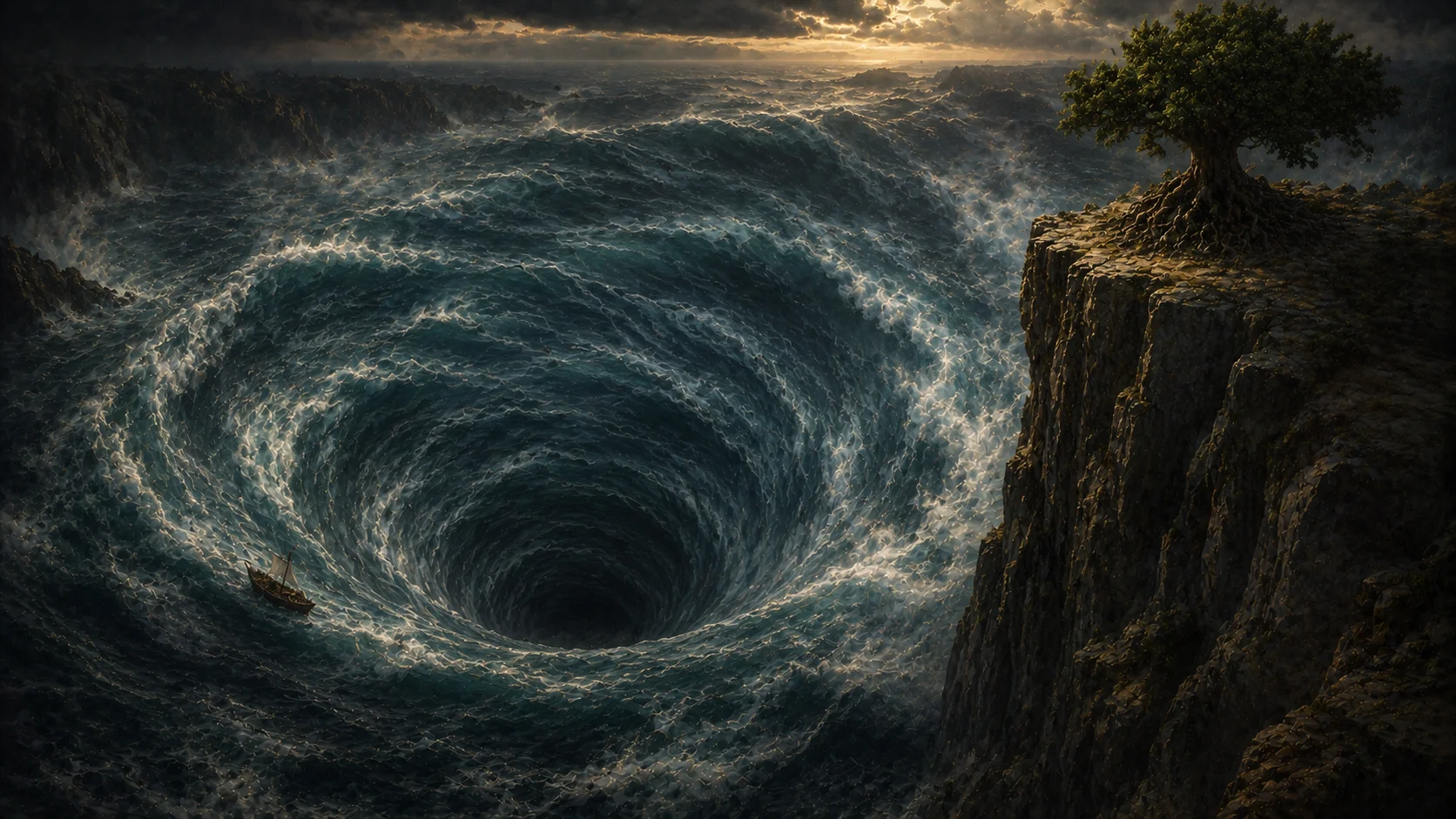
Across the narrow strait from the six-headed Scylla lurked a different kind of death — not a beast with teeth, but the sea itself turned monstrous: Charybdis, the great whirlpool that swallowed the ocean whole three times a day and belched it back out, dragging down any ship unlucky enough to be near.
The Whirlpool That Devours the Sea
Charybdis lived beneath a great fig tree on one side of a narrow strait (traditionally the Strait of Messina, between Italy and Sicily). Three times each day she sucked down the waters of the sea in a vast, roaring vortex, and three times she spewed them back. Any vessel caught in her pull was drawn down to destruction — not eaten, but drowned, ship and all, in the throat of the sea.
A Daughter of the Sea, Cursed
In myth she had once been a daughter of Poseidon and Gaia, a voracious being who flooded lands to enlarge her father's realm — until Zeus, angered, struck her with a thunderbolt and transformed her into the monstrous whirlpool, doomed to swallow and disgorge the sea forever. Her hunger, once for land, became an eternal, mindless thirst for the water itself.
The Other Half of the Choice
She is forever paired with Scylla, for they guarded opposite sides of the same deadly strait. To avoid one was to sail into the other. Odysseus chose to pass Scylla and lose six men rather than risk Charybdis swallowing his whole ship — but later, shipwrecked and alone on a raft, he was nearly taken by Charybdis herself, and survived only by clinging to the fig tree above her maw until she spat his timbers back up. To be caught between Scylla and Charybdis — the monster or the abyss — remains the proverb for an impossible choice.
Sometimes the sea does not need teeth to kill you — it only needs to open its mouth.
A Monster With No Childhood
Read Homer closely and something strange surfaces: Charybdis has no biography. The Odyssey never says where she came from, what she did to deserve her fate, or whether she was ever anything but a hole in the sea beneath a fig tree. Scylla at least gets a body — the yelping dogs at her waist, the six grasping necks. Charybdis gets none of that. She is simply there, an appetite with no face attached to it, and the poem never asks why.
Her origin story arrives centuries late, and from the margins of the page. The scholiast on the Odyssey — one of the ancient annotators whose notes were copied down the edges of the manuscripts — is the one who makes her a daughter of Poseidon and Gaia, loyal to her father and his widening sea. Servius, the grammarian who annotated Virgil around AD 400, gives a blunter and quite different version: a voracious woman who stole the cattle of Heracles, hurled into the sea by the thunderbolt of Zeus, where her greed simply carried on. Two commentators, two crimes, both set down long after the poem they were explaining. It is a pattern that repeats across Greek monster-myth — the earliest version is usually the strangest and the least explained, and every generation afterwards tries, a little uneasily, to supply the horror with a reason.
The Argonauts' Narrower Escape
Odysseus is not the only hero driven down this stretch of water. In the Argonautica of Apollonius of Rhodes, Jason's crew sails home from Colchis past the same array of hazards: Scylla's smooth rock on one side, Charybdis spouting and roaring on the other, and beyond them the Wandering Rocks, booming under the surge with flame spurting from their crags. The Argo survives because Hera will not let it die. She sends Thetis and the Nereids up from the deep — Thetis takes the steering-oar herself while her sisters ring the hull and pass it along from hand to hand.
Apollonius reaches for a startlingly domestic simile at the most dangerous moment of the voyage. The sea-nymphs handle the ship, he says, the way girls on a sandy beach toss a ball down a line of players, sending it up and catching it again and never once letting it touch the ground. The contrast with Odysseus is pointed. He has no goddess to carry his hull bodily through, so he must choose which horror to risk, and even the correct choice costs him six men to Scylla. The Argonauts are spared the choice entirely. Read side by side, the two episodes make the same point from opposite ends: surviving this water is either a matter of divine favour or a matter of picking your losses, and mortals are mostly offered the second.
The Warning Aeneas Heeded
Not every hero runs the strait at all. In Virgil's Aeneid, the seer Helenus tells Aeneas exactly what waits between Italy and Sicily, and hands Charybdis one of the most violent images anyone ever gave her: the water she hurls back up lashes the stars. Then comes the advice, which is unheroic and entirely practical. Do not thread the needle. Round the long southern cape of Pachynus, double back, spend the extra days, rather than gamble a fleet on either monster.
Aeneas obeys — though not before the strait nearly takes him anyway. His ships drift close enough that Anchises hears the roar, recognises it from the prophecy, and shouts the crews onto the oars; they are lifted skyward on one surge and dropped into the trough of the next before they pull clear and go the long way round Sicily. It is a passage easy to skim, but it says something the Odysseus story does not: the wiser answer to an impossible strait can simply be to refuse the crossing. Homer's hero is defined by the gamble he takes. Virgil's is defined by the one he declines — and only the gambler got a proverb out of it.
The Whirlpool You Can Still Sail To
Charybdis is unusual among Greek sea-monsters in that she was never left safely inside the story. Ancient writers pinned her to a specific channel that ships genuinely used, and the traffic never stopped; the same narrows carry ferries and freight today. The Calabrian shore still holds a town called Scilla, its castle set on the headland where local legend put Scylla's cave — a monster's name that has survived unbroken into use as a postal address.
The water earns its reputation honestly. The Tyrrhenian and the Ionian meet here and do not agree with one another: their tides run out of step, so the current through the narrows reverses roughly every six hours and can run at five or six knots, folding back on itself into real, boat-turning eddies. The worst of them has a working local name, the garofalo, and it is not a mythological one — it is what the whirlpool is called by people who have to plan around it. No ancient captain needed persuading that something was wrong with that stretch of sea. What he needed was a name for what was wrong with it, and myth supplied one.
Other Seas, Other Mouths
Charybdis was not the only water that people believed had a throat. Off the Lofoten islands in northern Norway runs the Moskstraumen, a genuinely formidable tidal current forced through a narrow gap between shallow banks. It is the original of the word maelstrom, and the whirlpool Edgar Allan Poe would later drop a narrator into in A Descent into the Maelström in 1841. Long before Poe, Olaus Magnus drew it onto his Carta Marina of 1539 and reached for the obvious comparison: here, he wrote, was a Charybdis, and a more violent one than Sicily's.
That borrowing is the detail worth pausing on, because the tidy version of this story — distant cultures independently inventing the same monster — is not what the record shows. Educated Europeans charting the Arctic reached straight for the Homeric name, because it was the only vocabulary anyone had for a hole in the ocean. The same inheritance runs through the sea-beasts. A thirteenth-century Norwegian book written for King Hákon, the Konungs skuggsjá or King's Mirror, describes the hafgufa: a creature more like an island than a fish, so large that no one could judge its length, which opens a cavernous mouth and draws in fish, whales and ships alike. Scholars trace its lineage back through the medieval bestiary tradition to the Physiologus, an Alexandrian text of the second century AD. The whale-island and the whirlpool travelled north together.
What is genuinely shared is the instinct rather than the creature. A whirlpool takes a ship down slowly and without visible violence, and that turns out to be harder to accept than teeth. Handed a stretch of water that swallows boats, people have consistently declined to describe a current and described a mouth instead.
Why the Proverb Outgrew the Poem
The phrase everyone knows has a paper trail, and it is not Homer's. Walter of Châtillon, composing his Latin epic the Alexandreis around 1180, wrote the line that did the work: incidit in Scyllam cupiens vitare Charybdim — he falls into Scylla, wanting to avoid Charybdis. Erasmus collected it in the Adagia in 1515, filing it under the case of a man who overcorrects so hard he lands in the opposite extreme, and from there it moved through the schoolrooms of Europe in a smoothed-out form, incidit in Scyllam qui vult vitare Charybdim, which is the version most quotation books still print. Hardly anyone reaching for the phrase in English has read Book Twelve of the Odyssey. They are quoting a Renaissance proverb collection quoting a medieval poem quoting a monster.
The literary afterlife runs stranger still. James Joyce titled the ninth episode of Ulysses “Scylla and Charybdis” for a chapter with nothing nautical in it whatever: Stephen Dedalus in the National Library of Ireland, pressing a theory of Hamlet on a small and unconvinced audience, steering between Aristotle on one side and Plato on the other. The strait had become a shape for an intellectual bind rather than a physical one. That a whirlpool out of an archaic Greek poem could be repurposed, the better part of three thousand years later, as the structural principle of an argument in a reading room is the measure of how completely Charybdis escaped her own myth. She stopped being a thing to be feared and became a way of describing being caught.
The Monster No One Could Paint
Walk a gallery of Greek pottery and you will meet Scylla again and again — a woman's torso running out into dog-heads and fish-tails, legible at a glance and endlessly reusable by painters who liked a strong silhouette. Charybdis is close to absent from the same shelves. She could not be given a recognisable body because she does not have one. She is not a creature but an event: a mouth opening in open water, with nothing at the centre of it to draw. Vase-painters had a well-developed grammar for rendering nouns and no settled way to render a verb, and she never acquired the fixed iconography that made her neighbour across the strait such a gift to a potter.
It leaves her in a peculiar position among the great monsters of Greek myth. She has been named and feared for the better part of three thousand years, quoted more often than almost any of the others, borrowed to label a whirlpool in the Arctic and a chapter of a modernist novel — and she still has no face. The one Homeric monster nobody could picture turned out to be the one hardest to forget.
Sources & traditions
- EncyclopediaWikipedia — Charybdis
- TraditionGreek texts, inscriptions and later retellings (Greece)
Myths change from area to area and from time to time. This chronicle follows the most widely told versions; tellings in other villages, regions and eras may differ.