Of the three brothers who divided the cosmos, one drew the realm no god wanted and few mortals dared to name: Hades, lord of the dead, king of the silent kingdom beneath the earth. He was not the Greek devil — that is a Christian misreading. Hades was a grim, just, and strangely passive ruler, feared not because he was evil but because his domain was the one place from which almost no one returned.
The Brother Who Drew the Dark
When Zeus, Poseidon and Hades cast lots for the cosmos after defeating the Titans, Hades drew the underworld. He took his realm and ruled it without ambition for anything beyond it — rarely leaving, rarely meddling in the affairs of Olympus or earth. He governed the dead with stern fairness, neither tormenting souls nor rewarding them; that was the business of other powers.
Last updated .
Lord of Riches
The Greeks were so wary of his name — to speak it could draw his attention — that they often called him by euphemisms, above all Plouton (“the wealthy one”), from which we get Pluto. The title fit: all the wealth of the earth, its buried metals and the seeds that sprout from the soil, belonged to the lord of the underground. Death and abundance, in the Greek mind, sprang from the same dark ground.
The Abduction of Persephone
His one great myth is also his only act of passion: his abduction of Persephone, daughter of Demeter, whom he carried down to be his queen. The grief of her mother brought famine to the world, and a bargain was struck whereby Persephone divides her year between the world above and the world below — giving rise to the seasons. It is telling that even the god of the dead, the loneliest of rulers, wanted a companion in the dark.
The Just King of the Silent Land
Hades endures as a more dignified, more tragic figure than the gleeful devils of later myth. He kept the most necessary and most thankless office in the cosmos — the keeper of all who die — and he kept it grimly, fairly, and almost entirely alone.
His helm rendered him invisible — a fitting emblem for the god the living tried hardest not to think about.
The God Nobody Named
The Greeks understood his name to mean something close to “the unseen” — and whether or not that etymology satisfies modern linguists, it is the meaning the culture believed in and behaved according to. There was one loud exception to the avoidance. The people who scratched curse tablets, who wanted his attention, wrote the name out in full, which tells you fairly precisely how everyone else felt about it.
Something stranger sits underneath the name. In Homer, Hades is almost never a place. The phrase is “to the house of Hades” — a possessive, a man’s home. Only later did Greek slur the god’s name into the address, until Hades stopped being a person you visited and became somewhere you went. It is one of the few cases in mythology where we can watch a god slowly dissolve into his own real estate.
He also carried titles that read like nervous flattery. Polydegmon and Polydektes, the receiver of many, the host of many — the underworld reimagined as hospitality. Klymenos, the Renowned, at Hermione in the Argolid. Eubouleus, of good counsel, in the Eleusinian orbit. Agesilaos, leader of the people, because in the end he leads all of them. And in the Iliad, at the terrible moment when a father curses his own son, he is invoked as Zeus Katachthonios — Zeus of the world beneath. The Greeks did not think of him as a lesser god. They thought of him as the same sovereignty pointed downward.
One gesture from the same book of the Iliad deserves its own line, because it is how ordinary Greeks physically reached him. When Meleager’s mother kneels to curse her son, she calls on Hades and Persephone while beating the ground with her hands. Prayer to the Olympians went up; prayer to the lord of the dead went down, through the soil, by knocking.
How the Living Actually Worshipped Him
Greek chthonic ritual is the inverse of the bright sacrifices on the Acropolis, and the inversions are systematic enough to look almost like a liturgical grammar.
- The victim was black — a black ram, a black ewe — not the white cattle of the sky gods.
- Its head was pressed downward at the throat-cut, so the blood ran into the earth rather than being flung upward.
- The blood went into a bothros, a pit dug for the purpose, or into a trench, feeding the ground directly.
- The animal was burned whole. At an Olympian sacrifice the worshippers ate the meat and the god got the smoke; at a chthonic one there was no feast. Nobody shared a meal with Hades.
- It was done at night or dusk, and the celebrant turned his face away as the offering burned.
Alongside the animal came the choai, the poured offerings for the dead: honey, milk, water, sometimes oil, sometimes a wineless libation because certain powers below were held to refuse wine. This is not exotic superstition — it is what a Greek household did at a family tomb on the anniversary of a death, and it is the ritual world in which Aeschylus’ Libation Bearers opens, at Agamemnon’s grave.
The One Temple
For all this, Hades had almost no temples. He is the great Olympian with no priesthood, no festival calendar, no civic cult worth the name. The famous exception is Elis, in the western Peloponnese, where the traveller Pausanias records a sanctuary of Hades that was opened once a year — and even then only the priest was permitted to go inside. It is the perfect Greek compromise: the god is real, the god is owed something, and the door stays shut for the other three hundred and sixty-four days.
Doorways
What the Greek world had instead of temples were entrances. Places where the ground was thought to be thin.
On the river Acheron in Epirus stood a nekromanteion, an oracle of the dead, where the living came to question the departed; Herodotus tells the story of the tyrant Periander sending envoys there to interrogate the ghost of his murdered wife. At Hermione the descent was believed to be so short that, Strabo reports, the locals did not put the ferryman’s coin in the mouths of their dead at all. And at Hierapolis in Phrygia — modern Pamukkale in Turkey — there was a Ploutonion whose credentials were not mythological but chemical. A fissure beneath the shrine vented carbon dioxide. Strabo describes birds released above the opening dropping dead, and animals led to the mouth dying, while the eunuch priests of the Great Mother walked in and came out breathing. Archaeologists relocated the site in the last two decades and confirmed the gas is still lethal at ground level. Birds still die there. The priests, standing upright, had their heads above a heavier-than-air pocket that killed anything close to the floor — a piece of stagecraft that was not stagecraft at all, and that persuaded the ancient world for centuries that the mouth of the underworld had been located and fenced.
Lead Tablets and Gold Leaves
Two archaeological classes give us Hades not as literature but as something people did with their hands at three in the morning.
The first are the katadesmoi — binding spells, curse tablets. Thin sheets of lead, scratched with a name and a demand, rolled or folded, often pierced with a nail, and then delivered downward: dropped into a grave, a well, a spring, a chasm. Hundreds survive from Athens, Sicily and beyond. They name Hades, Persephone and Hermes Chthonios and ask them to bind a rival athlete, a business competitor, an opposing litigant, a lover who chose someone else. This is Hades at street level, and it is one of the very few contexts in which Greeks were eager to write his name out plainly.
The second are gentler and far stranger: the gold leaves buried with initiates of Orphic and Bacchic rites, found in graves in southern Italy, Crete and Thessaly. They are tiny inscribed sheets, sometimes small enough to fold into the mouth, and they are not prayers — they are instructions for the newly dead. Do not drink from the first spring you come to, the one by the white cypress. Go on to the cold water flowing from the Lake of Memory. The guardians will ask who you are; tell them you are a child of Earth and of starry Heaven. Some leaves add a password and the promise that the dead will no longer be a mortal but something more.
Set beside Homer, this is a small revolution. In the Odyssey the dead are witless shadows who must drink blood before they can even speak. On the gold leaves, the dead are expected to keep their wits, remember their lineage, and negotiate. Somebody in the archaic Greek world decided the house of Hades could be argued with if you had studied for it.
The Geography of the Silent Kingdom
His realm is bounded by five rivers, each named for a mood. Styx, hatred, whose water is the oath even gods cannot break. Acheron, woe. Cocytus, wailing. Pyriphlegethon, burning with fire. Lethe, forgetting — the exact opposite pole to the Lake of Memory the gold leaves steer their owners toward.
Charon the ferryman is a comparative latecomer to the story — Homer has no use for him — and the coin paid to him, an obol or a small danake, is genuinely found in ancient burials, placed in or near the mouth, though far less often than the cliché suggests. Most Greek dead were buried without one. At the gate stands Cerberus, whose job is frequently misdescribed: he is not there to keep the living out. Hesiod is explicit that he fawns on everyone who enters and devours anyone who tries to leave. He is there to keep the dead in.
Two things about that kingdom are routinely got wrong, and correcting them is the fastest way to understand its king.
Hades does not judge. The judging is done by Minos, Rhadamanthys and Aiakos, mortal kings promoted for their fairness in life. Nor does he administer torment: that falls to the Erinyes and their kin. He presides. He is closer to a sovereign than to a jailer, and closest of all to a landlord who never evicts.
Tartarus is not his. The pit where the Titans are chained is older and deeper than the house of Hades — Homer sets it as far beneath Hades as heaven stands above the earth. The famous sufferers — Tantalus at his receding water, Sisyphus at his stone, the daughters of Danaus at their leaking jars — were gathered there by later tradition as exceptional criminals in an exceptional prison, not as a sample of what death is like. And Elysium, the meadow for the favoured, sits equally outside his grim administration. What Hades actually rules is the enormous grey middle: the asphodel meadow, where the ordinary dead of the ordinary world drift about in numbers no one has ever counted.
The Handful Who Got In and Came Back Out
The Greek word is katabasis — the going-down. It is the rarest achievement in myth, and each instance is really a story about what the god of the dead is willing to permit.
Herakles came for Cerberus, and the striking thing is that Hades agreed. The condition was that the hero take the hound bare-handed, without weapons — and afterwards return him. Even the theft of his guard dog was conducted, in the end, as a loan with terms.
Orpheus came for his wife, and did what no army could: he changed the god’s mind. The tradition is unanimous that music did it, and Persephone stands beside her husband in the telling — in Ovid, neither the queen nor the king who rules the depths can bear to refuse him. The condition — do not look back — is the cruellest clause in Greek myth precisely because it is not a trick. It is a test of whether a living man can trust the dark, and he cannot.
Theseus and Peirithoos came to steal Persephone outright, and got the treatment that arrogance earns. Hades played the host: he offered them seats. They sat, and the stone fused to them — the Chair of Forgetfulness. Herakles later tore Theseus loose, leaving skin behind. Peirithoos, who had proposed the scheme, was left where he sat. The god of the dead did not need to raise a hand; he only had to be hospitable.
Sisyphus beat the system twice: once by chaining Death himself, so that for a while nobody on earth could die, and once by instructing his wife to leave his corpse unburied, then complaining to Persephone about the impiety until he was allowed back up to put it right. He did not return of his own accord; Hermes had to be sent to fetch him. Homer never says what the stone is for. The tradition that grew up around the stone settled on his cunning — the offence, in effect, of making the underworld look administratively incompetent.
And Asklepios, the physician, grew skilled enough to raise the dead. Diodorus tells it plainly: Hades went to Zeus, not with vengeance but with a grievance — his kingdom was being depopulated. Zeus killed Asklepios with a thunderbolt. It is a rare glimpse of the lord of the dead appealing to a higher authority, and it reads exactly like a complaint filed by an administrator.
The Wound at Pylos
There is a strange, throwaway passage in the Iliad in which Hades is shot with an arrow by Herakles at Pylos, is racked with pain, and goes up to Olympus, where Paieon, the physician of the gods, spreads pain-killing herbs on the wound. It is a handful of lines and Homer does not explain it. But it tells us that the earliest Greek imagination did not think of him as an abstraction or a personified condition. He was a body that could be hurt, a god who bled, and who — on this one occasion — climbed out of the dark and went upstairs for treatment.
Minthe, Leuke, and the Plants of the Dead
For a god with almost no love life, Hades leaves an odd botanical trail. Minthe, a nymph of the Cocytus, was said to have been his lover and to have been trampled by Persephone into the herb that carries her name; Strabo attaches the story to a mountain near Pylos bearing the same name. That mint should turn up anywhere near this god is less strange than it looks: the kykeon that Demeter drinks in the Homeric Hymn, the draught at the centre of the Eleusinian rites, is barley meal, water and pennyroyal — a mint. Leuke became the white poplar, whose leaves are dark above and pale beneath, a tree associated with the underworld and with Herakles’ return from it. Both stories are late and thin compared with the Persephone myth, and both do the same quiet cultural work: they explain why certain plants belong to the boundary between worlds.
How to Recognise Him in Art
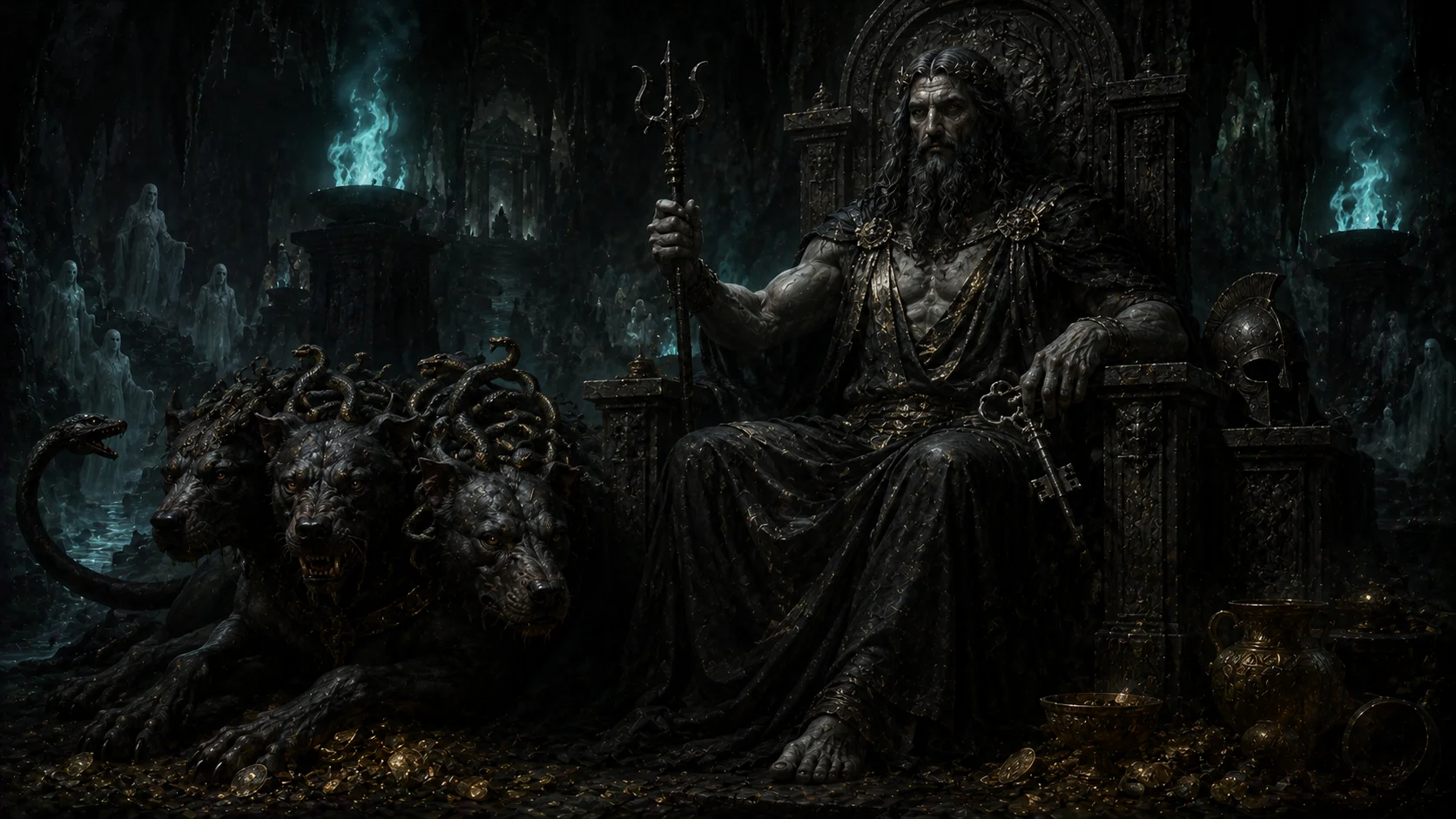
He is deliberately hard to tell from Zeus, and that is the point. Look for a mature bearded man, enthroned, heavily draped — then check the details:
- A sceptre, sometimes tipped with a bird, and often a phiale for pouring libations.
- A cornucopia, when he is being shown as Plouton the wealth-giver rather than the death-king.
- Cerberus at the foot of the throne, and Persephone enthroned beside or standing near him — the pair are almost always shown together, which is itself a statement.
- Hair falling low over the brow, and a face turned aside or downcast where Zeus would look straight out.
- In Hellenistic and Roman work, a modius or grain-measure worn on the head, the same headgear that identifies Serapis.
Two survivals are worth knowing by name. In the Macedonian royal tombs at Vergina, ancient Aigai, a wall painting of the abduction of Persephone survives from the fourth century BC — one of the very few original Greek paintings, as opposed to Roman copies, that we possess at all, and the chariot in it moves with a violence no vase can manage. And from Locri Epizephyrii in southern Italy come thousands of small terracotta plaques, the pinakes, showing the enthroned couple receiving offerings; there Persephone is worshipped less as a stolen girl than as a bride and a queen, and Hades is her consort rather than her captor. Local cult and panhellenic story do not always agree, and Locri is the best proof of it.
Dis Pater, Orcus, and the Pit in Rome
The Romans took Plouton at his word. Their name Dis Pater is a straight translation — dis from dives, rich; the wealthy father. Beside him stood the older, uglier Orcus, a punisher and oath-avenger with none of the Greek dignity, whose name has outlived him in odd places: in Italian folklore as the orco, the man-eating ogre.
Roman practice kept the same principle of the closed door. In the Campus Martius stood a subterranean altar to Dis Pater and Proserpina which was kept buried and unearthed only for the Saecular Games, the once-a-century rites marking the turn of an age. And in the city there was the mundus, a pit understood as a passage to the world below, whose covering stone was lifted on a small number of days each year. On those days, tradition held, the gate of the underworld gods stood open. No battle could be joined, no troops levied, no marriage made. Rome scheduled its dread.
Further east, Ptolemaic Egypt produced the most successful hybrid of all: Serapis, a deliberately engineered god blending Egyptian Osiris-Apis with the Hellenic Plouton, enthroned, bearded, grain-measure on his head and Cerberus at his knee. Greeks in Alexandria could recognise him immediately as the lord of the dead and the giver of abundance. So could Egyptians. That was the design brief.
The Long Afterlife
Christian writers folded Hades into hell, and the Greek word survives in scripture as the name for the abode of the dead — which is precisely where the popular confusion between a neutral underworld and a place of punishment was welded together. Dante inherited the mess and made art of it, naming the infernal city Dis and stationing a wealth-obsessed Plutus at the fourth circle, guarding the hoarders.
The Renaissance seized on the abduction rather than the god. Bernini carved it in marble in the 1620s, and the detail everyone remembers — the fingers of the god pressing into the girl’s thigh, stone rendered as yielding flesh — is arguably the most technically astonishing thing anyone has ever done to a block of Carrara.
Modern culture cannot decide what to do with him, and the range is revealing. Disney’s 1997 Hercules made him a fast-talking, blue-flamed schemer plotting a takeover of Olympus. Rick Riordan’s Percy Jackson novels restored some of his grimness. Anaïs Mitchell’s Hadestown recast him as an industrialist running an underground company town, which turns out to fit the lord of buried wealth uncomfortably well. And Supergiant’s 2020 game Hades made him something no ancient source quite did: a cold, disappointed father, whose kingdom you spend the entire game trying to leave. Every era gets the underworld king its anxieties require.
Why the Grim King Endures
The most frightening thing any Greek said about death is in the Odyssey, and it comes from the greatest of them. Odysseus finds Achilles among the shades and congratulates him — surely he rules gloriously down here. Achilles tells him he would rather be a hired labourer on the poorest farm alive than king over all the dead. That is the Homeric horror in one exchange: the underworld is not agony, it is diminishment. Everything you were, minus the substance.
And the god who presides over it is neither cruel nor consoling. He does not torture, he does not reward, and he cannot be argued with by anyone who has not brought a lead tablet or a gold leaf. That is why he survived when more colourful gods faded into decoration. Hades is the mythological shape of a fact rather than a fear: that there is a place everyone is going, that it is administered rather than personal, and that it will not be interested in who we were.
They wrote to him on lead when they wanted something, and on gold when they were dying. Both are the same request, made twice: notice me — and know who I was.