Hecate was the goddess of the threshold — of crossroads, doorways, boundaries, and the thin places where one world meets another. Daughter of the Titan Perses and the Titaness Asteria, she was honored by Zeus above nearly all other deities, and the Greeks came to know her, in later ages, as a formidable figure of witchcraft, ghosts, and the night, torch in hand, walking between the realms of the living and the dead.
Daughter of Perses and Asteria
Hecate's parentage, as recorded by Hesiod in the Theogony, sets her apart from the Olympian generation entirely: her father was Perses, a Titan, and her mother was Asteria, a Titaness and sister of Leto. This lineage places her among the elder powers of the cosmos, born of the generation that preceded Zeus's own rule, and it may be part of why Hesiod treats her with such unusual reverence rather than folding her into the Olympian family tree. She belongs, by birth, neither to the deposed Titans nor cleanly to the ruling Olympians, but stands somewhat apart from both — a status that suits a goddess whose defining power was always the space between one thing and another.
The Honor Zeus Gave Her Alone
Hesiod is strikingly emphatic in praising Hecate, devoting a long and distinctive passage to her powers that has no real parallel elsewhere in the Theogony. He states that Zeus honored her above all other deities, granting her a share of power over earth, sea, and starry heaven alike. She could grant success to mortals — or withhold it — in war, in athletic contest, in horsemanship, in seafaring, in animal husbandry, and in the rearing of the young. This is an unusually broad attested domain for any single deity, spanning nearly every arena in which a mortal life could rise or fail, and it marks her earliest known character as a goddess of sweeping, direct influence rather than a narrow underworld specialist. A farmer praying over his herd, a sailor setting out to sea, a boy entering his first footrace — all of them, in Hesiod's account, might look to Hecate before any other power, because her granted portion touched every one of those pursuits at once.
Where Three Roads Meet
Hecate's domain was liminal: the in-between. She presided over crossroads, thresholds, and gateways — the boundaries between places, and by extension between states of being. Cult images known as Hekataia, "Hecate at the crossroads," were placed at three-way road junctions across the Greek world, a practice that gave rise to her later epithet Trioditis, "of the three ways," and to the Roman equivalent Trivia. Her shrines at these junctions marked her as a guardian of passage itself — the goddess one encountered exactly where a traveler had to choose a direction, standing watch over a decision that, once made, could not be unmade.
Keeper of the Gate
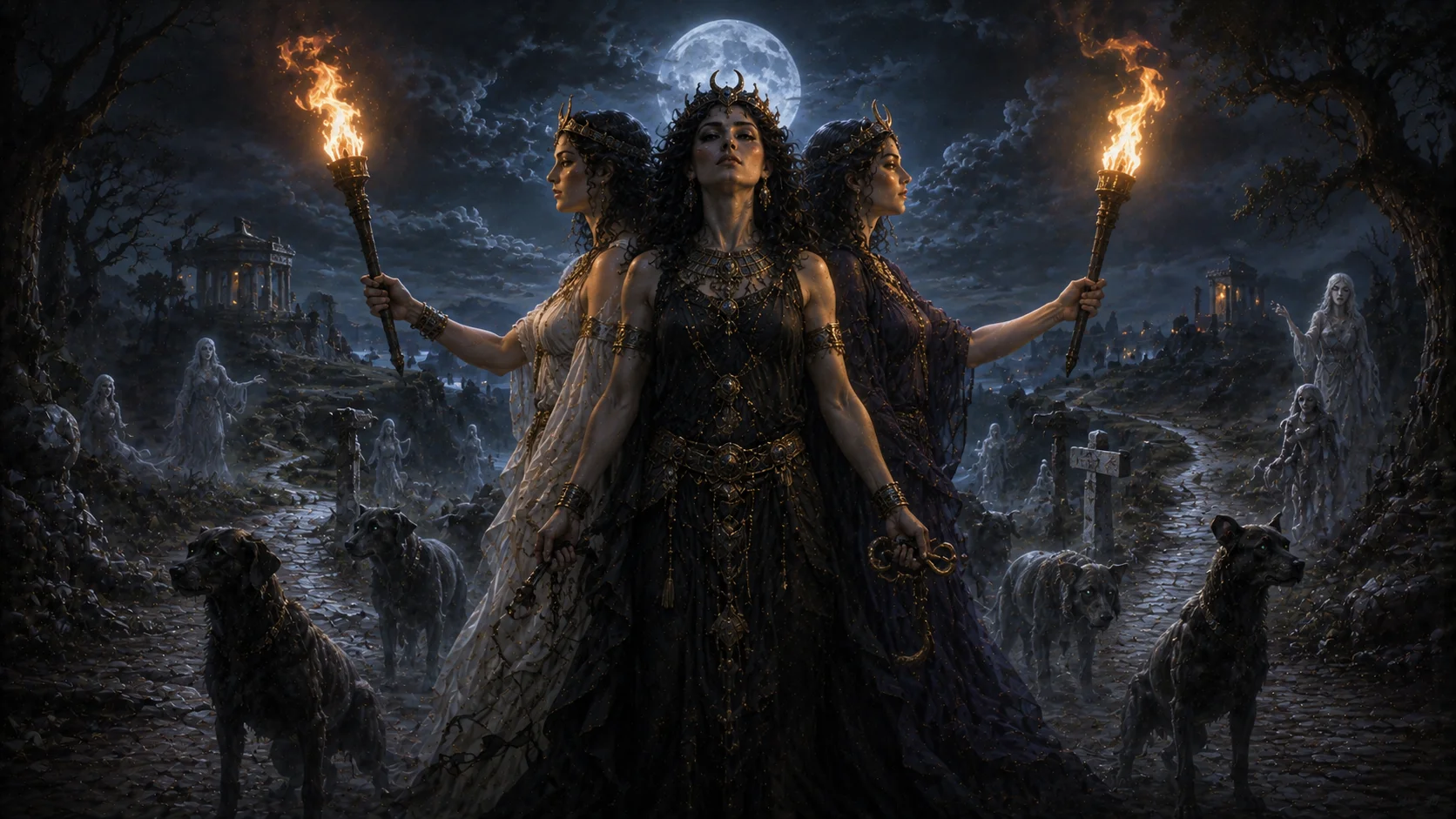
Beyond the open crossroads, Hecate held authority over thresholds and entrances more narrowly, an association reflected in the epithet Propylaia, "before the gate." She was also called Kleidouchos, "keyholder," a title that binds her directly to the image of the key as one of her defining attributes — the one who holds what opens or seals a passage between spaces. Torches and dogs completed her customary attributes: the torches lighting her way through places others could not see, and dogs, especially black dogs, sacred to her and sacrificed in her honor at crossroads in later ritual and magical practice. Together the key, the torch, and the dog formed a recognizable set of signs by which a devotee, or an artist, could mark a scene or an image as belonging to Hecate specifically.
Companion in the Search for Persephone
One of the fullest narrative roles attested for Hecate appears in the Homeric Hymn to Demeter. When Persephone was seized and carried off by Hades, it was Hecate who heard her cries. She later became Persephone's companion and attendant in the underworld, escorting her between the upper world and the underworld each year as the seasons turned. This role gave Hecate a lasting, personal connection to the underworld's queen — not merely a goddess who ruled over ghosts and boundaries in the abstract, but one bound by attested myth to Persephone's own passage between the two worlds, walking that same threshold road herself each time the season demanded it.
Phosphoros, the Light-Bringer
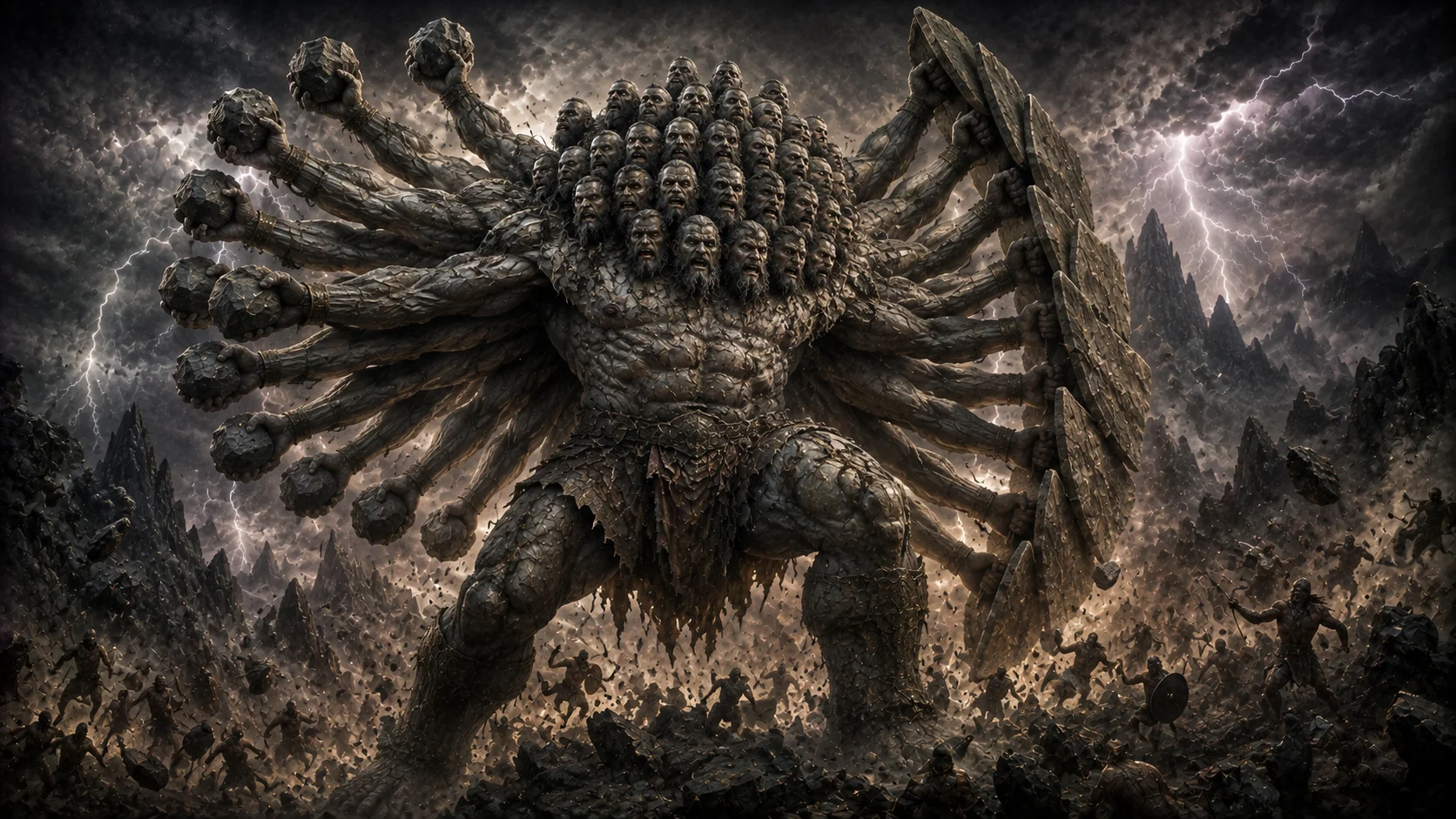
Her torches earned her the epithet Phosphoros, "light-bringer," an image that appears throughout her iconography and myth: Hecate is forever pictured bearing twin flames, illuminating paths through places where mortals and other gods alike could not see. This same attribute placed her among the Olympians' allies in the Gigantomachy, the war against the Giants, where some sources depict her fighting at their side, wielding her torches as weapons against the earth-born enemies of the gods. It is a fitting role for a goddess already defined by the crossing of boundaries: in the Gigantomachy she stands with the ruling order of Olympus against the chthonic uprising of the earth-born Giants, torch raised against creatures who might otherwise have overrun the very thresholds she guarded.
Chthonia, Goddess of the Earth Below
The epithet Chthonia, "of the earth" or "of the underworld," reflects the darker, deeper register of Hecate's power, distinct from the broad, worldly authority Hesiod first attributed to her. Over time, and especially from the Classical period onward, her character shifted noticeably: later tradition increasingly associated her with night, the moon, ghosts, necromancy, and sorcery. Scholars treat this darker, chthonic characterization as a genuine evolution of her cult image rather than a feature present from the start — the Hecate of the crossroads and the Hecate of the necromancer's invocation are separated by centuries of accumulating association, two faces of the same goddess built up layer by layer rather than present together from the beginning.
Triformis: The Threefold Watcher
From the Classical period onward, Hecate was sometimes depicted as triple-formed — Hecate Triformis, three bodies or three faces set back to back. This iconographic development is closely tied to her crossroads and threshold function: a goddess who watches every direction at once suits a power stationed exactly where three roads diverge. The sculptor Alkamenes is credited with an early triple image of her, and the form became a recognizable part of her later cult and artistic tradition, reinforcing the idea of a goddess whose vigilance covers every path a traveler might take, whichever of the three ways they choose to walk.
Invoked in the Papyri
Hecate's reputation as a figure of magic reached its fullest expression in the Hellenistic and Roman periods. She appears in the Orphic tradition and, most vividly, throughout the Greek Magical Papyri — the PGM — Roman-era texts of ritual and spell-craft in which she is invoked as a powerful figure of witchcraft and the underworld. This magical and necromantic reputation, so central to how later ages remembered her, is a layer built up well after her Hesiodic origins, the culmination of centuries in which practitioners of magic turned to her as their presiding power, invoking the same keyholder and light-bringer of the old crossroads shrines to unlock very different kinds of doors.
A Goddess Distinct, Sometimes Merged
Ancient sources occasionally syncretized Hecate with Artemis and Selene as a triple moon goddess, drawing on overlapping associations with the wild and the night. Later and non-specialist sources have sometimes conflated her outright with Artemis or Selene on the same basis. But this blending is a later development layered onto her identity, not evidence of a shared origin — Hecate's own independent character, rooted in the Theogony's account of her crossroads, thresholds, and broad-reaching power over mortal fortune, exists prior to and apart from these later syncretic pairings. The three goddesses share a family resemblance built by later poets and ritual practice, not a common birth.
Into Later Memory
Building on her late-antique magical associations, Hecate became, in later Western esoteric and literary reception, a central figure associated with witchcraft, magic, and liminality — a reputation that has carried from antiquity through modern witchcraft and neopagan traditions. The goddess Hesiod once praised for her power over war and harvest, ships and horses, came in time to be remembered above all as the keeper of the threshold between worlds: torch-bearer, keyholder, watcher of the crossroads where every road still divides, and companion, once, to a queen making her yearly passage between the light above and the dark below.
Sources & traditions
- EncyclopediaWikipedia — Hecate
- TraditionGreek texts, inscriptions and later retellings (Greece)
Myths change from area to area and from time to time. This chronicle follows the most widely told versions; tellings in other villages, regions and eras may differ.