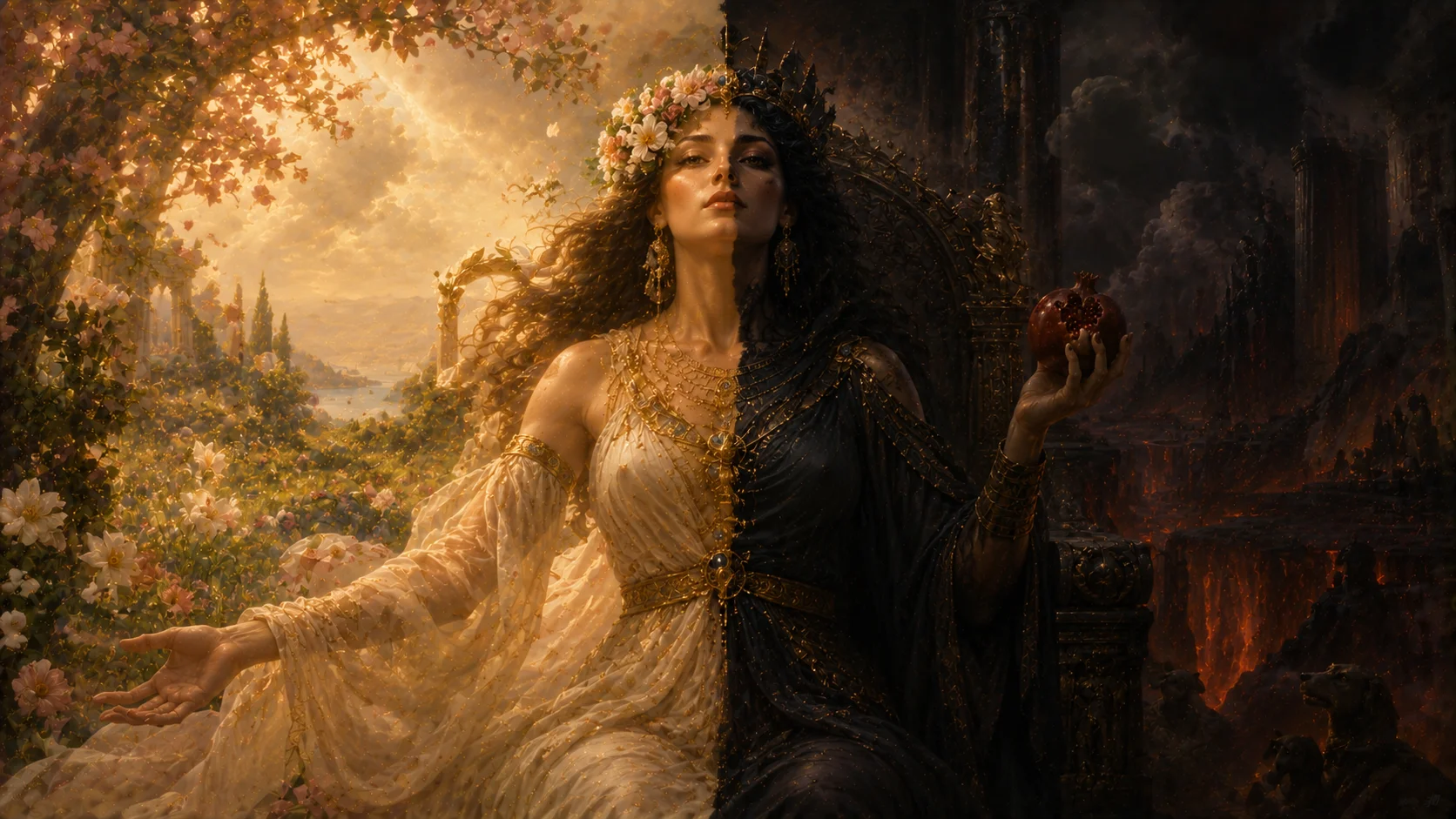
Persephone wore two faces, and the Greeks held both in awe: she was Kore, the radiant maiden of spring, flowers blooming where she walked — and she was the dread Queen of the Underworld, who sat beside Hades and held power over every soul of the dead. Her story is the great myth of the seasons, of a daughter torn from her mother, and of how something taken by force can grow into a strange, terrible sovereignty.
The Maiden in the Meadow
Daughter of Zeus and the grain-goddess Demeter, Persephone was gathering flowers in a meadow when the earth split open and Hades burst forth in his chariot, seizing her and dragging her down to the underworld to be his bride. Her mother's grief was so vast that the earth withered and humanity began to starve.
The Seeds of the Dead
Zeus, to end the famine, commanded Persephone's return — but she had eaten a few seeds of a pomegranate in the underworld, and whoever tastes the food of the dead belongs to them. So a compromise bound her: she would spend part of the year above with Demeter (and the earth would bloom into spring and summer) and part below as Hades's queen (and the world would wither into autumn and winter). Persephone became the living calendar of the year, the goddess whose comings and goings the whole earth obeyed.
The Dread Queen
What began in violence became real power. Persephone grew into a formidable Queen of the Dead in her own right — it was she, as much as Hades, whom heroes had to petition in the underworld. She showed mercy to Orpheus, granted Heracles passage, and ruled the shades with a sovereignty all her own. The maiden taken against her will became one of the most powerful goddesses in the cosmos.
The Goddess of Return
Persephone endures because she holds two truths at once: she is both the loss and the return, the descent and the rebirth. Her myth promised the Eleusinian initiates exactly what her own life embodied — that to go down into the dark is not always to stay there, and that spring follows even the deepest winter.
Each spring the maiden climbs back into the light — and each autumn the queen descends to her throne in the dark.
The Secret at Eleusis
Every autumn for the better part of two thousand years, thousands of Greeks walked the fourteen miles from Athens to a small town on the Bay of Eleusis, carrying torches and crying out to the god Iacchus, to be initiated into a rite so guarded that disclosing it carried the death penalty. The Eleusinian Mysteries were held in the joint honour of Persephone and Demeter, and what happened inside the great initiation hall — the Telesterion — has never fully reached us, because the men and women who underwent it, the mystai, kept their oath of silence with a discipline that still startles historians. We know the outline: a barley-and-herb drink called the kykeon, echoing the one Demeter herself drank to break her mourning fast; two priestly families, the Eumolpidae and the Kerykes, who supplied the officiants; a chief priest titled the hierophant, "the one who shows the sacred things." We know the stakes: the Athenian statesman Alcibiades was recalled from the Sicilian expedition and condemned to death in his absence in 415 BCE, accused of parodying the Mysteries in private houses. And we know the promise, because the hymn that tells Persephone's own story states it plainly — blessed is the mortal who has seen these rites, for the uninitiated never share the same lot once they are dead. The sanctuary's roots run back to the Mycenaean age, and the rites ended only at the very end of antiquity, after imperial edicts outlawed pagan cult in the 390s CE and Alaric's Goths overran Greece in 396.
The Nymph Who Became a Spring, the Servant Who Became an Owl
Ovid preserved two casualties of Hades's chariot ride that the older Greek hymn leaves out entirely. The water-nymph Cyane rose from her pool to block the god's path, protesting that a bride should be asked, not seized — Hades tore the ground open beneath her in answer and drove through. Cyane wept until she dissolved into her own waters; the spring bearing her name still rises near Syracuse in Sicily, a small, startlingly blue pool that ancient guides pointed to as the place where a nymph's grief became a landscape. Deeper below, in the orchard of the underworld, a keeper named Ascalaphus was the only witness when Persephone broke her fast and ate the pomegranate seeds that would bind her there. He told what he saw. For it he was pinned beneath a great stone and, in another strand of the story, turned into a screech owl — a bird the Greeks already read as ill omen — and he stayed trapped until Heracles, passing through on the labour that sent him after Cerberus, rolled the stone aside and let him go.
Proserpina, and the Sicilian Claim on Her Story
The Sicilians did not treat Persephone's abduction as something that happened somewhere vague and distant — they pointed to an exact field, on a lake called Pergusa beside the inland city of Enna, and said it happened there. The claim was taken seriously enough in Rome that when the governor Verres stripped the sanctuary of Ceres at Enna during his notorious command in the first century BCE, the orator Cicero prosecuted it in his Verrine Orations as sacrilege against the goddess herself, not merely as theft of civic property. Latin poets folded the island fully into the myth: in Ovid's telling it is another local nymph, Arethusa — herself fleeing a river god by diving underground and resurfacing as a freshwater spring on the islet of Ortygia — who glimpses Persephone enthroned below and carries the news back to a grieving Ceres. Rome had honoured the pair since 493 BCE with a temple to Ceres, Liber, and Libera on the Aventine Hill, a triad consciously modelled on Demeter, Dionysus, and Persephone, and taken up by the plebeian order as peculiarly its own.
Mother of the Torn God
Orphic poets told a version of Persephone's story that never surfaces in the mainstream Athenian tradition and never left the margins of Greek religion, but ran deep wherever it took hold. In it, Zeus came to Persephone in the underworld in the form of a serpent, and she bore a son, Zagreus, hailed as a first Dionysus. The jealous Titans lured the infant god away with toys, tore him to pieces, and devoured him; Zeus struck the Titans down with his thunderbolt, and from their ash — mixed, the Orphics held, with what remained of the god they had just consumed — humankind was formed, carrying both a Titanic taint and a spark of the divine child inside it. Orphic hymn credits Persephone with a second child by Zeus as well, Melinoë, a spirit of nightmares and restless ghosts, her body half dark and half pale, who walked among the tombs. Initiates of this same Orphic and Bacchic current were sometimes buried with thin sheets of inscribed gold — the gold tablets, recovered from graves in southern Italy, Crete, and Thessaly — carrying directions for the soul's journey through the underworld and words meant to be spoken to its queen, identifying the dead as one of her own and asking passage on that authority.
Reading Her in Clay and Stone
Before anyone needed her name written beneath her, a Greek worshipper could recognise Persephone by what she carried. A sheaf of ripened wheat marked her as Demeter's daughter and a power over the harvest; a pomegranate, cut open or held whole, marked the bargain that chained her to the dark half of the year; a raised torch, in scenes of her rising back to the surface, recalled the search that ended it. At Locri Epizephyrii in southern Italy, a sanctuary produced small terracotta plaques — pinakes — that show her not primarily as a ruler of the dead but as a bride: seated across from a solemn, bearded Hades, a cockerel between them, or opening a chest of wedding goods. It is an entire visual language built to reframe the abduction as a sanctioned marriage rather than a rape. Thousands of fragments of those plaques survive, most of them now in the Museo Nazionale della Magna Grecia at Reggio Calabria.
The Queen Who Kept Being Painted
The story never stopped needing to be told again. Gian Lorenzo Bernini carved his marble Ratto di Proserpina in 1621–22, famous for Pluto's fingers visibly pressing into flesh that is, of course, stone; the group was handed to another cardinal almost as soon as it was finished and only came to Rome's Galleria Borghese, where it stands today, in 1908. Dante Gabriel Rossetti painted Jane Morris, wife of his friend and collaborator William Morris, as a sombre, captive Proserpine in 1874 — a pomegranate split open in her hand, a sprig of ivy and one narrow shaft of daylight behind her — now in Tate Britain. Frederic Leighton went the other way in 1891 with The Return of Persephone, catching the moment of ascent: Hermes hauling her bodily up through a crack in the earth toward a waiting Demeter, sunlight breaking in from above. Three artists across nearly three hundred years, each choosing a different instant of the same myth — the seizure, the captivity, the return — because Persephone was never only one thing to paint.
Sources & traditions
- EncyclopediaWikipedia — Persephone
- TraditionGreek texts, inscriptions and later retellings (Greece)
Myths change from area to area and from time to time. This chronicle follows the most widely told versions; tellings in other villages, regions and eras may differ.