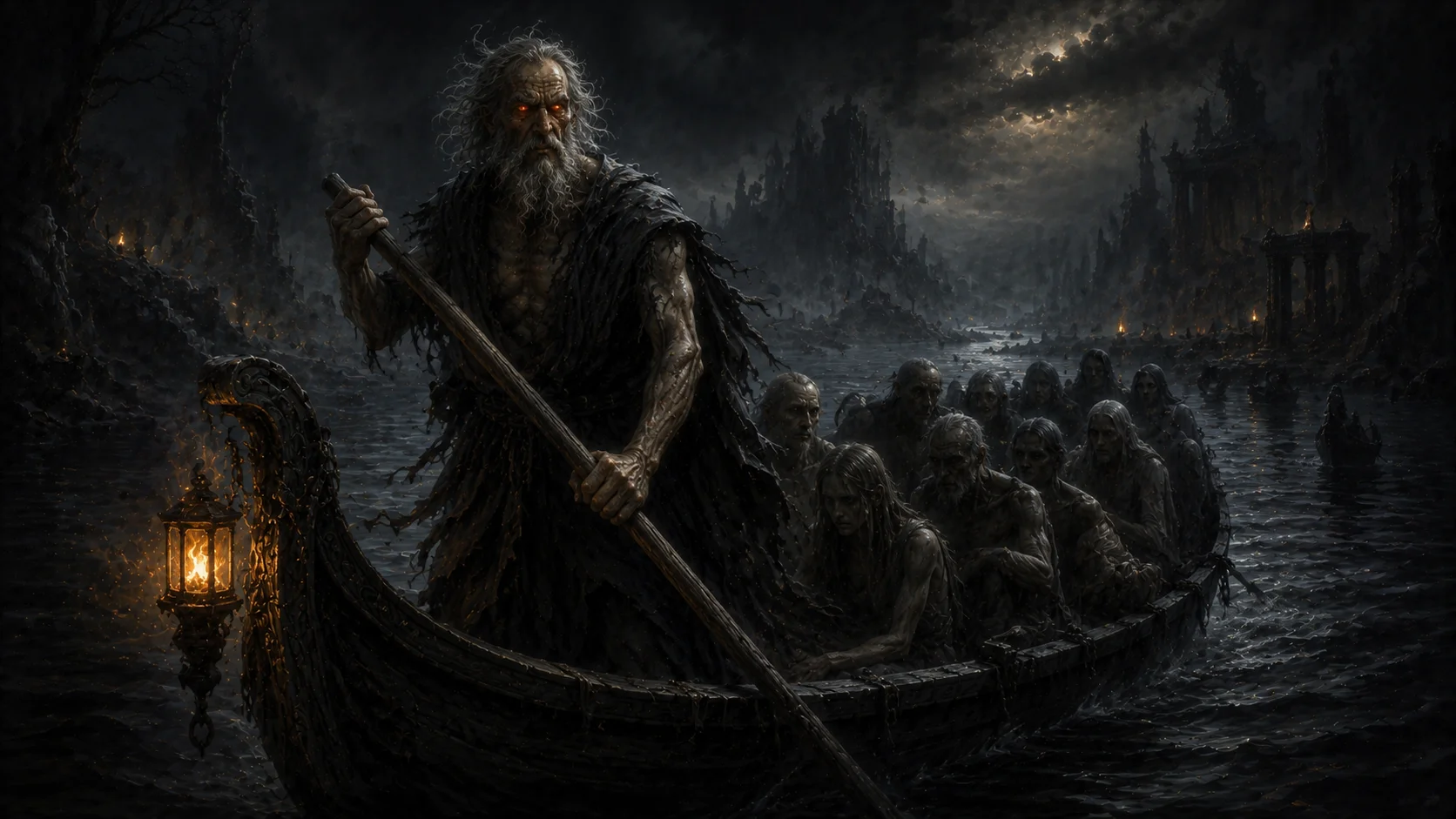
At the black river that rings the land of the dead waits one of the most quietly chilling figures in Greek myth: Charon, the grim ferryman who carries the souls of the newly dead across the water to the underworld. He is not a god of death so much as its civil servant, an old unsmiling boatman who asks only one thing, and never makes an exception.
A Child of Darkness and Night
Charon's pedigree sets him apart from the bright Olympian family that rules above. Hesiod's Theogony names his parents as Erebus, the primordial darkness that existed before the ordered cosmos, and Nyx, Night herself. He is not a son of Zeus or a servant raised up by Hades's favour; he belongs to an older stratum of divinity, born of the same shadowy lineage as Sleep, Death, and the Fates. That ancestry explains why Charon never behaves like an Olympian courtier bargaining and scheming for status. He simply is the crossing, as fixed and impersonal as the dark from which he came, doing the one task he was made for since before the younger gods had a throne to sit on.
The Rivers of Hatred and Woe
Ancient sources are not tidy about which river Charon actually poles his boat across, and the chronicle should be honest about that rather than pretend to a certainty the myths themselves lack. Some accounts place him on the Acheron, the river of woe; others on the Styx, the river of hatred by which even the gods swore their most binding oaths. The inconsistency likely reflects the fact that the underworld's geography was never fixed by a single authoritative source, but assembled over centuries from many poets, painters, and local cult traditions. What stayed constant across every version was the far bank: whichever river carried the dead, it emptied into the same grey kingdom, and the ferryman waiting at its edge was always the same grim, indispensable figure.
The Face at the Oar
Virgil's Aeneid, in its sixth book, gives Charon his most vivid physical portrait, and it is not a flattering one. He is old but unnervingly strong, an aged body that has not softened with the centuries. His eyes burn like fire, his beard hangs matted and unkempt, and his cloak is knotted carelessly at the shoulder, foul with the residue of his endless trade. His coracle is filthy too, patched and stained from ferrying souls without rest. It is worth noting that this description comes from a Roman poet writing centuries after the archaic Greek sources, drawing on Greek tradition rather than inventing from nothing, so it should be read as a later, richly detailed elaboration of Charon rather than the original Greek image of him.
The Obol Beneath the Tongue
Charon's toll is the detail that made him more than a literary figure: it shaped an actual funeral custom. He required a single coin, an obol, before he would let a soul aboard his boat, and the Greeks answered by placing that coin in or on the mouth of their dead before burial. Archaeology bears this out; graves across the Greek world have yielded skeletons with a coin still resting where the mouth once was, and writers such as Lucian describe the practice directly in his dialogues of the dead. The custom turned an abstract myth into a concrete household act: a family paying, quite literally, for a relative's passage into the next world, unwilling to let the crossing fail for want of so small a coin.
A Hundred Years on the Wrong Shore
The fare was not a formality. Those who could not pay, and those who had died without proper burial or funeral rites, found the ferryman would not take them. Virgil's Aeneid describes their fate most fully: they were left to wander the near bank of the Styx or Acheron, neither living nor properly dead, denied rest, for a full hundred years before Charon would finally carry them across. As with his physical description, this fullest account of the wandering dead comes from Virgil's Roman retelling rather than an archaic Greek source, though it draws on and crystallises older Greek anxieties about burial. The image gave the custom of funeral rites real teeth: an unburied body was not simply a grief for the living, but a sentence of a century's homelessness for the dead.
The Golden Bough's Bargain
A handful of living mortals are said to have crossed Charon's river while still breathing, and each crossing tells its own story about what could move him. In the Aeneid, Charon refuses at first to ferry the living hero Aeneas, unmoved by pleas or rank. Only when the Sibyl who guides him produces the golden bough, a token belonging to the underworld itself, does the ferryman relent and pole them across. It is not persuasion that works on him, nor status, nor claims of destiny. It is proof, an object that speaks the underworld's own language, that finally overrides his refusal.
Orpheus and the Silenced Oar
Where the golden bough worked by proof, Orpheus is remembered for working by beauty. Descending to plead for the return of his wife, he is said to have won his passage by music rather than force or token, his song reaching even the ferryman who turns away kings. The detail sits alongside the golden bough as one of the rare exceptions to Charon's single rule, and it matters that both exceptions still confirm the rule rather than break it: the boat crosses only under extraordinary circumstance, and ordinary mortals, however desperate or important, are never simply waved aboard.
Heracles and the Ferryman Compelled
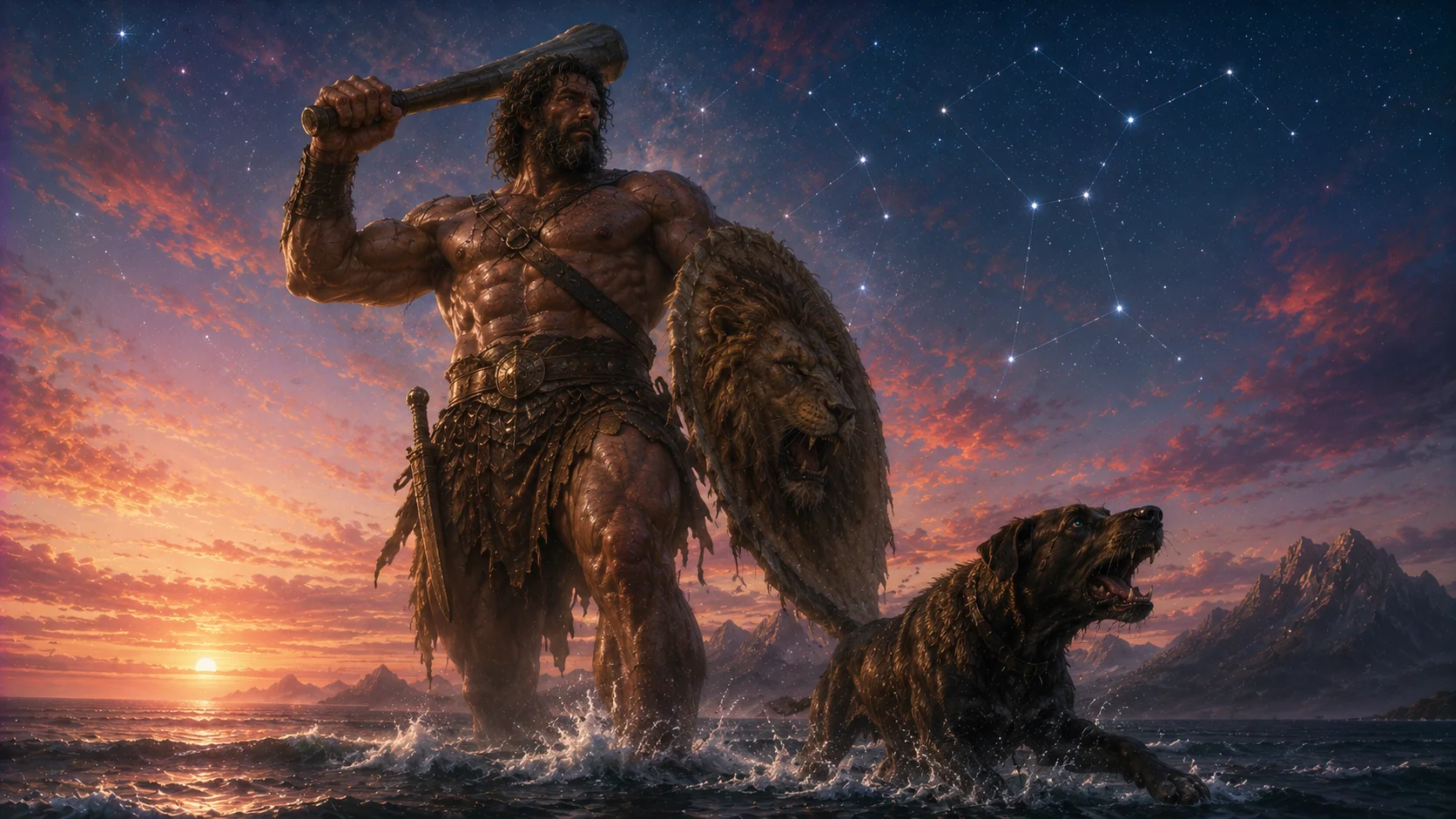
The most forceful of the exceptions belongs to Heracles, sent on his twelfth labour to drag Cerberus up from the underworld. Later mythographers and scholia record that Heracles did not persuade Charon and did not carry a golden token; he simply intimidated the old ferryman, scowling or threatening him into rowing across against his will. For this the ferryman is said to have been punished afterward, though the chronicle should note this detail rests on later, somewhat thinly attested sources rather than a single clear archaic account. Even so, the story fits a recognisable pattern: Heracles is the labour that breaks rules other heroes only bend, and Charon, ordinarily immovable even by heroes and grief, is the one figure on this journey who is made to bend by force rather than by gift or song.
Two Guides, One Journey
Charon does not work alone in the machinery of death, though his role is easy to conflate with that of his more famous colleague. Hermes, in his aspect as Psychopompos, the leader of souls, is the one who first guides the newly dead from the world of the living down to the riverbank itself. Only there does Hermes's task end and Charon's begin: the god leads, the ferryman rows. It is a sequence, not a partnership of equals or a shared office, and the distinction matters, because the two figures represent different halves of the same journey rather than interchangeable escorts. Hermes brings the soul to the threshold; Charon is the threshold's toll and its transport across.
The Hound Waiting on the Far Bank
Charon's crossing does not deliver a soul into safety so much as into the next test. Once across the river, the newly arrived dead come under the watch of Cerberus, the multi-headed hound who guards the gates or shore beyond, making certain nothing crosses back the way it came. Ferryman and hound function as sequential gatekeepers of the same journey, one after the other rather than side by side: Charon controls who may cross the water at all, and Cerberus controls what happens once they have. Together they frame the underworld as a place entered through two deliberate checkpoints, not a single open gate.
A Ferryman Fit for Comedy
Not every appearance of Charon is solemn. Aristophanes's comedy The Frogs, staged in fifth-century Athens, gives him a starring role of a very different tone: ferrying the god Dionysus across the underworld lake amid the play's comic chorus and stagecraft. The scene stands as one of the earliest and most important classical attestations of Charon in Greek literature, and it shows that the ferryman was familiar enough to Athenian audiences to be played for laughs rather than dread, a figure known well enough to become material for comedy without losing his identity in the process.
A Name Shared, A God Distinct
Charon is sometimes shown with wings in surviving art, a detail that owes something to contact with Etruscan visual tradition rather than to native Greek belief about him. It is worth being precise here, because the Etruscans had their own death-figure, Charun, a winged, hammer-wielding demon of death whose name closely echoes the Greek ferryman's. The resemblance in name and the occasional borrowing in image has led to the two being blurred together, but they are properly distinct figures from separate religious systems: one a chthonic ferryman of Greek myth bound to a specific transactional task, the other an Etruscan death-demon with a different iconography and role. The chronicle keeps them apart rather than let the shared name collapse two traditions into one.
A Demon Reborn in Later Verse
Charon's image did not end with antiquity. Dante's Inferno, in its third canto, reworks him as a demonic ferryman standing at the edge of Hell, refusing the still-living Dante passage much as Virgil's Charon once refused Aeneas before the golden bough changed his mind. This is a medieval Christian reimagining built on top of the classical figure, not a continuation of ancient Greek myth in its own right, and it shows how durable the core image proved to be: an old boatman, a required toll, a threshold no living traveller crosses without extraordinary cause, useful and recognisable enough that poets a thousand years later reached for him again.
The Toll We All Must Pay
Across every version, comic or grim, archaic or medieval, Charon endures as one of myth's most universal images: the boatman at the border of death, the toll that everyone must pay, the cold transaction at the end of every life. The custom of the coin for the dead survived for centuries, into Roman times and beyond, for no one wanted to imagine a loved one stranded, fareless, on the wrong shore. Bury your dead with a coin, the old wisdom said, for even death has its ferryman, and he does not row for free.
Sources & traditions
- EncyclopediaWikipedia — Charon
- TraditionGreek texts, inscriptions and later retellings (Greece)
Myths change from area to area and from time to time. This chronicle follows the most widely told versions; tellings in other villages, regions and eras may differ.