She has no dramatic myths, no love affairs, no wars — and that is precisely the point. Hestia, goddess of the hearth, was the still, sacred centre of every Greek home and city, the quiet flame around which all life gathered. In a pantheon of restless, quarrelling gods, she was the one who simply stayed, and kept the fire burning.
The Eldest of the Olympians
Hestia was the firstborn child of Cronus and Rhea — the first swallowed by her father, and so, when disgorged, the last to re-emerge: first and last at once. As the eldest of the great gods, she received the first portion of every sacrifice. Yet she wanted no part of the dramas of Olympus.
The Goddess of the Hearth
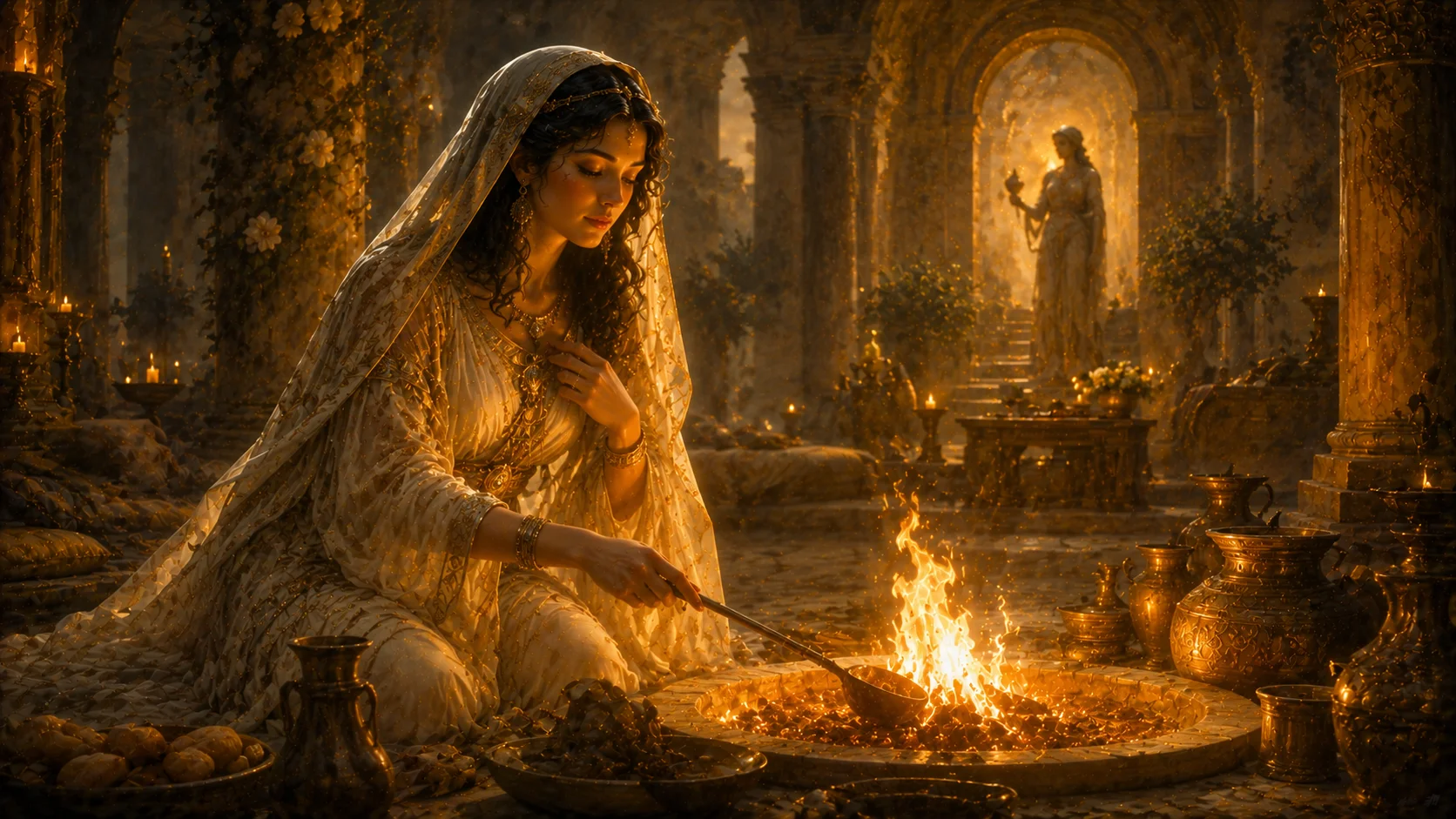
Her domain was the hearth — the fire at the heart of the home, used for warmth, for cooking, for sacrifice. To the Greeks the hearth was sacred: it was where the family gathered, where guests were welcomed, where the household's bond with the gods was kept alive. Hestia was that fire made divine — the spirit of home, family, and hospitality. Every meal began and ended with an offering to her.
The Vow of Peace
When both Poseidon and Apollo sought to marry her, Hestia refused them both and swore an oath of eternal virginity, asking Zeus only to let her keep the peace of the hearth. He granted it — and, in some tellings, she gave up her seat among the Twelve Olympians to the newcomer Dionysus, choosing to tend the divine fire rather than hold a throne. It was the most Hestian of gestures: to step aside, quietly, for the sake of harmony.
The Fire That Must Never Go Out
Every city kept a public hearth sacred to Hestia in its centre (the prytaneion), its fire never allowed to die; when colonists sailed to found a new city, they carried embers from the mother-city's hearth to kindle their own. Hestia is the goddess of belonging itself — the warmth at the centre that makes a house a home and a people a community.
The simplest and the most essential of the gods: the one who keeps the fire, and asks for nothing but peace.
Her Name Is Simply the Word for Hearth
Most Greek gods wear a name that hides something. Demeter is not the word for grain; Poseidon is not the word for sea. Hestia is different. Hestia is the ordinary Greek noun for the hearth — the stone ring of fire in the floor of every house. When a Greek said the word, he might mean the goddess, or he might mean the thing his mother cooked on. There was no gap between them to fall into.
That collapse of the divine into the domestic explains almost everything strange about her. A god who is a place cannot go anywhere. A god who is an object cannot be seduced, abducted, disguised, or provoked into a quarrel — the whole machinery of Greek myth simply has no purchase on her. The Greeks themselves felt the oddity: in Plato's Cratylus, Socrates plays with the idea that her name is connected to essia, an old form of the word for being itself, so that to sacrifice first to Hestia is to begin with existence. It is folk etymology rather than sound linguistics, but it records something true about how she was experienced — as the ground rather than a figure standing on it.
There is a further, quieter puzzle. When the Mycenaean Linear B tablets were deciphered, several Olympians turned up on them by name in Bronze Age Greek — Poseidon, Zeus, Hera and Dionysus among them. Hestia does not appear in any securely identified form. Whether that means she was a later abstraction from the hearth-cult, or simply that palace accountants had no reason to record offerings to a fire every household already tended, nobody can say. It is one of the oldest silences in Greek religion.
What People Actually Did at the Hearth
Hestia had almost no temples, because she did not need any: her sanctuary was the floor of every house in Greece. Her worship was not something one attended. It was something one performed several times a day without particularly noticing.
Three moments show how deep it ran. When a child was born in Athens, it was not yet a member of the family. A few days after birth — the sources disagree on the exact day — came the amphidromia, the “running around”: the newborn was carried at a run around the burning hearth, and only then was it acknowledged, named some days later, and counted as belonging. Entry into human life ran a circle around Hestia's fire.
When a bride arrived at her husband's house, she was led to the hearth and had nuts, figs and dried fruit poured over her head — the katachysmata. The same shower was poured over a newly bought slave. The hearth was the boundary control of the household: it decided who was inside and who was not, and it did so with sweets rather than oaths.
And the habit of beginning with her hardened into language. The Greeks had a proverb for doing a thing in its proper order: aph' Hestias archesthai, “to begin from Hestia.” It is the ancient equivalent of starting at the beginning, and it survived as an idiom long after anyone thought hard about the goddess inside it.
Sanctuary in the Ashes
Because the hearth was sacred and inviolable, a stranger who reached it could not be touched. This was not sentiment; it was enforceable custom, and it produced some of the most striking scenes in Greek literature. In the Odyssey, Odysseus arrives at the palace of Alcinous, crosses the hall, and sits down in the ashes at the hearth — the most abject and most unanswerable position a suppliant can take. The king must raise him up. There is no other option.
Thucydides records the same mechanism in cold history. Themistocles, the architect of the Greek victory at Salamis, fled as a hunted exile to the Molossian king Admetus — a man who had reason to resent him — and, on the queen's advice, took the king's small son with him to the hearth. Admetus protected him. To refuse a suppliant at the hearth was to break faith with the fire itself, and no Greek host was willing to be the man who did that.
The Fire of the Polis
The Greek city projected the household outward, and its hearth was a political institution. To eat at the public hearth of the prytaneion at the city's expense was among the highest honours Athens could confer — granted to victorious athletes, to the descendants of the tyrant-slayers, to ambassadors. This is what gives the sting to the most famous joke in Greek philosophy: on trial for his life, asked to propose his own penalty, Socrates suggests in Plato's Apology that what he actually deserves is free meals in the prytaneion. He was asking, in effect, to be fed at Hestia's fire like an Olympic champion. The jury did not find it funny.
Perpetual fires burned at the great sanctuaries too. Pausanias describes the hearth kept alight in the prytaneion at Olympia, and records that the Eleans sacrificed first of all to Hestia. Delphi held what the Greeks called the common hearth, and Plutarch tells how, after the Persian defeat at Plataea, the oracle pronounced the local fires polluted by the invaders: they were to be extinguished and clean flame fetched from Delphi. A Plataean named Euchidas ran the whole distance and back inside a single day, handed over the fire, and dropped dead in front of his countrymen. Whatever the historical truth of that, it tells you what fire meant: continuity, and the terrifying possibility of losing it.
One honest correction is worth making here, because the connection is so often assumed. The modern Olympic flame is not an unbroken thread from those hearths. The flame at the modern Games dates only from 1928, and the torch relay from Berlin in 1936. The ancient practice it gestures at was real; the continuity is a twentieth-century invention.
Hestia and Hermes: The Still Point and the Door
One of the short Homeric Hymns does something unexpected: it addresses Hestia and Hermes together, asking both to dwell in the house and grant favour. At first the pairing looks absurd. Hermes is motion itself — the trickster, the messenger, the god of roads, thresholds and lucky finds. Hestia never moves at all.
But that is the point. A Greek house was defined by exactly two sacred spots: the fire at its centre and the door at its edge. Hestia held the interior; Hermes governed everything that crossed in and out — guests, traders, news, luck, and the dead. Together they are a complete account of what a household is: a still centre and a permeable boundary. It is one of the most elegant pieces of religious thinking the Greeks produced, and it survives in a hymn of thirteen lines that almost nobody reads.
Plato reaches for the same image in the Phaedrus, where the gods drive their chariots up to the rim of heaven and Hestia alone stays behind in the house of the gods. In a myth about ascent and vision, someone has to keep the home fires. The Pythagoreans went further still: Philolaus placed a central fire at the middle of the cosmos, and ancient reports of his system call it the hearth of the universe. The kitchen fire had become an astronomical principle.
How to Recognise Her in Art
Hestia is the hardest Olympian to identify, because she is the one god with no attribute. Zeus has the thunderbolt, Poseidon the trident, Artemis the bow. Hestia carries nothing that means anything — at most a plain staff or a flowering branch. She is usually a mature woman, fully draped, often veiled, and almost always seated while the other gods stand or move.
She does appear when the full pantheon is assembled. The François Vase, painted around 570 BC, labels her by name in the procession of gods to the wedding of Peleus and Thetis. She is one of the figures proposed for the seated deities of the Parthenon's east frieze, though those identifications are argued over and none is settled. A well-known Roman marble in the severe style is conventionally called the Hestia Giustiniani, but that name too is a modern convention rather than a certainty. The pattern holds throughout: she is present, correctly placed, and doing nothing. Artists had no scene to give her.
Vesta: The Same Fire, A Much Harder Discipline
Rome took the same idea and made it a state apparatus. Vesta's temple in the Forum was round — a form modern archaeologists usually read as an echo of the earliest Italian huts — and it contained no cult statue. There was nothing to look at but the fire, because the fire was the goddess. Ovid says as much plainly in the Fasti: understand Vesta as nothing other than living flame.
Where Greek Hestia was served by everyone and no one, Vesta had the Vestal Virgins: six priestesses, taken as young girls, bound to thirty years of service and absolute chastity. They enjoyed privileges no other Roman woman had — release from a father's legal power, the right to make a will, a reserved seat at the games — and they carried a correspondingly brutal liability. A Vestal who let the sacred flame go out was flogged by the Pontifex Maximus. A Vestal convicted of breaking her vow was carried through the city in a covered litter and sealed alive in an underground chamber by the Colline Gate, because her blood could not lawfully be shed and the city could not be seen to execute her. The fire was ritually renewed at the start of March, the old Roman new year; the festival of the Vestalia fell in June, when the temple's inner store was opened to Roman matrons and then swept clean again.
This is the sharpest difference between the two cultures, and it is worth sitting with. The Greeks put the sacred fire in every kitchen and trusted families with it. The Romans took it out of the house, put it in a temple, and staffed it with women whose lives were forfeit if it failed. Same flame, entirely different theory of what a state is.
The Only Myth She Has — and Rome Told It
Hestia's mythlessness is nearly perfect, which makes the one exception fascinating. In Ovid's Fasti, at a rustic country feast where the gods have eaten and drunk and fallen asleep, the fertility god Priapus creeps toward the sleeping Vesta. A donkey brays, she wakes, the gods come running, and Priapus flees in humiliation — which is why, Ovid explains, donkeys are garlanded and let off work at the Vestalia.
Two things make this telling. First, it is an aetiology: a story reverse-engineered to explain a ritual detail, not a myth Hestia ever needed. Second, Ovid tells almost exactly the same story earlier in the same poem with the nymph Lotis in Vesta's place. Even the goddess's single myth is a borrowed one, fitted to her because the calendar demanded an explanation. She resisted narrative to the very end.
Why the Quiet Goddess Keeps Coming Back
Hestia's afterlife is stranger than her mythology. Her Roman name left little behind in English, but the Latin word for hearth — focus — walked straight in and became the word for the point where attention gathers. The metaphor is exact and almost nobody notices it. When we say a room, or an argument, or a life needs a focus, we are saying it needs a hearth.
Modern fiction, having exhausted the loud gods, has begun rediscovering her. She is the small girl tending the fire in Rick Riordan's Percy Jackson books, deliberately written as the last god anyone thinks to notice and the one who matters most. She is a lead character in the long-running Japanese series Is It Wrong to Try to Pick Up Girls in a Dungeon?, where an entire found family forms around her. Writers keep reaching for her for the same reason: in a cast of gods defined by appetite, a god defined by staying is the rarest character available.
And underneath it is an anxiety older than Greece. Fire is the one household possession that dies if it is neglected. Before matches, relighting a cold hearth was genuinely difficult — the usual remedy was to walk to a neighbour and beg a live ember, which is why a household that let its fire die had failed at the one task it could not delegate to anyone else. Hestia is the divine form of that vigilance: the knowledge that home is not a place you own but a flame you maintain, nightly, without applause, and that the moment you stop tending it, it goes.
Sources & traditions
- EncyclopediaWikipedia — Hestia
- TraditionGreek texts, inscriptions and later retellings (Greece)
Myths change from area to area and from time to time. This chronicle follows the most widely told versions; tellings in other villages, regions and eras may differ.