Of all the Olympians, Demeter is the one whose grief the ancient world could feel in its own belly. She was the goddess of the grain, of the harvest, of the bread that kept a civilisation alive — and when her sorrow came, the whole earth starved with her. Her myth is the story the Greeks told to answer the oldest question of all: why does the world die every winter, and how do we dare to believe it will come back?
The Goddess of the Golden Grain
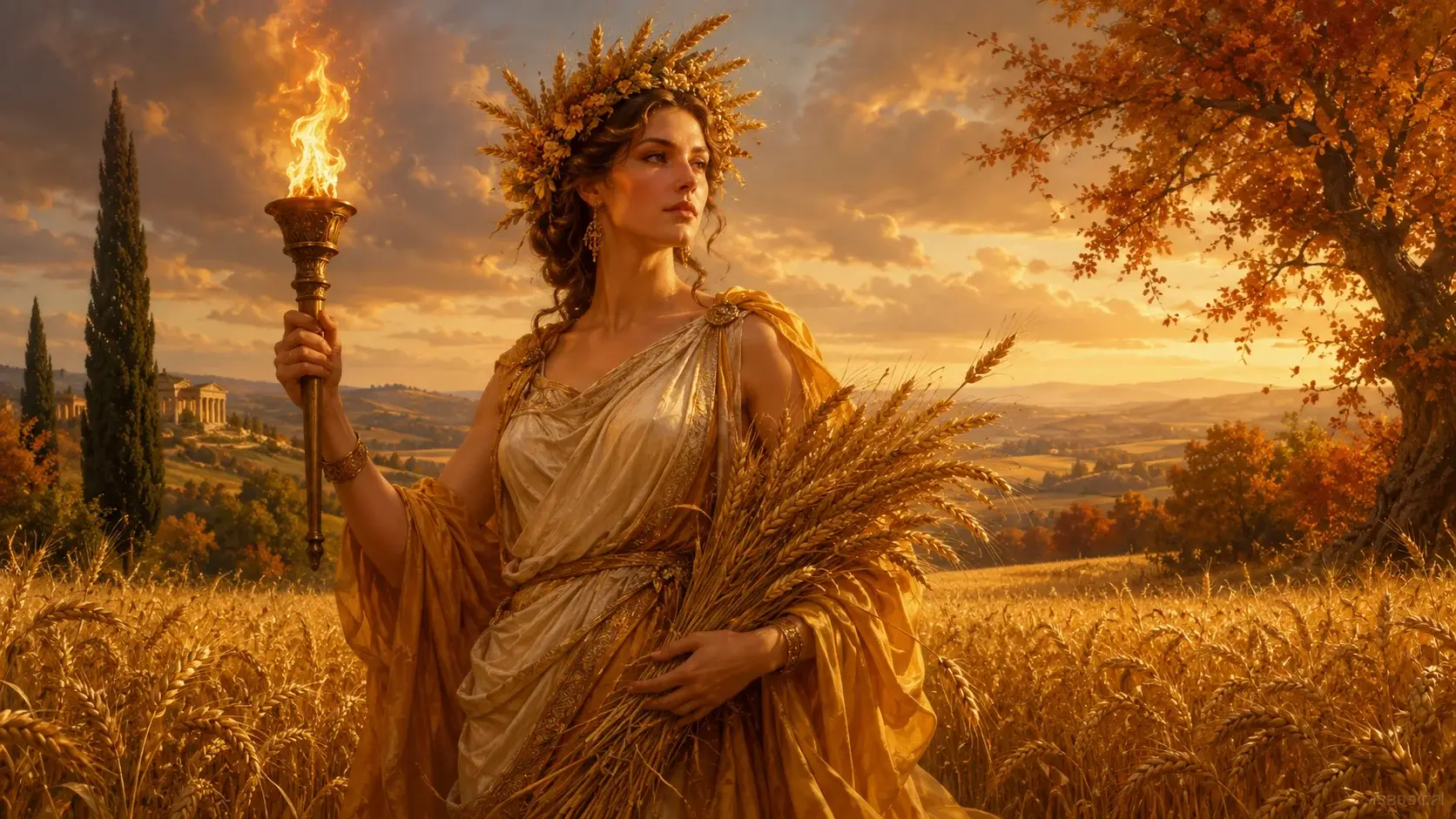
Demeter ruled the cultivated earth: the wheat and barley, the turning seasons, the sacred cycle of sowing and reaping. To an agricultural people she was not an abstraction but survival itself. Her name was spoken at every threshing floor.
The Day the Earth Went Silent
Then Hades, lord of the underworld, carried off her beloved daughter Persephone — with Zeus's quiet consent — to be his queen below. Demeter searched the world for nine days and nights, torch in hand, refusing food and rest. And when she understood her daughter was lost to the dead, her grief turned to wrath: she withdrew her gift from the earth. Crops withered. Fields turned to dust. Humanity began to die, and with no mortals left to make offerings, even the gods would soon be forgotten.
The Bargain of the Pomegranate
Faced with the end of all things, Zeus relented and ordered Persephone returned. But she had eaten a few seeds of a pomegranate in the underworld — and whoever tastes the food of the dead belongs, in part, to the dead. So a bargain was struck: Persephone would spend part of the year with her mother and part below with Hades. When mother and daughter are reunited, Demeter lets the world bloom — spring and summer. When Persephone descends again, Demeter mourns, and the earth falls into autumn and winter. The seasons themselves are the rhythm of a mother's grief and joy.
The Eleusinian Mysteries
From this myth grew the most revered religious rite of the ancient world: the Eleusinian Mysteries. For nearly two thousand years initiates gathered at Eleusis to share in a secret so closely guarded that, astonishingly, it was never written down. What we know is its promise: those who were initiated no longer feared death. In Demeter's grain — buried in the dark earth, only to rise green again — the Greeks found their boldest hope: that the human soul, like the seed, might not truly end in the dark.
Every loaf of bread, the ancients believed, was a small act of faith in Demeter's return.
Swallowed Before She Ever Saw Daylight
Before she ruled a single field of wheat, Demeter spent an unknown span of time in the dark — inside her own father's stomach. She was one of six children born to the Titans Cronus and Rhea, and Cronus, warned that his own child would one day depose him, swallowed each infant whole the moment it was born. Hesiod gives the order: Hestia, then Demeter, then Hera, Hades and Poseidon. Only the sixth, Zeus, escaped, smuggled away by Rhea and raised in secret on Crete; grown, he forced his father to disgorge the rest. Demeter came back into the world already whole, a goddess who had never yet drawn breath in daylight. It is a strange origin for the deity who would come to stand for growth itself: before she could make anything grow, she first had to be born twice.
The Old Woman Who Taught a City to Farm
Long before Eleusis held its Mysteries, it held a grieving stranger. Wandering the earth after Persephone, Demeter took the shape of an aged woman and came to a well outside the town, where the daughters of King Celeus found her and brought her home. Queen Metaneira welcomed her as a nurse for her infant son, Demophon — and Demeter resolved to repay that kindness in the only currency a mourning goddess had: she would make the boy immortal. Each night, unseen, she anointed him with ambrosia and laid him in the hearth-fire to burn away his mortal flesh. Metaneira crept in one night and screamed at the sight of her son among the flames, and the rite broke. Robbed of her gift, Demeter cast off her disguise, filled the house with her own light, and demanded a temple be raised for her on that spot.
To Metaneira's elder son, Triptolemus, she gave something almost as great as immortality: seed grain, and the craft of raising it. Riding a chariot drawn by winged serpents, he carried grain-craft to every corner of the mortal world — so that in the story Eleusis told about itself, agriculture did not spread outward from nature at all. It spread outward from grief, carried across the sky by a local boy on a goddess's errand.
One detail of that same visit softened the story for centuries of retelling. While Demeter sat in silent misery, refusing food and drink, a servant — Iambe in the oldest version, Baubo in later Orphic ones — made her laugh with crude jokes. The moment mattered enough to become ritual: obscene joking, aischrologia, was built into Demeter's festivals, because the goddess herself had once been coaxed out of grief by exactly that kind of laughter.
The Grove That Could Not Be Cut
Not every mortal who crossed Demeter fared as well as the house of Celeus. Erysichthon, son of the Thessalian king Triopas, needed timber and sent his men into one of Demeter's sacred groves to take it. When they hesitated before an ancient oak hung with votive garlands, Erysichthon seized the axe himself — and as the tree fell it bled, and a dying voice spoke from inside it. Demeter's punishment was exact and merciless: she set Limos, the spirit of Famine, to live inside him. From that day Erysichthon could not stop eating. He devoured his entire fortune buying food, then sold his own daughter, Mestra, for more — and because Mestra had been given the power to change her shape, she slipped free of each buyer and came back to be sold again. It was never enough. With nothing left in the world to consume, Erysichthon finally ate himself. Few Greek myths state the debt owed to a harvest goddess so bluntly: take from her without asking, and the hunger she answers with will never be satisfied.
The Festival No Man Was Allowed to Watch
Once a year the married women of the city vanished from ordinary life, and their households were left to manage without them. This was the Thesmophoria, Demeter's other great rite — celebrated far more widely across the Greek world than the Mysteries at Eleusis, and at Athens held over three days of the autumn month Pyanepsion. Almost nothing survives of what happened inside it, because like the Mysteries it was closed to outsiders and closed absolutely to men. What is known comes secondhand: comic drama, later commentators, and scattered inscriptions. Women camped together on sacred ground, fasted, and handled the remains of piglets that had been thrown into pits called megara months earlier and left to rot. The decayed matter was brought up, laid on the altars, and mixed with the coming season's seed grain before sowing — a literal marriage of death and fertility, returned to the earth that would shortly be asked to produce next year's bread.
The festival takes its name from one of Demeter's own titles, Thesmophoros, "she who brings the things laid down" — law-giver as much as grain-giver. It is a reminder that to the Greeks the goddess who taught the world to farm was, by the same gesture, the goddess who taught it to live under settled order. A people who plant a field and wait a year for it to ripen cannot survive as raiders; they must learn to live as neighbours.
The Black Mare of Arcadia
In the hill country of Arcadia the Greeks told a version of Demeter stranger and older-feeling than the stately grain-goddess of Eleusis. While she searched for Persephone, Poseidon desired her and pursued her across the countryside. To escape him she turned herself into a mare and hid among the grazing herds of a local lord. Poseidon was not fooled: he became a stallion and took her regardless. Her fury at the assault earned her the local title Demeter Erinys, the Wrathful, and the union produced two children — the wonder-horse Arion, and a daughter whose true name Arcadian initiates would not speak outside the rite, known publicly only as Despoina, "the Mistress." Afterwards Demeter washed in the river Ladon and was worshipped nearby as Demeter Lousia, "the Bathed." At Phigalia, in a cave on the mountainside, her image showed her not as a serene matron but robed in black with the head and mane of a horse, serpents growing from her hair — Demeter Melaina, the Black Demeter, a grief so total the Greeks gave it an animal's face. The traveller Pausanias went to both places in the second century CE and wrote down what the locals still told him, which is the only reason we have any of it.
Ceres, and the Word Hiding Inside "Cereal"
Rome did not import Demeter so much as grow into her. Ceres was already an old Italic deity of growth and increase — her name shares a root with crescere, to grow — when Rome, gripped by famine, consulted the Sibylline Books in 496 BCE and was told to vow a temple on the Aventine to Ceres, Liber and Libera. The building that followed was Greek in style and decorated by Greek artists, and over the following centuries Ceres drew Demeter's myths, epithets and women-only rites steadily into herself, until Roman writers could tell the Eleusinian story as if it had always been theirs.
Her own spring festival, the Cerealia, filled the Circus Maximus with games and released foxes through the arena with burning torches tied to their tails — a rite so strange that Ovid, writing about it, could only account for it with a village folktale about a boy and a stolen chicken. Her name outlasted her temples by two thousand years: every bowl of breakfast cereal carries it into the present morning, a goddess folded so completely into the idea of grain that she survives in ordinary language long after her altars fell silent.
Sheaf, Torch and Serpent: Reading Demeter in Ancient Art
Greek artists gave Demeter a body language none of the other goddesses shared: matronly rather than youthful, seated rather than striding, grave rather than triumphant. Where Aphrodite is caught in motion and Athena stands armed, Demeter is most often shown at rest, robed and veiled, holding a sheaf of wheat or barley in one hand and a torch in the other — the torch a standing reminder of the days she roamed the earth with fire in both hands, looking for her daughter.
Serpents run through her imagery as persistently as grain does. Attic vase painters loved the scene of Triptolemus setting out in his snake-drawn chariot, grain in hand; snakes coil around the sacred kiste, the covered basket of the Mysteries; and the Arcadian horse-headed Demeter had them growing out of her hair. They are the old sign of the earth itself, and of the underworld she had learned, painfully, to share her daughter with. One of the most admired surviving images, the seated marble Demeter excavated at Cnidus in the 1850s and now in the British Museum, shows her not as a distant power but as a woman caught mid-thought, the grief still legible in the face — proof that even carved in stone, the Greeks wanted her sorrow left visible.
Sources & traditions
- EncyclopediaWikipedia — Demeter
- TraditionGreek texts, inscriptions and later retellings (Greece)
Myths change from area to area and from time to time. This chronicle follows the most widely told versions; tellings in other villages, regions and eras may differ.