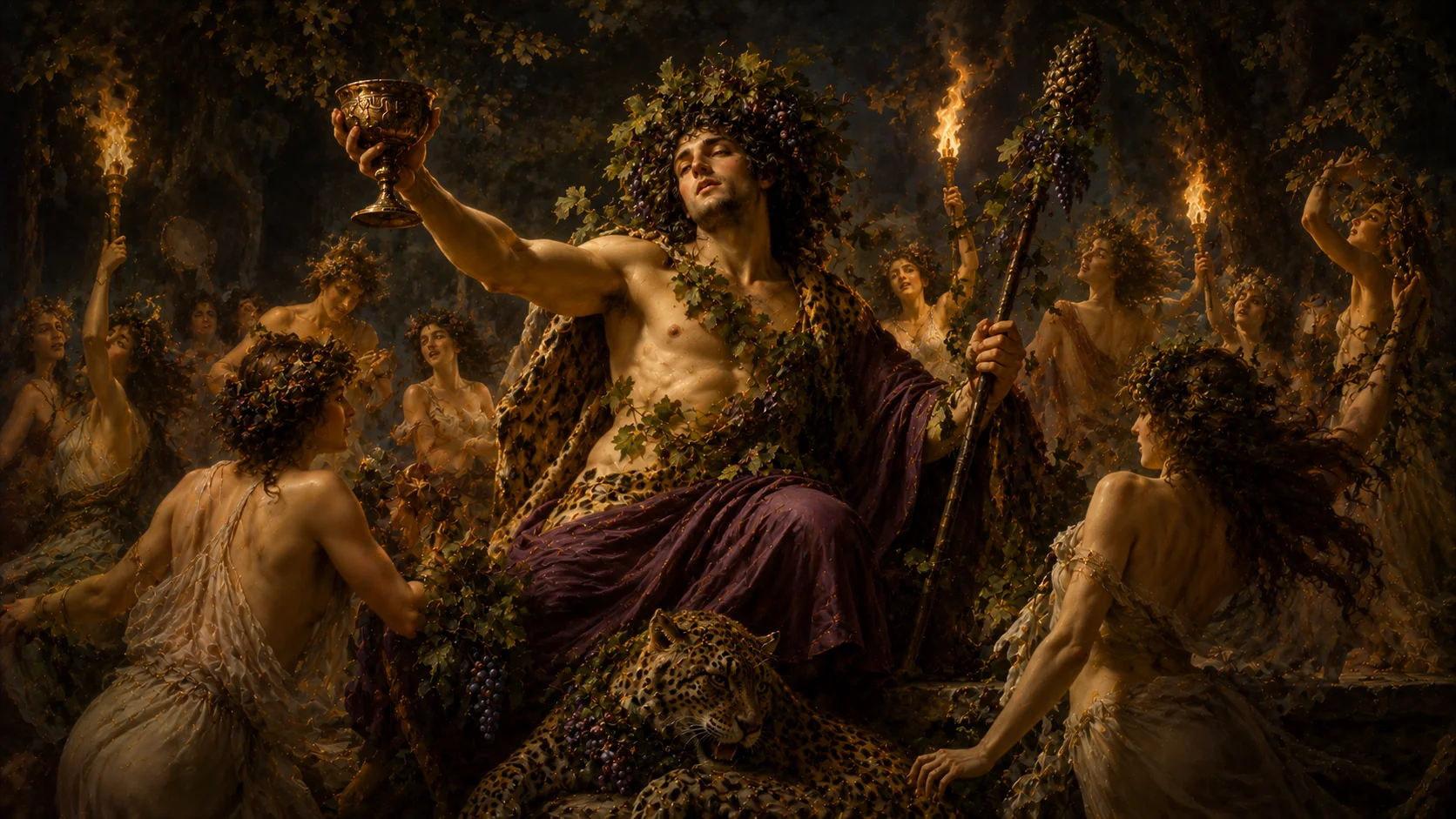
He arrives at the edge of every Greek myth like a stranger from somewhere wilder — crowned in vine leaves, trailed by ecstatic dancers, carrying wine and madness in the same cup. Dionysus, god of wine, ecstasy, the theatre, and divine madness, was the Olympian who dissolved the boundaries the others defended. Where Apollo stood for reason and restraint, Dionysus offered release: the loss of the self in joy — or in horror.
The Twice-Born God
Even his birth broke the rules. His mortal mother Semele, pregnant by Zeus, was tricked by a jealous Hera into asking Zeus to reveal his true divine form — and was instantly burned to ash by the sight. Zeus snatched the unborn child from the flames and sewed him into his own thigh until he was ready to be born. So Dionysus was twice-born, of fire and of a god's body — a deity who had already died once before he drew breath.
The Wine and the Madness
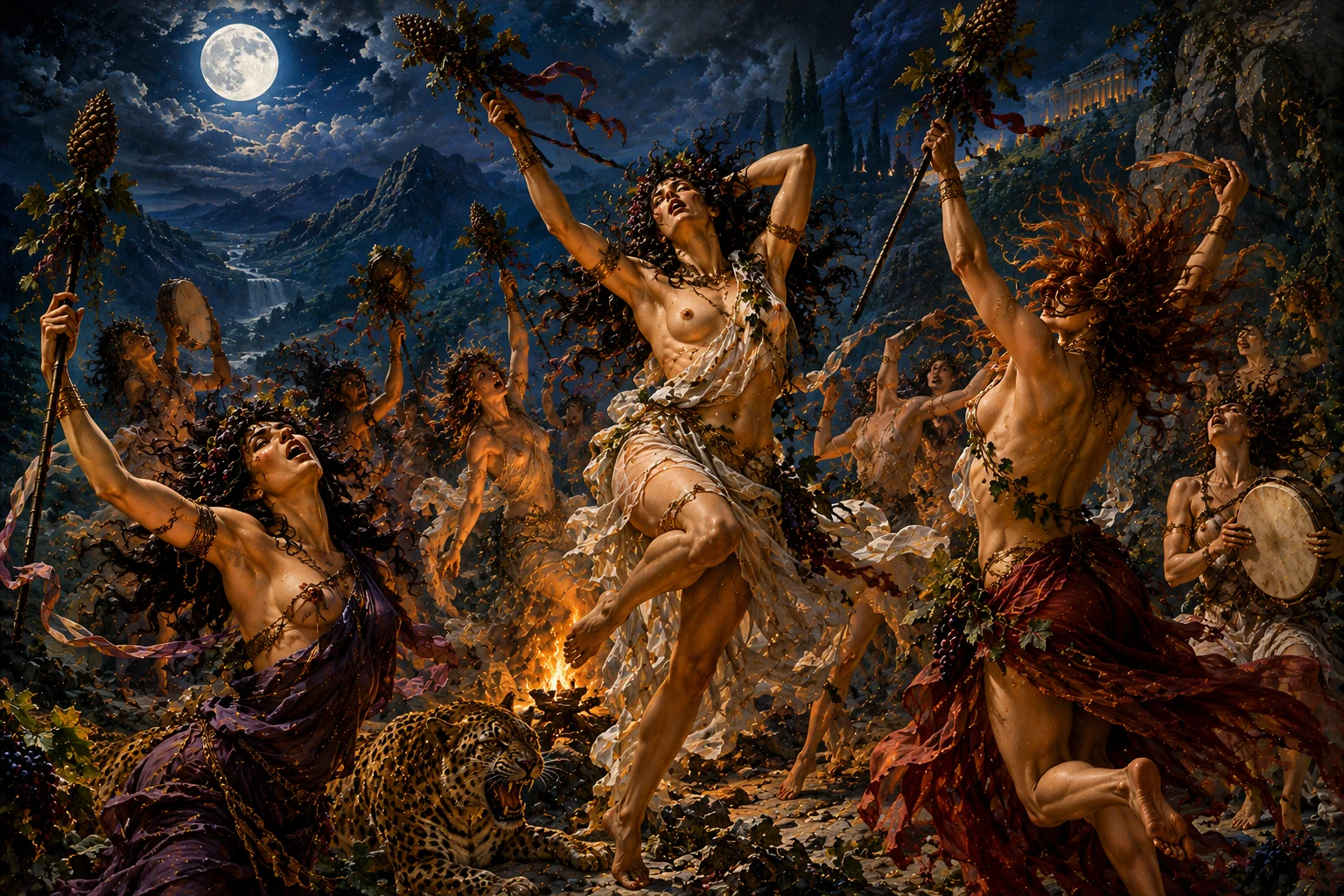
Dionysus gave humanity the vine and the gift of wine — and with it, ecstasy: the dissolving of ordinary self into something larger and freer. His followers, the maenads, danced themselves into a frenzy in the mountains, beyond law and shame. In that state was liberation and joy — but also danger, for the same ecstasy that frees can also tear apart.
The God Who Will Not Be Denied
To refuse Dionysus was fatal. When King Pentheus of Thebes banned his worship and tried to imprison him, the god drove the women of the city into a frenzy — and Pentheus's own mother, in her madness, tore her son apart with her bare hands, believing him a lion. The lesson of the Bacchae is stark: the wild, ecstatic forces Dionysus embodies cannot be denied or caged. Repress them, and they return as catastrophe.
Death and Return
More than any other Olympian, Dionysus was a god of death and rebirth — he descended to the underworld and returned, and his mystery cults promised initiates a blessed afterlife. From his rural festivals grew Greek theatre itself: tragedy and comedy were born as acts of worship to him. The god of wine was also the god of the mask, the stage, and the transformation that lets a person become someone else for a while.
Every glass raised, every actor who steps into another self, every crowd that loses itself in music — all of it still belongs, a little, to the twice-born god.
Older Than the Myths Say He Is
The Greeks themselves told a story about Dionysus arriving late — a foreign god riding in from Thrace or Lydia, trailing drums and strangeness, forcing his way onto Olympus after the other gods were already settled. Euripides staged exactly that anxiety in the Bacchae, where the god comes home to Thebes out of Asia. But clay tablets baked hard in a Mycenaean palace fire around 1200 BCE and dug out of the ruins of Pylos say otherwise. Inscribed in the syllabic script called Linear B is the name di-wo-nu-so — Dionysus, on the books of Greek religion centuries before Homer and centuries before anyone thought to write the myths down. A tablet from Khania on Crete goes further, recording honey set aside as an offering to him alongside Zeus. The god the classical Greeks treated as an outsider crashing the party had, in fact, been there from the beginning. His “foreignness” was not a fact of history but a story the Greeks needed to tell about him — a way of explaining why a native god felt so alien to their own sense of order.
Torn Apart Before He Was Reborn
The story already told of Dionysus's fiery first birth is not the only version. In the secretive teachings of Orphism, a much darker birth precedes it. Dionysus in his first incarnation — the child later poets name Zagreus, son of Zeus and Persephone — was set on the throne of heaven as an infant, and Hera, unable to bear it, sent the Titans to destroy him. They lured the child with toys, a mirror among them, and while he was distracted by his own reflection they seized him, tore him limb from limb, and ate him. Only his heart survived, rescued by Athena and carried to Zeus, who swallowed it and from it fathered Dionysus a second time, this time through Semele. Enraged, Zeus struck the Titans with his thunderbolt, and from their ashes — scorched with the flesh of the god they had devoured — humanity was born. Later Orphic writers read that ash as an explanation for what a person is: a Titanic body, coarse and violent, wrapped around a spark of something Dionysian and divine. To be initiated into the god's mysteries was to answer to that spark rather than the body it lived in — the theological weight behind everything the more familiar stories only gesture at when they call him a god of death and return.
A Crown for the Woman Everyone Else Abandoned
Dionysus's most enduring love story starts with someone else's cruelty. Ariadne, the Cretan princess who gave Theseus the thread that let him escape the Labyrinth, was abandoned by him on the island of Naxos while she slept. She woke to an empty shore and a god instead of a husband. Dionysus found her grief and did not treat it as something to console but something to answer: he married her, and by some tellings placed his own wedding gift — a jewelled crown — into the night sky, where it still burns as the constellation Corona Borealis. Their sons read like an inventory of the vine: Oenopion, “wine-face,” who carried the grape to Chios; Staphylus, “grape-cluster”; and Thoas, who ruled Lemnos. The same instinct shows elsewhere in his household. Priapus — the misshapen, permanently phallic little god of gardens and orchards, born to Dionysus and Aphrodite in the usual telling — was cast off at birth by an ashamed mother and raised instead among shepherds. It is a small, telling pattern: the figures Dionysus takes in are almost always the ones the Olympian order has already discarded.
The Sailors Who Mistook a God for Cargo
One of the oldest surviving stories about Dionysus, preserved in a Homeric Hymn, has almost nothing to do with wine — it is about the price of not recognising him. Standing on a jutting headland in the likeness of a young man in the first bloom of youth, Dionysus was spotted by a crew of Tyrrhenian pirates, who assumed they had found an easy prize: a rich man's son to sell into slavery. They bound him in ropes that fell away from his wrists the moment they were tied. The helmsman alone sensed what was standing on his deck and begged the crew to let the stranger go; they laughed at him and set sail anyway. Then the ship stopped answering the wind. Wine ran in fragrant rivers across the deck; a vine spread along the sail and burst into hanging clusters of grapes; dark ivy twined up the mast in flower and berry. Dionysus became a lion and seized the captain, and the terrified crew leapt overboard and were transformed, one by one, into dolphins — a punishment and, in its way, a mercy, since the Greeks counted dolphins among the kindliest creatures alive, known in their own stories for carrying drowning men to shore. Only the helmsman who had argued for the god's release was spared and taken into his favour. It is one of the few myths in which Dionysus's power is aimed not at Thebes or a royal house but at ordinary men who simply failed to see the god standing in front of them.
The Festival That Built the Stage
The theatre traced to Dionysus's worship was not a metaphor but a specific, dated civic institution. Each spring in Athens, the City Dionysia opened with a procession that carried an ancient wooden image of the god into the city along the road from Eleutherai, re-enacting his arrival and his welcome as an adopted citizen rather than an intruder. For days afterward, the whole city sat in the theatre built into the slope beneath the Acropolis and judged competitions: three tragedians each staging three tragedies and a satyr play, comic poets competing on a separate day, choruses of ordinary citizens trained and funded by wealthy sponsors called choregoi. Aristotle, writing generations later in the Poetics, traced tragedy itself back to the leaders of the dithyramb, a wild choral hymn sung in the god's honour, and comedy to the phallic songs carried through the streets at his more unruly festivals. Drama was not inspired by Dionysus in some loose, poetic sense — it was his liturgy, paid for by the city, performed as an act of worship, and only later understood as art.
One God Wearing Other Cities' Names
Wherever Greek and Roman religion touched a wine-growing culture, Dionysus tended to be recognised rather than replaced. The Romans folded him into Liber Pater, the “free father,” a native Italian god of the vine and of male coming-of-age, celebrated each March at the raucous Liberalia, when boys exchanged the child's toga for a man's. When private, unlicensed Bacchic societies spread through Italy in the early second century BCE, the Roman Senate panicked hard enough to leave a record of its fear: the Senatus Consultum de Bacchanalibus of 186 BCE, a bronze decree that survives to this day, which broke up the cult's assemblies and put what remained under state licence — no shrine, no common fund, no priest, and no gathering beyond a handful of worshippers without the Senate's leave. The historian Livy's account of the scandal adds secret nocturnal rites, sworn oaths, and alleged conspiracy against the state. It is one of the few moments in antiquity where the anxiety underneath the myth — that ecstatic worship might dissolve not just the self but the state's hold on its citizens — became actual law. Further east, Herodotus reported that the Egyptians worshipped a god answering to Dionysus under the name Osiris, and in Thrace and Phrygia his cult overlapped so closely with that of the local god Sabazios that Greek writers frequently treated the two as one figure in different regional clothes.
How to Know Him in a Ruin or a Museum Case
Long before an inscription confirms it, a few objects give Dionysus away. He carries the thyrsus, a giant fennel stalk crowned with a pinecone and bound in ivy — a wand that is also, unmistakably, a weapon. He is crowned in grapevine or ivy rather than the laurel or olive of the other Olympians. His cup is the two-handled kantharos, and his chariot, on the vases and mosaics where he rides one, is drawn by panthers or leopards rather than horses. Archaic art gives him a full beard and heavy robes, dignified and almost paternal; by the fourth century BCE, sculptors working in the softer manner associated with Praxiteles had reimagined him as a smooth-limbed, androgynous youth — a shift in taste that happens to mirror his own doubled nature, equally at home as an old bearded lawgiver of the vine and as a beautiful boy nobody can quite pin down.
The Idea That Outlived the God
Dionysus's afterlife in modern thought owes more to a philosopher than to any storyteller. In 1872, Friedrich Nietzsche's The Birth of Tragedy proposed that Greek tragedy — and, by extension, all art worth taking seriously — was born from the tension between two forces he named after two gods: the Apollonian, orderly, individuated, dream-like, and the Dionysian, ecstatic, formless, and collective, the force that dissolves the boundary between self and other. The pairing escaped philosophy almost immediately and became one of the most durable shorthand ideas in modern criticism — used, argued with, and misquoted ever since — because it finally gave a name to something people already sensed: that civilisation runs on two engines at once, the one that builds forms and the one that periodically needs to smash them.
Why the Frenzy Never Left Us
Every society that has feared crowds, mobs, festivals, and altered states has, in some sense, been afraid of Dionysus. The Roman Senate's panic over the Bacchanalia was not really about wine; it was about what happens to obedience when people are given a sanctioned reason to stop supplying it. That fear has never fully gone away, because the need underneath it never has either. Carnival, mosh pits, football terraces, all-night raves, revival tents — every culture eventually invents its own regulated Dionysia, a fenced-off season or space where the self is allowed to come apart on purpose, safely, before Monday returns and the individuated, Apollonian world claims everyone back. Dionysus persists not because people still literally believe a god rides with the leopards, but because the experience he stands for — the relief of losing yourself, and the real danger of losing too much — is one that being human never stops requiring an answer for.
Sources & traditions
- EncyclopediaWikipedia — Dionysus
- TraditionGreek texts, inscriptions and later retellings (Greece)
Myths change from area to area and from time to time. This chronicle follows the most widely told versions; tellings in other villages, regions and eras may differ.