History remembers Hera for her jealousy — the wronged wife of Zeus, forever hunting down his lovers and their children. But that portrait is a trap, and a shallow one. Long before she was anyone's wife, Hera was a great goddess in her own right, and the deeper you look, the clearer it becomes: her wrath was never really about a husband. It was about sovereignty.
Queen Before She Was a Bride
In the oldest layers of Greek religion, Hera ruled. Her temples at Argos and on Samos were among the grandest in the Greek world — some older than the great temples of Zeus himself. She was the protector of women across every threshold of their lives: maidenhood, marriage, childbirth. To the cities that revered her, she was simply the Queen, Hera Basileia.
The Sacred and Stormy Marriage
Her marriage to Zeus was the divine template for every mortal marriage — the hieros gamos, the sacred wedding that sanctified the bond itself. As goddess of marriage (Hera Teleia, “the Fulfilled”), she presided over the most important social contract in the ancient world. And that is precisely why Zeus's endless betrayals struck so deep: every affair was not just a personal wound but an assault on the very institution she embodied.
The Wrath of Heaven's Queen
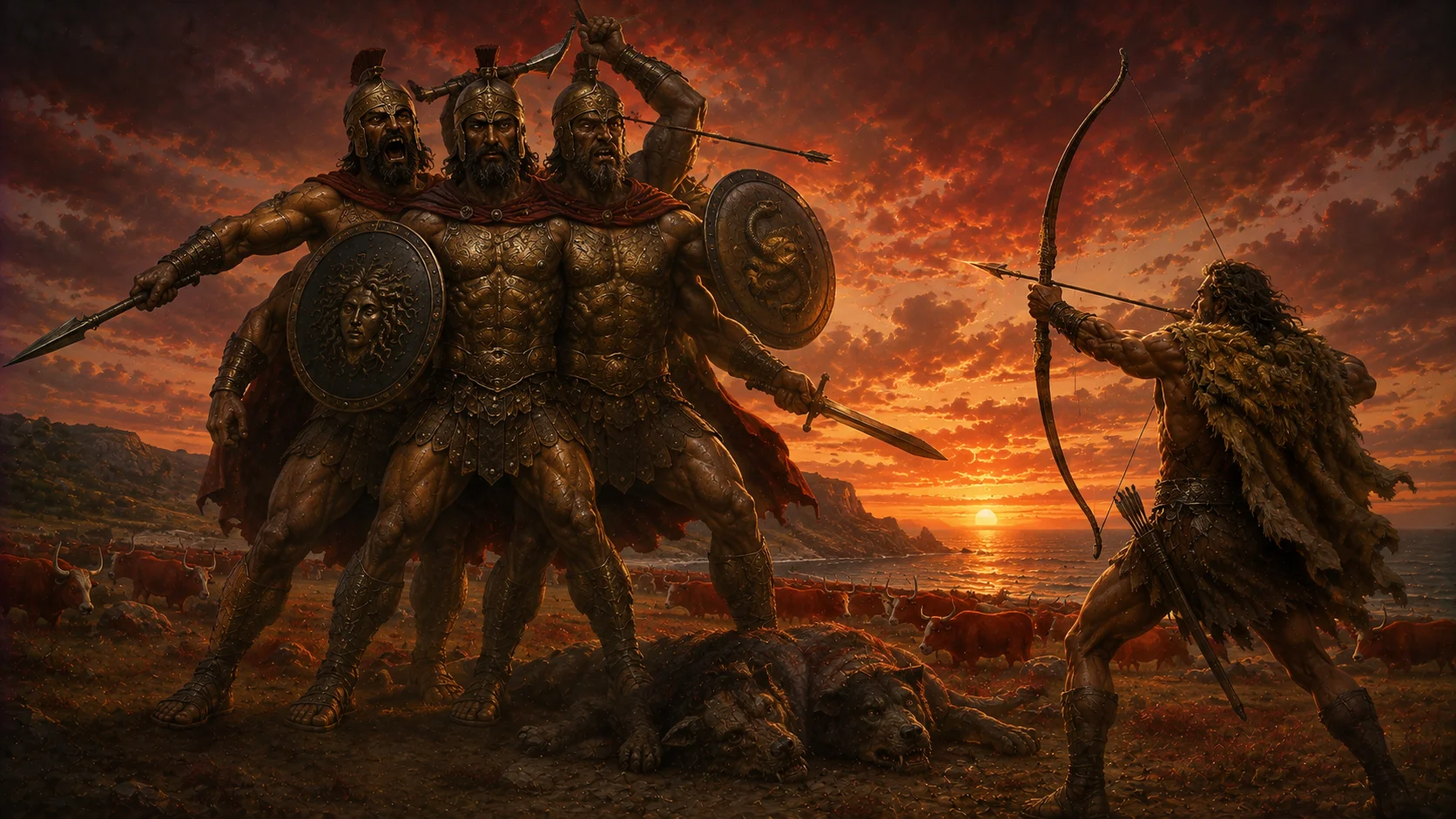
Hera's vengeance is the stuff of legend, and it is relentless. She drove the nymph Io across the world as a tormented heifer. She delayed the birth of Apollo and Artemis by forbidding any land to receive their mother Leto. She tricked Semele into demanding Zeus reveal his true form, incinerating her. And above all she pursued Heracles — whose very name means “glory of Hera” — from the cradle, sending serpents to his crib and madness upon his mind.
To be loved by Zeus was a death sentence signed by Hera.
The Goddess Behind the Jealousy
Read only for her vengeance, Hera is a villain. Read whole, she is something far more interesting: a powerful, independent deity folded — not entirely willingly — into a marriage with a more powerful and unfaithful king, and fighting, with every weapon she has, to defend her dignity and her domain. Her rage is the rage of sovereignty insulted. In an age that gave women little power, the Greeks imagined a queen of heaven who answered betrayal not with tears but with terror.
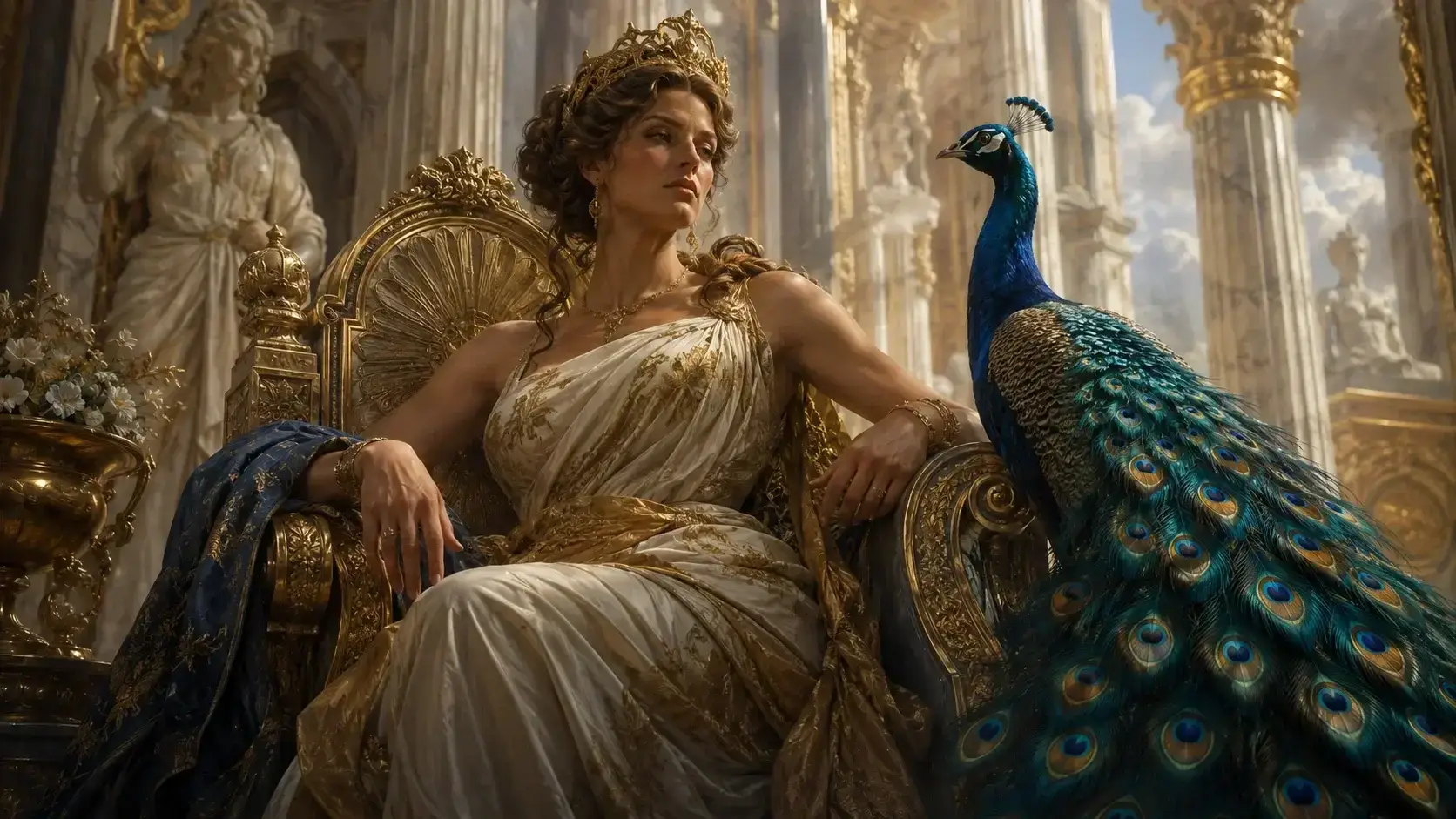
The peacock spreads its hundred eyes in her honour still — a reminder that the Queen of Heaven sees everything, and forgets nothing.
A Queen Older Than Homer
Centuries before a single line of the Iliad was sung, a scribe in the palace of Pylos pressed a stylus into wet clay and recorded an offering to a name: e-ra. The tablet survives only because the palace later burned, baking the soft clay hard. Most Mycenologists read that syllabic script as the earliest trace of Hera we have — a goddess already receiving offerings in the Bronze Age, some four centuries before the first monumental temple was raised to her on Samos. If they are right, the marriage Homer dramatises may be the late meeting of two independent and far older cults, pressed by poets into a single divine household.
A House Divided Against Itself
When Zeus produced a daughter from his own skull without her, Hera answered in kind. In Hesiod's telling she bore a son — Hephaestus — with no father at all, in open rivalry with her husband. But the child arrived lame, and Hera, ashamed of the imperfection, hurled him from Olympus into the sea. Hephaestus never forgot it. Grown, and skilled beyond any craftsman on the mountain, he sent his mother a golden throne of astonishing beauty. The instant she sat in it, invisible bonds locked around her, and no god on Olympus could work the mechanism loose. Only wine solved what force could not: Dionysus got the sulking smith drunk and walked him back up the mountain on a mule to free her — and in one strand of the tradition the price he named for the favour was a bride, Aphrodite. It is a story about a family that wounds itself and then has to go on living together, forever.
The Bird in the Rain
Hera did not choose Zeus so much as get cornered by him. An Argive tradition — the one that put a cuckoo on the sceptre of her cult statue — told of a courtship built on a single act of theatre. Zeus turned himself into a cuckoo, battered and soaked by a storm, and let himself be found shivering on the ground before her. Hera, moved to pity, lifted the bird and warmed it against her breast, at which point Zeus resumed his own shape and forced himself on her; she agreed to the marriage to cover the shame. It is an ugly story, and it is not incidental. The goddess who presided over every wedding in Greece entered her own by ambush, and the rest of her mythology keeps returning to that wound.
The Hundred Eyes That Became a Tail
The peacock did not always belong to Hera; it entered her iconography through a specific and gruesome debt. To keep watch on Io once the girl had been turned into a heifer, Hera set a giant named Argus Panoptes — “the all-seeing” — to guard her, a creature whose body carried a hundred eyes, so that even in sleep some of them stayed open. When Zeus sent Hermes to lull every eye shut and kill him, Hera lifted the hundred eyes from the corpse; Ovid describes her setting them into the feathers of her own bird and filling its tail with those star-bright jewels. Read that way, the peacock's fan is not vanity, as it is usually taken now, but vigilance — a watchman's eyes still open long after the watchman is dead.
The Seduction That Turned a War
Homer gives Hera one of the great set-pieces of the Iliad: the Dios apate, the deception of Zeus. Determined to help the Greeks despite Zeus's order that the gods keep out of the fighting, she went to the one goddess she had every reason to avoid, and lied — telling Aphrodite she needed the embroidered girdle to reconcile the long-estranged Oceanus and Tethys, when she meant to use it on her own husband. She bought Hypnos, the god of sleep, with the promise of one of the Graces as a wife. Then, bathed, perfumed, and wearing borrowed desire beneath her robe, she climbed Mount Ida and drew the king of the gods into her arms — and while he slept, Poseidon turned the battle below. It is Hera at her most formidable: not a jealous wife but a strategist who out-thought the ruler of the universe using nothing but timing and a lie.
The Apple She Never Forgave
Her hostility toward Troy runs deeper than any single affair of Zeus's. At the wedding of Peleus and Thetis, Eris — Strife — tossed a golden apple among the guests inscribed for the fairest, and three goddesses claimed it: Hera, Athena and Aphrodite. The Trojan prince Paris was handed the impossible task of judging between them, and each offered him a bribe: Hera dominion over Asia, Athena victory in every battle, Aphrodite the most beautiful woman alive. He took Aphrodite's offer, and with it Helen. Zeus's infidelities made Hera vengeful in private; that verdict made her vengeful on the scale of a ten-year war. The Iliad shows her spending it without a flicker of pity — she tells Zeus outright that he may raze Argos, Sparta and Mycenae, the three cities she loves best, whenever he pleases, so long as Troy falls first.
Races for the Queen, a Wedding Re-enacted
Cult honoured Hera with rites that had nothing to do with jealousy at all. At Olympia a separate festival, the Heraia, was held for unmarried girls and organised by a college of sixteen women. Pausanias describes the runners with their hair hanging loose and their tunics cut above the knee, the right shoulder bared to the breast, racing a track shortened by about a sixth of the men's stadium; the winners took crowns of olive, a share of the cow sacrificed to Hera, and the right to set up portraits of themselves in her sanctuary.
On Samos the islanders held that Hera had been born on the island itself, by the river Imbrasos, beneath a lygos — the chaste tree — that was still growing in her sanctuary when Pausanias wrote. Her ancient wooden image was carried down to the shore once a year, screened in a thicket of that same lygos and bound about with its branches, then formally discovered, purified, dressed and brought back to the temple in procession. Whole communities shaped their calendar around losing and finding her again. It is a side of her worship the vengeance stories never show: a queen honoured, not appeased.
How to Know Her in Stone and Paint
Greek and Roman artists gave Hera a small, consistent vocabulary. She is veiled — the bride's marker, worn into full maturity — or crowned with the polos, the tall cylindrical crown that Greek art reserves for great goddesses. In the gold-and-ivory cult statue Polykleitos made for her Argive temple she sat enthroned, a sceptre in one hand topped with a cuckoo, a direct citation of her courtship myth, and a pomegranate in the other. Pausanias, describing that statue, refused to explain the pomegranate at all: the story attached to it, he says, is one he may not tell — a rare moment of an ancient guidebook falling deliberately silent. As for the peacock, the attribute everyone reaches for now, it arrived late. Peafowl were eastern birds the Greek world only came to know well in the classical period, and Samian tradition claimed they were first reared at her own Heraion; it is Roman art that finally makes the bird inseparable from Juno — the eyes of Argus, in the end, dressed in imperial pageantry.
Sources & traditions
- EncyclopediaWikipedia — Hera
- TraditionGreek texts, inscriptions and later retellings (Greece)
Myths change from area to area and from time to time. This chronicle follows the most widely told versions; tellings in other villages, regions and eras may differ.