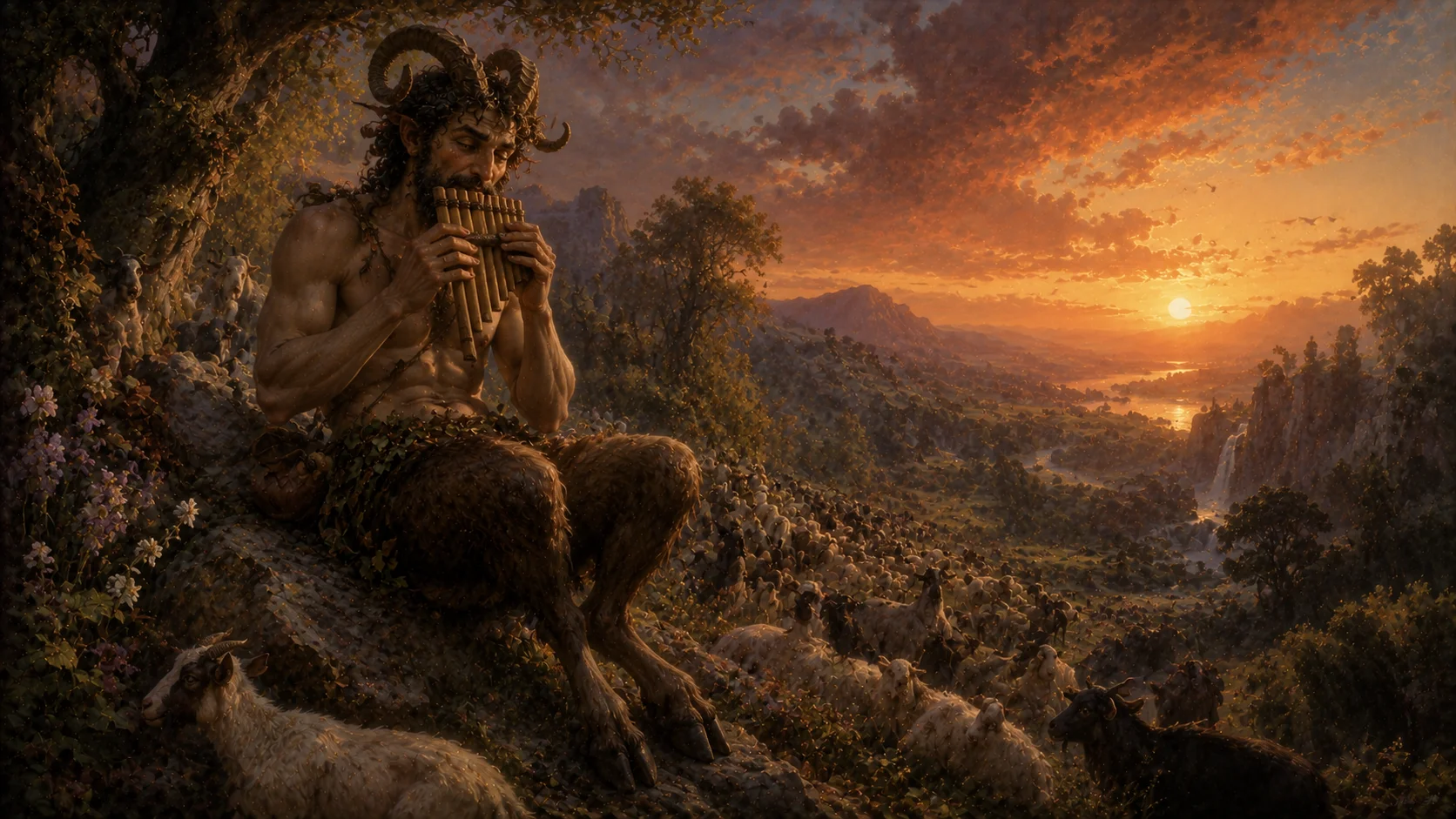
Pan was the goat-legged god of the wild — of shepherds and flocks, mountains and forests, rustic music and untamed nature. Half-man and half-goat, mischievous and lustful, he was the spirit of the countryside itself: its fertility, its strange noises in the dark, and the sudden, mindless terror that could seize a lonely traveller in a wild place — the feeling we still call panic, after him.
The God of the Wild
Pan haunted the rugged backcountry of Arcadia: the rocky slopes, the shady groves, the shepherds' pastures. With his goat horns, goat legs, and shaggy hide, he was the least “civilised” of the gods — not a dweller of marble Olympus but of caves and hillsides. He watched over herdsmen and their flocks, roamed the wilds chasing nymphs, and napped in the noonday heat (when it was dangerous to disturb him).
The Pipes of Syrinx
His signature instrument has a bittersweet origin. Pan pursued a beautiful nymph named Syrinx, who, fleeing him, prayed to be saved and was transformed into a stand of river reeds. Unable to tell which reeds had been his beloved, Pan cut several and bound them together to make the first panpipes (the syrinx), whose plaintive music is the sound of his unfulfilled longing. The wild god's most beautiful creation was born from loss.
The Origin of Panic
Pan's most enduring legacy is the emotion named for him. Lonely travellers in the wilderness sometimes felt a sudden, overwhelming, irrational fear with no visible cause — and the Greeks attributed it to the unseen presence of Pan. This panikon, “the fear of Pan,” is the root of our word panic. He could also strike whole armies with this terror, routing them without a blow — the wild's power to unman even the brave.
The Death of the Great God
Pan is the subject of one of antiquity's eeriest legends: a sailor in the reign of Tiberius was said to have heard a voice cry across the water that “the great god Pan is dead” — a story later read as marking the passing of the old pagan world. Yet the wild he embodied never truly died. Whenever the countryside feels alive and watching, whenever sudden dread grips us alone in nature, Pan is near.
The wild has not gone quiet. It only learned to whisper — and we still flinch when it does.
A God Born Laughing, and Fled From at First Sight
The fullest ancient account of Pan’s birth is also the strangest nativity in Greek myth. The Homeric Hymn to Pan tells of a daughter of Dryops who bore Hermes a son — goat-footed, two-horned, noisy, and laughing from the first moment. The hymn is precise about who ran: it was the child’s nurse who took one look at that bearded, unkindly face, sprang up, and fled, leaving the baby where he lay. Hermes was delighted rather than dismayed. He wrapped the infant in the warm skins of mountain hares and carried him up to Olympus to show the other gods, and there the child became the occasion for pure joy — Dionysus most of all was glad of him. The assembled gods, charmed by his wildness, are said to have named him Pan because he had delighted them all. It is a lovely story and almost certainly false as etymology: philologists derive the name instead from an old root meaning to pasture or to guard the flock, which would make him a distant linguistic cousin of the Vedic herdsman-god Pushan rather than a walking pun. The false etymology tells its own truth, though. The Greeks wanted Pan to mean everything — and eventually, in the mystical tradition, he would.
Not even his parents are agreed. Herodotus records the Greek belief that Pan was the child of Hermes and Penelope, the wife of Odysseus; later commentators preserved a coarser version of the same tale in which the father was not Hermes at all but the whole crowd of suitors who filled her house during the years she waited for her husband to come home. The joke turns on the same pun — Pan, born of all. Other poets gave him other fathers again. Whatever his parentage, the pattern repeats across every version: Pan enters the world already fully formed, already strange, and the reaction he provokes is never indifference.
The Contest That Gave Midas His Ears
Pan’s confidence in his own music nearly ended in disaster for someone else. Proud of the reed pipes he had made, he was rash enough to claim his rustic playing could rival Apollo’s lyre — and rasher still to say so where it could be tested. A contest was arranged, as Ovid tells it, with the mountain god Tmolus appointed judge. Tmolus, unsurprisingly, ruled for Apollo, and for the civilised authority of the lyre over the reed-pipe of the wild. Only one listener disagreed: King Midas, who said openly that he preferred Pan’s playing. Apollo did not take the insult well. He declared that ears so poor a judge of music did not deserve to stay human, and Midas’s ears lengthened, sprouted fur, and became a donkey’s.
Midas hid the deformity under a purple turban, and only his barber knew the truth. Sworn to silence but unable to bear the secret, the barber dug a hole in the ground, whispered into it that Midas had a donkey’s ears, and buried the words. Reeds grew on the spot — and when the wind moved through them, they repeated the barber’s whisper to anyone who passed. The countryside itself, the story insists, cannot keep a secret; sooner or later the reeds will say what actually happened. It is a fitting moral for a god whose own instrument was cut from a riverbank that could not stop speaking.
The God Who Was Recruited Before Marathon
Before the Battle of Marathon in 490 BC, the Athenians sent a trained long-distance runner, Pheidippides, racing to Sparta to beg for military help. Herodotus records what happened on the road: on the mountain above Tegea — Mount Parthenion — Pan himself called out to the runner by name and asked why the Athenians paid him no honour, though he was well disposed towards them, had often been useful to them already, and would be again. Pheidippides delivered the message when he returned, and the Athenians afterwards believed the god had kept his word.
Athens paid its debt. A shrine was established in a natural cave on the north-west slope of the Acropolis, sacrifices were instituted, and a torch race was run each year in Pan’s honour — extraordinary attention for a god who, a generation earlier, had barely been worshipped in the city at all. Caves like it became his characteristic sanctuaries across Greece, from Attica to Arcadia: dark, uncarved, natural spaces rather than built temples, visited by shepherds and by individuals who believed themselves seized by the god’s presence — a state ancient writers called nympholepsy, being caught, however briefly, by Pan and the nymphs who kept him company.
One God, Many Names
Wherever the Greeks travelled, they looked for Pan in other peoples’ gods. Herodotus reports that the people of Mendes in Egypt honoured a goat-shaped god of their own, and that the Greeks, seeing the same horns and the same hindquarters, simply decided it was Pan under an Egyptian name. Egyptologists have since established that the animal at Mendes was in fact a ram, not a goat — which makes the identification a double misreading, and a neat illustration of how confidently the Greeks recognised their own gods abroad.
Rome performed the same trick from the other direction. Faunus, its native god of the wild, of prophetic voices, and of the flock, absorbed so much of Pan’s imagery that Latin writers used the names almost interchangeably, and a further Roman title, Inuus, covered the same wild, procreative ground. The most striking identification, though, came from within Greek religion itself. Mystical and Orphic tradition took the pun on his name seriously rather than as a joke and reimagined Pan not as one god among many but as the embodiment of the whole cosmos: his horns read as the rays of the sun and the crescent of the moon, his dappled hide as the star-flecked night sky, his shaggy lower half as forests and wild beasts, his goat feet as the solid earth underfoot. A god whose name merely sounded like the word for everything became, for these worshippers, literally All.
Knowing Pan When You See Him
On painted pottery and in sculpture, Pan is almost always caught mid-motion — running, dancing, or startling someone. Look for the goat legs bending backwards at the knee, small horns pushing through a shock of hair, and either the pedum, a shepherd’s crook, in one hand or the panpipes raised to his mouth. Archaic and classical images do not flinch from his fertility, showing him openly aroused as a mark of his generative power over flocks and fields. By the Hellenistic period artists had multiplied him outright: swarms of small, goatish Paniskoi — “little Pans”, known to Latin writers as Panisci — appear alongside the god himself in the retinue of Dionysus, wild nature broken into a hundred capering pieces.
Pan After Antiquity
The god outlived the religion built around him. Elizabeth Barrett Browning took the making of the pipes as the subject of her poem A Musical Instrument, following Pan as he tears a reed from the river, strips it, hollows it, and plays — and closing on the price of that music, which the poem insists the gods themselves count as loss. Arthur Machen pushed the darker inheritance further in his 1894 novella The Great God Pan, using the god as a name for a horror lying just behind the visible world, deliberately reviving the dread the Greeks felt on lonely hillsides rather than the pastoral charm.
Kenneth Grahame went the opposite way. In the seventh chapter of The Wind in the Willows, Rat and Mole come at dawn upon a horned, piping figure on a river island and are awed rather than afraid — a guardian of small wild creatures, and one Grahame never names, though every reader knows who it is. And when J. M. Barrie needed a name for a boy who would never grow up, pipe in hand, at home in the wild and faintly dangerous to know, he reached for the same god. Peter Pan carries the music, the mischief, and a little of the power to unsettle into a nursery a world away from Arcadia.
Every age keeps a place for him: sometimes a hillside shrine, sometimes a haunted novella, sometimes a green boy who refuses to grow old. Call him god, call him metaphor — something in the wild has never stopped answering to his name.
Sources & traditions
- EncyclopediaWikipedia — Pan (god)
- TraditionGreek texts, inscriptions and later retellings (Greece)
Myths change from area to area and from time to time. This chronicle follows the most widely told versions; tellings in other villages, regions and eras may differ.