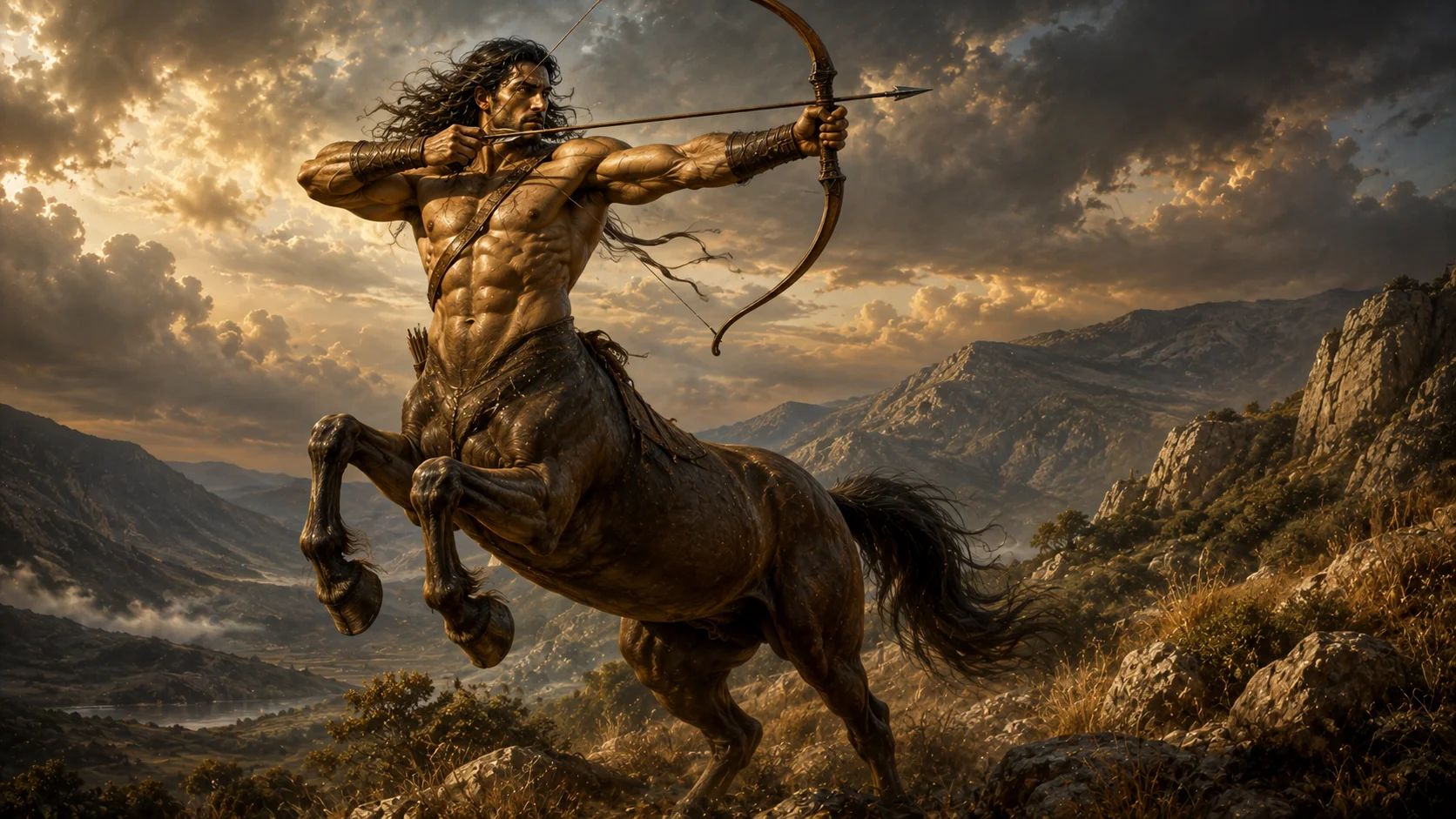
The Centaur — a being with the upper body of a man joined to the body of a horse — embodies one of the deepest tensions in Greek thought: the war between civilisation and wild instinct, reason and appetite, fighting within a single creature. Most centaurs were savage and drunken; a rare few were the wisest beings alive. Together they map the whole struggle of the human animal.
The Wild Half-Men
Born (in one myth) from the cloud-nymph Nephele and the impious king Ixion, the centaurs dwelt in the mountains and forests of Thessaly, living as a wild, lawless tribe. They were notorious for their lack of self-control, especially when it came to wine — and their most infamous myth shows exactly why the Greeks distrusted them.
The Battle at the Wedding
Invited to the wedding of the Lapith king Pirithous, the centaurs got drunk and attempted to carry off the bride and the other women — sparking the Centauromachy, a furious battle between the civilised Lapiths and the bestial centaurs. The Greeks depicted this scene endlessly (most famously on the Parthenon) as a symbol of civilisation's struggle to master savagery — order versus chaos, fought hand-to-hand.
The Wise Exception: Chiron
Yet not all centaurs were brutes. Chiron, the noblest of his kind, was utterly different — immortal, gentle, and supremely learned in medicine, music, prophecy and the arts of war. He was the great teacher of heroes, tutoring Achilles, Jason, Asclepius and many more. Chiron is the proof that the same dual nature that makes a beast can also make a sage — that the wild and the wise are two faces of one creature.
The Beast Within Us All
The centaur endures because it is, transparently, a portrait of ourselves: the rational mind riding atop the powerful, instinctive animal body, never quite in full control. Whether brute or sage, the centaur asks the question that defines being human — which half is truly in the saddle?
Half of us reasons; half of us gallops — and the Greeks gave that whole struggle a single body.
A Beast Older Than Homer
Long before any surviving poem describes the creature, someone in Greece had already imagined it clearly enough to build it. A terracotta figure from the cemetery at Lefkandi on Euboea — made around 900 BC, its head and its body recovered from two different tombs — joins a horse's body to a bearded man's torso, and carries a deliberate gash cut into one knee. It is the earliest known image of a centaur to survive from Greece, and nobody can say what story its maker had in mind. The wound that later myth deals Chiron also falls on the knee; whether that is meaning or coincidence, no one can prove. What is certain is that the horse-man was already an old idea by the time Greek literature began.
Homer, the earliest literary witness, has two words for these beings and uses both. In the battle memories of the Iliad they are pheres — simply "beasts", the mountain-dwelling kind, the shaggy kind — when Nestor boasts of fighting beside Pirithous in his youth, and when Pirithous drives them off Mount Pelion. Elsewhere Homer calls them Kentauroi outright: Chiron is "the most righteous of the Centaurs", and in the Odyssey it is the Centaur Eurytion whom wine destroys in Pirithous' hall. What kentauros originally meant has never been settled. The Greeks, it seems, inherited the animal before they agreed on a name for it.
The Wine Jar That Started a War
Chiron was not the only centaur Heracles met, and the others fared badly. Hunting the Erymanthian Boar, Heracles lodged with the centaur Pholus in a cave on Mount Pholoe. Pholus served his guest roasted meat while eating his own raw, then hesitated over the wine: the jar was not his to open. It belonged to the centaurs in common — left with the tribe by Dionysus generations earlier, to be broached only when Heracles came. Heracles pressed him. The scent carried on the mountain air, and the rest of the centaurs came down on the cave in a fury, armed with rocks and uprooted firs. What followed was a running battle in which Heracles turned his arrows — tipped, fatefully, with the venom of the Lernaean Hydra — on his own hosts.
Pholus came through the fighting and was killed by his own curiosity. Drawing a spent arrow from a fallen kinsman to marvel that so small a thing could bring down something so large, he let it slip and gashed his foot. The poison that would one day undo an immortal had just demonstrated it could undo anybody.
The Same Poison Finds Chiron
Chiron had no part in the brawl, and no part in the centaurs' ancestry either. Where the tribe is traced to Ixion, Chiron's parents were the Titan Kronos and the Oceanid Philyra, and his horse-shape came from his father, who had taken that form to escape being discovered — which is the quiet explanation for why the wisest centaur is unlike every other. The routed centaurs fled to him for shelter. Heracles shot after them, and a stray arrow passed through one fugitive's arm and lodged in Chiron's knee.
Because Chiron was immortal, the wound could not kill him. It simply never stopped. The ancient accounts leave him in unending pain, unable either to heal himself — he who had taught medicine to Asclepius — or to die of it. Release came through an exchange. Prometheus lay chained for the theft of fire, and Chiron offered to surrender his own immortality so that Prometheus might go free and the sentence be discharged. Zeus allowed it. Chiron died, and the mythographers set him among the stars, though they disagree over which constellation he became. The greatest teacher in Greek myth ended by giving away the one gift he could no longer use.
Nessus and the Shirt That Killed a Hero
The Hydra's venom claims one victim more, and this time it reaches Heracles himself. Years after Pholoe he came to the river Evenus with his new wife, Deianira, and hired the centaur Nessus as ferryman to carry her across on his back. Midstream, Nessus laid hands on her; Heracles, still on the far bank, shot him down with another poisoned arrow. Dying, the centaur told Deianira to gather the blood clotting at his wound and keep it hidden — a charm, he promised, that would hold her husband's love for ever. She believed him.
Years later, hearing that Heracles had brought another woman into his house, she smeared a fine robe with the preserved blood and sent it to him as a gift. Sophocles built Women of Trachis around the moment it is put on. The venom, no less lethal for the years and for the death of the creature that carried it, fused the cloth to Heracles' skin and burned him from the inside; strength was no use against it, and it ended on his own pyre on Mount Oeta. One poison, drawn from a swamp monster in an early labour, accounts for the host who fed him, the teacher who raised him, the ferryman who tried to rob him, and finally the hero himself — and Heracles supplied every arrow.
Kin of the Horse-Men
The centaur was not the only hybrid the Greeks put on four legs. The onocentaur — donkey-bodied rather than horse-bodied — entered the tradition sideways, through the Greek translation of the Book of Isaiah, where an obscure Hebrew word for a creature haunting ruined places was rendered as "onocentaur". Christian writers of late antiquity and the medieval bestiaries seized on the result, making the donkey-centaur an emblem of the double-minded man: a thing that will not commit to either of its halves, and is therefore trusted by neither.
The sea got its own version. The ichthyocentaur — a man's torso, a horse's forelegs, and a long coiling fish tail where the hindquarters should be — appears in Hellenistic and Roman art escorting marine deities, and in some mosaics attending the birth of Aphrodite from the foam.
Female centaurs are the real rarity. The early vase painters scarcely drew them at all, and the kentaurides arrive late. Lucian describes a lost painting by Zeuxis showing a centaur mother stretched on the grass suckling twin foals, and reports that the crowd looked straight past the skill of the picture to gawp at its strangeness — the painter's complaint, and the proof that nobody had thought to imagine the creature domestically before. Ovid gives the type its one great character in Hylonome, who grooms herself with care, loves the centaur Cyllarus, and throws herself onto the spear that has killed him. A monster with a household is a much harder thing to cheer against.
Reading a Centaur on a Vase
The centaur in your head — one seamless horse's body with a man rising from where the neck should be — is not what the earliest Greek artists drew. On the oldest images the creature is closer to a man wearing a horse: a complete human figure in front, legs and all, with a horse's barrel and hind legs grafted on behind. The fully equine, four-legged form takes hold over the course of the Archaic period, and once it settles it never leaves.
The older shape survives longest on Chiron, and that is not an accident. On the François Vase, painted around 570 BC, Chiron arrives at the wedding of Peleus and Thetis with human legs at the front, decently clothed, a branch over his shoulder hung with the game he has taken — every visual signal saying this one is a person. His cousins are drawn the other way: naked, wholly horse below, fighting with whatever the mountain or the banqueting hall happens to put in reach — boulders, torn-up trees, and, at the wedding feast, the furniture and the wine jars themselves.
Sculptors kept returning to the same fight, and not only on the Parthenon. The west pediment of the temple of Zeus at Olympia freezes the wedding brawl at its ugliest moment, with Apollo standing motionless at the centre of it; the frieze at Bassae runs Lapiths and centaurs around the inside of the cella, where only worshippers would see them. Each is the same argument in stone, set where citizens would pass it without ever being asked to stop and think about it — which is exactly how a durable idea gets installed.
Sources & traditions
- EncyclopediaWikipedia — Centaur
- TraditionGreek texts, inscriptions and later retellings (Greece)
Myths change from area to area and from time to time. This chronicle follows the most widely told versions; tellings in other villages, regions and eras may differ.