At the gates of the underworld stood a guardian that let any soul enter — and tore apart any that tried to leave: Cerberus, the monstrous three-headed hound of Hades. He is the most famous guard dog in history, the slavering, serpent-maned beast who made the kingdom of the dead a one-way door.
The Hound of Hades
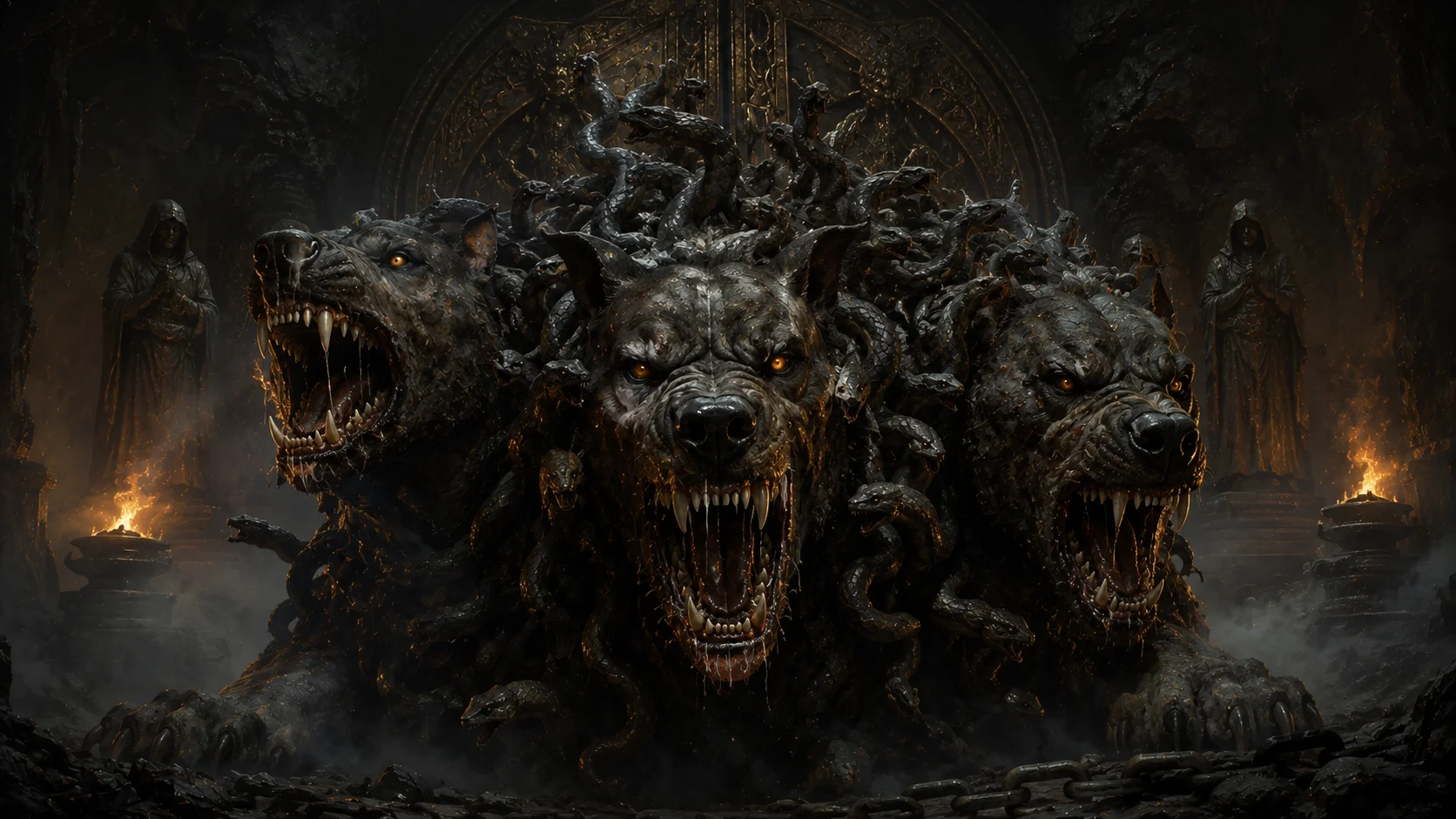
A child of Typhon and Echidna, Cerberus had three heads (some say more), a mane and tail of writhing serpents, and a bite of venom. His task was absolute: he kept the living from entering the realm of the dead, and — more importantly — kept the dead from ever escaping back to the world of the living. He was the lock on the door of death itself.
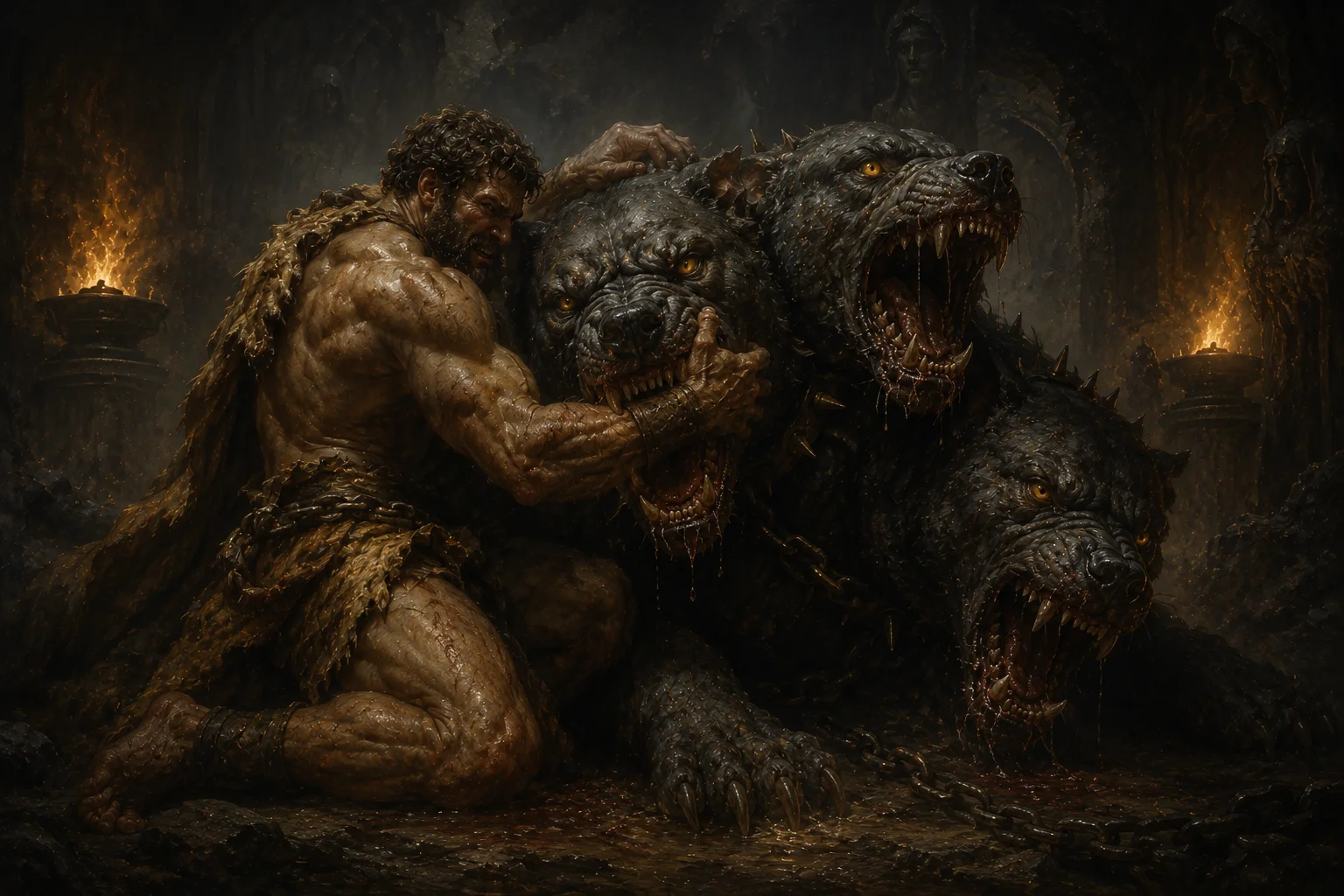
The Twelfth Labour
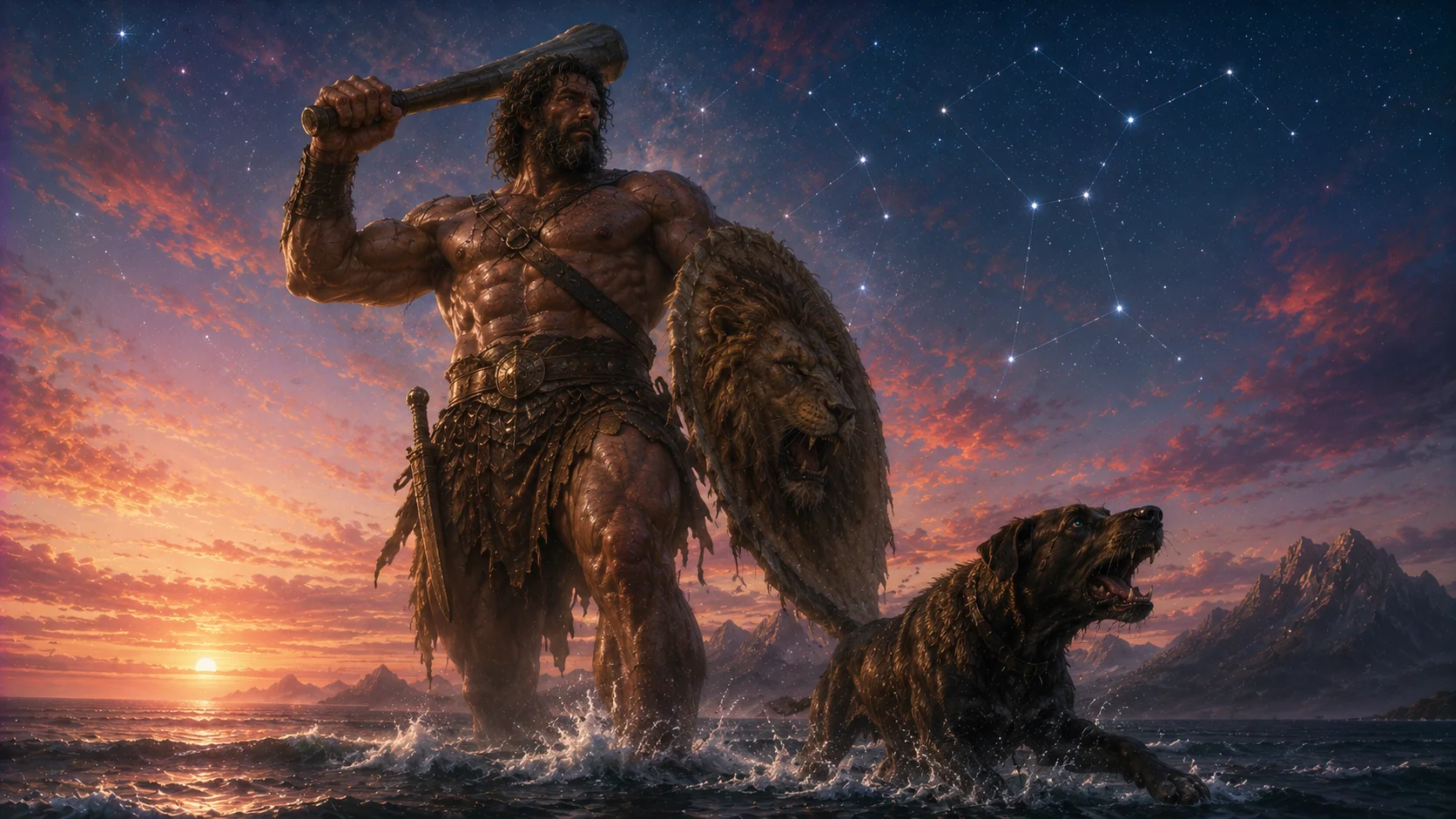
His greatest myth is his defeat — or rather, his temporary capture. For the last and hardest of his Twelve Labours, Heracles was sent to drag Cerberus up from the underworld alive. With Hades' grudging permission — granted on the condition that he use no weapons — Heracles wrestled the great hound into submission with his bare hands and hauled him up to the surface, before returning him to his post. It was the labour that conquered death's own guardian.
Music and Honey-Cakes
A few others slipped past him. Orpheus lulled the beast to sleep with the music of his lyre. The Sibyl who guided Aeneas tossed him a honey-cake drugged to make him drowse. The Greeks loved these details: even the unconquerable guardian of the dead had his weaknesses — a beautiful song, a sweet treat, a hero strong enough to choke him quiet.
To “throw a sop to Cerberus” still means to placate a fearsome guardian — for everyone, even death, can sometimes be slipped past.
A Hundred Heads, Then Three
The Cerberus most people picture is not how he first appears in writing. Hesiod's Theogony, composed around 700 BC and the oldest surviving text to name him, calls Cerberus the “brazen-voiced hound of Hades,” an eater of raw flesh, and gives him fifty heads. The lyric poet Pindar, two centuries later, is credited with pushing the count to a hundred. The tidy three-headed hound came afterwards and won by attrition: vase painters, who needed a beast that would actually fit on a pot, had settled into small numbers by the sixth century BC, and the mythographers followed them — Apollodorus gives three dog heads, a dragon's tail, and snake heads sprouting along the back. The monster shrank as the story matured, which is the opposite of what most legends do.
Litter of the World's End
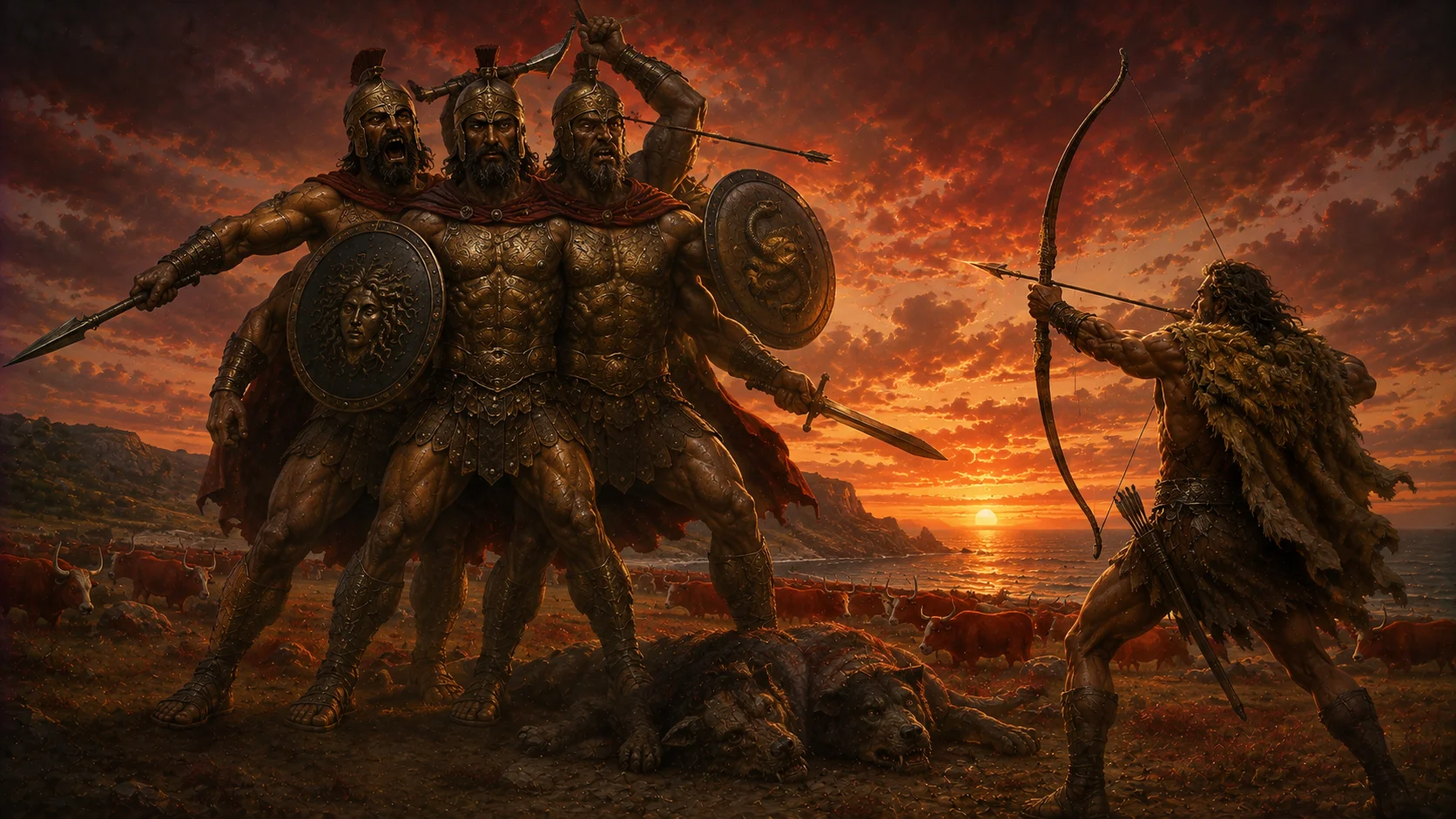
Typhon and Echidna did not stop at one guard dog. Hesiod runs through their brood in a single breathless genealogy: the Lernaean Hydra that Heracles would later behead; the Chimera, part lion, part goat, part serpent, breathing fire; and Orthrus, a two-headed hound set over the cattle of the giant Geryon until Heracles killed him during an earlier Labour. Orthrus and Cerberus were, in effect, brothers doing the same job on opposite sides of existence — one guarding a giant's herd at the edge of the world, the other guarding the dead at the edge of everything. Echidna herself is remembered simply as the mother of monsters, a den-keeper at the margins of the map, where the ordinary rules of nature stopped applying.
The Cave at Tainaron
The Greeks did not leave Cerberus floating in pure myth — they gave him a front door. At Cape Tainaron, the southernmost tip of the Mani peninsula in Laconia, a cave beside a sanctuary of Poseidon was named as the mouth Heracles hauled the hound out of. Strabo describes the grove, the temple, and the cave through which, by the old stories, Cerberus was brought up from Hades. Pausanias saw the same spot and was pointedly unimpressed: he found no road leading underground, and passed on an older rationalisation credited to the geographer Hecataeus — that the “hound of Hades” had really been a venomous serpent living in that cave, so deadly that a bite killed instantly, and that this was the creature Heracles carried to Eurystheus. Two things are worth noticing. The first is that for the people telling these stories the underworld was not an abstraction on the far side of belief; it had a coastline, and you could sail to within sight of its gate. The second is that the sceptics arrived early — the impulse to explain the monster away is very nearly as old as the monster.
Psyche's Second Sop
Orpheus's lyre and the Sibyl's honey-cake are not the only bribes on record. In Apuleius's The Golden Ass, the mortal girl Psyche is set an impossible errand by a jealous Venus: go down to the underworld and bring back a box of beauty from Persephone herself. A tower speaks up and gives her the practical briefing that travellers to Hades always seem to need — two coins held in the mouth for Charon, and barley cakes soaked in sweet wine carried in both hands, one to throw to Cerberus on the way in and one for the way out. She is warned not to let go of them for anything. The second cake is the story's quiet joke: everyone remembers that Cerberus stops the dead from leaving, but here is a living girl expected to walk back out the same door, and the only thing standing between her and the dog is remembering to feed him twice.
Painted in Black and Red
Vase painters came back to the Twelfth Labour again and again, and they were remarkably casual about the anatomy. Most surviving vases of the scene give Cerberus two heads rather than three; others add snakes at whatever angle the curve of the pot allowed. The canonical number was evidently a suggestion. The best-known version, a hydria painted around 530 BC and now in the Louvre, shows Heracles walking the hound out on a leash with his club raised — never mind the condition that he take no weapons — while King Eurystheus, who set the Labour in the first place, has dived into a storage jar sunk in the ground and is craning out of it in terror. It is one of the few moments in Greek heroic art played for comedy rather than awe: the man who commissioned the monster cannot bear to be in the room with it.
An Old Dog in Distant Mythologies
Cerberus may have relatives well outside Greece. In the Rigveda, Yama — the first mortal to die, and therefore king of the dead — keeps two four-eyed, broad-nosed dogs, the sons of Sarama, who watch the road the dead must travel; a funeral hymn urges the departed soul to hurry past them. One of the pair, Sharvara, has been proposed since the nineteenth century as a linguistic cousin of “Kerberos” itself — a connection argued, disputed and never settled, but far too tempting for comparative mythologists to leave alone. Far to the north, Norse myth chains a hound named Garm before Gnipahellir, a cave on the road to Hel; his howling measures the approach of Ragnarok, and when he finally breaks loose he and the god Tyr kill one another. Whether these hounds share an ancestor or merely a logic is precisely the argument. What is not in dispute is simpler: cultures that kept dogs to guard the house gave death a guard dog too.
Cerberus in Dante's Third Circle
The hound outlived paganism by becoming furniture in somebody else's hell. In Canto VI of the Inferno, Dante posts Cerberus over the gluttonous: three throats barking doglike, red eyes, a greasy black beard, a swollen belly, and clawed hands that flay and quarter the souls lying in the freezing filth. When the beast rounds on the travellers, Virgil stoops, fills both fists with earth, and hurls it down the three ravenous gullets — and the guardian of the gluttons, being a glutton, swallows and falls quiet. The joke runs deeper than it looks. Virgil the character is doing exactly what Virgil the poet had written some thirteen centuries earlier, when the Cumaean Sibyl silenced this same dog with a drugged honey-cake in the Aeneid. Dante is not merely borrowing a monster; he is handing his guide the guide's own best trick.
Why We Keep Building Him a Kennel
Cerberus endures because he answers an enormous fear with an entirely ordinary animal. Everyone in the ancient world knew what a guard dog's loyalty looked like, and knew exactly how little it cared about your excuses. Projecting that unbribable devotion onto the threshold of death turns an abstract terror — that nobody comes back — into something almost domestic: a beast that is only doing its job. Modern retellings lean hard on the domesticity. J.K. Rowling's three-headed Fluffy guards a trapdoor rather than an afterlife, but keeps the old weakness for music, a direct descendant of Orpheus's lyre. The video game Hades goes further still and makes Cerberus an enormous, slobbering, entirely friendly dog the player can stop and pet between escape attempts — the guardian of the one-way door reduced to a good boy at the end of a hallway. The gate has not moved. Only our nerve around it has.
Sources & traditions
- EncyclopediaWikipedia — Cerberus
- TraditionGreek texts, inscriptions and later retellings (Greece)
Myths change from area to area and from time to time. This chronicle follows the most widely told versions; tellings in other villages, regions and eras may differ.