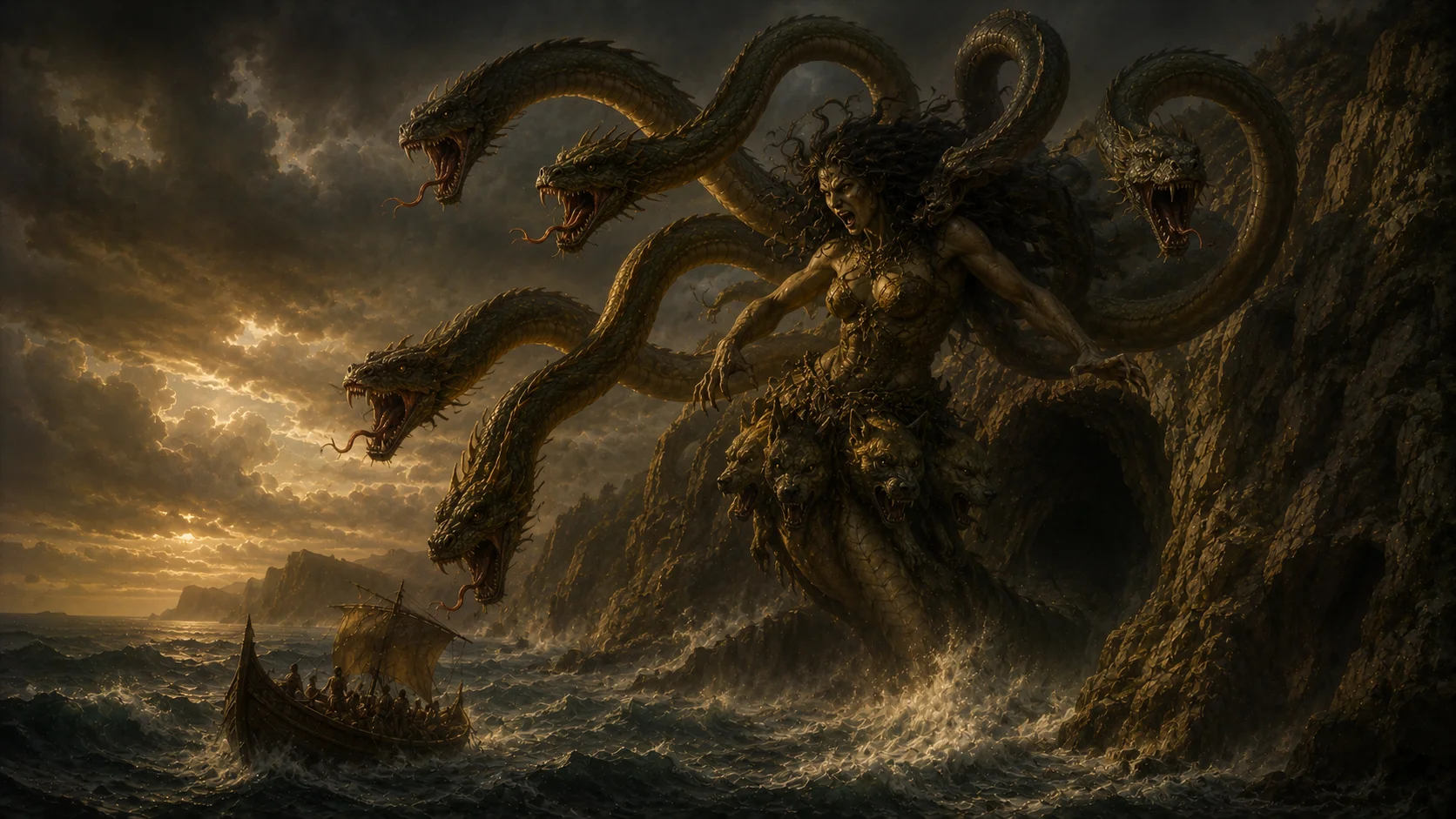
In a narrow strait of churning water, sailors faced a choice with no good answer: steer too close to one shore and a whirlpool would swallow the whole ship; steer too close to the other and a six-headed monster would pluck the men from the deck one by one. That monster was Scylla — and to pass her was to lose someone, always.
The Six-Headed Horror of the Strait
Scylla lurked in a cliffside cave above a narrow sea-passage. From the waist up she appeared a woman, but around her body grew six long, snaky necks, each ending in a ghastly head with three rows of teeth, and a girdle of barking dogs' heads at her waist. As ships passed beneath, she would dart out her six heads and snatch six sailors at once, devouring them alive in her cave.
A Beauty Turned to a Monster
Like Medusa, Scylla was not born monstrous. In the most famous version she was a beautiful sea-nymph loved by the sea-god Glaucus — but the jealous sorceress Circe, who wanted Glaucus for herself, poisoned the pool where Scylla bathed. When Scylla stepped in, her lower body erupted into the writhing dogs and serpent-necks. Driven mad by her transformation, she became the man-eating terror of the strait — another beautiful woman remade into a monster by a god's jealousy.
Between Scylla and Charybdis
Her most famous appearance is in Homer's Odyssey. Forced to sail the narrow strait, Odysseus was warned he could not avoid both perils: the whirlpool Charybdis on one side would destroy his entire ship, while Scylla on the other would take only six men. He chose Scylla — and watched, helpless, as she snatched six of his crew, “calling out my name for the last time.” To be caught “between Scylla and Charybdis” still means to be trapped between two equally deadly dangers.
Some passages cannot be made without loss — the only choice is which loss you can bear.
The Voice of a Newborn Puppy
The most frightening detail Homer gives Scylla is not her teeth. It is her voice. For all her bulk — twelve dangling feet, six necks swaying out over the water — the sound she makes is described as no louder than the yelp of a newborn whelp. A sailor rowing through the dark would hear something small and pitiful from the cliff above, and only afterwards understand what had made it. That mismatch is the whole horror of her: nothing announces itself, nothing roars, and then six men are simply gone.
Greek ears heard a dog inside her name. Skylax means puppy, and the related verb skyllein means to tear or mangle. Whether or not either is the true etymology, that is plainly how ancient audiences heard her — a creature named for the animal that howls around her waist. She is a kennel with a woman's face.
Where the Monster Actually Lives
Unlike most Greek monsters, Scylla has a postal address. Antiquity placed her and Charybdis in the Strait of Messina, the narrow channel between the toe of Italy and the north-eastern corner of Sicily. On the Calabrian side the town of Scilla still stands on her rock, a castle now occupying the crag where the cave was imagined; opposite, off Cape Peloro, lie the waters where Charybdis was said to swallow the sea three times a day and spit it out again.
The strait earned its reputation honestly. The Tyrrhenian and Ionian seas sit at slightly different levels and run on tides that are out of step with each other, so roughly every six hours the flow through the bottleneck reverses — and the bottleneck is barely three kilometres across. The result is shearing counter-currents, standing water that heaps and collapses, and true whirlpools; on spring tides the stream runs at four or five knots through the narrows. A vessel under oar and sail, with no engine to break out of a stream, could genuinely be carried sideways onto the Calabrian rocks while trying to keep clear of the turbulence on the Sicilian side. The myth is not an explanation bolted onto a harmless piece of water. It is a fairly accurate piece of sailing advice with faces on it.
Daughter of Nobody in Particular
Scylla's parentage is a mess, and the mess is informative. Homer names her mother as Crataeis — a name that means something like “the strong one” and appears to exist for no other purpose than to be Scylla's mother. Later poets and mythographers variously attached her to Hecate, to the old sea-god Phorcys, to Lamia, and to the monster-breeding pair Typhon and Echidna, whose litter conveniently absorbs any horror lacking a pedigree.
This is what happens when a place produces a monster rather than a genealogy producing one. Scylla began as a hazard, not as a family member. The strait was dangerous first; the six heads came second; the parents were supplied afterwards by poets who could not leave a divine being unfathered.
What Circe Actually Advised
The sailing directions Circe gives Odysseus are worth reading closely, because they are the opposite of every heroic instinct. Do not arm yourself, she tells him. Do not stand and fight. Scylla is not a beast that can be killed — she is a deathless evil, and any time spent attempting battle simply lets her come back for a second mouthful. Row hard, hug her cliff rather than the whirlpool, and call on Crataeis, her mother, to hold her back.
Odysseus, of course, puts on his armour and takes up two spears anyway, and admits as much when he tells the story later. He is standing on the foredeck scanning the rock, weapons in hand, in the exact moment she strikes behind him. It is one of the sharpest pieces of characterisation in the poem: the hero's competence is precisely what makes him disobey, and his disobedience buys nothing. He watches his men lifted into the air, still shouting his name, and calls it the most pitiable thing he saw in all his wanderings — and this is a man who had already walked through the land of the dead.
The Ships That Got Through
Odysseus is the only captain in ancient epic who pays Scylla's toll, and the contrast with the others is deliberate.
- The Argo is carried through the passage by Thetis and the Nereids, who handle the ship between them like a ball tossed from hand to hand while Scylla and Charybdis wait on either side. Divine patronage, no casualties.
- Aeneas never enters the strait at all. In the Aeneid the prophet Helenus tells him bluntly that it is better to go the long way round the whole of Sicily than to catch sight of Scylla once — and when the fleet hears the water ahead, the helmsman swings the prow away and the Trojans take the detour. Roman piety chooses the long road where Greek curiosity sails in.
Virgil also multiplies her: at the mouth of the underworld he stations Scyllae biformes, double-formed Scyllas in the plural, among the shapes crowding the entrance to the world below. She has become less a specific individual than a category of nightmare.
The Strange Later Traditions
Two additions from outside Homer are worth knowing. In one, preserved by Lycophron and the later commentators on him, Scylla makes the mistake of stealing cattle from the herd Heracles is driving home from Geryon, and Heracles kills her outright — only for her father Phorcys to burn her back into life with torches. It is a rare glimpse of a Scylla who can be beaten, and it exists mainly because Heracles must be able to beat everything.
In the other, Ovid gives her an ending rather than a fate. Hating Circe, she robs Circe's lover Ulysses of his companions — and afterwards hardens into stone, a rock that still juts from the water and that sailors still steer around. The transformation that made her a monster is answered by a second transformation that makes her geography again. She began as a hazard and returns to being one.
The Other Scylla
There is a second Scylla in Greek myth and the two have been confused for well over two thousand years. She is the daughter of Nisus, king of Megara, whose city was safe as long as a single lock of his hair remained uncut. Besieged by Minos of Crete, Scylla fell in love with the enemy king from the walls, crept into her father's chamber, and cut the lock. Megara fell. Minos, appalled by a woman who would betray her own father, refused her and sailed away; she flung herself into the sea and clung to his stern, and was turned into a bird called the ciris, forever pursued through the air by her father in the form of a sea-eagle.
Ancient poets slid between the two Scyllas so freely that some texts give the Megarian princess the dogs at the waist — Virgil does it in the Eclogues — and the conflation persisted through the Middle Ages. It is an accident of naming, but a revealing one: both stories are about a woman whose desire wrecks something, and about a punishment that fixes her permanently in a landscape.
How to Recognise Her in Art
Ancient artists almost never drew what Homer describes. The six necks are difficult to compose and were largely abandoned. The standard image instead is a woman to the waist, a coiling fish-tail or two below, and — the identifying feature — the foreparts of dogs erupting from her hips like a belt of hunting hounds. In her hands she frequently carries a ship's rudder or an oar, wielded as a club: the sea's own equipment turned against sailors.
She appears on painted pottery, on Etruscan funerary urns among the marine hybrids that crowd the imagery of the soul's passage, and on Roman coinage — most famously on a silver denarius struck for Sextus Pompeius, who held Sicily and the strait against Octavian, and who was perfectly happy for his enemies to associate his waters with her: the lighthouse of Messana on one face, Scylla swinging a rudder in both hands on the other. The most spectacular surviving treatment is the marble group recovered from the seaside grotto of the emperor Tiberius at Sperlonga, where she is caught mid-attack on the ship of Odysseus, hauling the steersman and his crewmates off the deck — a monster carved at colossal scale to be looked at from a dining couch inside a cave beside the sea.
The Proverb That Outlived the Monster
Scylla's most durable descendant is a sentence. The twelfth-century Latin poet Walter of Châtillon, writing of the doomed Persian king Darius fleeing one enemy into the hands of another, compressed the dilemma into a single line of his Alexandreis: incidis in Scyllam cupiens vitare Charybdim — you fall into Scylla while trying to avoid Charybdis. Erasmus collected it in his Adagia, and from there it spread through every learned language in Europe, which is why the phrase now outlives almost everyone's memory of which hazard was which.
Her physical shape had a long afterlife too. When Milton needed a body for Sin at the gates of Hell in Paradise Lost, he built her out of Scylla — woman above, serpentine below, ringed with hell-hounds that bark ceaselessly around her waist — and he names the Calabrian and Sicilian shores outright to make sure the reader sees the source. From there the dog-girdled woman passes into the standard vocabulary of European nightmare.
She has also, quietly, become a taxonomic name and a naval one: Scylla is the genus of the heavy-clawed mangrove mud crabs of the Indo-Pacific, and five ships of the Royal Navy have carried her name — sailors naming their own vessel after the thing that used to eat them, which is either bravado or a very old apotropaic instinct.
Why She Will Not Go Away
Charybdis is the more spectacular monster and the less memorable one, because a whirlpool is only death. Scylla endures because she is a price. She does not destroy the ship; she takes a fixed number of people from it and lets the rest continue, which quietly converts a danger into an accounting problem — and an accounting problem has a correct answer.
That is the shape of every command decision that costs lives, and of a great many ordinary adult ones. What Homer understood, and what keeps the story alive three thousand years later, is that the correct answer absolves nobody. Odysseus is right, and six men die screaming his name, and he still cannot look at the memory. The monster in the cliff is not really the thing that haunts the passage. The arithmetic is.
Sources & traditions
- EncyclopediaWikipedia — Scylla
- TraditionGreek texts, inscriptions and later retellings (Greece)
Myths change from area to area and from time to time. This chronicle follows the most widely told versions; tellings in other villages, regions and eras may differ.