If Achilles was the hero of strength, Odysseus was the hero of mind — the cleverest of all the Greeks, “the man of twists and turns,” whose ten-year struggle to get home from the Trojan War became the Odyssey, the greatest adventure story ever told. He won by wits where others won by the spear, and his legend is a hymn to cunning, endurance, and the longing for home.
The Mind That Took Troy
The Trojan War had ground on for ten years until Odysseus devised the trick that ended it: the Trojan Horse, a giant hollow wooden horse left as a false offering, its belly packed with Greek soldiers. The Trojans dragged it inside their own walls, and that night Troy fell. It was the masterstroke of a mind that always found the answer no sword could.
The Long Way Home
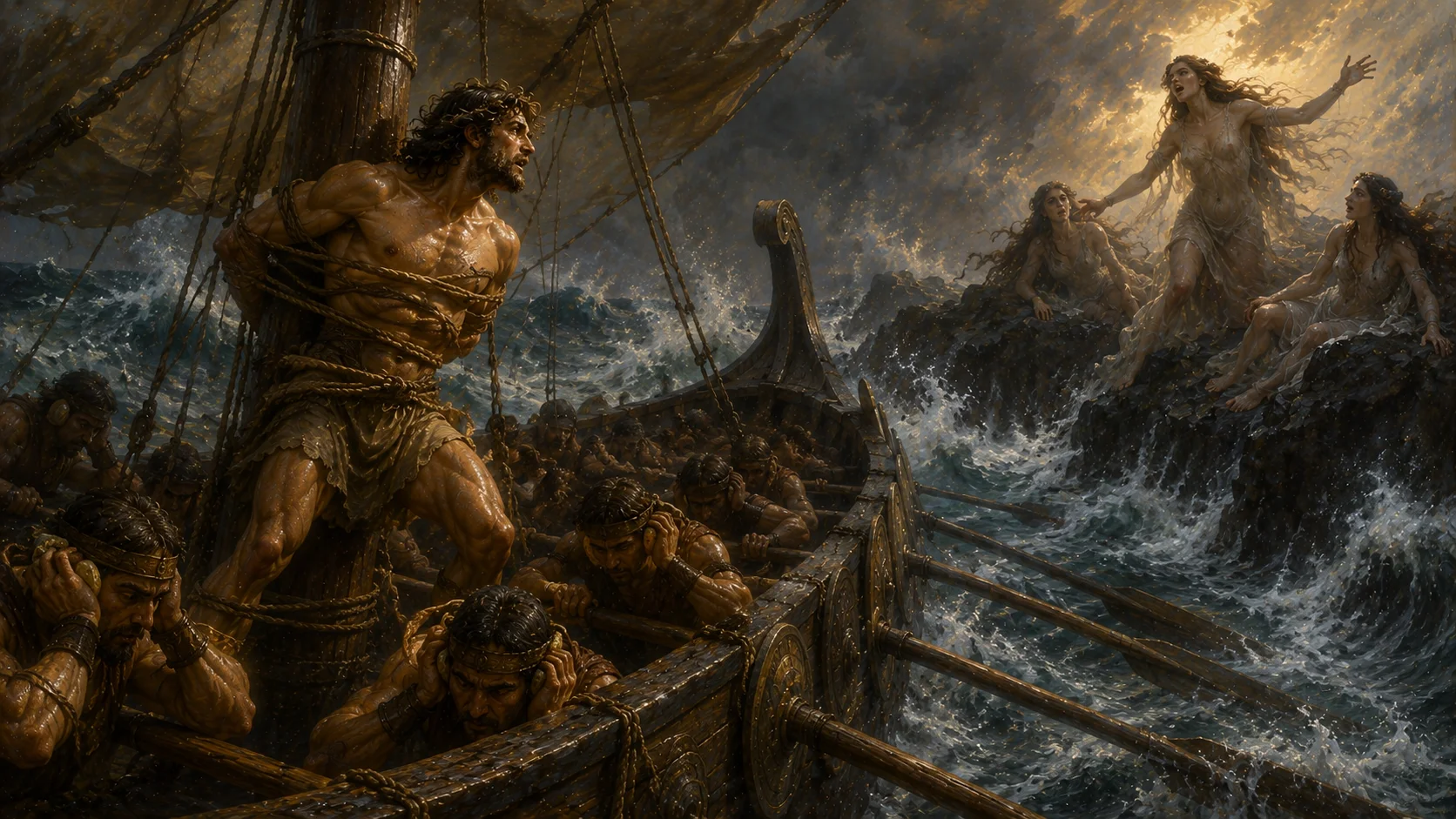
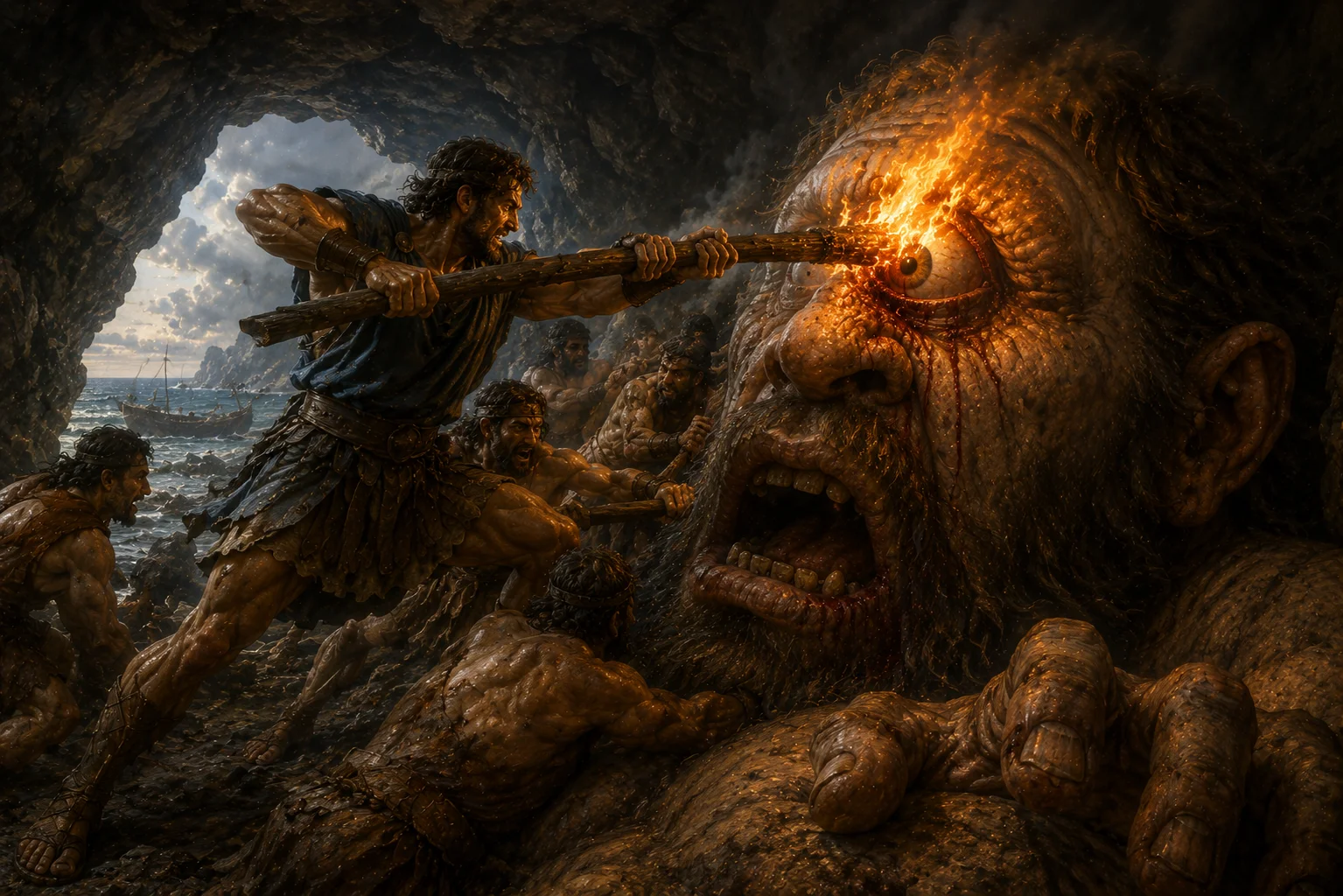
But the gods made his homeward voyage a ten-year ordeal. He blinded the man-eating Cyclops Polyphemus — earning the undying wrath of the boy's father, Poseidon. He resisted the enchantress Circe, who turned his men to swine; sailed past the deadly song of the Sirens lashed to his mast; threaded the strait between Scylla and Charybdis; and descended even to the land of the dead. One by one he lost every ship and every man, until he alone remained.
The Faithful and the Suitors
Home in Ithaca, his palace had been overrun by arrogant suitors pressing his faithful wife Penelope to remarry and devouring his wealth. Disguised as a beggar, Odysseus bided his time, then strung the great bow that none of the suitors could bend — and revealed himself in a storm of arrows, reclaiming his home, his wife, and his kingdom. Twenty years after he sailed for Troy, the wanderer was finally home.
The Hero of Cunning and Home
Odysseus endures because his enemy was not a monster but distance, time, and despair — and his weapons were patience, disguise, and an unbreakable will to return. He is the patron of every traveller who ever wanted, more than glory or treasure, simply to come home.
An “odyssey” still means a long, hard journey home — because no one ever made one harder, or wanted it more.
A Trickster’s Inheritance
Cunning was not a skill Odysseus picked up on the road to Troy — it ran in his blood. His mother’s father was Autolycus, whom Homer calls the man who surpassed all others in thievery and the oath, gifts granted to him by Hermes; later tradition made the god his father outright. When the old thief came down from Parnassus to name his newborn grandson, he chose a name built out of a verb meaning to be angered, or to give pain — because, as he explained it, he himself had come into the world at odds with a great many people. Odysseus: the man of wrath, or the man others have cause to hate, depending which end of him you stood at. Years later, hunting boar on that same mountain with Autolycus’ sons, the young Odysseus took a tusk through the thigh. The scar it left was the mark by which his old nurse, washing a stranger’s feet two decades on, knew the beggar at her master’s hearth for the king himself. A name meaning strife, and a scar that unmasked him at the exact moment he most needed to stay hidden — his whole story is folded into the two things his family gave him before he ever picked up a spear.
The Oath That Caught Its Author
Helen had so many suitors that her guardian Tyndareus feared bloodshed whichever one he chose. It was Odysseus who solved the problem for him: make every suitor swear in advance to defend the marriage of whichever man won her. He asked no share of Helen in return, only help in winning Penelope. Years later the oath came back for him, because he had sworn it too. He tried to dodge the war by feigning madness — yoking an ox and a horse together to plough a field, and sowing it with salt instead of seed. It nearly worked, until Palamedes, one of the men sent to fetch him, laid the infant Telemachus in the plough’s path. A madman would have driven on. A father swerved. Odysseus went to war, and never forgave the man who had unmasked him: before Troy’s walls he had a forged letter planted implicating Palamedes as a Trojan spy, with gold buried in his tent to match it, and the army stoned an innocent man to death on evidence Odysseus had manufactured himself. It is the uncomfortable underside of his cleverness — the same mind that built the Horse could also frame an ally — and Greek tradition never pretended otherwise.
Whom He Met Among the Dead
The descent to the land of the dead takes Homer an entire book, and what Odysseus finds down there is not monsters but people. He meets the ghost of his own mother, dead of longing for him while he was still at sea, and reaches for her three times before learning that the dead are smoke to the touch. He meets Achilles, who tells him he would sooner be a hired hand on a poor man’s farm than a king over all the perished dead — the greatest warrior of the age, disowning the glory he died for. And he meets Ajax, who lost the contest for Achilles’ armour to him and killed himself in shame and rage afterwards. Ajax’s ghost says nothing at all. He turns and walks away into the dark, still refusing, even dead, to forgive him. It is the prophet Tiresias, though, who matters most. He promises Odysseus his homecoming, but only through more suffering, and tells him his true rest lies further off still: a last journey inland, carrying an oar on his shoulder until he meets someone who mistakes it for a winnowing-fan, and only then, his peace made with Poseidon, a gentle death that will come to him from the sea in a sleek old age. Nobody in the poem thinks to ask what that last phrase might mean.
Argos at the Threshold
Of everyone in Ithaca, the first to know him was not his wife, his son or his old nurse. It was his dog. Argos, the hound Odysseus had bred himself before he ever sailed for Troy, was by now old and neglected and lying on a heap of dung outside his own master’s hall, thick with ticks, nobody left who cared enough to move him. Odysseus came past in his beggar’s disguise, unrecognisable to every human being he had met that day, and the dying dog alone knew him: he wagged his tail and dropped his ears, and tried to drag himself nearer, and could not stand. Odysseus, who could not afford to be recognised even by his own animal, turned his face aside and wiped away a tear where his companion would not see it, and walked on into the hall. Argos died a moment later, having done the one thing he had waited twenty years to do. Homer spends barely thirty lines on it. They have outlasted the civilisation that produced them.
A Greek Hero, A Roman Villain
Homer’s audience heard resourcefulness. Not everyone afterwards did. Athenian tragedy had already begun to darken him — the Odysseus of Sophocles’ Philoctetes is a political operator arguing that a lie is worth telling if it wins — but the sharpest turn came from Rome. The Romans traced their ancestry to the losing side, and in Virgil’s Aeneid, written for a people who believed themselves descended from Trojan refugees, the same man appears as Ulysses: not a hero of ingenuity but the architect of a great city’s destruction by fraud rather than valour. It is the Trojan priest Laocoön who delivers the verdict on him and his gift-horse, in five words that outlived the empire which first read them — “timeo Danaos et dona ferentis”, I fear the Greeks, even bearing gifts. The qualities that made him Homer’s most interesting hero made him one of Roman literature’s most useful villains. Few mythic figures get to be the protagonist of one culture’s epic and the antagonist of its neighbour’s.
The Cave of the Tripods
Myth this old rarely leaves anything behind you can touch, but Ithaca may be an exception. Twentieth-century excavation of a cave above Polis Bay, on the island’s north-western coast, turned up votive offerings left across many centuries — among them a group of bronze tripod-cauldrons, and, from a far later layer, a fragment of a terracotta mask inscribed with a vow to Odysseus. What makes the find sit strangely is the detail the poem supplies: it is tripods the Phaeacians load aboard as parting gifts, stacked up for him before they set him ashore asleep on his own island at last. Whether the cult grew up in imitation of that scene, or simply shows that Ithacans went on honouring their most famous son for centuries after Homer, it is the closest thing this myth has to a physical footprint — ordinary people, generation after generation, climbing to a cave to leave something behind for a man who may never have existed at all.
Death From the Sea
Homer never says how Odysseus died — only what Tiresias foretold. A later epic finished the story, and finished it cruelly. The Telegony, attributed to Eugammon of Cyrene, is lost; its plot survives only because a summary of it was copied into a much later handbook. While Odysseus was wandering, Circe had borne him a son he never knew: Telegonus. Grown, the boy sailed out to find his father, was driven ashore on Ithaca without recognising it, and raided the coast for food. Odysseus came out to defend his own land from the stranger, and Telegonus struck him down with a spear tipped with the spine of a stingray — a weapon out of the sea, answering the prophecy in the one way nobody had thought to guard against. Father and son knew each other only after the blow had landed. The man who spent ten years outwitting monsters was killed by his own blood, with a barb taken from an animal, on the shore he had crossed the world to reach.
Restless Forever After
The Odysseus who reaches Ithaca and stops travelling is not the one later ages kept reaching for. Dante, who could not read Homer and knew him only at second hand through the Latin poets, put Ulisse in the eighth circle of the Inferno among the counsellors of fraud — and gave him an ending Homer never wrote: an old man talking his last crew into sailing out past the Pillars of Hercules, into the forbidden ocean, chasing knowledge until the sea closes over them within sight of a mountain no living sailor was meant to see. Tennyson took up the same restlessness five centuries later, from the throne room rather than the deck: a king bored of governing, aching for one more voyage before the end. And in 1922 James Joyce mapped the whole ten-year wandering onto a single day in Dublin, turning the king into an advertising canvasser and the epic homecoming into a walk back to bed beside a sleeping wife. Two languages, six centuries, the same instinct every time — this is a hero nobody could leave finished. The Greeks gave the world its cleverest man, and every generation since has found a reason to send him back out to sea.
Sources & traditions
- EncyclopediaWikipedia — Odysseus
- TraditionGreek texts, inscriptions and later retellings (Greece)
Myths change from area to area and from time to time. This chronicle follows the most widely told versions; tellings in other villages, regions and eras may differ.