Achilles was the greatest warrior of the Trojan War — near-invincible, all but unbeatable in battle, and doomed. His story, at the heart of Homer's Iliad, is the supreme meditation on rage, glory, mortality, and the terrible bargain a hero makes when he chooses a short life of undying fame over a long life forgotten.
A Son of Sea and Shore
Achilles was born to an unlikely pairing: Peleus, the mortal king of the Myrmidons, and Thetis, a sea nymph whose beauty and power had once drawn the attention of gods. Their marriage sat at the hinge between two worlds — the salt-water depths where Thetis belonged, and the sunlit kingdom of men that Peleus ruled — and their son inherited both. From his father he had a throne and a people, the Myrmidons, who would follow him without question into the worst war of the age. From his mother he had something rarer: a divine parent who could walk into the halls of Olympus and be heard.
Schooled on the Mountain
Achilles was not raised entirely among men. For part of his childhood he was sent to Mount Pelion, to the cave of the centaur Chiron — wisest and gentlest of his half-horse kind, tutor to more than one hero of the age. Chiron trained the boy in the arts a king's son needed and a few that few kings' sons ever learned: the handling of spear and blade, yes, but also the healer's craft of herbs and wounds, and the discipline of music. The Achilles who later stood outside Troy playing a lyre in his own tent, even as he sulked in fury, was Chiron's pupil as much as Peleus's.
The Heel the River Never Touched
Later tradition — not Homer himself, but poets writing centuries after him, most clearly Statius in the first century CE — tells that Thetis tried to make her son immortal. In the best-known version of that story she carried the infant Achilles down to the river Styx, the water that bound even the gods to their oaths, and dipped him beneath its surface. Every part the river touched became invulnerable. But Thetis held the child by the heel to keep him from being swept away, and the water never closed over the skin beneath her grip. That single unguarded spot — the only place on his body that could ever be wounded — gave the world its lasting phrase for a fatal weakness hidden inside apparent strength: an Achilles' heel.
Hidden Among the Daughters of Skyros
Thetis knew, by prophecy, that if her son went to Troy he would die there — young, and covered in glory. So before the war could claim him, she is said to have hidden him at the court of King Lycomedes on the island of Skyros, dressed and disguised among the king's daughters so that no recruiter would ever think to look for a warrior in that room. It was there, tradition adds, that Achilles fathered a son, Neoptolemus, with Lycomedes's daughter Deidamia. The disguise held until the cunning Odysseus arrived, posing as a peddler. Among his wares of jewelry and cloth he laid out a sword and a shield, and when a war-horn was sounded in alarm, every girl in the room fled — except the one who instinctively reached for the weapons. Achilles was found out, and Troy had its warrior.
Fifty Ships to Troy
When the Greek fleet finally sailed, Homer's Catalogue of Ships records Achilles at the head of fifty vessels, commanding the Myrmidons — his father's people, fierce and utterly loyal to him alone. Through the long years of siege that followed, he became the name spoken with the most fear on both sides of the wall: podarkes, swift-footed Achilles, brilliant Achilles, the fighter no Trojan wanted to meet in the open field.
A Rage That Opens an Epic
The Iliad itself does not open with a battle. It opens with a single word that names its whole subject: mēnis, wrath. When the Greek commander Agamemnon is forced to give up his own war-prize, he seizes Achilles's — a woman named Briseis, awarded to Achilles as his rightful share of spoils — and in doing so insults the one man the Greek army cannot afford to lose. Achilles's fury is not petty; in the honor-bound world of the poem it is a mortal wound to his standing among men. He withdraws from the fighting entirely, taking the Myrmidons out of the war, and asks his mother to intercede with Zeus on his behalf so that the Greeks will suffer for what Agamemnon has done. They do. Without Achilles, the tide turns hard against the Greek camp.
Grief Wearing Another Man's Armor
What finally breaks Achilles's withdrawal is not glory but loss. His closest companion, Patroclus, pleads to be allowed into the fighting and borrows Achilles's own armor to rally the terrified Greeks. He succeeds — and then the Trojan prince Hector kills him in single combat, stripping the borrowed armor from his body. When word reaches Achilles, Homer describes a grief so total it frightens the men around him. He returns to the war not for Agamemnon, not for Greece, but transformed by rage and mourning into something closer to a force of nature than a man. His mother goes to the god Hephaestus, who forges him a new set of armor — described in the poem in famous, glittering detail — so that her son can go back out and answer Hector's death-blow with one of his own.
Before the Walls of Troy
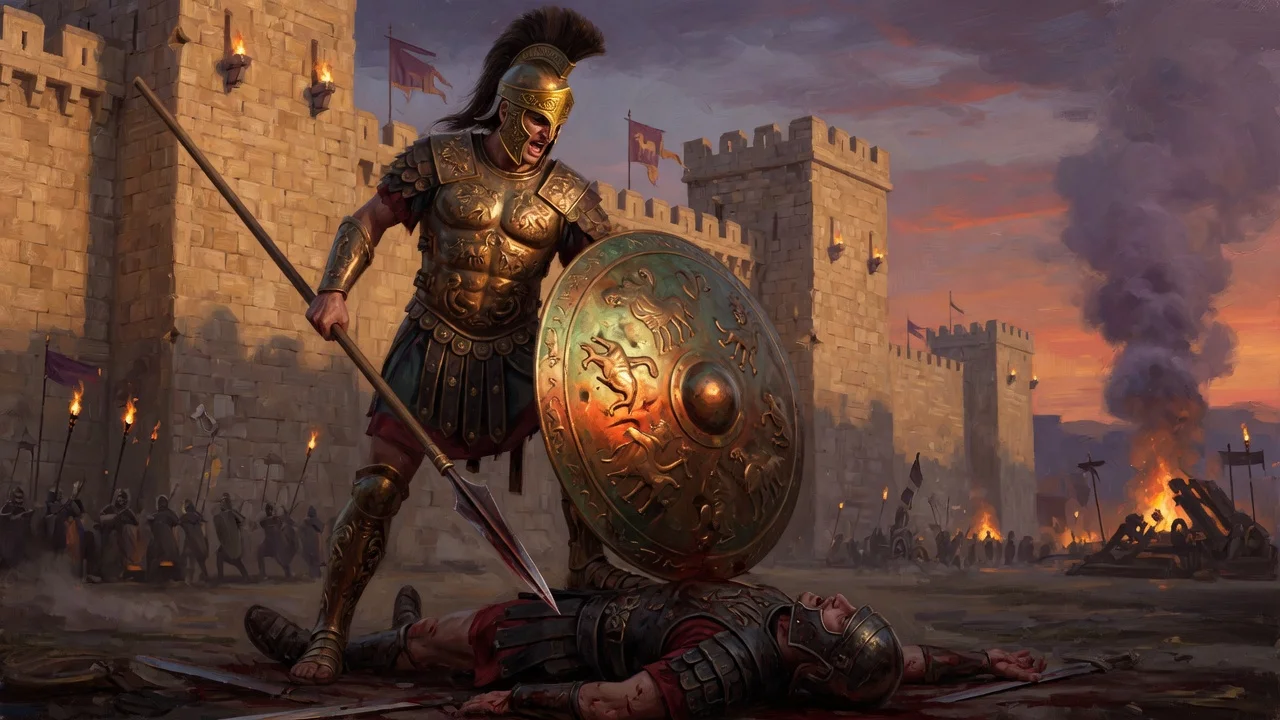
The duel between Achilles and Hector outside the walls of Troy is the dramatic center the entire epic has been building toward. Achilles kills him. And then, still consumed by grief and fury, he does something no code of honor in the poem sanctions: he ties Hector's body to his chariot and drags it in the dust, again and again, in view of the city that loved him.
A King Kneeling in the Dark
The Iliad ends not on the battlefield but in Achilles's own tent, in the middle of the night, with an old man kneeling at his feet. King Priam of Troy, Hector's father, has come in secret across enemy lines to beg for his son's body back. It is the poem's most human scene: the greatest, most terrifying killer of the war looks at the father of the man he killed, and is moved to pity. Achilles returns the body. Book 24 closes not on triumph but on grief recognized between enemies — a moment of mercy the whole poem has earned and never repeats.
Glory Against the Amazon and the Dawn King
The Iliad itself ends before Troy falls and before Achilles dies, but the wider Trojan War cycle — preserved for later readers only in summary, through the lost epic the Aethiopis — carried his story further. In it Achilles kills the Amazon queen Penthesilea, who had come to fight for Troy, and the Ethiopian king Memnon, son of the dawn goddess, in battles that added still more glory and still more grief to a war already thick with both.
The Prophecy That Never Lied
Achilles always knew how his story would end. In the Iliad his own immortal horse, Xanthus, is made to speak and warns him plainly that his death is near; his mother tells him the same. He chooses to go to Troy anyway, fully aware that a long, comfortable, forgotten life was the alternative he was refusing. That is the choice that gives his entire legend its weight — not that he was fated to die, but that he walked toward it with open eyes in exchange for a name that would outlast him.
Struck Where the River Missed
The prophecy came due, as it always does in these stories, at the one place fate had left open. According to the tradition carried in the Aethiopis and repeated by poets for a thousand years afterward, Achilles was killed by an arrow from Paris — a fighter far beneath him in every measure of the battlefield — guided, the old poets insist, by the god Apollo himself. It struck him in the heel, the single point his mother's love had never managed to protect. The mightiest warrior of the age fell to the smallest possible wound, in exactly the spot the river Styx had never touched.
A Name Still Spoken
Achilles became the central figure not just of the Iliad but of the whole Epic Cycle that grew up around the Trojan War, and of Greek tragedy after it — Aeschylus wrote an entire lost play, the Myrmidons, built around Achilles's grief for Patroclus, a bond ancient writers themselves debated the exact nature of, discussed as far back as Aeschylus and Plato. Vase painters returned to him for centuries; later poets, Statius among them, kept extending his story long after Homer had set down his pen. He traded a long life for eternal fame — and three thousand years later, we are still saying his name.
Sources & traditions
- EncyclopediaWikipedia — Achilles
- TraditionGreek texts, inscriptions and later retellings (Greece)
Myths change from area to area and from time to time. This chronicle follows the most widely told versions; tellings in other villages, regions and eras may differ.