Every other Olympian had admirers. Ares, the god of war, had almost none — and that, paradoxically, is the most interesting thing about him. The Greeks worshipped many gods they feared, but Ares they feared and despised, because he embodied the part of war no one wants to admire: not the strategy, not the glory, but the raw, screaming, blood-drunk slaughter of the battlefield.
The God Nobody Loved
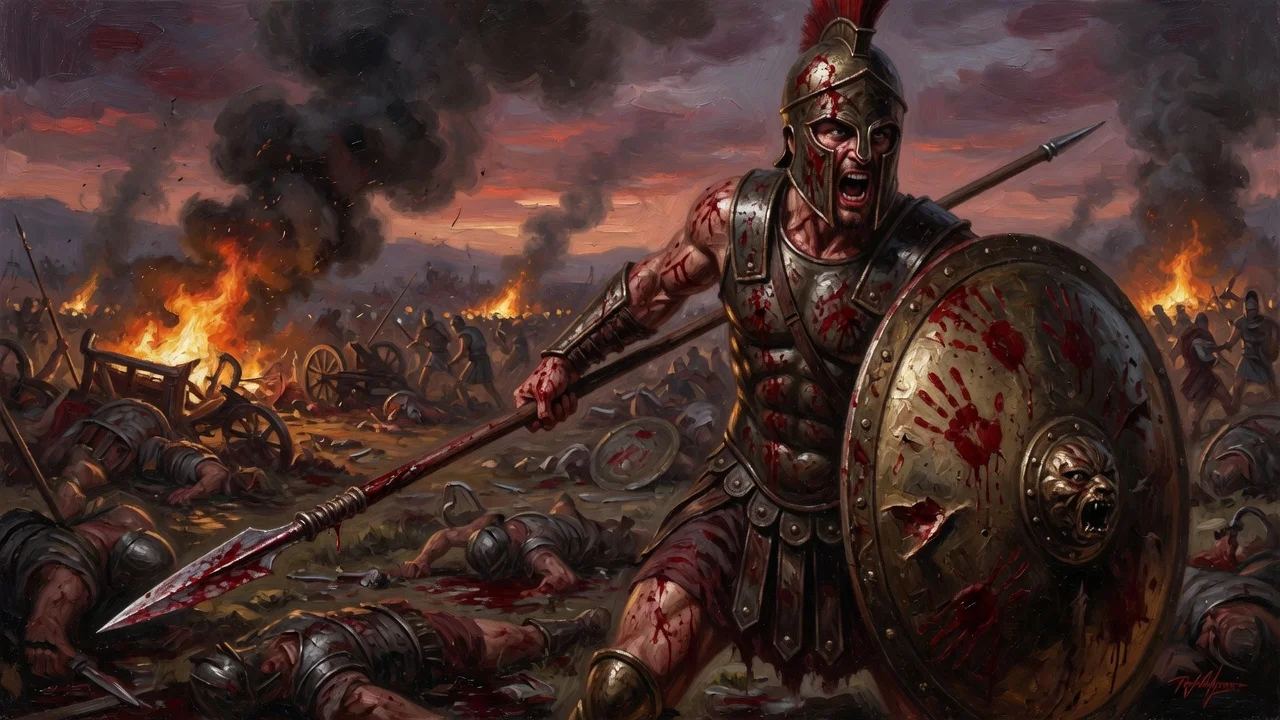
In Homer's Iliad, Zeus himself looks on his son and says plainly that of all the gods on Olympus, Ares is the most hateful to him — a god in love with strife and killing for its own sake. Where Athena's warfare was discipline and just cause, Ares was the chaos of combat: the panic, the bloodlust, the meaningless carnage. Even his own father could not stand him.
War as Slaughter, Not Strategy
This split between Ares and Athena is one of the sharpest ideas in Greek myth. Two gods of war — but they could not be more opposed. Athena wins; Ares merely rages. In their myths Athena repeatedly bests him on the battlefield, wisdom triumphing over fury. The Greeks were telling themselves a truth they had learned the hard way: that the warrior who only knows how to kill will always fall to the one who knows why and when.
The Affair and the Net
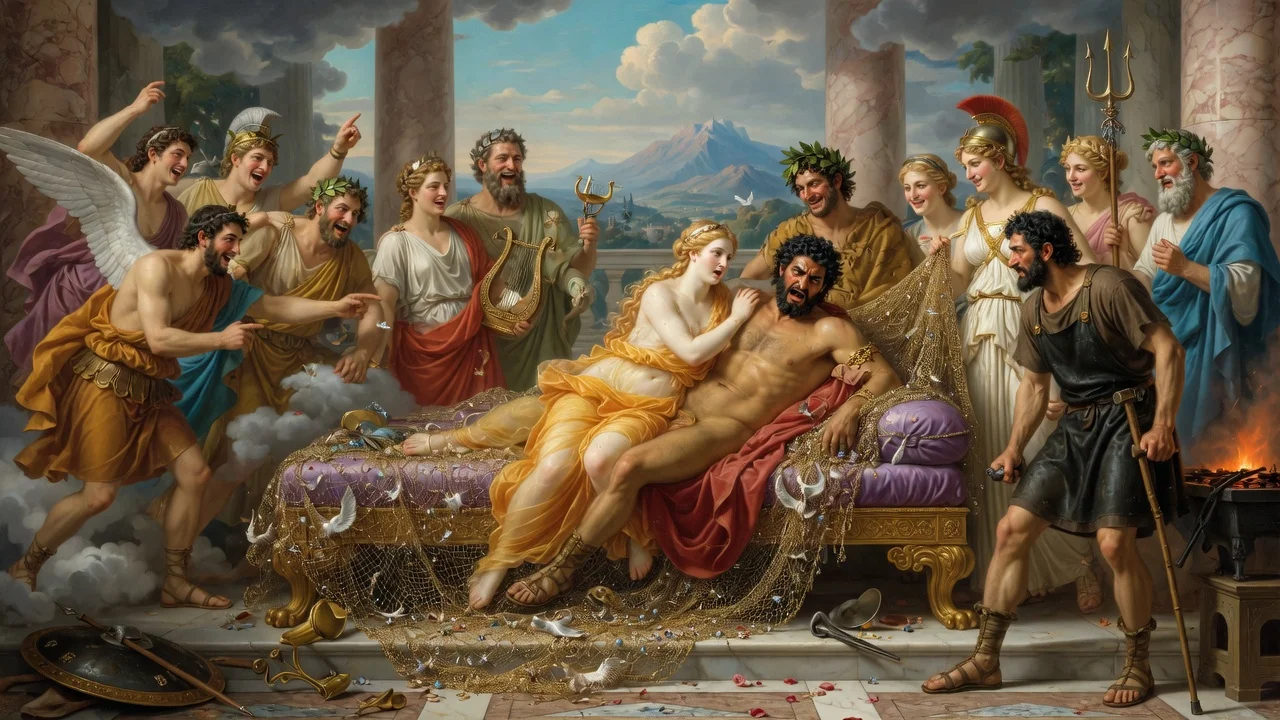
Ares' great myth is not a battle but a scandal. He took Aphrodite, goddess of love and wife of the smith-god Hephaestus, as his lover. The cuckolded Hephaestus forged a net of unbreakable, invisible chains, trapped the two lovers in bed, and hauled them before the assembled gods to be laughed at. The god of war, undone not by an enemy but by a clever craftsman and his own appetite.
The Children of Fear
From his union with Aphrodite came fitting offspring: Phobos (Fear) and Deimos (Terror), who rode before him into battle — but also Harmonia (Harmony), as if to whisper that even from violence and desire, peace can sometimes be born. It is the one redemptive note in the story of a god the Greeks loved to hate.
Two moons of the red planet Mars — the Roman Ares — carry the names of his sons to this day: Phobos and Deimos, Fear and Terror, still circling the god of war.
A God the Poets Kept Sending North
The name is older than the Iliad. It surfaces in the syllabic script called Linear B, pressed into wet clay in Bronze Age palaces centuries before Homer — though the war god those tablets name most clearly is e-nu-wa-ri-jo, Enyalios, a title later Greek poets would use as another word for Ares himself. What the earliest evidence hands us is not a portrait but a name, and an argument about whose name it is.
And when the poets do give him an address, they point away from Greece. Homer's Ares comes down to battle out of Thrace, the rough horse-country north of the Greek world; in the Odyssey, the moment Hephaestus' net lets him go, it is to Thrace that he bolts. A war god whose own storytellers keep gesturing past the border when asked where he truly belongs is a god who was never entirely made welcome in the family he was born into.
A War God With Almost No Altars
For all his rank as an Olympian, Ares received strikingly little worship. He held no sanctuary of Panhellenic importance anywhere in Greece, and the temple that now carries his name in the Athenian Agora was never built for him: it was raised in the fifth century BC at Pallene, out in the Attic countryside, for Athena. Only under Augustus was it taken apart block by block, rebuilt in the heart of the Agora, and rededicated to Ares — centuries after the myths themselves had set. His grandest address in Athens is a hand-me-down.
Sparta is usually offered as the exception, and the truth is stranger than the shorthand. Pausanias records that Spartan youths sacrificed puppies by night at a place outside the city called the Phoibaion — the bravest of the tame animals for the bravest of the gods — and that Sparta kept an ancient image of that god bound in fetters, not as punishment but as insurance: a war god in irons cannot desert the city. Yet the rites belonged to Enyalios, whom the Greeks sometimes merged with Ares and sometimes kept firmly apart, and Sparta's great festivals ran to Apollo, to Artemis Orthia, to the Dioscuri. Even the most militarised city in Greece did not build its religion around the god of war.
The Hill Named for His Trial
Athens does carry one permanent mark of Ares, and it has nothing to do with a temple. When his daughter Alcippe was raped by Halirrhothius, a son of Poseidon, Ares killed him where he stood, and Poseidon demanded that the gods judge the killing. They tried him on the bare rock northwest of the Acropolis that looks down over the marketplace, heard Alcippe confirm her father's account, and acquitted him. The hill kept the name it earned that day: the Areopagus, “the crag of Ares,” which went on to house the homicide court of historical Athens for centuries afterward. The city that would not build him a temple gave his name to its gravest tribunal.
Thirteen Months in a Bronze Jar
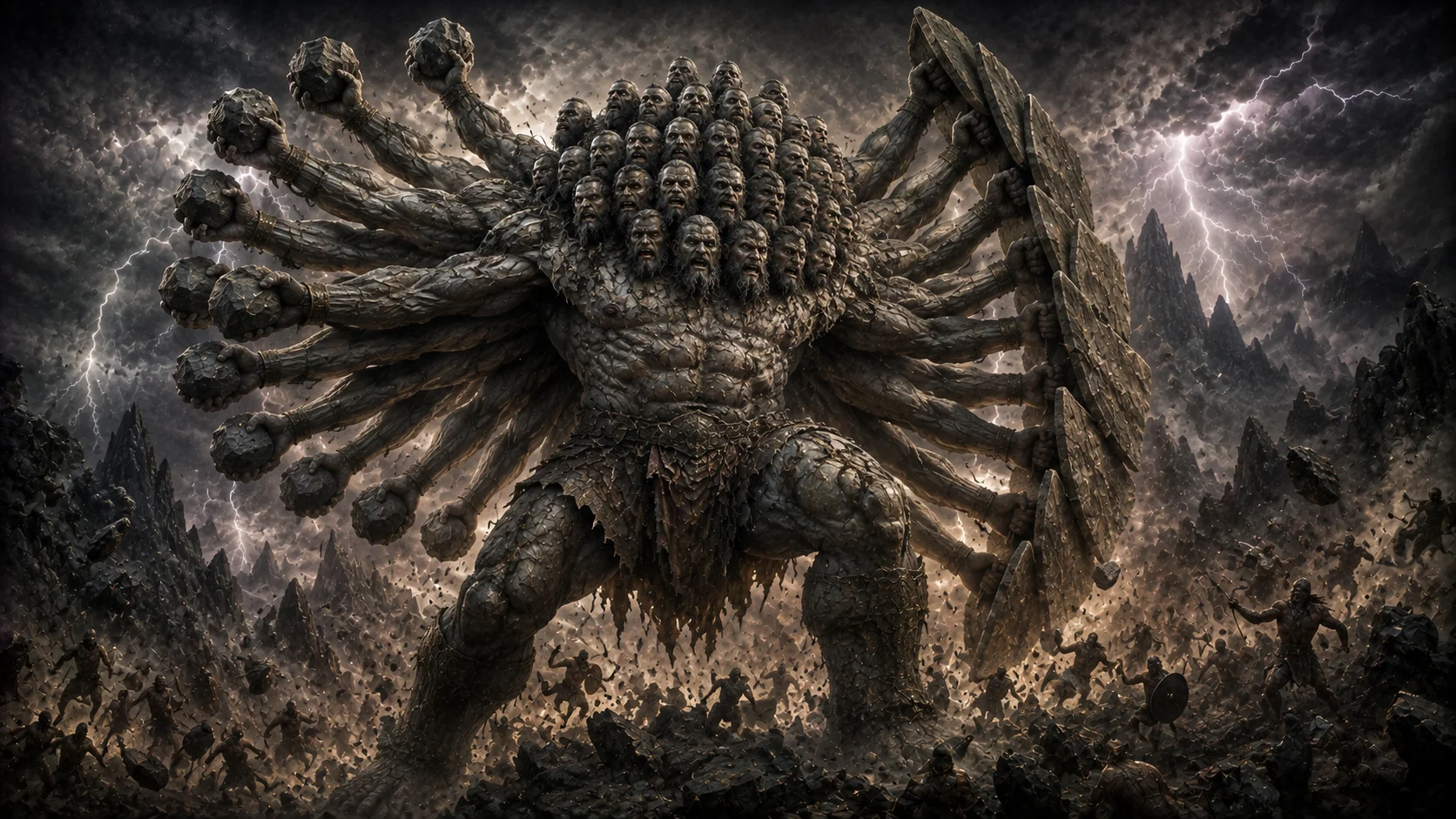
The Iliad preserves a humiliation stranger than any of his defeats, and it arrives as a consolation. Aphrodite has been wounded and is weeping; her mother Dione soothes her by listing the indignities other gods have swallowed. Otus and Ephialtes — giant twins fathered by Poseidon, who by the Odyssey's account grew a fathom taller every year and schemed to stack mountain on mountain and climb into heaven — once caught Ares and sealed him inside a bronze jar. He stayed in it thirteen months, and Homer says he would have wasted away there had the twins' stepmother Eriboea not got word to Hermes, who stole him out. The personification of unstoppable violence, corked in a storage jar for over a year, is one of Greek myth's driest jokes at a god's expense.
What Ran in His Veins
Later in that same book, Diomedes drives a spear into Ares with Athena leaning on the shaft, and the god pulls the wound open to show it: what runs out is ambroton haima, immortal blood. A few hundred lines earlier, wounding Aphrodite, Homer had stopped to name the substance and explain it — ichor, the fluid of the blessed gods, who eat no bread and drink no wine and are therefore bloodless, and are therefore called immortal. It is one of the clearest statements Greek poetry ever made about what divides god from mortal, and the difference is not invulnerability. Ares can be hurt. He bellows at the shock of it with the voice of nine or ten thousand men, and Achaeans and Trojans alike stand shaking. He simply cannot die of it — even bleeding, he could not bleed like the soldiers who feared him most and prayed to him least.
The Dragon of Thebes and the Debt Cadmus Paid
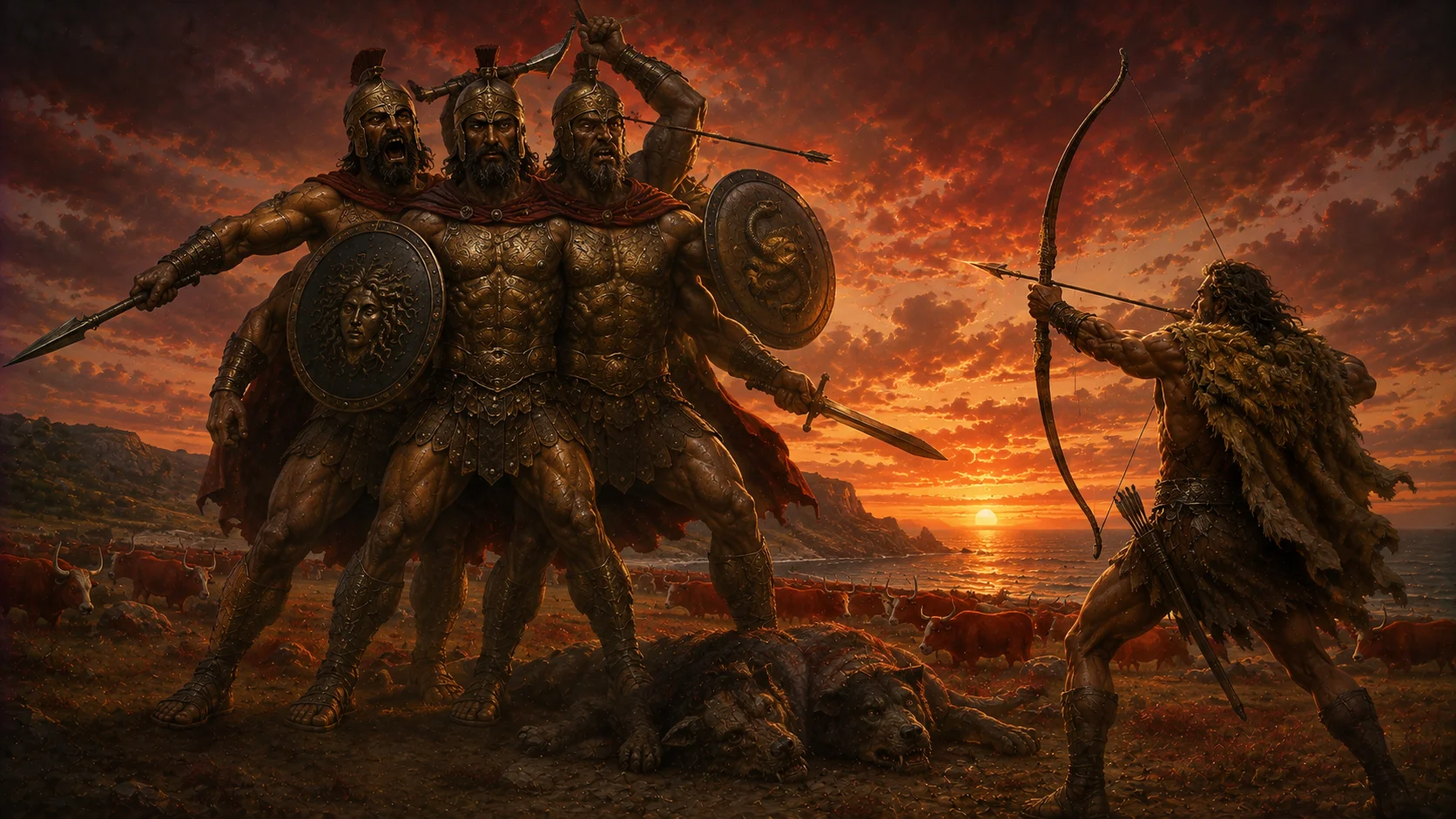
Before Thebes had walls, the spring on the site was guarded by a serpent sacred to Ares, and fathered by him in most tellings. Cadmus, the Phoenician prince sent to found a city there, killed it to reach the water, then sowed its teeth on Athena's advice; armed men, the Spartoi, came up out of the furrows and cut one another down until five were left, and those five became the ancestors of Thebes' oldest houses. Killing something sacred to Ares carried a price. Apollodorus has Cadmus serve the war god as a bondsman for what he calls an everlasting year — eight years by ordinary reckoning. Only when the servitude ended did Athena grant him the kingship and Zeus give him a bride: Harmonia, Ares' own daughter, at the wedding Diodorus calls the first the gods themselves laid the feast for. The Theban royal line, and every tragedy that grew out of it, opens with a debt owed to Ares.
Daughters of the War God
One people in Greek tradition genuinely revered Ares rather than merely flinching from him — and tradition placed them safely outside the Greek world. The Amazons of the Thermodon, on the Black Sea coast of what is now northern Turkey, were called his descendants, and their queen Hippolyta was his daughter. The war-belt she wore as the token of her supremacy was a gift from her father; Heracles was sent to take it from her, and that errand became his ninth labour. It is one of the few corners of myth where Ares' influence reaches past a single battlefield scene into an entire society organised around the thing he elsewhere only unleashes.
Mars: The War God Rome Actually Loved
Cross into Roman religion and the contrast could hardly be sharper. Mars began as an Italic god of the fields and their boundaries — Cato preserves a farmer's prayer to Father Mars, asking him to keep disease and bad weather off the crops, spoken while a pig, a sheep and a bull were walked around the land — and he stood in the oldest Roman triad beside Jupiter and Quirinus, second only to Jupiter himself. Rome claimed literal descent from him: Mars fathered Romulus and Remus on the priestess Rhea Silvia, which made the god of war the ancestor of the Roman people rather than an embarrassment to be managed. His month, March, opened the old year and the campaigning season together, and his priests the Salii danced through the city in armour beating the twelve sacred shields, the ancilia, one of which Rome counted among the pledges of its own sovereignty. When Rome took the Greek stories wholesale, Mars inherited the scandal with Venus as well — and Roman art turned it into an elegant thing worth painting on a wall, the same story wearing a completely different expression depending on which city was telling it.
Knowing Him When You See Him
Archaic and Classical vase painters gave Ares no attribute of his own: a bearded man in hoplite armour, helmet and spear and shield, identifiable only by an inscription or by whoever is standing beside him. Later sculpture went the other way entirely and made him a beardless, idealised nude. The seated Ludovisi Ares, a Roman marble after a fourth-century BC original, rests on a heap of armour with a small Eros playing at his feet — the god of war caught off duty and turned into an object of desire. The standing figure known as the Ares Borghese is the other famous type, though scholars are not certain the statue is Ares at all. The dog and the vulture were counted among his creatures, and Homer gives him the retinue you would expect: in the Iliad he orders Deimos and Phobos to yoke his chariot horses for him.
Why He Kept His Grip on the Stories
Add it up and the pattern is peculiar. No great sanctuary, a borrowed temple, rites that may not even have been his — and set against that, a hill in Athens carrying his name, a month at the head of the Roman year, a Theban dynasty founded on a debt to him, and a nation of warriors claiming him as father. Ares was not a god the Greeks wanted to petition. He was a god they could not stop accounting for, which is what happens when a people invent a figure to hold the part of war they cannot admire, and then find how much of their own history has to be explained through him.
Sources & traditions
- EncyclopediaWikipedia — Ares
- TraditionGreek texts, inscriptions and later retellings (Greece)
Myths change from area to area and from time to time. This chronicle follows the most widely told versions; tellings in other villages, regions and eras may differ.