No god in the Greek pantheon was more dangerous than the goddess of love — and the Greeks knew it. Aphrodite ruled desire, and desire, they understood, is a force that topples kings, starts wars, and humbles even the gods. To call her merely the goddess of beauty is to miss the terror in her: she could make anyone, mortal or immortal, want something badly enough to destroy themselves for it.
Born from the Foam
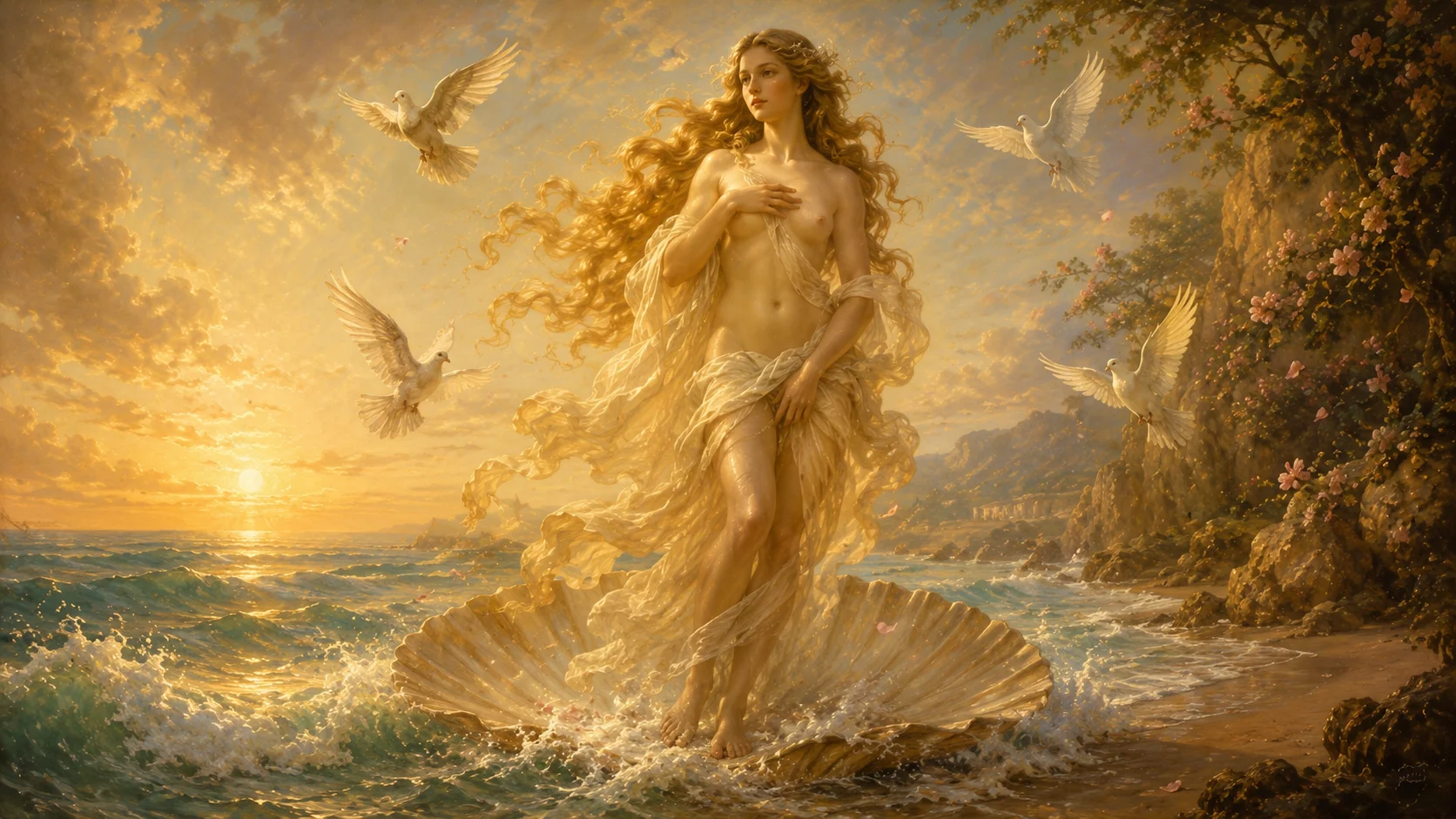
Her birth is one of the strangest and oldest in Greek myth. When the Titan Cronus castrated his father Uranus and cast the severed flesh into the sea, the waters foamed white — and from that foam rose Aphrodite, fully grown and impossibly beautiful, drifting ashore on a shell at Cyprus. She was born not of a mother's love but of a primal, violent act of the cosmos itself, which is perhaps why the desire she governs is never quite safe.

The Power No God Could Resist
Aphrodite wore a magic girdle, the cestus, that made its wearer irresistible — but she scarcely needed it. Her power compelled even Zeus to fall for mortal women; only three goddesses, the virgins Athena, Artemis and Hestia, were immune to her. To everyone else, gods included, she was an irresistible force.
The Apple and the War
Her most fateful act began with a single golden apple inscribed “to the fairest.” When Aphrodite, Hera and Athena each claimed it, the mortal prince Paris was made to judge. Aphrodite won by bribing him with the most beautiful woman in the world — Helen — who was already married to a Greek king. Paris took her to Troy, and so the goddess of love lit the spark of the Trojan War, ten years of slaughter born from a promise of desire.
Loves and Griefs
Married unwillingly to the smith-god Hephaestus, she took the war-god Ares as her lover. She loved the beautiful mortal Adonis and mourned him bitterly when a boar killed him, raising the blood-red anemone from his blood. Aphrodite's myths circle one truth the Greeks held close: love is the most beautiful of all powers, and the most ungovernable.
The morning star and the evening star both bore her name — for desire, like Venus, is the first light to rise and the last to fade.
A Goddess Borrowed from the East
Long before Homer sang of her, a goddess who looked remarkably like Aphrodite was already being worshipped on the Levantine coast — and the Greeks themselves seem to have known it. The historian Herodotus reports that the oldest sanctuary of “Heavenly Aphrodite” anywhere in the world stood not in Greece but at Ascalon, in Syria; the Cypriots, he says, admitted that their own famous temple had been founded from it, and the shrine on Cythera was built by Phoenicians out of that same coast. Cyprus and Cythera — the two islands her myth keeps returning to — both sat on the trade routes running from the Levant into the Aegean, which may be why a goddess of desire came ashore there first. Greek writers routinely recognised the Levantine Astarte as their own Aphrodite, and Astarte's Mesopotamian counterpart Ishtar had the same unsettling double nature: a goddess of love who was equally a goddess of war, with none of the tidy modesty later ages wanted from her.
Two Poets, Two Mothers
Even the Greeks could not agree on her parentage. Hesiod's foam-birth was never the only story: in the Iliad, Homer makes her the daughter of Zeus and a shadowy goddess named Dione, whose name is simply the feminine form of Zeus's own. When Diomedes wounds Aphrodite on the battlefield at Troy, it is Dione she flees to, and it is in her mother's lap that the goddess of love sits weeping while the other Olympians mock her. Two of the most authoritative poets in the Greek canon could not settle where their goddess had come from — a fitting uncertainty for a power nobody could fully explain.
A Sparrow-Drawn Prayer
Most of what survives about Aphrodite is myth told at a distance — kings, wars, the fates of heroes. One poem instead speaks to her directly, the way one speaks to a friend. In the only poem of hers that survives complete, Sappho of Lesbos calls the goddess by name and asks her, as she has come before, to leave her father's golden house and drive down in her chariot — yoked, in Sappho's image, to swift sparrows whirling their wings above the dark earth — and to ask, half smiling, who has wronged the poet this time. What Sappho wants is precise: let the girl who flees soon give chase, and the one who refuses gifts soon offer them. Where the epic poets show Aphrodite bending the fates of nations, Sappho shows her doing the smaller and far more universal thing she was actually prayed to for — fixing one particular broken heart.
Heavenly Love and Common Love
Greek thought eventually split the goddess in two. In Plato's Symposium, the speaker Pausanias distinguishes Aphrodite Ourania — “Heavenly” Aphrodite, the elder, born of Uranus with no mother at all, patroness of a love aimed at the soul — from Aphrodite Pandemos, “Common” Aphrodite, the younger daughter of Zeus and Dione, who governs the ordinary bodily desire of ordinary people. It was a philosopher's tidy solution to an untidy problem: how could one goddess preside over both a marriage vow and a moment's lust? Both titles belonged to genuine cult, with real altars in Athens and elsewhere — though in worship Pandemos seems to have meant something closer to “of all the people,” the goddess of the whole community, rather than anything sordid. It is the philosophers' reading that stuck.
The Stone at Paphos and the Price of Corinth
At Paphos on Cyprus stood her oldest and most sacred house, named already in the Odyssey, where Aphrodite withdraws to her own precinct and fragrant altar. The Roman historian Tacitus, describing the shrine as it still stood in his own era, records an image utterly unlike the beautiful statues familiar from later art: not a human figure at all, but a continuous rounded stone, broad at the base and tapering upward like a cone — and he admits nobody could say why. No blood was permitted on the altar; the priesthood passed down within particular families; the omens were read in the entrails of the victims; and although the altar stood open to the sky, Tacitus writes, no rain ever wet it. The ancient world's holiest image of the goddess of loveliness was, for centuries, a stone nobody would have called beautiful.
Corinth's temple took the opposite road to fame. The geographer Strabo claims the sanctuary once held more than a thousand consecrated women, dedicated to the goddess by worshippers of both sexes, and credits them with the city's wealth and its reputation for expensive pleasure — hence the proverb that the voyage to Corinth was not one every man could afford. Whether the practice was quite what Strabo imagined is doubted. But the story he chose to tell is true to how the Greeks thought about Aphrodite's power: it was never separated from money, status, and the games cities played with both.
Children Born of Love and War
Her affair with Ares produced offspring as unsettling as the pairing itself. Hesiod names their children as Phobos and Deimos — Fear and Terror, who ride at their father's side and break apart the close ranks of men — and, strangest of all, Harmonia, goddess of concord, born of the two forces that most threaten it. Harmonia married Cadmus and became ancestress of the royal house of Thebes, a line that afterwards produced almost nothing but catastrophe. In the tradition most familiar today, though not in Hesiod's own account, this same pairing also produced Eros: desire recast as the child of love and violence together, rather than the primordial force Hesiod had made him.
Her most consequential child, though, was mortal. The Homeric Hymn to Aphrodite tells how Zeus, tired of watching her make gods fall for humans, turned that same helpless desire back on her: she fell for the Trojan herdsman-prince Anchises. Disguised as a mortal princess, she came to him on Mount Ida, then revealed what she was and warned him never to boast of it — if he named her, Zeus would strike him with a smoking thunderbolt. Their son was Aeneas, who in Roman telling carried his father out of the burning city and founded the line that led to Romulus. It is why Julius Caesar's own family claimed descent from Venus: Aphrodite's one great mortal love affair became Rome's founding myth.
The Net That Caught Two Gods
The Odyssey preserves the cruellest joke ever played on the goddess of love, sung by the bard Demodocus at a Phaeacian feast. When the sun-god Helios reported her affair with Ares to her husband Hephaestus, the smith said nothing — he simply forged bonds finer than a spider's web, invisible and unbreakable, and rigged them above his own marriage bed. The lovers were caught mid-embrace, unable to move, while Hephaestus called the gods to come and look. They came — the goddesses, Homer notes, stayed away out of shame — and they laughed; and when Apollo asked Hermes whether he would change places with Ares, Hermes answered that he would gladly bear three times the chains, with every god and goddess watching besides. It is Aphrodite at her most human: caught, humiliated, and still, even the gods conceded, worth it.
The Sculptor's Prayer
Not every story about her ends in disaster. On her own island of Cyprus, the Roman poet Ovid tells of a sculptor named Pygmalion, so disgusted by the women around him that he carved himself an ivory one instead — and fell in love with what he had made. At the goddess's festival he prayed, not quite daring to ask outright, for a bride like his ivory maiden. When he came home and kissed her, the ivory warmed under his mouth. Aphrodite had granted, without being asked directly, exactly what he wanted rather than what he had said aloud. The same power that burned Troy could also, quietly, hand a lonely man the one thing he wished for.
Knowing Her in Art
Long before Botticelli painted her drifting ashore on a scallop shell, Greek and Roman artists had fixed her attributes: the dove, and the sparrow that draws Sappho's chariot; the myrtle, woven into wreaths for weddings; the rose, bound to her in poetry from antiquity onward. The mirror, which Roman and later European painters made her signature prop, is not quite vanity — it is a recognition that beauty, for Aphrodite, was never separable from the act of being looked at. And when Renaissance philosophers rediscovered Plato's two Aphrodites, they read Ourania, the Heavenly one, as an allegory of divine love itself.
That last move is the whole afterlife of the goddess in miniature. Every age took the Aphrodite it could use — the Levantine goddess the Greeks recognised as their own, Sappho's confidante, Plato's ladder to the soul, Rome's imperial ancestress, the Renaissance's emblem of heavenly love — and each time, the parts that did not fit were quietly left out. She has outlasted her own temples by two thousand years for precisely that reason: she is the one Olympian nobody has ever finished rewriting.
Sources & traditions
- EncyclopediaWikipedia — Aphrodite
- TraditionGreek texts, inscriptions and later retellings (Greece)
Myths change from area to area and from time to time. This chronicle follows the most widely told versions; tellings in other villages, regions and eras may differ.