On a mountain of gods who prized beauty and perfection above all, Hephaestus was the outsider: lame, cast out, ugly by Olympian standards — and the only one of them who actually made anything. God of fire, the forge and craftsmanship, he was the divine artisan whose hands shaped the wonders the other gods merely wielded. His is the myth of the maker rejected by those who cannot live without what he makes.
The God Cast Down
Accounts differ, but all agree he fell. In one, his mother Hera, disgusted that her son was born deformed, hurled him from Olympus into the sea. In another, Zeus flung him down for taking Hera's side in a quarrel — and he fell for a whole day before crashing to earth, lamed forever. The rejected child of heaven landed among mortals and the sea-nymphs who raised him, and there he learned to build.
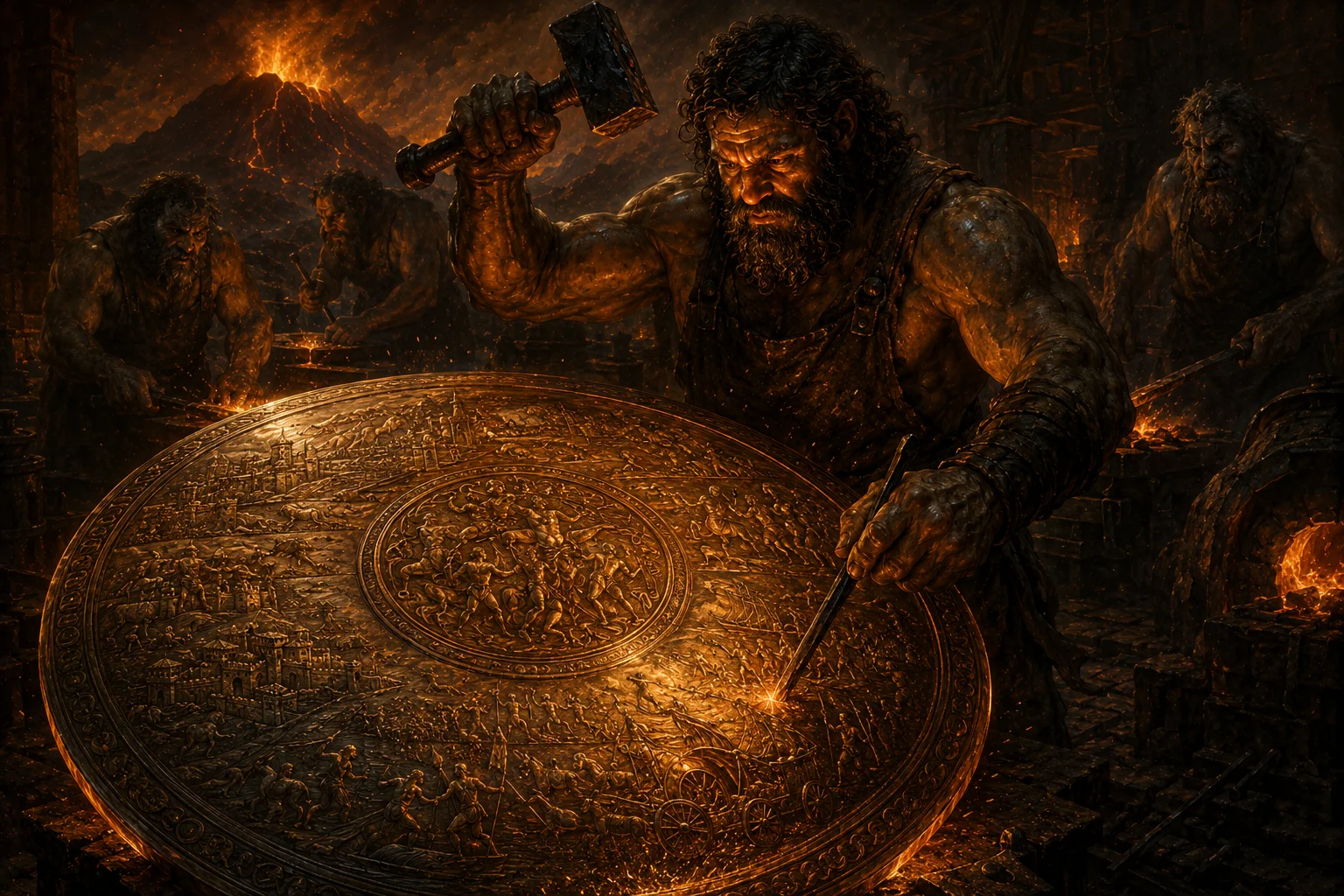
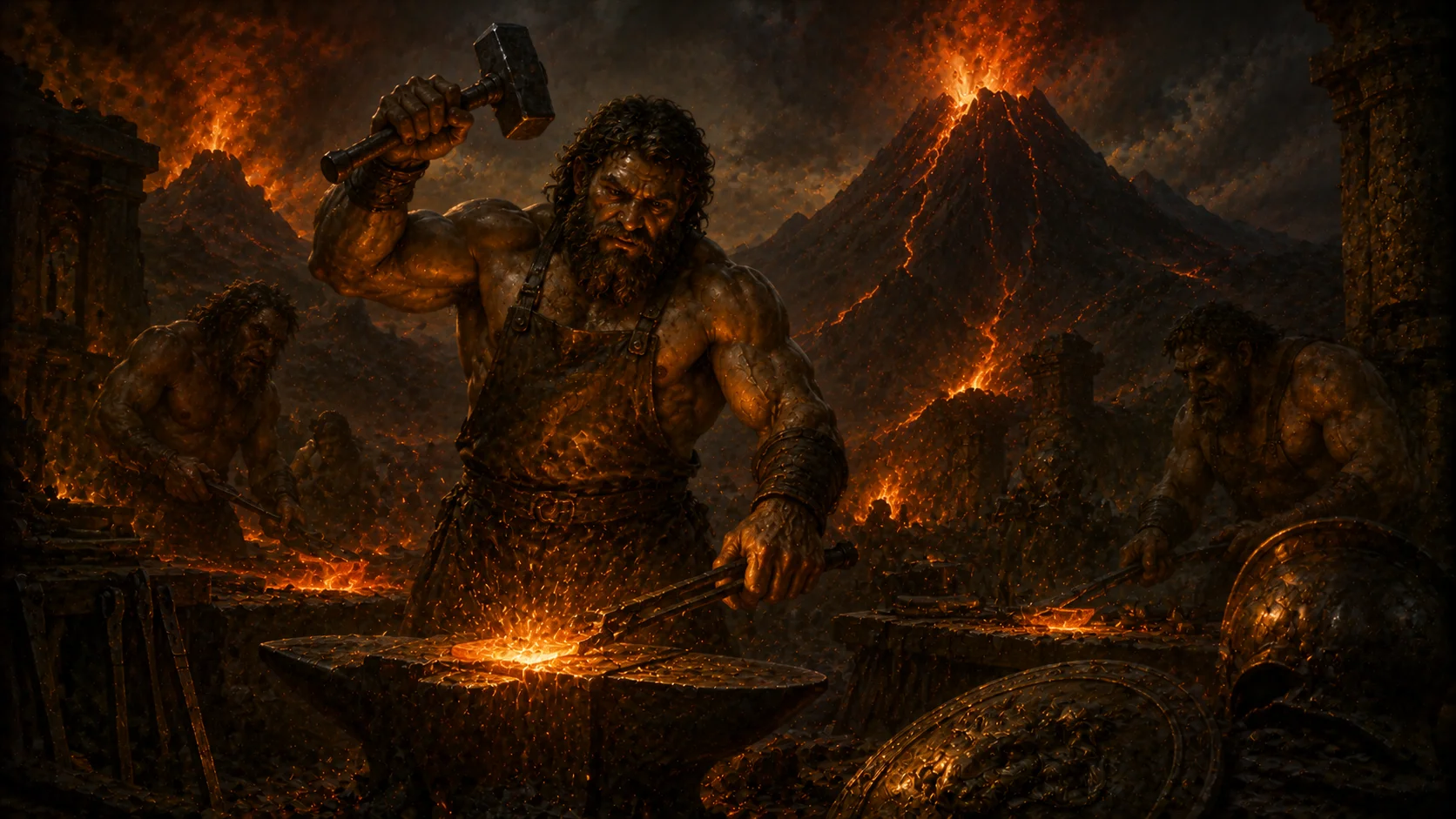
The Forge Beneath the Volcano
Hephaestus set his workshop beneath the earth, his forge-fires the source of every volcano's heat. There, with the Cyclopes as his assistants, he laboured at an anvil no other god would deign to touch — and produced marvels none of them could rival.
The Maker of Wonders
Nearly every legendary object of Greek myth came from his hands: Zeus's sceptre and aegis, the thunderbolts themselves, the armour and shield of Achilles, the chains that bound Prometheus, the bronze giant Talos, and golden mechanical servants that could move and think — the ancient world's dream of the robot. At the gods' command he even shaped the first woman, Pandora, out of clay. The Olympians despised his form and depended utterly on his genius.
The Cuckold's Revenge
Given the beautiful Aphrodite as wife, Hephaestus was inevitably betrayed — she took the war-god Ares as her lover. But the lame smith had the last laugh: he forged a net of invisible, unbreakable chains, caught the lovers in the act, and dragged them before the assembled gods to be mocked. The despised craftsman outwitting the beautiful and the strong — it is the revenge of every maker the world overlooks.
When the mountains smoke and the earth's fire breaks the surface, the old Greeks said, the lame god is at his anvil still — making the things the beautiful cannot.
Born of One Parent, in Spite
Hesiod tells the birth differently from Homer, and the difference matters. In the Theogony, Zeus brings Athena out of his own head with no mother involved at all; Hera, furious at being cut out of the act of creation, answers in kind and bears Hephaestus alone, without lying with any husband. It is a strange origin for the god who exists to make things — he begins as a rebuttal, a child conceived to settle an argument. The Iliad knows nothing of this and calls him plainly the son of Zeus and Hera. Both versions leave the same uncomfortable fact standing, and the Greeks never smoothed it away: the craftsman of Olympus arrives in the middle of his parents' quarrel, and the myths never quite let him out of it.
The Throne That Held Its Maker's Grudge
Cast out and mocked, Hephaestus did not rage — he built a gift. He sent Hera a golden throne, finely wrought, and when she sat in it invisible fetters closed on her and would not open. No god on Olympus could work them loose, because none of them understood the mechanism; only its maker did, and he had no intention of coming back to explain. The council sent Ares first, on the theory that force would achieve what asking had not, and the war-god was driven off with firebrands. It took Dionysus — patient, talkative, and willing to sit down and drink — to get the smith comprehensively drunk and walk him home on the back of a mule. Only once he was restored to the household that had thrown him out did Hephaestus release his mother. Greek vase-painters could not leave the scene alone: the lame god slumped on his mule, the wine-god and his revellers steering him back up the mountain he had fallen down.
Seed on the Earth: The Birth of Erichthonius
One of the ugliest stories told about him is also one of the most consequential. Athena came to the forge on an errand — for weapons, in the version Apollodorus preserves — and Hephaestus, seized by desire, tried to force himself on her. She broke away, and his seed fell instead on the ground. The earth conceived from it and bore Erichthonius, snake-limbed in some tellings and wholly a boy in others. Athena, unwilling to abandon a child that was in some sense hers by accident if not by choice, hid him in a chest, raised him in secret, and made him in the end a king of Athens. The Athenians then built their entire civic self-image on that soil-born boy: they were autochthonous, sprung from the ground of Attica rather than arrived there from anywhere else, and their proof of it was a child the earth produced when a god missed his aim. It is a national origin story that flatters nobody in it — which is a reasonable argument that they did not invent it to flatter themselves.
Lemnos, Where the Smith Came Down
The accounts of his fall disagree, and the striking part is that both of the disagreeing versions are Homer's, inside a single poem. In the first book of the Iliad Hephaestus remembers Zeus catching him by the foot and flinging him from the threshold of heaven; he struck Lemnos with barely any life left in him, and the island's people, the Sintians, took him in. In the eighteenth book he tells it the other way, blaming his mother, and it is sea-goddesses who catch him. Greek myth was never a single authorised text, and here the seam runs straight through one work.
Lemnos, at any rate, never let the claim go. The island kept a mystery cult of the Cabeiri, minor smith-gods whom one genealogy traces to Hephaestus through a Lemnian nymph named Cabeiro, and its principal city was called Hephaestia outright. It earned the association physically as well: ancient writers describe fire breaking out from Mount Mosychlos, and the rock of Lemnos carries the burnt, glassy look of old volcanic ground. A fire-god living there was less a poetic flourish than an explanation.
The Forge in the Agora
Walk into the Ancient Agora of Athens today and the best-preserved Greek temple anywhere in the world still stands on the low hill above it. For a long time it was called the Theseion, on the strength of the Theseus scenes carved around its metopes; it is in fact the fifth-century temple of Hephaestus, and Pausanias records that it held bronze cult statues of two gods rather than one — Hephaestus and Athena together, both by the sculptor Alkamenes. Excavation confirmed the identification in the most fitting way available: the ground around the hill proved to be full of metalworking debris. The city's smiths and foundrymen had their shops at the foot of the temple, close enough that the arrangement reads less like worship at a distance than a trade living next door to its patron. Once a year, at the Chalkeia, the craftsmen kept a holiday shared between Hephaestus and Athena Ergane — Athena “the Worker” — and it was on that same day that the priestesses set up the loom and began weaving the great robe that would be carried to Athena nine months later at the Panathenaea. The bronze-workers' festival and the city's most sacred piece of cloth began on the same morning.
How to Know Him: Tongs, Cap and Mule
On a painted vase Hephaestus is almost never idealised the way his half-siblings are. He wears the exomis, the short workman's tunic pinned to leave one shoulder and arm bare for labour at the anvil, and the pointed felt cap of an ordinary workman, the pilos, rather than anything resembling a crown. Tongs and a hammer identify him from across a room. A twisted or backward-turned foot, or a stick to lean on, marks the lameness the other gods never let him forget. And in the one myth the painters returned to again and again he arrives not by chariot but astride a mule, drunk and swaying. It is close to the least dignified mount available to a god, and they chose it for him over and over, because it was the truest picture they had of him: power that comes in on bad legs and gets there anyway.
Vulcan's Fire Is Not Hephaestus's Fire
Rome did not simply rename him. Vulcan was an old Italic god of fire in its destructive, uncontrolled form long before any Roman had heard of a Greek smith on Olympus, and his festival was not a craftsmen's holiday at all. At the Volcanalia on 23 August — the hottest, driest, most flammable point of the Italian year — live fish taken from the Tiber were thrown onto bonfires. Varro says they went into the flames pro se, on one's own behalf; Festus puts it without euphemism, in place of human lives. The fire was handed something living so that it would not come and take something living. Only later did Vulcan acquire Hephaestus's forge, his Cyclopes and his beautiful, unfaithful wife — a craftsman's mythology layered over an older fear of fire running loose in a city built largely of wood. The Greeks had already made a comparable identification well beyond their own borders: walking through Memphis, Herodotus simply calls the god of its great temple Hephaestus. The Egyptians knew that god as Ptah, creator and patron of craftsmen — a different deity in a different rite, whom a Greek recognised on sight. Wherever metal was worked over an open flame, someone eventually needed a god to account for the skill, and to settle whether fire was a gift or a threat.
The God Who Let Them Laugh
There is a scene early in the Iliad that says more about Hephaestus than any inventory of his works. Zeus and Hera are quarrelling and the feast is about to come apart, so Hephaestus stands up, takes the wine, and goes limping around the hall pouring for everyone — work the poem elsewhere gives to Hebe, young and graceful and everything he is not. Unquenchable laughter breaks out among the gods at the sight of him bustling through the room. He has made himself the joke on purpose, and it works: the quarrel dissolves, the feast goes on all day. The only Olympian with a trade is also the only one who will absorb ridicule deliberately to hold a household together. That is not a small thing to notice about the god they least liked to look at.
Sources & traditions
- EncyclopediaWikipedia — Hephaestus
- TraditionGreek texts, inscriptions and later retellings (Greece)
Myths change from area to area and from time to time. This chronicle follows the most widely told versions; tellings in other villages, regions and eras may differ.