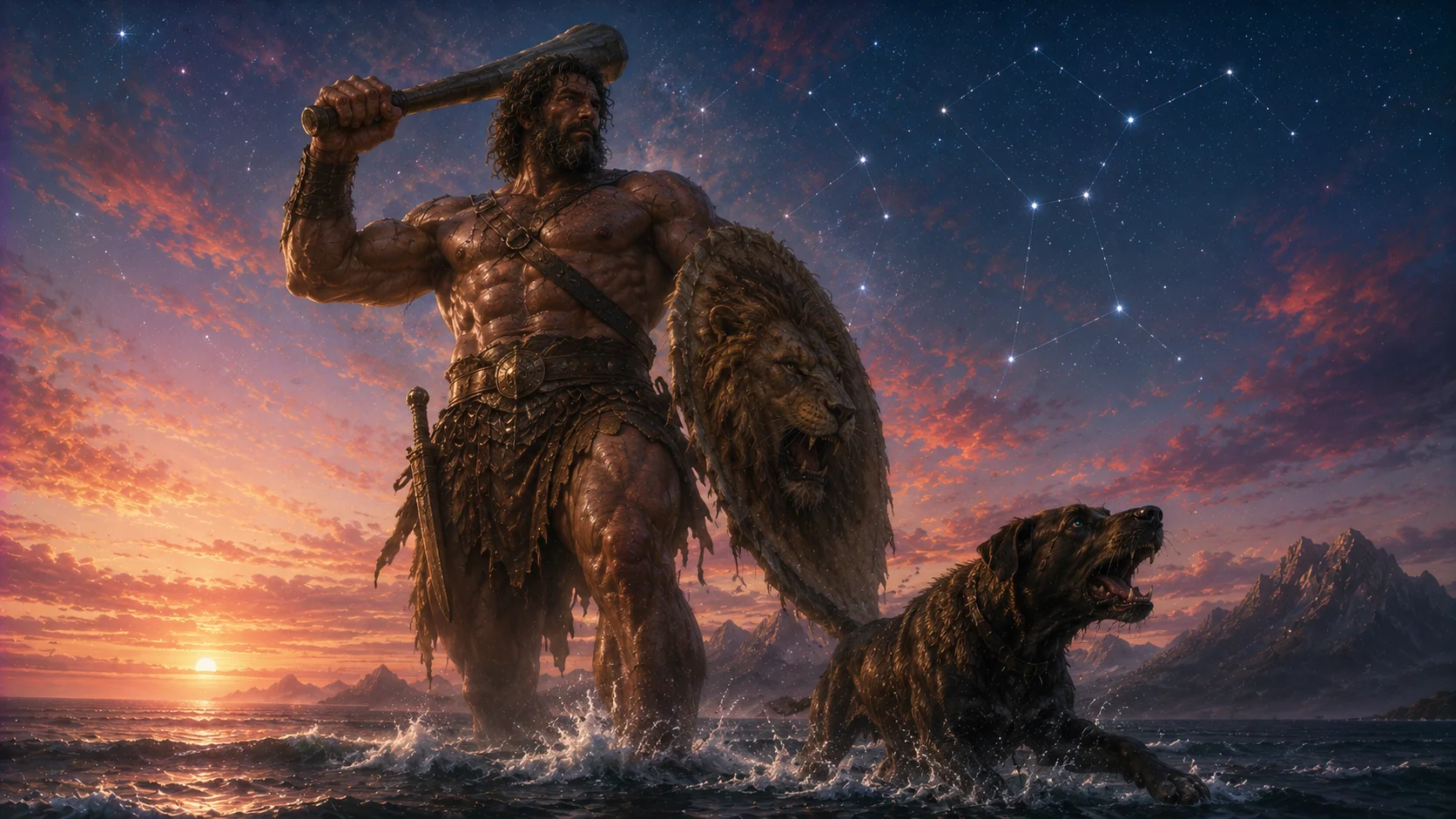
Orthrus was the two-headed hound — the lesser-known but no less monstrous brother of Cerberus — and one more of the great brood of monsters spawned by Typhon and Echidna. Where Cerberus guarded the gates of the dead, Orthrus guarded a herd of cattle at the edge of the world, and like so many monsters, his role in myth was to fall before the might of Heracles.
The Brother of Cerberus
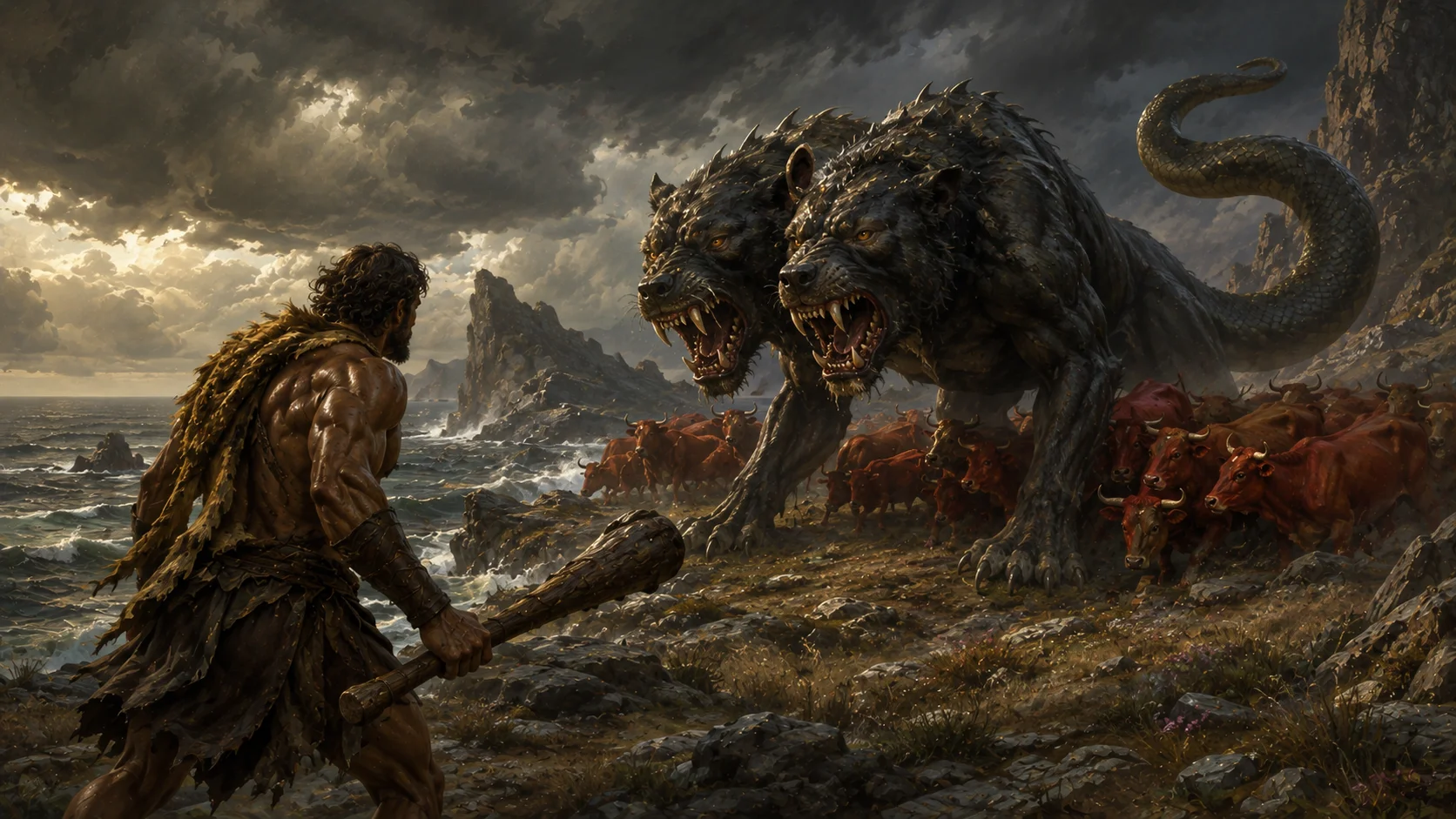
A child of the monster-parents Typhon and Echidna, Orthrus was a fearsome dog with two heads (and, some say, a serpent for a tail). He was brother to Cerberus, the Hydra, the Chimera and the rest of that terrible family — a true monster of the bloodline that produced nearly every great beast the heroes faced.
The Guardian of the Red Cattle
Orthrus belonged to the three-bodied giant Geryon, who lived on the far western island of Erytheia and possessed a magnificent herd of red cattle. Orthrus, together with the herdsman Eurytion, guarded these cattle — and they were exactly what Heracles was sent to capture as the tenth of his Twelve Labours.
The Tenth Labour
When Heracles came for the cattle, Orthrus charged him — and the hero killed the two-headed hound with a single blow of his great club, before going on to slay the herdsman and then Geryon himself. Orthrus' death was swift, a stepping-stone in a greater labour, but it cemented his place among the monstrous family whose destruction defined Greek heroism.
The Shadow of His Brother
Orthrus is forever in the shadow of his more famous three-headed brother, yet he is significant precisely as part of that pattern: the monstrous brood of Typhon and Echidna, set as guardians and obstacles across the world, each in turn falling to a hero. He is also said, in some accounts, to be the father (with Echidna) of the Sphinx and the Nemean Lion — making this two-headed dog a link in the very chain of monsters.
Two heads were not enough to stop Heracles — few things ever were.
What Hesiod Actually Wrote
Open the oldest surviving text that names him and you find something the later tradition quietly reversed. In Hesiod's Theogony, where the poet lists the brood that Echidna bore to Typhon, he counts them off in sequence — and Orthrus is first. Cerberus is only second. The Hydra is third. The Chimera comes later still. The dog now remembered as an afterthought to his brother is, in the earliest account we have, the firstborn of that whole monstrous line, introduced with the flat, functional epithet that would define him forever: the dog of Geryon.
And that is close to everything Hesiod gives him. No deeds, no epithet of dread, not even a count of his heads — the poet who cheerfully reports that Cerberus has fifty says nothing at all about Orthrus' second one, which enters the record only with much later mythographers. He is not given a life. He is given an owner.
Hesiod also spells him differently. The archaic form is Orthos; the longer Orthros, with its extra r, is what later authors preferred, and the two words mean quite different things in Greek. Orthos is "straight", "upright", "true" — the root behind orthodox and orthography. Orthros is the last darkness before sunrise, the hour before dawn. Nobody can now say which sense the name was built from, or whether the ancients themselves were sure. But the second reading has an uncomfortable elegance to it, because the dog named for daybreak stands guard at the far western edge of the world, where the sun goes down. A creature called Dawn, posted at the sunset.
The Line That Broke the Family Tree
Not twenty lines later, Hesiod does something that has kept editors arguing ever since. He says that she — and the Greek does not make clear which female of the preceding passage he means — was subject to Orthrus and bore two more monsters: the Sphinx, whom the poet calls by her older Boeotian name Phix, and the Nemean Lion.
The problem is the antecedent. The nearest candidate is the Chimera, which would make the mother Orthrus' own sister. The other candidate is Echidna, which would make her his mother. Greek genealogical poetry does not usually flinch at either, and the ambiguity has never been settled from the text alone. What the passage does establish is that this obscure guard dog sits at a genuine junction of the monster-lineage: two of the most consequential adversaries in all of Greek myth — the riddler who empties Thebes, and the beast whose hide becomes Heracles' armour — are traced back through him.
The name Phix is worth pausing on. Mount Phikion stood near Thebes, and it is the mountain the monster was said to sit upon; Sphinx, with its Greek echo of "strangler", looks like the later, tidied, panhellenic form. Hesiod, a Boeotian himself, used the name his neighbours used. It is one of the small places where the Theogony shows its seams — local monsters being stitched into a single family, and the dog of Geryon serving as the thread.
A Cattle Raid Older Than Greece
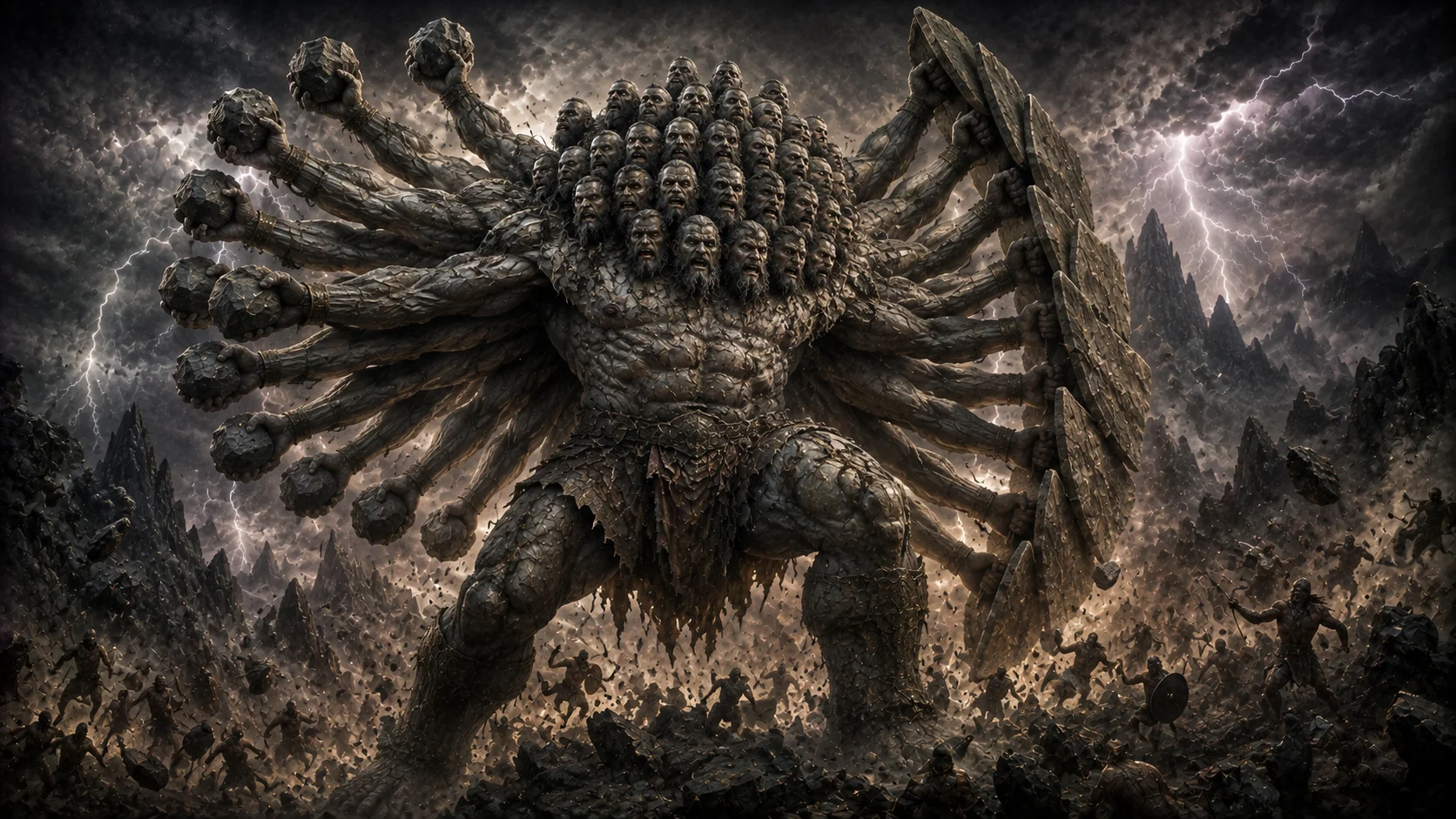
Strip the tenth Labour down to its bones and a very old shape emerges. A hero travels to a distant, otherworldly place. He confronts an adversary who is multiple — three-bodied, three-headed, or simply monstrous in number. He kills it and drives home a herd of cattle that the adversary had no right to hold.
That pattern is not only Greek. Comparative scholarship has long set Heracles and Geryon beside the Vedic story of Trita Āptya, who slays the three-headed Viśvarūpa and releases the cows, and beside the Roman tale of Hercules and the cave-thief Cacus. In a world where wealth walked on four legs, the recovery of stolen cattle from a monstrous holder was one of the stories a culture told about what a hero was for. Heracles is not adventuring in Erytheia. He is doing the oldest job in the repertoire.
Where Orthrus fits in that inheritance is genuinely uncertain — the guardian dog is not a fixed member of the pattern the way the multiple adversary and the cattle are. But it is worth noticing how many Indo-European traditions post dogs at the boundary of the other world, and how often they come in pairs. The Vedic god of the dead keeps two of them, broad-nosed and brindled, watching the road the dead must walk. Greece kept its pair too, and split them: one dog at the gate of the underworld, one at the edge of the sunset, and both of them brothers.
Erytheia: The Island at the End of the Light
Erytheia means the red place, and the herd it pastured was red. Ancient geographers did not treat it as pure fable: they placed it in the far west beyond the Pillars of Heracles, and increasingly identified it with an island at Gades — modern Cádiz, on the Atlantic coast of Spain, then a Phoenician city with a famous sanctuary of Melqart, whom the Greeks identified with Heracles himself.
That is the quiet, unromantic engine behind the myth's geography. As Greek and Phoenician ships pushed further west, the location of the world's edge kept moving with them, and the story moved too. Heracles' route to Geryon's cattle reads, in the later sources, rather like a sailing itinerary with monsters attached. To cross the encircling Ocean at all, Heracles must borrow the golden cup in which Helios travels back east across the water each night — the sun's own vessel, lent to a man going to the place the sun goes. Red island, red cattle, the borrowed boat of the sunset: the tenth Labour is soaked in the imagery of the day's end, and Orthrus is the thing that meets you there.
How to Recognise Him in Art
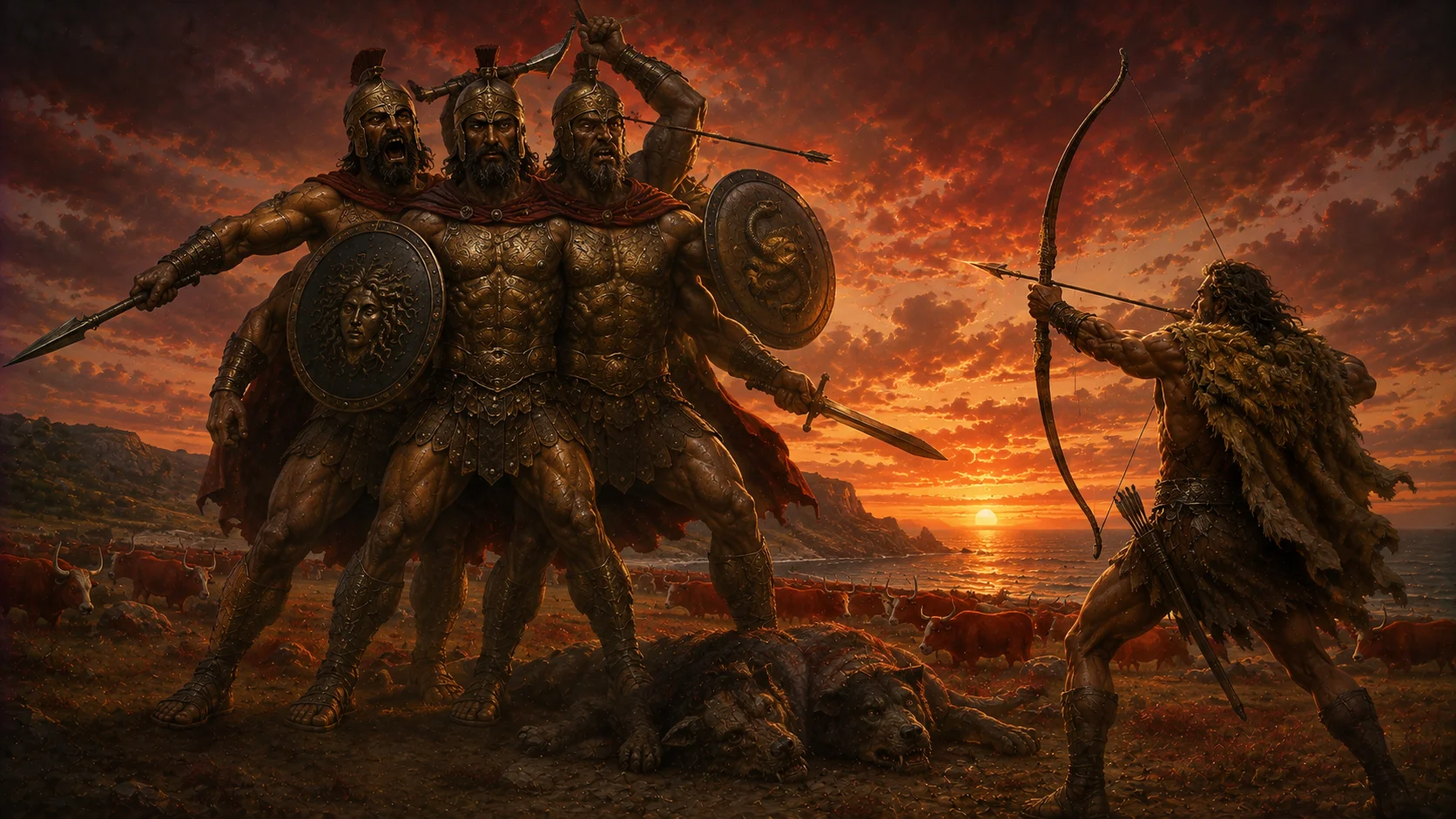
Orthrus is one of those figures better preserved on pottery than in poetry. Attic and Chalcidian black-figure painters loved the Geryon combat, and it settles into a recognisable composition: Heracles at the left, club raised or bow drawn; Geryon at the right, his three bodies overlapping like a hand of cards, one shield-arm already dropping; the herdsman Eurytion crumpled below; and near Heracles' feet, the dog.
He is usually shown already down — falling, sprawled, or dead. Painters used him the way a modern illustrator uses a toppled chair: to tell you the fight has been going for some seconds and is going badly for the defenders. And they were not consistent about the heads. Some vases give him two, clearly and deliberately. Others give him one, either because the painter did not know the detail, did not care, or could not fit a second head into the space beneath a hero's knee. The serpent tail appears in some scenes and is absent from others. If you are hunting him in a museum case, the reliable identifier is not his anatomy but his position: the dog underfoot in a scene with a triple-bodied giant is Orthrus.
Stesichorus and the Monster Who Could Be Pitied
The tenth Labour once had a great poem of its own. In the sixth century BC the Sicilian poet Stesichorus composed the Geryoneis, a long lyric narrative that survives now only in fragments — chiefly papyrus scraps recovered from the rubbish heaps of Oxyrhynchus. Even in that state it is startling. It gives Geryon a mother, Callirhoe, who bares her breast and begs her son not to go out to fight. It lets Geryon deliberate about his own mortality. And when Heracles' arrow finally lands, the poem compares the drooping of the dying head to a poppy shedding its petals — an image of such tenderness that it changes the moral weather of the whole episode.
This matters for Orthrus because it shows what the tradition was capable of and then declined to do for him. The mythographers who came later — the compilers who reduced the Labours to itineraries and body counts — give the dog one clause. He rushed at the hero; the club came down; the story moved on to the herdsman. That is the whole of it. Somewhere between the lyric poets and the handbook writers, the two-headed hound lost whatever interior life a poem might have granted him and became a bullet point in a hero's résumé.
The Cattle Reach Italy
The Labour did not end when Geryon fell. Driving the red herd home overland, Heracles crossed Italy, and the Romans built a substantial piece of their own foundation legend on the back of it. Camped by the Tiber, the hero wakes to find cattle missing; the fire-breathing thief Cacus has dragged them backwards into his cave on the Aventine so the hoofprints point the wrong way; Heracles tears the hill open and kills him. The story was told to explain the Ara Maxima, the great altar in the Forum Boarium — the cattle market — where Hercules received offerings long before Rome was an empire.
So the herd Orthrus died defending goes on to give Rome one of its oldest cults, and the guardian who failed becomes the first casualty in a chain of events that ends with an altar in a foreign city. It is a good illustration of how Greek myth actually travelled: not as a fixed text but as a driven herd, picking up local landmarks and local monsters at every stop.
Why a Dog?
Of all the animals the Greeks might have posted at the world's edge, the dog is the least surprising and the most revealing. The dog is the boundary animal — the only beast that lives inside the human household while retaining the capacity to tear a person apart. It belongs to the wild and to the hearth at once, and Greek thought put it wherever two orders met: at the gates of the dead, at the crossroads with Hekate, at the door, at the edge of the flock.
And behind the monster stands something entirely ordinary. Ancient herdsmen really did keep enormous guard dogs; the Molossian hounds of Epirus were famous across the Mediterranean for exactly this work, and a Greek listener who had ever walked past a stock enclosure at dusk knew precisely what it felt like to be assessed by an animal whose job was to decide whether to kill you. Orthrus is that experience with the volume turned up. Give the dog a second head, set him at the far end of the sea in a country where the cattle are the colour of sunset, and you have taken a familiar dread and made a monster of it — which is what mythology mostly does.
The Monster Nobody Mourns
Orthrus dies in one line and stays dead. He gets no bargain, no riddle, no reprieve, no cult, no constellation. Cerberus at least survives his encounter with Heracles and is returned to his post; the Hydra takes two men and a torch and a rewritten rulebook; the Sphinx empties a city before she falls. Orthrus charges, and that is the end of him.
But the loyal guard who dies instantly is not a small figure in the machinery of a hero-story — he is the measuring instrument. He exists so that the audience understands the scale of what is coming. Everything about him says this creature could kill you: the parentage, the second head, the serpent in the tail, the reputation of the herd he keeps. And Heracles removes him without breaking stride. The two-headed hound of Erytheia is remembered less for what he did than for how quickly it stopped mattering — which is, in the end, a very old and very human thing to be afraid of.
Sources & traditions
- EncyclopediaWikipedia — Orthrus
- TraditionGreek texts, inscriptions and later retellings (Greece)
Myths change from area to area and from time to time. This chronicle follows the most widely told versions; tellings in other villages, regions and eras may differ.