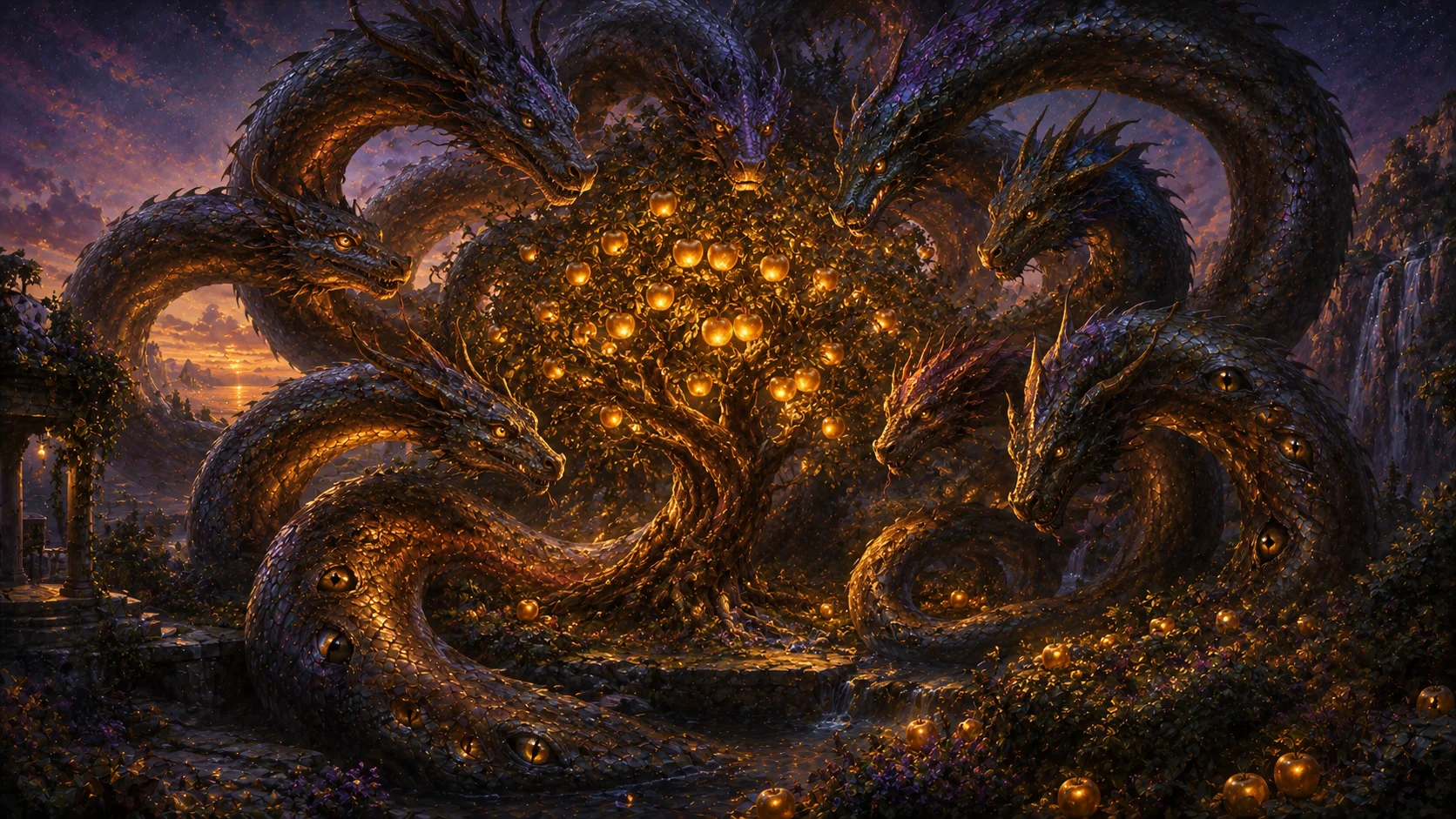
Ladon was the immortal hundred-headed dragon that coiled around the tree of golden apples in the garden of the Hesperides, the never-sleeping guardian of one of the most precious treasures in the cosmos. To win the apples, even the mightiest hero had to get past a serpent whose hundred mouths never all closed at once.
The Serpent of the Golden Apples
At the western edge of the world lay the garden of the Hesperides, where a tree bearing golden apples — a wedding gift to Hera from Gaia — grew under the care of the nymphs called the Hesperides. To guard this priceless treasure, the dragon Ladon was set coiling around the trunk. A child of the monstrous brood (offspring of Typhon and Echidna, or of the sea-deities Phorcys and Ceto), Ladon had as many as a hundred heads, and it never slept — for with a hundred heads, there was always a watchful eye and a ready mouth, and the tree was guarded without pause, day and night.
The Eleventh Labour
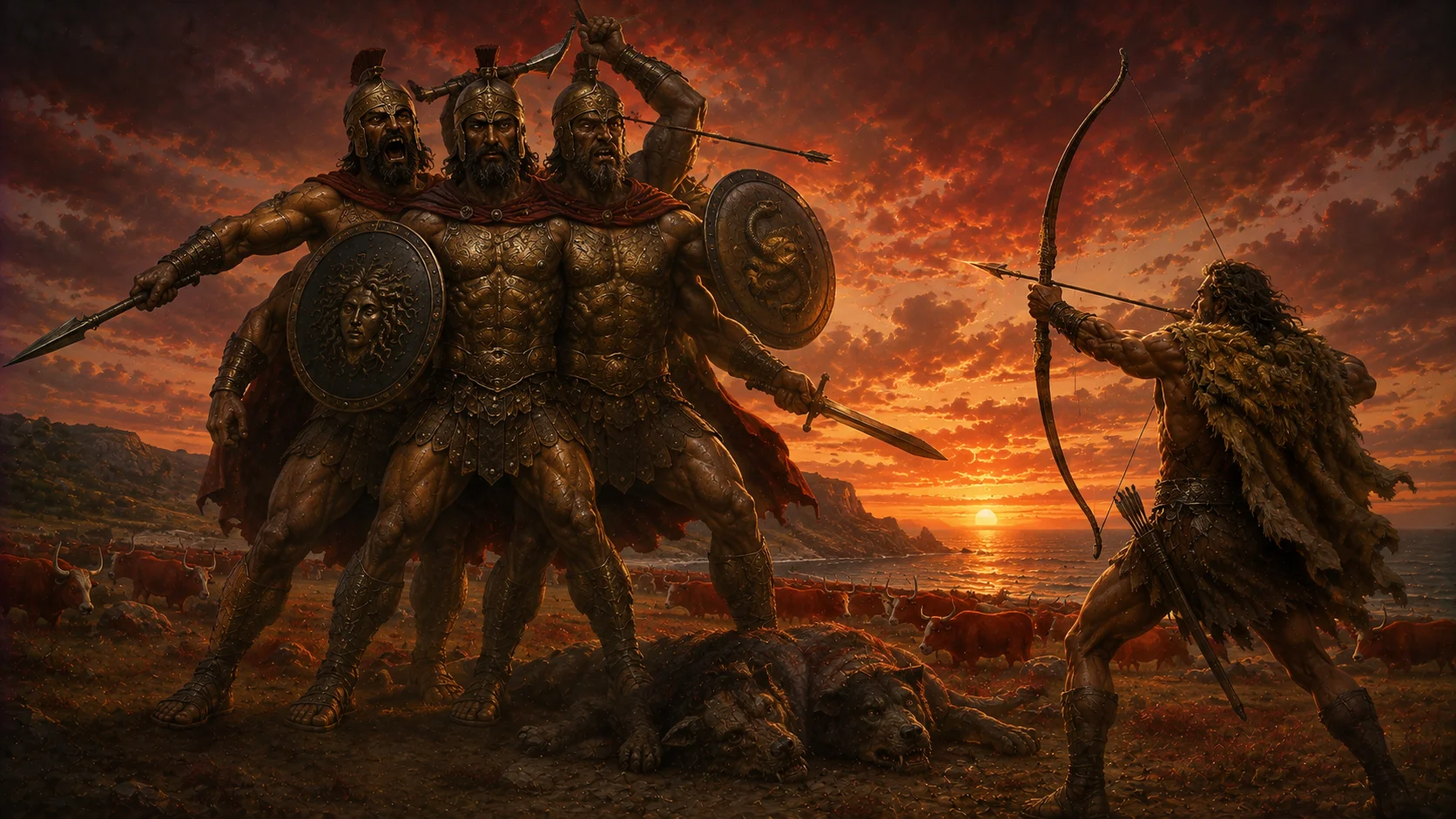
The fetching of the golden apples was the eleventh of the Twelve Labours of Heracles. Accounts differ on how Ladon met his end: in one, Heracles himself slew the dragon with his arrows to reach the apples; in another, the cleverer hero persuaded the Titan Atlas (father of the Hesperides) to fetch the apples for him while Heracles temporarily held up the sky. Either way, Ladon's long vigil ended with the hero's success.
The Dragon Among the Stars
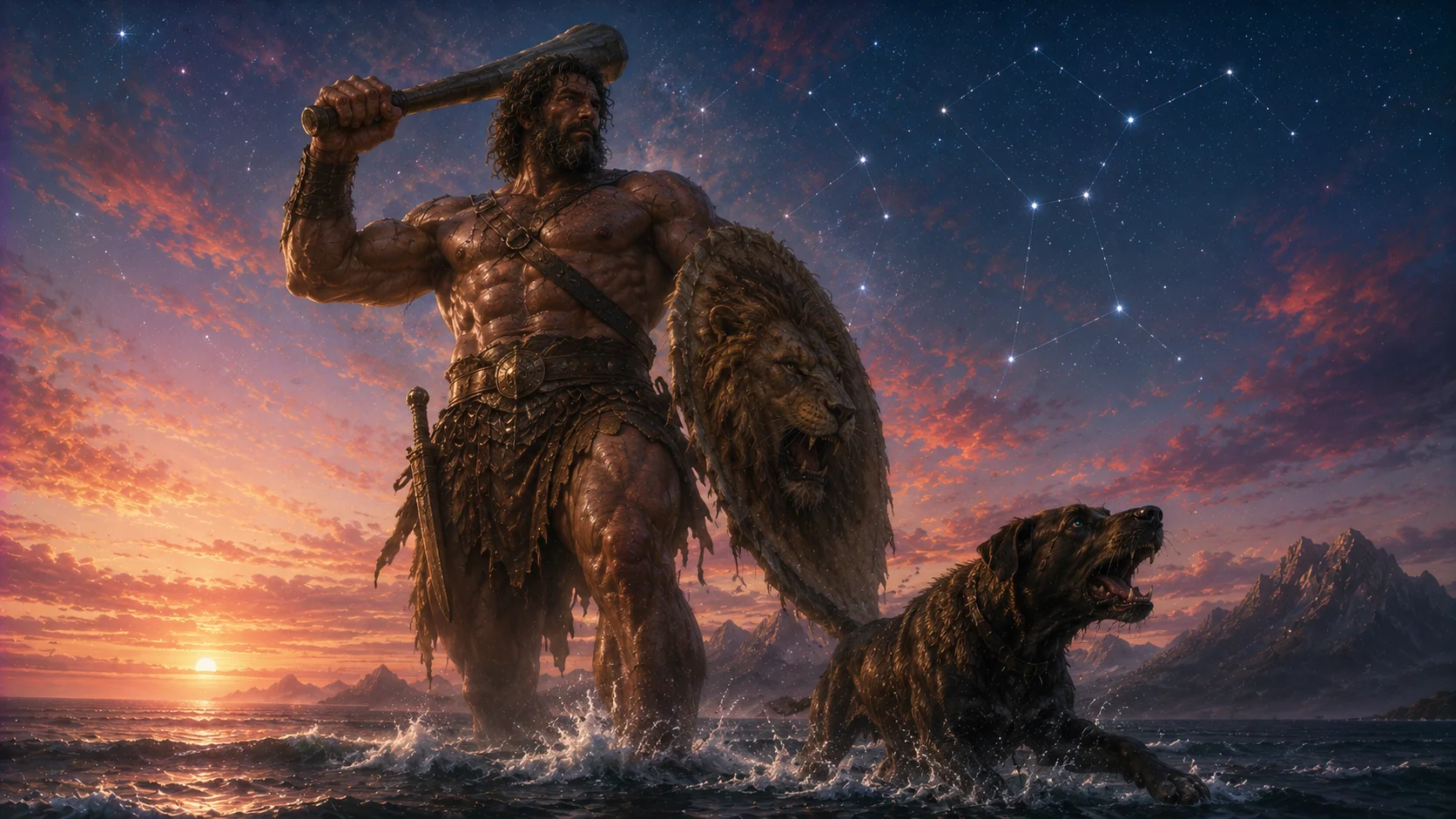
Because Ladon had served Hera faithfully, the goddess honoured the slain dragon by placing it among the stars as the constellation Draco, the great serpent that coils around the celestial pole — still guarding, in a sense, the highest point of the heavens. Ladon endures as the archetypal treasure-guarding dragon, the never-sleeping serpent coiled around what is most precious, an image that flows directly into the dragon-and-hoard motif of countless later myths and tales.
A hundred heads, and never all asleep at once — the perfect guardian for the most precious tree in the world.
Whose Son Was Ladon? Two Rival Genealogies
Ask an ancient Greek who fathered the dragon of the Hesperides and the answer changed with the poet. Hesiod, in the Theogony, makes the serpent that guards the golden apples the last-born child of the primordial sea-powers Phorcys and Ceto, hidden away at the dark limits of the earth. The mythographer known as Apollodorus, compiling the old stories centuries later in the Bibliotheca, gives him a different parentage altogether: Typhon and Echidna.
The choice was not a trivial one. Ceto's other offspring in the Theogony are the Gorgons, Medusa among them, and the grey Graeae — a lineage of ancient, oceanic horror reaching back almost to the beginning of the world, monsters who belong to no hero's story in particular. The brood of Typhon and Echidna, by contrast, is very nearly the catalogue of heroic labours itself: Cerberus, the Hydra, the Chimera, and, in the mythographers, the Sphinx and the Nemean Lion. To make Ladon their child was to file him with the same family that had already supplied Heracles with opponents — a guardian standing at the far end of the hero's career who was kin to the beasts he had killed at its beginning.
The Argonauts Find the Garden a Day Too Late
Heracles's raid on the garden survives in a second and much stranger telling, written from the far side of the event. In the Argonautica of Apollonius of Rhodes — among the earliest surviving texts to give the guardian a name at all — Jason's crew, driven onto the Libyan coast on the long way home from Colchis, carry their ship across the desert and stumble into the garden of the Hesperides. They have missed Heracles by a single day. The tree still stands. The dragon lies dead at its roots, motionless but for the very tip of the tail, and the arrows in him still carry the Hydra's venom, so that the flies settling on the festering wounds shrivel where they land.
At the sight of armed strangers the Hesperides crumble where they stand into dust and earth. Only when Orpheus prays to them as goddesses does the dust put out grass, then shoots, then trees — Hespere a poplar, Erytheis an elm, Aegle a willow — before the three step out of the trunks in their own shapes again and tell the parched sailors what happened the day before. They also point the crew to a rock the stranger had struck with his foot, from which water had gushed: the spring that keeps the Argonauts alive.
It is a mournful companion piece to the triumphant labour narrative. The same killing, witnessed a day late by travellers who missed the fight entirely and inherited only its wreckage — a corpse, three terrified tree-nymphs, and, by pure accident, the water that saves their lives.
A River That Shares the Name
Not every Ladon in Greek myth had scales. In the mountains of Arcadia a real river carried the same name, a tributary of the Alpheus, and the traveller Pausanias, writing in the second century AD, thought its water the most beautiful in Greece. The Arcadians who lived along its banks claimed a famous nymph as a local daughter: Daphne, known to readers of Ovid as the child of the Thessalian river Peneus, is in Pausanias's Arcadian version the daughter of their own river-god Ladon, and her story there turns on the hunter Leucippus, who disguised himself as a girl to join her hunting and was killed for it when the deception was exposed.
What, if anything, links the dragon to the river is not something the surviving sources explain. But it is worth remembering when the name is spoken: a Greek who said Ladon might have meant a hundred-headed serpent at the western edge of the world, or cold water running for miles through Arcadian gorges — and would not have thought the pairing strange.
Why Draco, of All the Stars
Draco was not universally read as Ladon, even in antiquity. The mythographer Hyginus, cataloguing the constellations, offers rival explanations for the long chain of stars that winds between the two Bears: in one it is the dragon of the Hesperides, killed by Heracles and set among the stars by Hera; in another it is a serpent flung skyward by Athena during the war against the Giants, hurled so hard that it twisted around the pole and froze there before it could uncoil. The garden's guardian was one candidate among several. It is simply the one that stuck.
There may be a reason a serpent was thought fit for that part of the sky at all. Around 3000–2500 BC, long before any Greek named these stars, the celestial pole lay close to Thuban, the star in Draco's tail — which is to say the sky turned on Draco itself. The slow wobble of the Earth's axis has since carried the pole away towards Polaris, but the constellation still coils around the place where north used to be: a serpent that once, quite literally, guarded the top of the sky.
The Serpent in the Painter's Eye
Greek painters never attempted the hundred heads. On Attic and South Italian vases of the fifth and fourth centuries BC the labour of the apples is compressed into shorthand: a tree, a single serpent wound up the trunk with its head raised and alert, the Hesperides to either side, Heracles reaching past. No caption was needed. A hero beside a tree-bound snake read as instantly as a lion's pelt read as Heracles himself.
The garden kept its hold on painters long after antiquity. Frederic Leighton returned to it around 1892 in The Garden of the Hesperides, where the three nymphs lie asleep in a circle beneath the tree and Ladon is looped around and over them — guardian and guarded knotted into a single golden tangle of limbs and scales. And the dragon has kept the job into the present: in Rick Riordan's Percy Jackson novels he is still coiled around a tree of golden apples, and still, some twenty-seven centuries after Hesiod, no easier to get past.
Sources & traditions
- EncyclopediaWikipedia — Ladon (mythology)
- TraditionGreek texts, inscriptions and later retellings (Greece)
Myths change from area to area and from time to time. This chronicle follows the most widely told versions; tellings in other villages, regions and eras may differ.