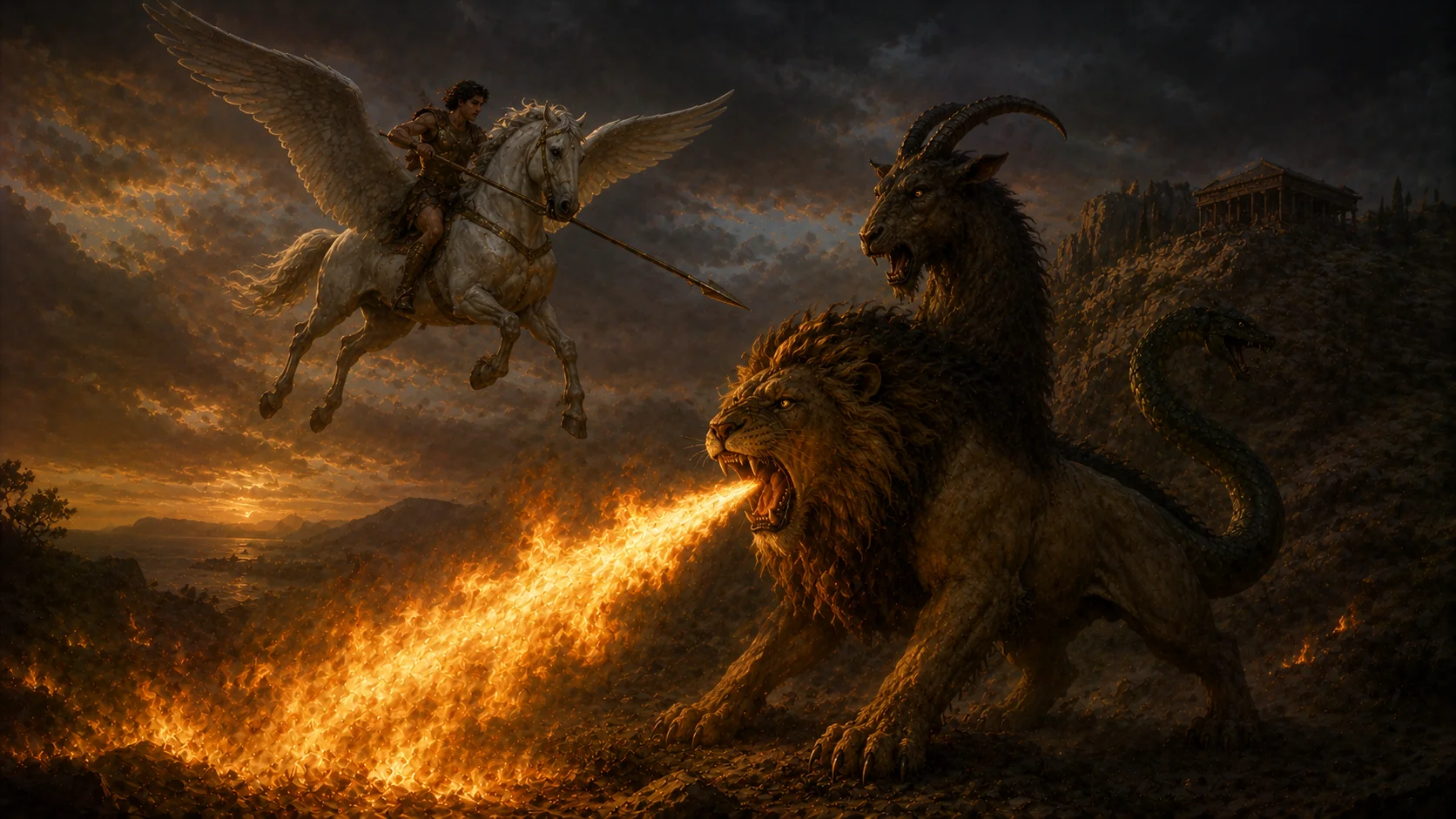
The Chimera was a creature that should not have been possible — three different beasts fused into one fire-breathing impossibility: a lion in front, a goat rising from its back, and a serpent for a tail. So unnatural was it that its very name became the word, in many languages, for a wild fantasy or an impossible hybrid dream.
The Impossible Beast
A child of Typhon and Echidna, the Chimera terrorised the land of Lycia in Asia Minor. Homer describes it as “a thing of immortal make, not human, lion-fronted and snake behind, a goat in the middle, and snorting out the breath of the terrible flame of bright fire.” Three predators in one body, breathing fire — it was a walking violation of the natural order, and a sign of doom wherever it appeared.
The Hero on the Winged Horse
It fell to the hero Bellerophon to destroy it — and he could only do so with the help of the winged horse Pegasus. Unable to approach the fire-breathing beast on foot, Bellerophon flew above it on Pegasus, raining down arrows from the air. To finish it, he fixed a lump of lead to the tip of his spear and thrust it into the Chimera's flaming mouth; the creature's own fiery breath melted the lead, which poured down its throat and killed it. Heroism by altitude and ingenuity, against a foe that could not be fought head-on.
The Word for the Impossible
The Chimera endures less as a story than as an idea. A “chimera” is now anything monstrously hybrid or impossibly fanciful — in biology, an organism of mixed genetic tissue; in dreams, a hope too strange to come true. The Greeks gave the world its enduring symbol for the unnatural fusion of things that were never meant to be one.
Whenever something is too strangely combined to be real, we still call it by her name.
Born of Monsters: A Family Tree of Horror
Her parentage is usually one line in a retelling, but Hesiod's Theogony sets it inside a whole catalogue of monstrous kin. The Chimera belongs to the brood of Echidna — Apollodorus and Hyginus both name Typhon as the father — which makes her sister to Cerberus, the brazen-voiced hound of Hades, whom Hesiod gives not three heads but fifty; to the many-headed Lernaean Hydra; and to Orthus, the two-headed dog of Geryon, killed later by Heracles. The line runs on, though here the Greek turns slippery: at Theogony 326 an unnamed “she” mates with Orthus and bears the riddling Sphinx that besieged Thebes and the Nemean Lion that became Heracles' first labour. Readers ancient and modern have often taken that “she” to be the Chimera herself, making her the mother of two more famous monsters by her own brother — though Echidna is an equally possible reading of the same line, and Apollodorus elsewhere simply calls the Nemean Lion a child of Typhon. Either way, it is a lineage built out of wrong numbers — too many heads, too many tails, too many teeth — as though nature, left to chaos instead of order, could only produce violations of its own rules. Zeus's defeat of Typhon is the cosmic prelude to all of it: Hesiod hurls the father down into Tartarus, while Pindar and Aeschylus pin him under the weight of Mount Etna. Monstrous excess loses in the end — first to a god, and later, in Lycia, to a man.
The Mountain That May Have Made the Myth
Unlike most Greek monsters, the Chimera has an actual address. Pliny the Elder records in his Natural History that the mountain called Chimaera, in the territory of the Lycian city of Phaselis, was on fire — burning, he writes, with a flame that dies neither by day nor by night. That place still burns. At Yanartaş (“burning rock”), on the hillside above Çıralı near the ruins of ancient Olympos, methane and hydrogen seep up through fissures in the rock and feed small permanent flames scattered across the slope, in the same stretch of Lycian coast the ancients named for the beast. Two cautions are worth keeping. The ancient geographers did not entirely agree with one another — Strabo also places a Chimaera in Lycia, but as a ravine on a different mountain some seventy-five kilometres to the west. And a landscape that suits a story is not proof that the landscape caused it. Still, the fit is hard to ignore: a fire-topped mountain standing over slopes grazed by goats, with snakes in the scrub at its foot, gives Lycia's own ground a shape a storyteller could read as a single fused animal — fire above, goat in the middle, serpent below.
Why Bellerophon Had to Fight Her
Homer's Iliad holds the oldest surviving account of the killing, and in it the monster is almost an afterthought. Bellerophon is living at the court of Proetus — lord of the Argives in Homer, king of Tiryns in the later mythographers, who add that he had arrived as a suppliant to be purified of an accidental killing. Proetus's wife Anteia (Stheneboea in later versions) tried to seduce him; when he refused her, she told her husband that he had forced himself on her instead. Proetus shrank from killing a man beneath his own roof. So he sent him to his wife's father, the king of Lycia — left unnamed by Homer, called Iobates by later writers — carrying a folded tablet scratched with what Homer calls baneful signs, which the bearer could not read. Only the Lycian king, opening it after nine days of hospitality, learned that it asked for its carrier's death. That folded tablet is the single mention of writing anywhere in Homer, and the poem handles it as something sinister and new.
Unwilling to break the same guest-law himself, the king set Bellerophon tasks instead, each meant to finish what the letter could not. The Chimera came first, and was expected to be fatal. When Bellerophon came back alive he was sent against the Solymi, then against the Amazons, then ambushed on the road home by the best fighting men in Lycia. He survived all of it. Only then did the king recognise a man the gods were protecting, give him his daughter, and hand over half his royal honours. In the oldest version of the story the Chimera was never really the point — she was the first and loudest attempt to kill a guest without anyone's hands getting dirty.
The Horse That Made the Victory Possible
Bellerophon could not simply walk up and bridle Pegasus. The winged horse had sprung from the blood of the slain Gorgon Medusa and answered to nobody. Pindar's thirteenth Olympian ode tells how the hero, on a seer's advice, slept the night on Athena's altar and dreamed that the goddess put a golden bridle into his hands — a gentle charm for the horse, she called it — telling him to sacrifice a bull to Poseidon, tamer of horses. He woke to find the bridle really there beside him, made the sacrifice, raised an altar to Athena of the Horses, and slipped the golden bit over the jaws of Pegasus as the horse drank at the Corinthian spring of Peirene. Without that gift the Chimera was simply unreachable, which quietly reframes the whole myth: even its most celebrated hero could not out-fly an impossible monster on courage alone. He needed a goddess's bridle before he needed his own nerve.
The Beast in Bronze
The clearest picture of how antiquity actually imagined her survives not in a text but in an object: the Chimera of Arezzo, an Etruscan bronze of around 400 BCE, turned up by workmen near the San Lorentino gate at Arezzo in November 1553 and claimed at once for the collection of Cosimo I de' Medici. It is smaller than its reputation — roughly 78 cm high and 129 cm long — and it was made as an offering: an Etruscan inscription on the right foreleg reads tinscvil, marking it as a dedication to the god Tinia. The lion braces, hackles up. The goat's head hangs sideways from the spine, mortally wounded, blood running from its neck. A round hole in the left haunch may be where a now-lost spear once stood. It has been in Florence's Museo Archeologico Nazionale since 1870, and remains one of the finest Etruscan bronzes anywhere.
One warning about that famous silhouette, though. The serpent tail was missing when the bronze came out of the ground, and stayed missing for more than two centuries: it was not replaced until 1785, when Francesco Carradori — or his teacher Innocenzo Spinazzi — supplied a new one and curled it round to bite the goat's own horn. The arresting pose everyone knows, the creature apparently savaging itself as it dies, is therefore an eighteenth-century invention, and probably a mistake; ancient images show the serpent striking outward, at the attacker. The Greek version of the image is older still, and reached Etruria through the Greek settlements in Italy. Corinthian vase-painters had fixed the type by the 670s BCE — lion body, goat rising mid-spine, serpent for a tail — a shape distinctive enough that it never needed a name written beside it.
An Older Anatolian Shadow
Lycia sat at the edge of the Greek world and well inside a much older one. It appears in Hittite records, centuries before any Greek poet, as the Lukka lands, and the Lycian language descends not from Greek but from Luwian, an Anatolian tongue. Scholars tracing the Near Eastern roots of Greek myth have long compared the fight between Zeus and Typhon — the conflict that generates the Chimera's whole family — with Anatolian storm-god combat stories: the Hittite tale of the serpent Illuyanka, and the Kumarbi cycle. In one detail the parallel is uncomfortably close. In Apollodorus's telling, Typhon cuts the sinews out of Zeus's hands and feet and hides them away, and the god cannot win until they are stolen back; in the Hittite story the serpent takes the storm-god's heart and eyes, which are likewise retrieved before the rematch. Whatever else she is, the Chimera is a monster of the border — assembled where two mythologies overlapped, and never entirely resolving into either.
What the Fusion Was Really About
Almost every other Greek monster keeps to one legible shape. The Hydra only multiplies a single head. The Cyclops is a giant that differs from a man by one eye. The Minotaur is a man's body with a bull's head set on top — a graft, but a graft with an obvious hierarchy: man below, beast above. The Chimera refuses even that. Three complete predators share one spine, none subordinate to the others, none of them in charge, and no amount of looking resolves them into a single animal. A monster that is one thing wearing a disguise can eventually be understood, and in Greek myth is usually pitied. A monster that is genuinely three things at once, permanently and without hierarchy, cannot be. That unresolved plurality — more than the fire, more than the fangs — is why bringing her down took a goddess's bridle and a soft lump of lead, and why a Corinthian painter could put her outline on a pot and trust a stranger to know her without a word written underneath.
Sources & traditions
- EncyclopediaWikipedia — Chimera (mythology)
- TraditionGreek texts, inscriptions and later retellings (Greece)
Myths change from area to area and from time to time. This chronicle follows the most widely told versions; tellings in other villages, regions and eras may differ.