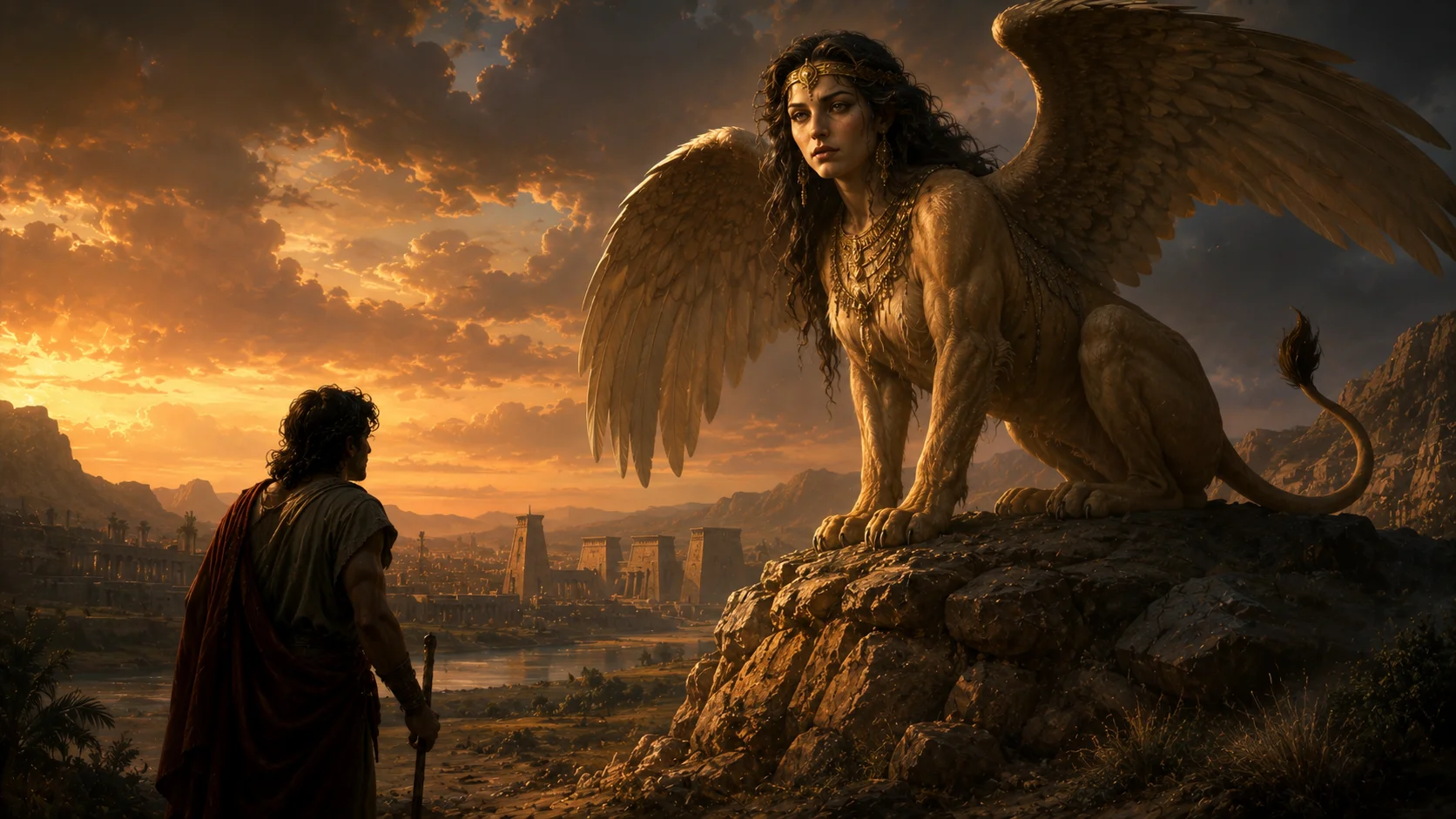
The Greek Sphinx was a monster of the mind as much as the body — a creature with the face and breast of a woman, the body and haunches of a lion, and, in most depictions, the wings of a bird of prey, who killed not with claws alone but with a riddle. She is the guardian of the most famous question in mythology, and the architect of one of its greatest tragedies. Unlike the older, wingless Egyptian sphinx — a benevolent royal guardian carved beside temples and tombs — the Greeks reimagined the type as female, winged, and murderous, a genuinely narrative monster rather than a static icon. She belongs to Thebes alone, a single named individual rather than a category of creature, and everything that survives of her is bound up with the single road outside that city where she chose to sit.
A Lineage the Sources Cannot Agree On
Even her ancestry arrives contested. Hesiod's Theogony places the Sphinx among the monstrous brood of Echidna and Typhon, the same fearsome union that produced the Chimera, the many-headed Hydra of Lerna, the hound Cerberus, and the Nemean Lion — making the Sphinx sister, by that reckoning, to some of the most feared beings in Greek myth. But manuscript traditions diverge: other lines of transmission name her instead as daughter of Orthrus (the two-headed hound) and Echidna, which would make her sister to the Nemean Lion by a different mother-father pairing entirely. Ancient sources simply do not settle the question, and rather than force a single genealogy onto her, it is truer to the myth to hold both threads as live and inconsistent — a monster whose place in the family tree of monsters was never fixed even by the poets who first wrote her down. What both versions preserve is the same underlying claim: whatever her exact parentage, she springs from the deepest, most primordial stratum of monstrous birth in the Greek imagination, kin to the beasts every hero of the age was fated to face.
Sent to Sit Above the Road
The Sphinx did not simply appear at Thebes; she was sent. The sources vary on who dispatched her — in some accounts it is Hera, in others Ares — and the surviving material does not agree on, or even specify, why. Whichever hand loosed her, the effect was the same: she took up a position on a rock or mountain outside the city walls, overlooking the single road that travelers had to use, and made herself the toll no one could pay in coin. She was not a beast that had to be hunted down in some wilderness; she had installed herself at the threshold of civic life, turning the ordinary act of entering or leaving Thebes into a gamble with one's own throat.
The Question No One Could Escape
Her method was psychological before it was physical. Every traveler who approached was stopped and put to the same test: answer her riddle, or die. Those who failed — and by every account, everyone failed, for a very long time — were killed and devoured on the spot. The city was not besieged by fire or army but by dread, an ordinary road turned into a one-way passage for anyone who could not out-think a monster. This is the shape of a particular Greek pattern, the riddle-guardian: a threshold figure who does not simply block passage but demands proof of wit before granting it, so that the true danger is not claws but a failure of thought.
What Walks on Four Legs, Then Two, Then Three
The riddle itself, as it comes down through later tradition rather than directly from Hesiod's fragmentary lines, ran: "What walks on four legs in the morning, two legs at noon, and three legs in the evening?" It is worth noting that this fullest version of the riddle — its exact wording, its staging as a spoken exchange — is elaborated in later mythographic sources such as Apollodorus's Bibliotheca rather than attested in complete form in the earliest epic or lyric poetry. The core of the myth is ancient; the polish on its most famous line is a later systematization, laid over an older, sparer story.
The One Who Answered
Traveler after traveler failed and paid for it with their lives, until Oedipus came up the same road, a man fleeing a prophecy of his own rather than seeking out the Sphinx by design. He gave the answer she had never heard spoken correctly: a human being — who crawls on all fours as an infant, walks upright on two legs through the long middle of life, and in old age leans on a third leg, a staff, to steady a body time has worn down. It is a riddle about the single shape of every human life read out across a single day, dawn to dusk standing in for birth to death. The answer was not a trick or a technicality; it was recognition — the one thing the Sphinx, for all her menace, could not out-argue.
Undone by the Thing She Could Not Survive
What happened next is itself remembered two ways. In the version treated as standard, the Sphinx, hearing the riddle solved at last, threw herself from her rock or cliff to her death — destroyed not by a blade but by the plain fact of being answered, as though the question had been the only thing holding her together. Other variants have her killed or devoured by Oedipus himself, a more violent close to the encounter. The sources do not resolve which is "true," and the myth is not diminished by the disagreement; both endings agree on the essential point, that the Sphinx's power ended the instant her riddle no longer had force, and that nothing in her monstrous nature equipped her to survive that moment.
The Hinge of a Larger Tragedy
The death of the Sphinx is not where the story of Oedipus ends — it is where his true story begins. Freed from her, Thebes hailed him as its savior, and the throne, left vacant, came to him along with the hand of its widowed queen. He did not yet know, and could not have known, that the woman he married was Jocasta, his own mother, or that in solving one riddle he had walked directly into the fate the earlier prophecy had marked out for him and that his flight from Corinth had been meant to avoid. The Sphinx episode is the narrative hinge of the entire Oedipus cycle: it is the act that converts an exile fleeing a prophecy into a king who has, without knowing it, fulfilled the worst of it. Sophocles's Oedipus Rex is built entirely on the aftermath of this moment — the play opens with Thebes already ruled by Oedipus and Jocasta, the riddle long since answered and the Sphinx long since gone, and it never brings her onto the stage at all. She is present in the play only as the unspoken reason the throne was his to take, the offstage catastrophe that made the onstage one possible.
A Guardian Whose Test Was the Danger Itself
Read as more than a single episode, the Sphinx functions as one of Greek myth's clearest examples of a liminal guardian-monster — a being that polices not a treasure or a territory but a threshold of civic life, and that tests not strength but wit. Her presence at the gate of Thebes turns the ordinary passage into and out of the city into a philosophical ordeal, and her riddle folds the entire arc of a human lifetime into a single question asked at a roadside. She embodies, more directly than almost any other Greek monster, the destructive consequence of an unanswered intellectual challenge: where other beasts kill through force she kills through failure, making her a peculiarly intimate kind of threat, one that could not be outrun, only out-thought. And because her defeat sets the Oedipus tragedy in motion, she is bound as tightly to the Greek preoccupation with fate and prophecy as she is to the riddle-guardian tradition — a monster whose death does not resolve a story so much as release the one underneath it.
The Sphinx of Thebes, Named by Her City
No single fixed poetic epithet beyond the geographic identifier is firmly attested for her; she is most often known simply as the Theban Sphinx, or the Sphinx of Thebes, a title that does double work — distinguishing her from the Egyptian sphinx type and rooting her permanently to the one city whose road she chose to haunt. She has no other name that survives the centuries with any authority, as though the place she terrorized was identity enough.
A Guardian Figure Beyond Her Own Story
Separate from her role in the Oedipus narrative, the Sphinx image itself circulated widely through Greek art as a guardian and apotropaic figure — carved onto funerary monuments where she stood watch over the dead, and painted onto vases where her composite form, woman's head and breast fused to a lion's haunches and a bird of prey's wings, made an immediately recognizable emblem of threshold and protection. In this visual life she is not always the Theban riddler of the myth specifically; she is a type, a warning shape set at boundaries, drawing on the same essential menace without necessarily invoking the particular story of Oedipus at all. It is the myth, though, that gave the image its sharpest edge and its longest life — the later Western fascination with the "answer the riddle or die" motif traces back through centuries of retelling to this one figure on her rock outside Thebes, deciding, question by question, who was permitted to pass.
What Endures
The Sphinx's story is short in the telling and enormous in its consequence: a monster of contested birth, installed at a city's threshold, undone the instant her one weapon — an unanswered question — was finally answered, and gone the moment before the true tragedy of the man who answered her began. She left behind no epithet beyond her city's name and no fixed account of her own death, only a riddle sharp enough to outlive every teller who ever repeated it, and a place at the hinge of one of Greek tragedy's darkest turns.
Sources & traditions
- EncyclopediaWikipedia — Sphinx
- TraditionGreek texts, inscriptions and later retellings (Greece)
Myths change from area to area and from time to time. This chronicle follows the most widely told versions; tellings in other villages, regions and eras may differ.