The first of the great trials of Heracles was a beast whose golden hide no weapon on earth could pierce: the Nemean Lion, a monstrous lion that terrorised the valley of Nemea and could not be killed by any blade, arrow, or spear ever forged. To defeat it, the strongest hero in the world would have to throw away his weapons entirely.
The Lion Whose Skin Could Not Be Cut
An offspring of Typhon and Echidna (or, some say, fallen from the moon), the Nemean Lion was larger and fiercer than any natural lion, and its tawny-golden fur was utterly impervious — arrows bounced off it, swords shattered against it, spears could not break the skin. It made its lair in a cave with two entrances and devoured the people and flocks of Nemea, and no one could stand against it.
The First Labour
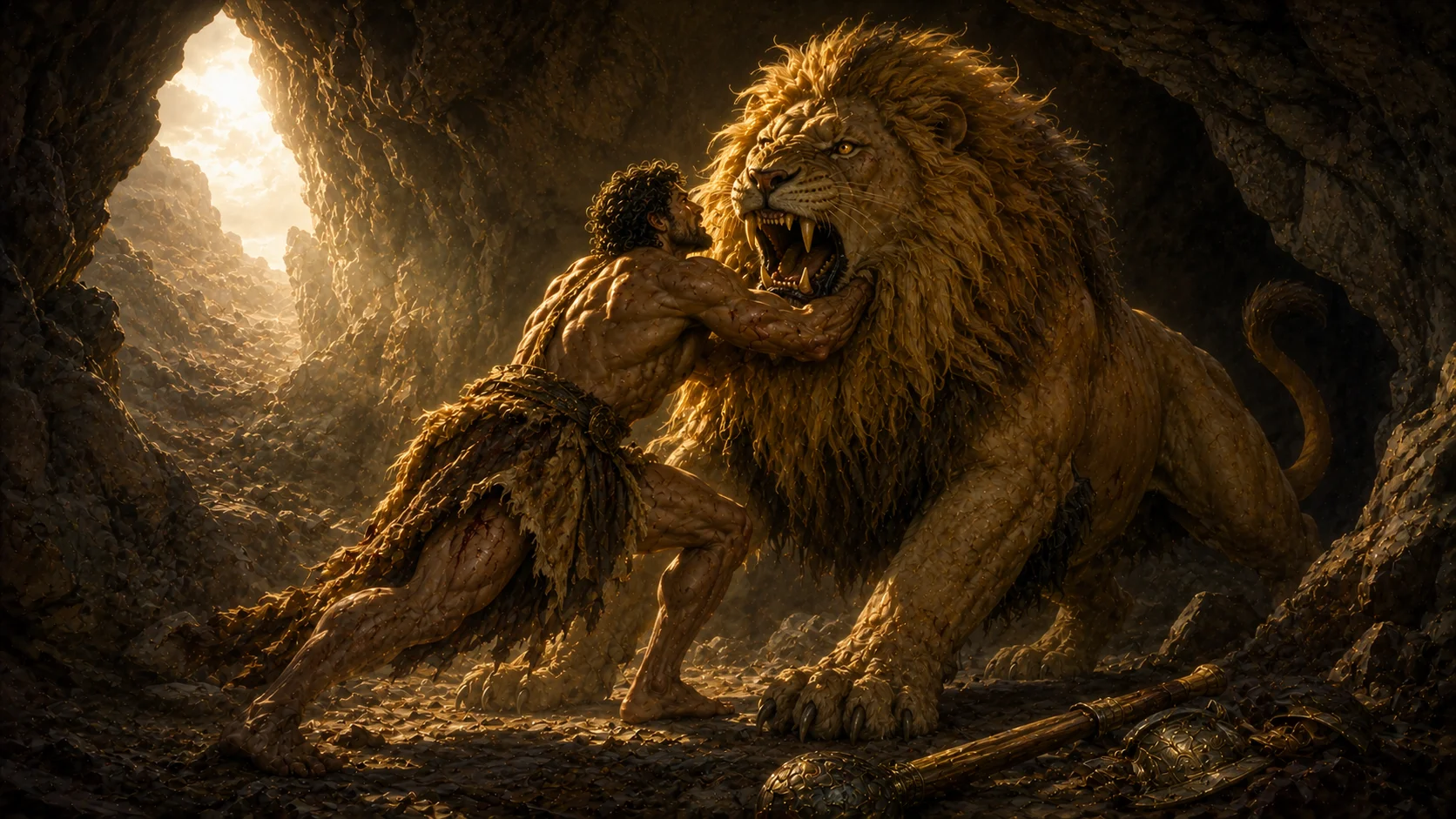
Slaying it was the first of the Twelve Labours of Heracles. The hero soon discovered that his arrows were useless. So he trapped the lion in its cave by blocking one entrance, cornered it, and — in the image that defines him forever — throttled the beast to death with his bare hands, his immense strength succeeding where every weapon had failed.
The Invincible Cloak
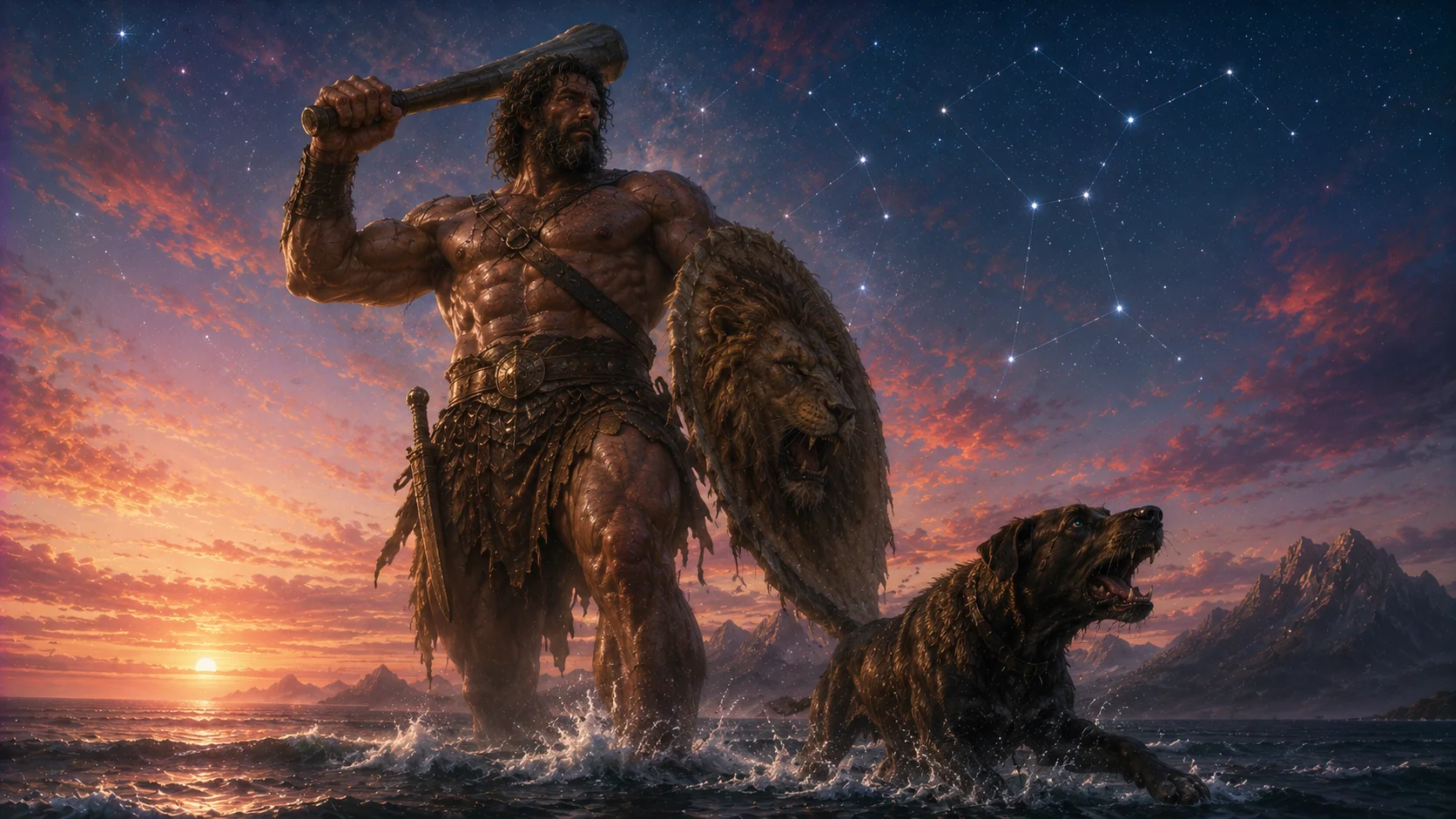
The triumph gave Heracles his iconic emblem. Unable to cut the hide with any blade, he used one of the lion's own razor-sharp claws to skin it, and thereafter wore the impenetrable pelt as a cloak and helm — an armour no weapon could pierce. The lion that had been invincible became the hero's own invincibility. The Greeks set the beast in the sky too, as the constellation Leo.
The strongest of all heroes began his legend by learning that some enemies cannot be cut — only out-gripped.
The Oldest Version: A Monster Raised by a Goddess
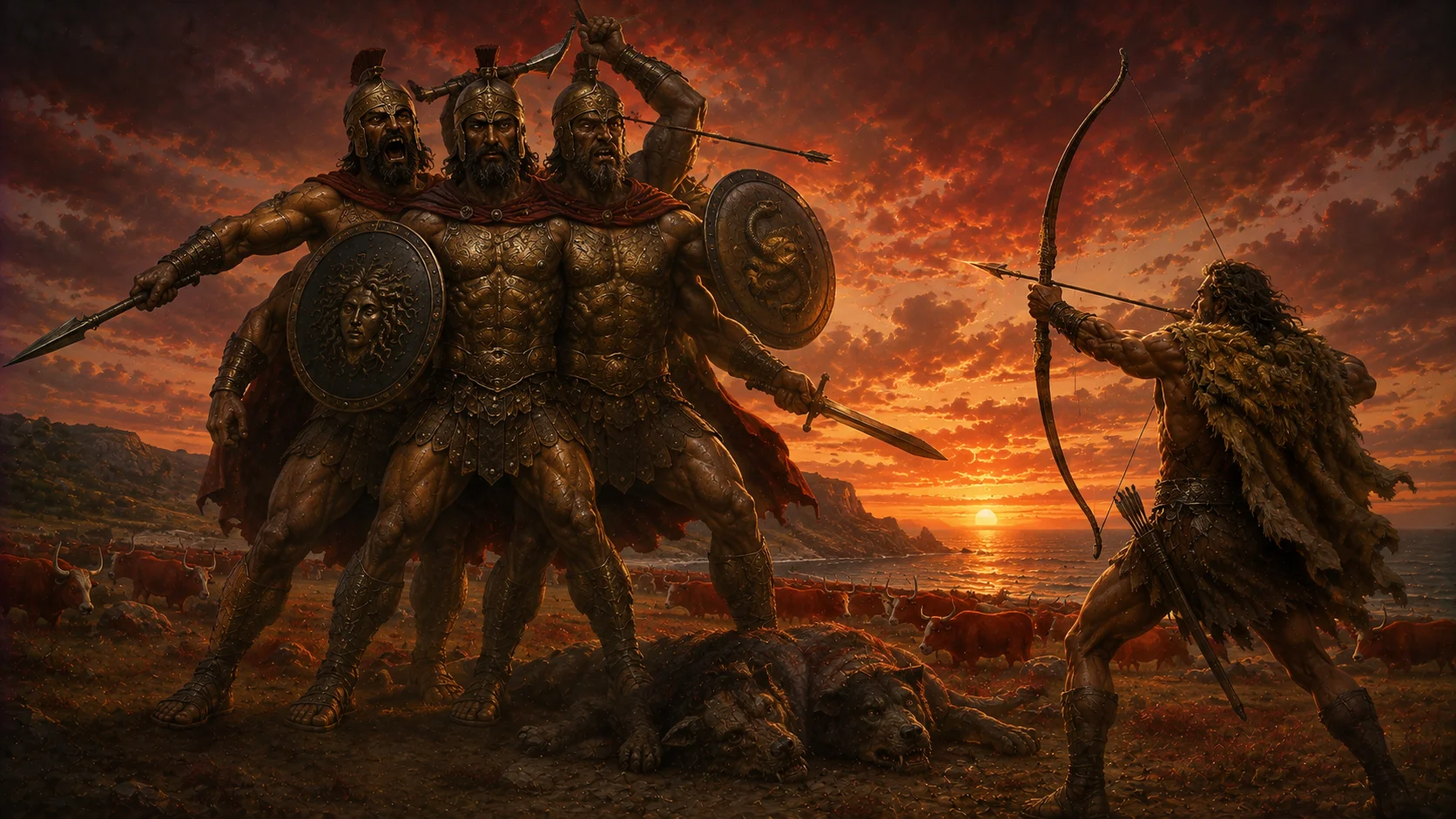
The earliest surviving account of the lion is not a monster story at all — it is a family tree. Hesiod's Theogony, the great catalogue-poem of divine descent, sets the beast in Echidna's line, fathered by Orthrus, the two-headed hound that Heracles would later kill in the far west while taking the cattle of Geryon. That makes the Nemean Lion the sibling of the Sphinx of Thebes: two lion-bodied horrors, each set down at the edge of a Greek city to strangle its traffic and eat its people, each finally undone by a single man.
But Hesiod adds the detail that changes everything. The lion did not wander into Nemea by chance. Hera reared it, and Hera settled it there — a plague deliberately planted among men. In Hesiod's lines it lords over Tretus and Apesas, the heights that frame the Nemean valley, and devours the tribes of men living beneath them.
The rival genealogies keep pointing the same way. Apollodorus makes the lion a child of Typhon. Epimenides, quoted centuries later by Aelian, has the Moon herself shudder the beast off her surface — and do it at Hera's bidding. Hyginus says only that the Moon nursed it, in antro amphistomo, in a cave with two mouths. Whoever fathered it, the goddess standing behind it does not change.
Read the First Labour with that in mind and it stops being a monster hunt. Heracles — whose name means something like glory of Hera, a bitter joke on a hero the goddess spent his life trying to destroy — begins his penance by killing Hera's own foster-child with his hands. The Labours are usually told as a sentence handed down by King Eurystheus. The oldest sources suggest they were always a war between a stepmother and her husband's son, and that the first move had been made long before Heracles walked into the valley.
Nemea, Tretus, and the Cave the Locals Still Showed
Nemea is a real and rather ordinary place: a fertile upland basin in the north-eastern Peloponnese, between Corinth and Argos, today better known for its dark red wine than for its monster. The mythical geography is precise enough to walk. Mount Apesas rises flat-topped to the north, remembered as the spot where Perseus first sacrificed to Zeus. Tretus — the name means pierced, or bored through — is the pass carrying the road on toward Mycenae, and the mountains around it are riddled with caves.
Pausanias walked the route in the second century AD with the professional scepticism of a man who has been shown too many relics. At the sanctuary he found the temple of Nemean Zeus with its roof fallen in and no cult image left, a grove of cypresses around it, and the grave of the infant Opheltes inside a low stone enclosure ringed with altars. On the Tretus road, he notes, they still show you the cave of the famous lion.
What he does not report is any local claim about the cave's shape. The two mouths belong to the storytellers, and they never let the detail go: Apollodorus builds the whole Labour on it, and Hyginus fixes it in a single Latin phrase. It is the hinge the episode turns on. A creature that cannot be shot has to be reached instead, and a beast with two exits cannot be reached at all.
Molorchus, and the Thirtieth Day
The most human episode in the whole Labour is almost always left out of the retellings, and it is the one the ancients liked best.
On his way to Nemea, Heracles lodged at Cleonae with a day-labourer named Molorchus. His host moved to kill an animal in his guest's honour, and Heracles stopped him: wait thirty days. If the hero came back alive, they would sacrifice together to Zeus Sōtēr, Zeus the Saviour. If he did not return, Molorchus should offer the victim to Heracles instead, in the way men offer to the dead.
On the last of the thirty days Molorchus led the animal out to kill it for a ghost. Heracles walked in with the lion.
Callimachus, writing in Alexandria centuries later, thought this small story worth a long and affectionate poem — the opening of the third book of his Aetia, composed for a queen's chariot victory at Nemea — and gave it a domestic subplot in which Molorchus wages his own campaign against the mice eating him out of house and home. The epic monster and the household pest, set deliberately side by side: exactly the sort of joke Hellenistic poets loved. The episode survived because it does something the strangling cannot. It puts a clock on the Labour, gives the hero a host to come home to, and makes the difference between triumph and funeral a matter of a single afternoon.
The Games the Lion Left Behind
Nemea was not a place of horror in historical times. It was a sanctuary, and one of the four great crown festivals of the Greek world — alongside Olympia, Delphi and the Isthmus — was held there for Nemean Zeus every second year. The prize was a wreath of wild celery and nothing else. No money. The wreath, and the fact that everyone in the Greek-speaking world would know your name.
Two rival stories explained where the games came from. One credited Heracles, founding them in thanksgiving after the lion — the version Callimachus tells. The one attested earlier in our surviving sources is far darker: the games began as funeral rites for a baby. The infant Opheltes, son of Lycurgus, was set down for a moment on a bed of wild celery by his nurse Hypsipyle while she showed the passing army of the Seven against Thebes where to find water. A serpent killed him. The seer Amphiaraus read the death as an omen for the whole doomed campaign and renamed the child Archemorus, the beginning of doom — and the Seven buried him with contests. The judges at Nemea wore black, it was said, still in mourning for him.
So the valley carried two founding deaths, a child's and a monster's, and it is the child's that shaped the ritual. Pindar wrote odes for the victors there; Statius gave Opheltes' funeral a long, grief-soaked stretch of his Thebaid. The sanctuary can still be visited: a fourth-century BC Doric temple whose columns have been raised again from their own fallen drums in recent decades, and a stadium entered through a vaulted stone tunnel where competitors, waiting in the dark before their heat, scratched their names into the soft limestone. The names are still there.
The King and the Bronze Jar
The return is the part of the myth that turns comic, and the comedy is deliberate. Heracles carried the carcass back to Mycenae and laid it in front of Eurystheus, the cousin who had been given command over him. The king took one look and barred him from the city; from then on Heracles had to display the proof of each Labour outside the gates. Apollodorus adds the detail that fixed the king's reputation for good — Eurystheus had a great bronze storage jar sunk into the earth to hide in whenever his champion came home.
Greek vase painters found this irresistible. There is a whole family of images showing a bearded king cowering neck-deep in a pithos, hands up, while Heracles hoists a boar over the rim. The joke has a point. The man with legitimate authority is in a pot, and the man doing the work is locked outside the walls. The lion is the first Labour, and it is where the balance of the story tips permanently away from the throne.
How to Recognise Him in the Art
The lion fight is among the most frequently painted scenes in all of Greek art, and its composition settled as the story did. Some of the earliest depictions show Heracles going in armed, with sword or club — the sequence the written sources also preserve, in which the weapons are tried and fail. By the sixth and fifth centuries BC the scheme is fixed and unmistakable: hero and lion locked upright chest to chest, the beast rearing, Heracles' arm clamped round its neck, both bodies bent into a single strained arc. Off to the side stand the usual spectators — Athena with her spear, the nephew Iolaus holding the discarded club, sometimes Hermes.
After Nemea, the pelt becomes the signature. In sculpture, on coins, in mosaic and on gems, you identify Heracles by three things: the club, the bow, and the lion's scalp worn as a hood with the forepaws knotted at the throat. The emblem outlived the literal telling. Alexander the Great's silver tetradrachms carry a head in the lion scalp — Heracles, whose bloodline the Macedonian kings claimed, and, to anyone turning the coin over in a marketplace, unmistakably a hint of Alexander himself. Five centuries later the emperor Commodus had himself sculpted in the same scalp, with the club and the apples of the Hesperides, which his contemporaries found a good deal less impressive than he did.
The Cynic philosophers took the same equipment and stripped the glamour off it. Heracles was their model — the man who owned nothing but a skin and a stick and needed nothing else — and a Cynic on the road carried a staff and a doubled cloak that made the resemblance hard to miss. From there it was a short step to the allegorists, who read every Labour as a passion mastered and turned the invulnerable lion into whatever in a man cannot be argued with and must simply be overpowered.
There Really Were Lions
The most disorienting fact about this myth is that the Greeks were not inventing an exotic animal. Lions lived in south-eastern Europe within historical memory. Herodotus reports that as Xerxes' army moved through the north, lions came down at night on the camels carrying its grain — touching no man and no other beast — and he sets their range between the Nestus, which runs past Abdera, and the Achelous in Acarnania, adding that they are found nowhere else in Europe. Aristotle repeats that boundary almost word for word. Excavated bone from Bronze and Iron Age sites in the southern Balkans supports them.
Go back further and the lion is everywhere in the art of exactly the region the myth is set in. The gate of Mycenae — Eurystheus' citadel in the story — is crowned by two great flanking beasts carved in relief, often called the oldest monumental sculpture in Europe. An inlaid dagger from the shaft graves below it shows hunters with spears and body-length shields facing lions, one man already down.
That is the ground the story grows out of. A Mycenaean lord's proof of fitness to rule was the lion hunt, an undertaking that genuinely killed people, conducted with the best bronze available. The Nemean Lion takes that ordeal and removes the bronze from it. It is the lion hunt with the technology confiscated — and it asks, of a culture that measured its kings by exactly this, what a man is worth when the equipment stops working.
Why the Strangling Endures
Every version of this myth is organised around one refusal. The arrows are not turned aside because the poet needed a complication; they are turned aside because the story is about the moment a tool fails. In the Hellenistic poem that circulated under Theocritus' name, Heracles narrates the fight himself, and the sequence is almost procedural: one shaft glances off and drops in the grass, a second falls uselessly at his feet, and as he reaches for a third the lion is already on him — so he swings the club into its temple, and the club breaks clean in two. Only then, with nothing left in his hands, does the Labour actually begin.
Bare-handed lion-killing is one of the oldest images humanity has of its own heroes. Gilgamesh kills lions in the mountain passes and wears their skins. Samson tears one apart in the vineyards of Timnah with nothing in his hand. The image keeps recurring because it answers a question no weapon can settle: strip away everything you have made, and are you still stronger than the thing in the dark?
That is why this Labour comes first, and why it is the one the Greeks painted more than any other. Every trial after it is fought by a man who already knows the answer — and who is wearing the proof. The lion is not simply defeated. It is worn.
Sources & traditions
- EncyclopediaWikipedia — Nemean lion
- TraditionGreek texts, inscriptions and later retellings (Greece)
Myths change from area to area and from time to time. This chronicle follows the most widely told versions; tellings in other villages, regions and eras may differ.