Jason was the captain of the greatest crew ever assembled — the leader of the Argonauts on their quest for the Golden Fleece. His is the great voyage of Greek myth, a journey to the edge of the known world and back, won not by his own strength so much as by the loyalty of his heroes and the terrible, brilliant love of the sorceress Medea. He is a king's son raised in hiding, a captain who led without always deserving to, and a man whose ending proves that Greek myth rarely lets its heroes keep what they win.
A Prince Smuggled Out of Iolcus
Jason was born the son of Aeson, the rightful king of Iolcus, at the moment his father's throne was being stolen out from under him. Aeson's half-brother Pelias seized power, and an infant heir was a danger Pelias would not have tolerated for long. So the child was sent away for his own safety, carried out of the city before he could become a target, and raised far from the court that should have been his.
Schooled on the Mountain by the Wisest of the Centaurs
The place Jason was sent was Mount Pelion, and the one who raised him there was Chiron, the centaur whose name recurs through Greek heroic legend as tutor to more than one great figure — Achilles among them, in later tradition. From Chiron, Jason learned what a king's son needed to know before ever setting foot back in a court that wanted him dead: survival, discipline, and the bearing of someone who could one day command men far more famous than himself. This account of Jason's upbringing comes down to us chiefly through Apollonius of Rhodes' Argonautica, the great epic source for his whole story.
The Woman at the River and the Missing Sandal
When Jason finally came down from the mountain to reclaim his father's throne, an old woman needed help crossing a swollen river. He carried her across, and in doing so lost a sandal to the current — a small, almost comic mishap that turned out to be nothing of the kind. The old woman was Hera in disguise, testing him. Jason arrived before Pelias with one foot bare, and the sight struck the usurper like a thunderclap: an oracle had long ago warned Pelias to beware a man who came to him wearing only one sandal. The prophecy had simply been waiting for its man to arrive.
A Throne Offered on an Impossible Condition
Pelias could not kill the one-sandaled man outright without seeming to defy the gods, so he did something more cunning: he agreed, in principle, to yield the throne — but only if Jason first sailed to distant Colchis and returned with the Golden Fleece. It was framed as a hero's proving ground. It was meant as a death sentence, a quest built to be unsurvivable, sending Jason to the far edge of the known world in the hope he would simply never come back.
Building the Argo and Gathering an Age of Heroes
Jason did not sail alone, and the ship itself was a marvel before it ever left harbor. The Argo was built by the craftsman Argus, with the goddess Athena lending her own aid to its construction, and it gave its name to the crew that would sail it. To fill that crew, Jason called on the greatest names of the heroic age: Heracles, the divine twins Castor and Pollux, the singer Orpheus, and, in some tellings, the huntress Atalanta, among many others who answered the call. No single voyage in Greek myth gathered so many famous names under one captain, and the Argonautica has always functioned as something like a roll call of the age's heroes as much as a travel narrative.
Trials Set by a King Who Never Meant to Let Go of the Fleece
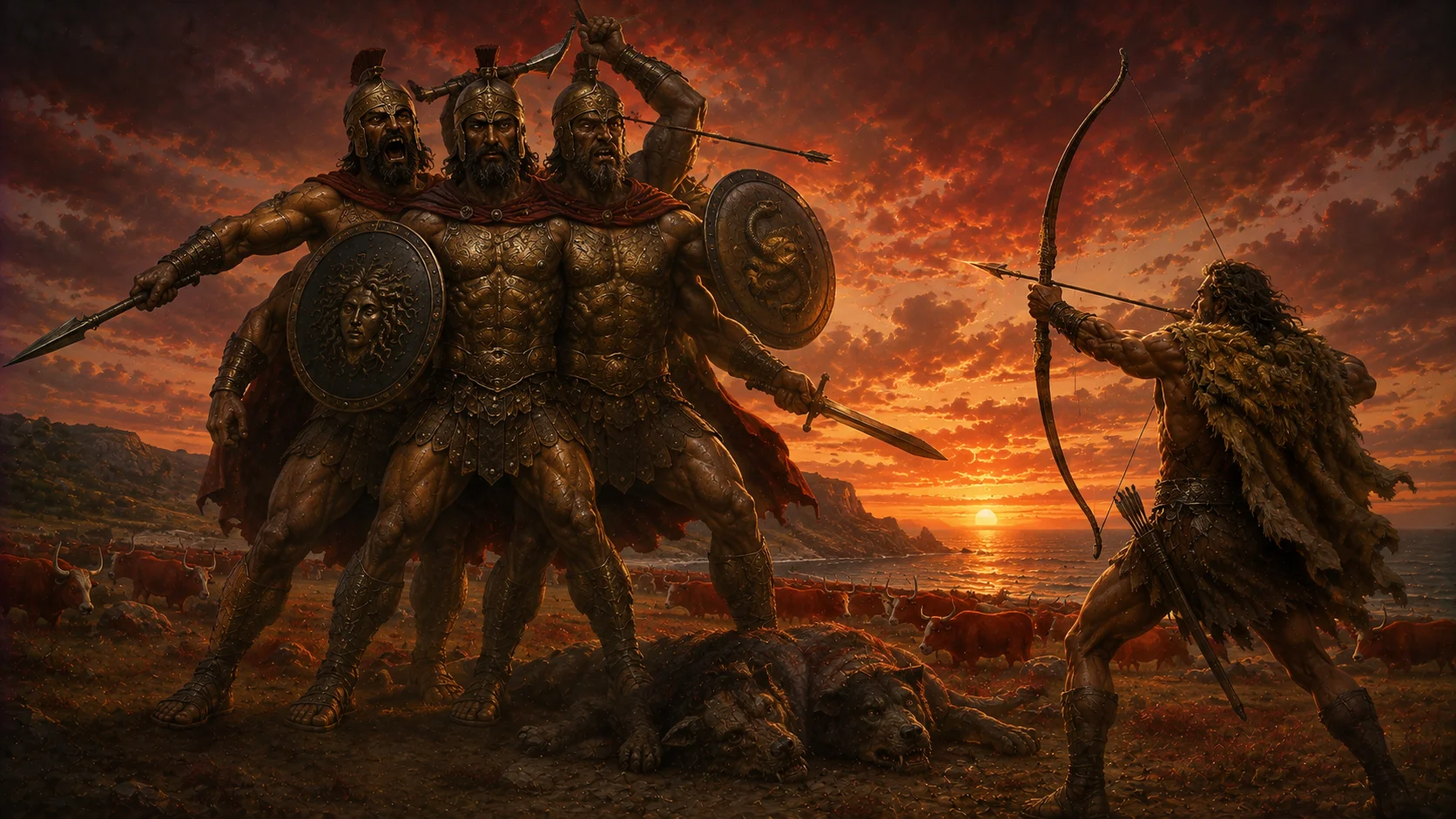
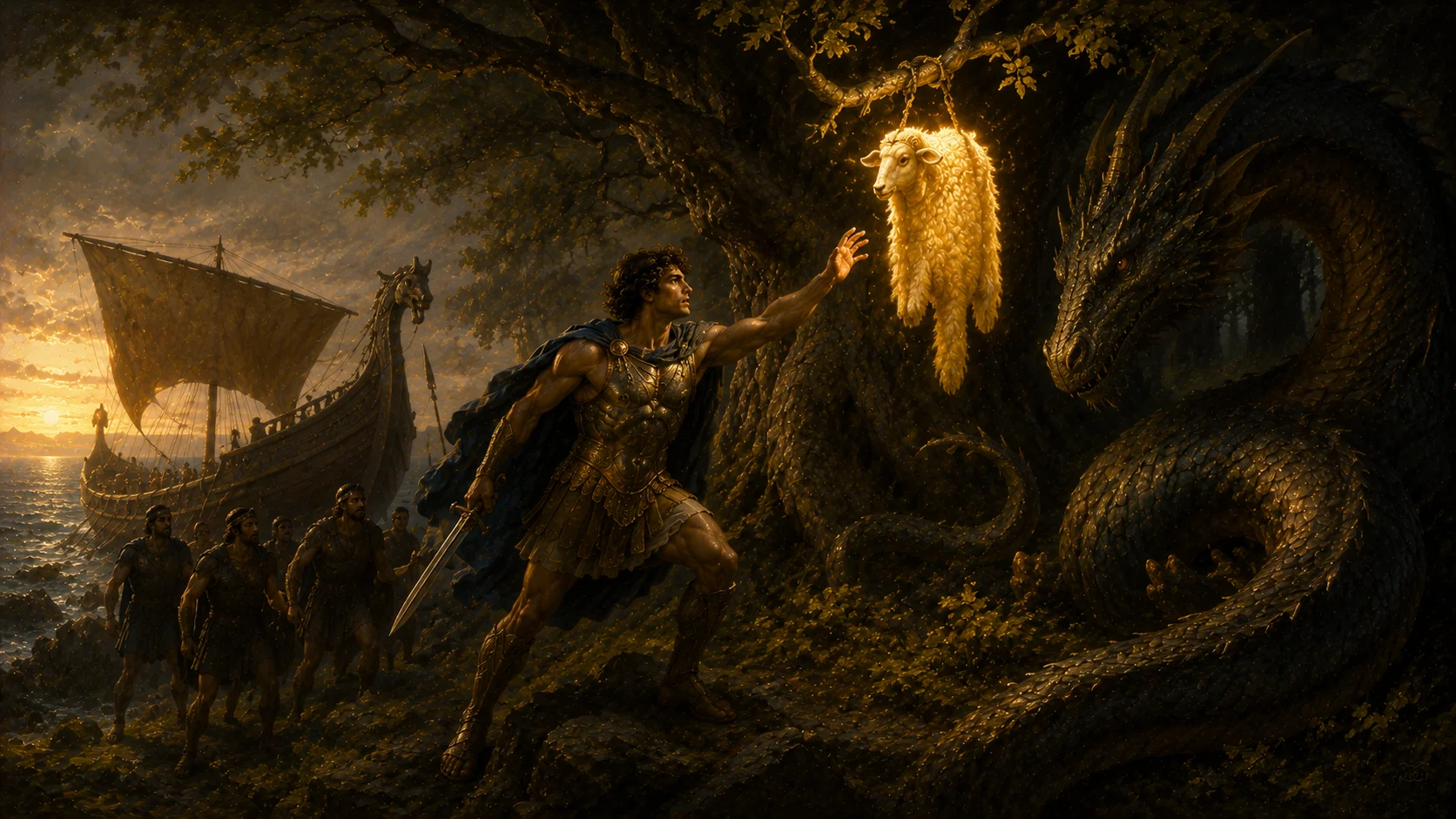
Arriving in Colchis did not mean claiming the Fleece. King Aeetes, who guarded it, set Jason a sequence of trials designed to be fatal: yoke a pair of bulls that breathed fire, sow a field with the teeth of a dragon and survive the armed warriors that sprang instantly from the furrows, and finally face down the sleepless dragon coiled around the Fleece itself. Any one of the three would have finished an ordinary man. Aeetes had not built these tasks to test Jason — he had built them to end him.
The Sorceress Who Made the Impossible Survivable
Jason lived through all three trials only because of Medea, Aeetes' own daughter and a sorceress in her own right. She fell in love with him — aided, in Apollonius' telling, by the intervention of Eros and Aphrodite — and turned that love into the margin between Jason's death and his triumph. Her craft neutralized the bulls, her counsel carried him past the sown warriors, and her power was what finally stilled the dragon long enough for the Fleece to be taken. Without her, there is no version of this story in which Jason leaves Colchis alive.
Blood on the Water During the Escape
Winning the Fleece was not the end of the danger; Aeetes pursued them, and the escape from Colchis cost a life beyond any dragon or bull. Medea's own brother, Apsyrtus, died in the course of the flight — killed and dismembered by Medea herself, in Apollonius' account, specifically to delay their pursuers, who were forced to slow and gather the scattered remains. It is one of the darkest single acts in the whole cycle, committed by the woman who had already given up everything else for Jason's sake, and it marks how far her devotion to him was willing to go.
A Homecoming Bought with Pelias' Own Blood
Jason returned to Iolcus with the Fleece in hand, but Pelias had never truly intended to surrender the throne, prophecy or no prophecy. Medea settled that account in her own fashion: she tricked Pelias' daughters into believing that cutting their aged father into pieces and boiling him in a cauldron would restore his youth. It did not. The daughters killed their own father believing they were saving him, and Jason's claim to Iolcus was avenged in the same stroke — but the act was too monstrous to be forgiven by the city, and Jason and Medea were forced out of Iolcus into exile at Corinth.
The Marriage That Undid Everything
In Corinth, Jason set aside the woman who had killed for him, deceived for him, and given up her homeland and her family for him. He chose instead to marry Glauce, also known as Creusa, the princess of Corinth — a match that offered him status and security in a city that was not his own. It is the hinge on which the entire legend turns: everything Medea had done was in service of a bond that Jason discarded the moment a better offer arrived.
Medea's Answer, and the Price Jason Paid for It
Medea's revenge, as dramatized in Euripides' tragedy Medea in the fifth century BCE — the source through which this episode is best known — was total. She killed Glauce, and then killed her own children by Jason, ensuring that nothing of what he had built with her, or without her, would survive intact. Jason was left with no bride, no heirs, and no wife, having lost in a single act of vengeance everything the Fleece and the throne of Iolcus had ever been worth to him.
Death Beneath the Ship That Made Him
Jason's end, as later mythographers record it, came without battle or grandeur. He had dedicated the aging Argo at a sanctuary, the great ship long retired from the sea, and one tradition holds that he was resting beneath it when a rotting beam gave way and fell on him as he slept. The ship that had carried him to the edge of the world and made him the most celebrated captain of his age was, in the end, the thing that killed him — a quiet, almost anticlimactic close to a life built on the loudest kind of glory.
The Shape Jason Gave to Every Quest After Him
Beyond the particulars of his own story, Jason stands as the paradigmatic quest-leader of Greek myth: the man who assembles a crew of the age's greatest names and sails them into the unknown for a single, near-impossible prize. The Argonautica, chiefly preserved through Apollonius of Rhodes' epic, alongside Euripides' Medea and Pindar's Fourth Pythian Ode, established a narrative pattern — the gathered company, the trials, the fatal cost of victory — that would echo through Western storytelling long after the Argo itself had rotted at its mooring. He gathered the greatest crew in history, and his own legend still turns less on what he won than on what his triumph ultimately cost the people who made it possible.
Sources & traditions
- EncyclopediaWikipedia — Jason
- TraditionGreek texts, inscriptions and later retellings (Greece)
Myths change from area to area and from time to time. This chronicle follows the most widely told versions; tellings in other villages, regions and eras may differ.