Orpheus was the greatest musician who ever lived — a poet and lyre-player whose songs could charm beasts, move stones, and bend rivers from their course. But his fame rests on the most heartbreaking journey in all of Greek myth: the day he walked into the land of the dead to bring back the woman he loved, and lost her at the very last step.
A Muse's Son from Thrace
Orpheus was born in Thrace, the wild country north of Greece proper, long associated with music and ecstatic religion. His mother was Calliope, the Muse of epic poetry — the eldest and most eloquent of the nine sisters who preside over the arts. Most sources give his father as Oeagrus, a Thracian king, though a strand of later tradition names Apollo himself as his father instead, a claim that reflects how completely Orpheus was bound up with Apollo's own domain of music and prophecy. Whichever parentage a given storyteller preferred, the point of both versions was the same: this was no ordinary singer, but one born from divinity itself, half-mortal only in the technical sense.
The Lyre That Could Not Be Refused
In many tellings it was Apollo who gave Orpheus his lyre, placing in mortal hands an instrument that belonged properly to a god. What Orpheus did with it went beyond even Apollo's own reputation for beautiful music. When Orpheus played, wild animals abandoned their fear and their hunger alike and lay down together to listen. Trees were said to tear their roots from the earth and shuffle closer, and rivers slowed their current, and rocks that had never moved for anything moved for him. Greek sources as early as Apollonius of Rhodes describe this power plainly, and Roman poets after him, especially Ovid, elaborated it further. It was not simply that Orpheus played well. His music was described as a force that could suspend the ordinary rules by which the world worked — persuasion made audible, capable of reaching creatures and objects that had no ears for language and no reason to listen to anyone.
Aboard the Argo
Orpheus's gift was not confined to quiet wonder-working; it also had practical, even life-saving use. He sailed with Jason and the Argonauts on their voyage for the Golden Fleece, taking his place among heroes like Heracles in a crew whose fame rested mostly on strength and cunning. Orpheus's contribution was different in kind. His music, by tradition, helped set the rhythm and morale of the rowers and was said to calm dangerous seas when the ship needed it most. His single most celebrated feat as an Argonaut came when the ship passed the Sirens, whose song lured sailors to their deaths on the rocks. Where Odysseus, in a separate and later story, would survive the Sirens by having himself bound to the mast and his crew's ears sealed with wax, Apollonius of Rhodes tells of Orpheus doing something bolder: he simply played his own lyre louder and more beautifully than the Sirens could sing, drowning out their voices entirely so that the Argonauts sailed past unharmed and, by most accounts, unafraid.
Eurydice
Orpheus married Eurydice, a dryad or nymph of the woodlands in most versions of the story. Their marriage is given almost no detail in the surviving sources beyond its ending — the myth is interested in her death, not her life, which is itself telling of how completely this story is organized around loss. In the fullest ancient accounts, those of Virgil in the Georgics and Ovid in the Metamorphoses, Eurydice died of a snakebite while fleeing the unwanted pursuit of Aristaeus, a beekeeper. She stepped, in her flight, onto a serpent hidden in the grass, and the marriage that the poets never pause to describe was over almost as soon as it is mentioned.
Into the Land Where No Living Foot Belongs
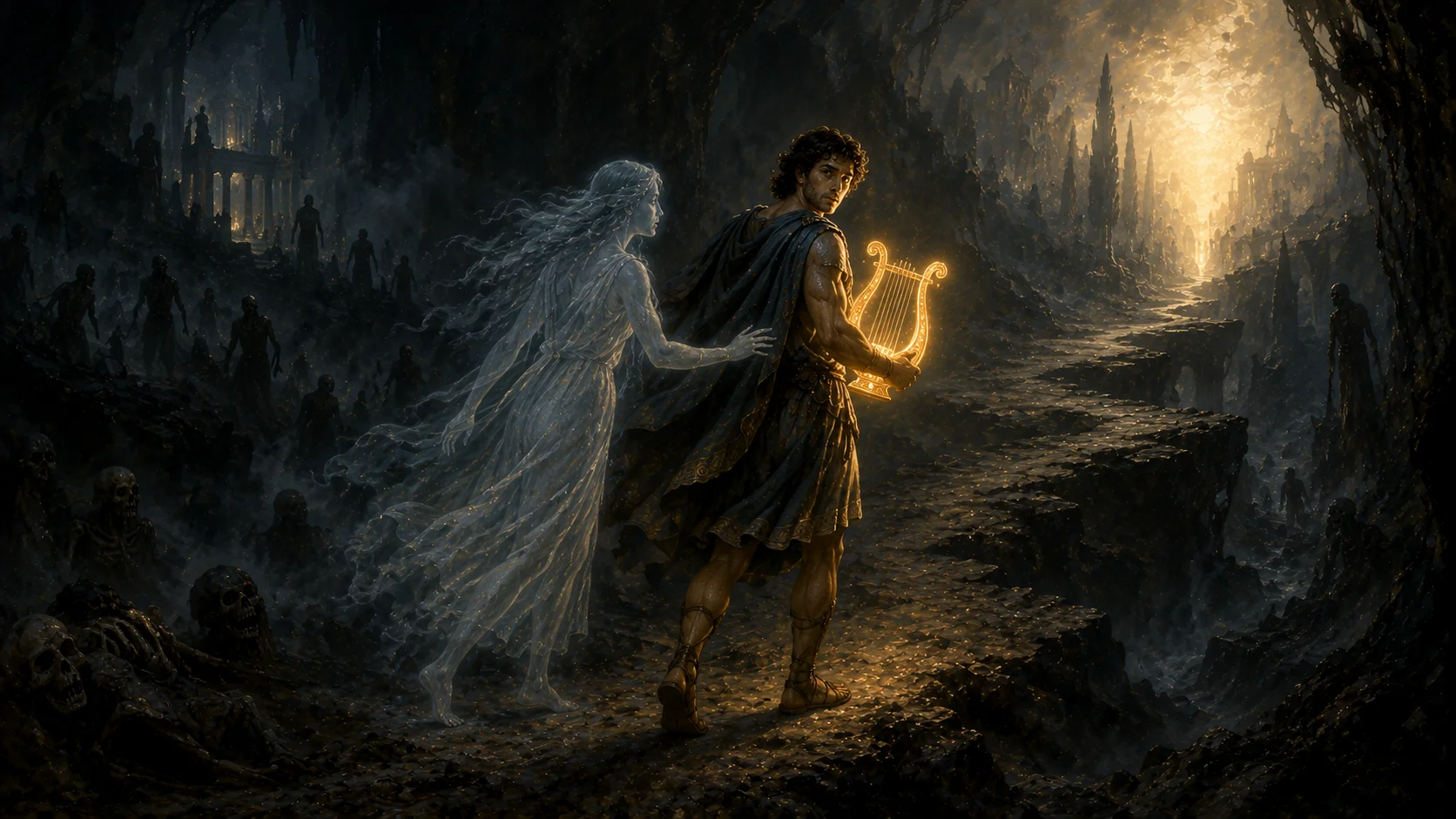
Grief did not settle into acceptance. Orpheus did what no other figure in Greek myth is remembered for attempting in quite the same way: he went down, alive, into the underworld to ask for his wife back. This descent is the best-attested and most fully developed of all the Orpheus myths, given its richest surviving literary treatment in Virgil's Georgics, Book Four, and in Ovid's Metamorphoses, Book Ten. He carried nothing with him but the lyre. Whatever guardians and horrors stood between the world of the living and the world of the dead, the story does not dwell on them as obstacles overcome by force — Orpheus's only weapon, and his only argument, was song.
A Song Before the Thrones of the Dead
Orpheus played and sang before Hades and Persephone, the king and queen of the underworld, pleading his case not in ordinary speech but in music powerful enough to move the immovable. The effect, as the poets describe it, was almost unthinkable in a realm defined by the fixed and irreversible: the rulers of the dead were said to have wept, and the wheel on which the sinner Ixion was eternally bound was said to have stopped turning, if only for the length of the song. Whatever the underworld's usual laws, they bent that day. Hades and Persephone granted Orpheus's plea: Eurydice would be permitted to leave with him and return to the world of the living.
One Condition
The grant came with a single condition, and the whole weight of the myth rests on it. Orpheus was to walk ahead, out of the underworld and back toward daylight, with Eurydice following behind him — and he was forbidden to look back at her until both of them had fully reached the world above. It was a test built entirely out of trust, asking Orpheus to believe in what he could not see or hear confirmed, for as long as it took to climb out of the dark.
The Long Climb
The ascent through the underworld's passage was, by every account, agonizing. Orpheus heard nothing behind him to prove Eurydice was there — no footsteps, no voice, nothing but silence and his own uncertainty growing with every step closer to the light. Had Hades and Persephone kept their word, or had it all been an illusion granted only to be cruelly withdrawn? The myth does not give Orpheus any reassurance to hold onto. It gives him only the climb, and the growing weight of not knowing.
The Backward Glance
In both Virgil's and Ovid's versions, Orpheus's nerve broke not partway through the ascent but at its very end, almost within reach of the surface. Unable to bear the doubt any longer, he turned to look at her. For one instant she was there, visible, real — and then she slipped back into the dark, this time beyond any recovery, with only a faint and final word of farewell reaching him. He had lost her a second time, and this time by his own hand, at the exact threshold of success.
Grief, Rejection, and the Maenads
What became of Orpheus afterward is remembered as a second tragedy layered on the first. Most accounts describe him withdrawing from the company of women altogether in his grief, a rejection that some tellings connect to his eventual death; other versions instead attribute his death to a slight against Dionysus, favoring Apollo and the sun over the wine-god's rites. Either way, he was set upon and torn apart, in an act of ritual violence known as sparagmos, by the Maenads — the frenzied female followers of Dionysus native to his own Thrace. The instrument of his greatest fame, in some tellings, could not save him from those he had once been able to charm.
The Head That Kept Singing
Even dismemberment did not silence him. Orpheus's severed head, still singing according to Ovid and other classical sources, was carried down the Hebrus River until it came to rest on the island of Lesbos, where it was said to have continued speaking prophecy to those who sought it. An oracle grew up around it and was consulted for a time, until, in the sources that record its end, Apollo himself ordered it to fall silent — a fitting final note given how closely Orpheus's own gifts had always overlapped with Apollo's twin domains of music and prophecy.
Teachings Carried in His Name
Orpheus's legend gave rise to Orphism, a body of religious and mystery beliefs, along with a collection of Orphic Hymns composed later, in the Hellenistic and Roman periods, and attributed back to him. These teachings concerned the fate of the soul after death and its possible reincarnation, offering initiates a different relationship to mortality than the ordinary Greek afterlife promised. Scholars continue to debate how much of Orphism traces to any single historical founder and how much accumulated around his name over centuries, but the association itself was strong enough that his myth became inseparable from Greek religious speculation about what happens to a person after they die — an apt legacy for a man who had once tried, and failed, to answer that question by force of will alone.
A Story the World Kept Retelling
Few Greek myths have been returned to as often, in as many forms, as this one. Orpheus's descent and his backward glance became a founding subject of opera — Monteverdi's L'Orfeo and Gluck's Orfeo ed Euridice among the most celebrated — and have furnished painters and poets with material for centuries after. The image of Orpheus turning to look, undone in the very last step by the one thing he was asked not to do, has outlasted the details of plot and setting to become a touchstone in its own right: shorthand for how easily faith gives way to doubt, and how the smallest human weakness can undo what even the dead were once persuaded to grant.
He charmed even death into mercy — and then could not trust it for the length of one last walk into the light.
Sources & traditions
- EncyclopediaWikipedia — Orpheus
- TraditionGreek texts, inscriptions and later retellings (Greece)
Myths change from area to area and from time to time. This chronicle follows the most widely told versions; tellings in other villages, regions and eras may differ.