Atalanta was the great heroine of Greek myth — a huntress as swift and deadly as any man, who drew first blood on a monstrous boar, wrestled a hero to the ground, and would only marry a man who could outrun her. In a mythology dominated by male heroes, she stands as the woman who beat them at their own games, a figure the ancients themselves could not agree how to place: Arcadian tradition called her daughter of Iasus, while other accounts, including material drawn from Hesiodic fragments, name her father as Schoeneus of Boeotia. The two lineages were never reconciled in antiquity, and later retellings simply chose whichever suited the region telling the story.
Left on the Mountain, Nursed by a Bear
Atalanta's father wanted a son. When a daughter came instead, he had her exposed on Mount Parthenion to die of cold and neglect, as was done to unwanted infants across the ancient world. She did not die. Artemis, goddess of the wild places and of women who lived outside marriage, sent a she-bear to suckle the abandoned child, and hunters found her afterward and raised her among their own. The girl grew up in the forest rather than the household, trained to the bow and the chase rather than the loom, and the manner of her survival marked her from birth as belonging to Artemis before she belonged to any husband or father.
A Virgin Sworn to the Wild Goddess
Atalanta became one of Artemis's devoted favorites, and she kept the vow of virginity that devotion implied with the same ferocity she brought to the hunt. Ancient sources treat her Artemis-worship not as an incidental detail but as the key to everything else about her: the forest childhood, the hunting prowess, the refusal of marriage, and the violence with which she defended that refusal all trace back to the goddess who had saved her life on the mountainside. She was swift-footed, self-sufficient, and, in a mythology that rarely allowed women such things, entirely her own.
First Blood on the Calydonian Boar
When Artemis loosed a monstrous boar upon Calydon in punishment for a slight, the greatest hunters of Greece assembled to bring it down. Among them, uniquely, was a woman. Atalanta drew first blood, landing her arrow in the beast before any of the men could claim the honor. Meleager, who led the hunt, awarded her the boar's hide as the rightful prize of the first strike — and the gift split the company into bitter factions. In some accounts, the resentment ran so deep that Meleager's own uncles were killed over the dispute, a chain of consequence that some tellings trace all the way to Meleager's own death. Whatever the aftermath, the hunt itself left no doubt: Atalanta had outshot every man on the field.
A Disputed Place Among the Argonauts
Some traditions carry Atalanta even further, placing her aboard the Argo among Jason's crew on the quest for the Golden Fleece. The claim was never universally accepted. Apollonius of Rhodes, in his Argonautica, pointedly leaves her off the ship's roster, and gives Jason's own reasoning for the exclusion: he feared that a woman's presence among so many men would breed exactly the kind of strife that had already torn the Calydonian hunters apart. Whether or not she ever set foot on the Argo, the dispute itself says something about how ancient audiences understood her — a figure whose presence among heroes was always, to some tellers, a provocation.
Thrown to the Ground by a Future Hero's Father
Among Atalanta's most striking feats was not a hunt but a wrestling match. At the funeral games held for King Pelias, she faced Peleus — the man who would in time father Achilles — and beat him. Apollodorus and other mythographers record the victory plainly, without hedging, as one more proof that Atalanta's body could do what heroes' bodies did, on the same ground, against the same opponents, and win.
A Race Where Losing Meant Death
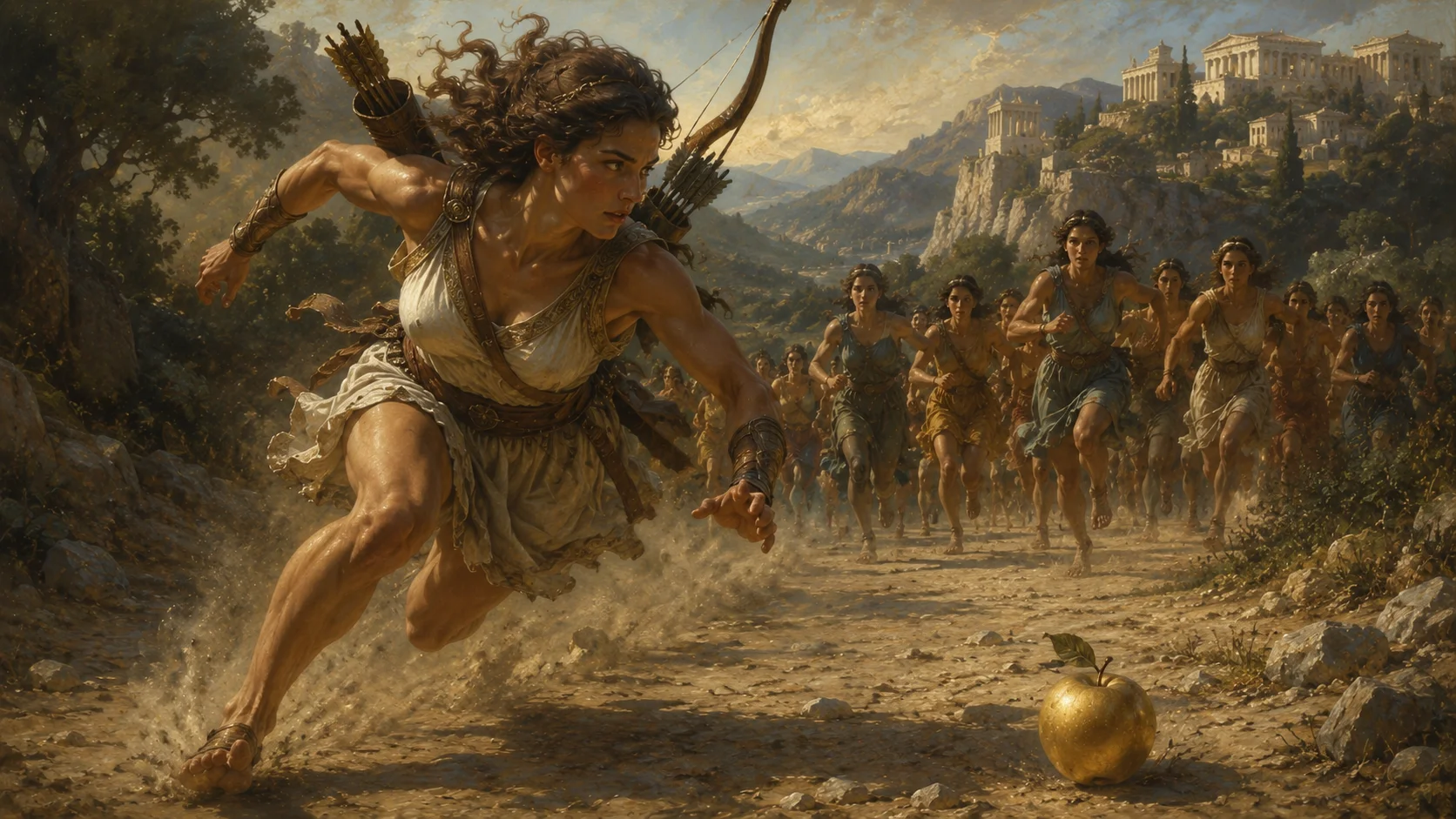
Pressed, as every woman in her position eventually was, to marry, Atalanta answered on her own terms. She would take no husband who could not first outrun her in a footrace — and any man who tried and failed would be killed. It was not an idle threat. She was faster than every suitor who came before, and the losers paid the price she had set. The contest reads less as a bride-game than as a continuation of her Artemis-sworn refusal of marriage: a test designed, at least in part, never to be passed.
Three Golden Apples from the Garden of the Hesperides
It was passed all the same. A suitor — Hippomenes in Ovid's telling, Melanion in the older Boeotian tradition, the sources disagreeing on his name as thoroughly as they disagree on Atalanta's own parentage — prayed to Aphrodite for help against a runner he could not hope to beat honestly. The goddess gave him three golden apples, plucked from the garden of the Hesperides, each one so radiant that no mortal eye could pass over it unmoved. During the race he let them fall one at a time. Each time, Atalanta broke her stride to snatch the gleaming fruit from the ground, and each pause cost her just enough distance. She crossed the line beaten — not by speed, which she still possessed in full, but by desire, and by a goddess who had reason to see the huntress married.
Lions in a Sacred Grove
The marriage that followed did not end peacefully. The couple, in the flush of their union, made love inside a sacred precinct — a temple, depending on the source, either of Zeus or of Cybele — and the offended deity punished the sacrilege by transforming them both into lions. The Greeks believed lions could not mate with their own kind, could only pair with leopards, and so the transformation was not merely a curse but a particular cruelty shaped to the crime: the two who had defiled a god's sanctuary with their desire were condemned to bodies that could never again satisfy it with each other. It is a savage coda to a courtship that began with a trick of golden apples, and ancient tellers seem to have meant it that way.
A Son Marked for the Seven Against Thebes
Atalanta bore a son, Parthenopaeus, whose name carries an echo of the mountain where she herself had once been left to die. His paternity shifts with the source, as so much of Atalanta's story does: some accounts give the child to Melanion or Hippomenes, her husband, while others — particularly those emphasizing his eventual fate — make Ares his father. Whichever line is followed, Parthenopaeus grew to manhood and joined the doomed company of the Seven Against Thebes, carrying his mother's blood into one of the great catastrophes of the heroic age.
A Figure Vase-Painters Could Not Stop Drawing
No scene from Atalanta's story appears more often on Greek pottery than her wrestling match with Peleus, unless it is her drawing her bow against the Calydonian boar. Painters returned to both again and again, drawn to the same thing later poets were drawn to: a woman's body doing, without apology, exactly what a hero's body did. She became a fixture of vase painting precisely because she offered artists an image mythology rarely supplied elsewhere — strength and swiftness embodied in a woman who needed no man's permission to possess them.
Ovid's Runner, Rendered for Rome
Centuries after the vase-painters, Ovid gave Atalanta her fullest literary treatment in Book Ten of the Metamorphoses, dwelling at length on the race against Hippomenes and the golden apples that decided it. The episode became, through Ovid's telling, one of the most widely known versions of her story to reach later European readers, fixing the footrace and its trick as the image of Atalanta that outlasted the older, harsher variants of her myth.
An Emblem That Outran Her Own Century
Atalanta's afterlife in European art and literature reached far beyond the vase-painters and Ovid. She became a recurring emblem — invoked wherever writers and painters wanted a figure who embodied female athletic prowess, or who stood for resistance to marriage refused and only reluctantly, cunningly, overcome. The huntress raised by a bear on an Arcadian mountainside, who outran every suitor but one, remained legible across centuries precisely because no later age could fully resolve what the Greeks themselves had left unsettled: whether she was ultimately caught, or whether the apples were simply the price the world extracted from a woman who had, for as long as she could, refused to be caught at all.
Sources & traditions
- EncyclopediaWikipedia — Atalanta
- TraditionGreek texts, inscriptions and later retellings (Greece)
Myths change from area to area and from time to time. This chronicle follows the most widely told versions; tellings in other villages, regions and eras may differ.