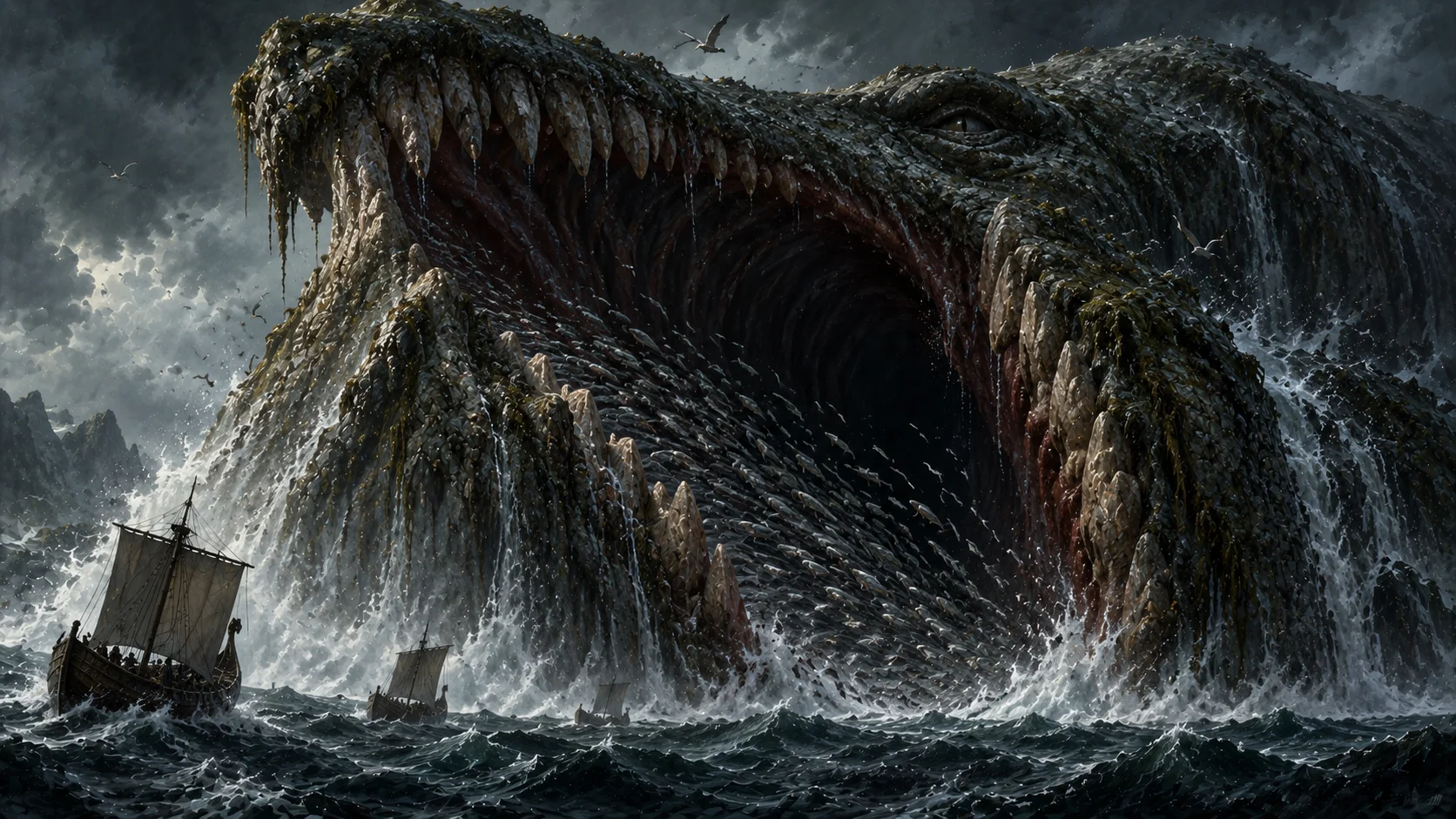
A sailor on the Greenland Sea sees two rocks break the surface ahead. He steers around them. Later, a heather-covered island rises off the bow. Then the island sinks. Then the rocks sink. There was no island and there were no rocks. There was a mouth.
Two Rocks That Were Not Rocks
This is the scene Örvar-Odds saga — Arrow-Odd's Saga, a legendary saga (fornaldarsaga) likely composed in the 13th century and set in a pseudo-historical Viking Age — gives us, and it is the only saga narrative in which the Hafgufa appears at all. Örvar-Oddr and his crew are sailing through the Greenland Sea in pursuit of the troll Ögmundr Eythjófsbani, also called Ögmundr Floki, when the sea itself seems to misbehave. First come the two rocks. Later comes the heather-covered island. Oddr, sensibly cautious, sends five men ahead to investigate before anyone else sets foot on it — and as the boat closes the distance, both the rocks and the island vanish beneath the waves, taking whatever confidence the crew had in the solidity of the sea with them.
It falls to the character Vignir to explain what the men have actually been looking at. The rocks, he says, were Hafgufa, a creature so vast it is said to "bear" or "contain" all the other monsters of the sea — the greatest of them, the one the rest are measured against. The island was a second monster entirely, Lyngbakr, "heather-back," a beast whose spine had grown its own miniature landscape. Vignir's closing point is the one that should chill a reader more than the sighting itself: had the five men actually landed, they would have drowned. The saga does not treat this as a narrow escape from an unlucky reef. It treats it as an escape from a decision the sea had been quietly inviting them to make.
The Name Is the First Clue
Old Norse haf means "sea, ocean"; gufa means "steam, mist, vapour." Put together, Hafgufa is "sea-mist" or "sea-steam" — a name that describes not a shape but an impression. It is the name sailors would give something glimpsed at a distance, hazy on the horizon, more atmosphere than anatomy, before it resolved — too late — into something with a jaw. Lyngbakr's name, by contrast, is transparent and un-mysterious: lyng ("heather") plus bak ("back"), describing exactly what it looks like from a boat. The two names together tell you how each creature deceives. Lyngbakr looks convincingly like land because vegetation has taken root on it. Hafgufa looks like nothing in particular — a haze, a smudge, something the eye fills in as rock because rock is the least alarming explanation available.
The King's Mirror Sees It Clearly
The saga sighting is brief and gives Hafgufa almost no physical description beyond its outline on the water. The fuller picture comes from a very different kind of text: Konungs skuggsjá, the "King's Mirror" or Speculum Regale, a 13th-century Norwegian didactic work composed for or around King Hákon Hákonarson, who reigned from 1217 to 1263. This is not saga literature. It is closer to an education manual — a father instructing a son in the practical and natural knowledge a future king should have, including, apparently, what waits in the water off Norway's coasts.
The King's Mirror calls Hafgufa the largest of all creatures in the sea, and it makes explicit what the saga only implies: those two "islands" or skerries that sailors sometimes see rising from open water are not separate from the monster. They are the monster — its jaws, its nostrils, breaking the surface while the rest of its bulk stays submerged. A ship's crew scanning the horizon for landmarks is, without knowing it, reading the face of something enormous and alive.
A Trap Built From Appetite
Where the saga gives a sighting, the King's Mirror gives a mechanism, and it is the single most vivid thing in the entire Hafgufa tradition. The creature does not hunt by chasing. It hunts by advertising. Hafgufa gives a great belch from its throat, releasing a large quantity of food and scent into the water around it — an offering, in effect, cast out into open sea. Fish of every kind, large and small, come from all directions to feed on what has been disgorged, drawn by a smell too good to leave uninvestigated.
They gather. And gather. The King's Mirror is specific that even whales join the crowd, all of them believing they have found a sheltered channel between two rocks — a safe harbour, of sorts, rich with food and calm water. It is, of course, the space between Hafgufa's open jaws. When enough of them have crowded in, the monster simply closes its mouth and swallows everything inside it at once: the fish, the whales, and any ship that happened to be drifting with them, mistaking the same gap for safe passage.
It is worth sitting with what kind of monster this makes Hafgufa. It does not chase, does not fight, does not need speed or teeth bared in pursuit. Its entire predation is patience dressed as generosity: offer something desirable, let hunger do the work of gathering the prey into a single space, then close the trap. The fish are not caught. They arrive.
Only Two, and None to Follow
The King's Mirror adds a detail that turns Hafgufa from merely enormous into something closer to singular: it is said that only two Hafgufur exist in all the seas of the world, and that they are unable to reproduce — the only ones of their kind, with no others to come after them. Medieval writers grappling with a creature this vast seem to have reasoned backward from its size to its scarcity: the world could not hold more than a pair of something so large, and a species this immense could not sustain the ordinary churn of birth and generation that smaller sea-life manages. Whether or not the saga audience took this literally, it does real narrative work — it makes every sighting of Hafgufa feel less like an encounter with a species and more like an encounter with an entity, one of only two things like it that will ever exist.
Absent From the Central Myths
It would be easy to assume a monster this dramatic belongs somewhere in the Eddas, alongside Jörmungandr and the other great beasts of Norse cosmology. It does not. Hafgufa is absent from the core narrative portions of both the Poetic Edda and Snorri Sturluson's Prose Edda — it plays no part in Gylfaginning's account of the gods, and no part in the main narrative of Skáldskaparmál. The closest brush with that material is a variant spelling, "hafgúa," which turns up only in the Nafnaþulur, a whale-name list appended to some manuscripts of Skáldskaparmál, and even that connection to the saga/King's Mirror creature is uncertain rather than established.
This absence is not a gap in the record so much as a statement about what kind of thing Hafgufa is. No source gives it a parent, an origin, a death, or a place in any divine genealogy — unlike Jörmungandr, who is Loki's child and Thor's great adversary, bound into the structure of the pantheon and its coming end at Ragnarök. No god rides Hafgufa, fights it, binds it, or fishes for it in any surviving text. It belongs instead to saga literature and to a king's education manual: the register of the sea as sailors actually reported it, hazardous and half-understood, rather than the register of cosmic myth. Hafgufa is not there to explain the shape of the world. It is there to explain why an experienced crew still drowns sometimes, for no reason anyone on shore can account for.
A Family of Deceiving Coastlines
Hafgufa is not alone in this particular fear. It belongs to a widespread family of "living island" sea-monster legends found across medieval traditions — the same motif behind the Greek Aspidochelone and, later, the island Sinbad lands on in the Arabian Nights: a creature so large that sailors mistake it for solid ground, to their ruin if they anchor or step ashore. Within Norse tradition specifically, its nearest kin is Lyngbakr, the heather-backed whale it shares its one saga scene with. The two function as a matched pair rather than rivals — Lyngbakr deceives by growing a landscape on its back, Hafgufa deceives by simply looking like the sea itself, mist and rock indistinguishable from the real thing until it is too late to matter which.
Medieval and later commentators, faced with sparse and sometimes ambiguous sources, have not always agreed on how literally to take any of this — whether Hafgufa is best understood as a whale, a fish, an early ancestor of the Kraken, or simply a generic sea-monster type applied loosely across different manuscripts. Because Hafgufa survives in only two real textual attestations, that uncertainty is built into the tradition rather than a modern imposition on it.
What the Whales Were Actually Doing
The most striking modern turn in Hafgufa's story is not literary but scientific. A discussion that circulated widely in 2023, popularised through outlets including Yahoo Sports and drawing on academic commentary, proposed that the King's Mirror's belch-and-swallow description maps with real precision onto documented baleen whale behaviour — a technique now known as "trap feeding," in which a whale holds its mouth open and motionless at the surface, letting fish gather inside it before closing on the shoal in a single motion.
Read this way, the medieval account is not pure invention scaled up for effect. It may be an accurate field observation of actual whale behaviour, magnified by distance, fear, and the storytelling instincts of sailors who had genuinely seen something extraordinary happen on open water and described it as faithfully as they could — just at a far larger scale. The name itself, "sea-mist," would then record the very moment of that magnification: a whale's blow and surfacing, seen from far off, resolving in the mind into something altogether larger and stranger.
Where the Kraken Begins
Hafgufa is frequently linked, in modern popular and cryptozoological writing, to the Kraken — the giant sea-monster of later Scandinavian folklore best known from Erik Pontoppidan's 18th-century Natural History of Norway. The connection is intuitive: both are described as vast, both are associated with luring or overwhelming ships, both sit at the outer edge of what the medieval and early-modern North Atlantic imagination could do with the idea of "something enormous, under the water, that you cannot see the whole of."
But this equation belongs to later commentators making a comparison, not to the medieval sources making an identity claim. The Kraken as a named folkloric monster is a distinct, later development, attested centuries after the King's Mirror and the Örvar-Odds saga episode were composed. Hafgufa is not called a Kraken in any medieval Norse text, and treating the two as simply the same creature under different names collapses a gap in the record that the sources themselves never close.
What Survives of the Sea-Mist
Hafgufa has carried its name into modern media on its own terms rather than through the Kraken's. The 2022 video game God of War Ragnarök features Hafgufa as a named creature, loosely inspired by the medieval descriptions but embellished well past them — depicted as something closer to a giant jellyfish-leviathan hybrid, a design choice with no basis in either the saga or the King's Mirror. It is a reminder of how thin the original textual record actually is: two attestations, a handful of sentences each, are more than enough raw material for a modern imagination to build an entire boss encounter on, but not enough to constrain what shape that encounter takes.
Strip the adaptations away, though, and what is left is remarkably steady across eight centuries: a creature identified with the sea itself rather than opposed to it, so large that the distinction between monster and landscape briefly stops meaning anything. It does not need to chase what it eats. It only needs to look, for a little while, like somewhere safe to be.
Sources & traditions
- EncyclopediaWikipedia — Hafgufa
- TraditionNorse texts, inscriptions and later retellings (Scandinavia)
Myths change from area to area and from time to time. This chronicle follows the most widely told versions; tellings in other villages, regions and eras may differ.