Fenrir was the monstrous wolf of Norse myth — the gigantic, ever-growing child of Loki whom the gods feared so much that they bound him with an unbreakable magical fetter, and who is fated, at Ragnarök, to break free and devour Odin himself. He is the embodiment of the destructive chaos the gods could chain but never destroy, the wolf whose breaking loose signals the end of the world.
A Litter Born of Chaos
Fenrir (Old Norse Fenrir, also rendered Fenrisúlfr, “Fenris-wolf”) came into the world as one of three terrible children born to the trickster Loki and the giantess Angrboða. His siblings were no less fearsome: Jörmungandr, the serpent destined to encircle the whole of Midgard in its coils, and Hel, who would come to rule over the realm of the dead. Together the three represented something the gods had never had to reckon with before — offspring of their own kinsman Loki, but shaped by giant blood into forms built for ruin. Where Jörmungandr was cast into the sea and Hel was given dominion over the dead, Fenrir alone was kept close, brought into Asgard itself, because the gods believed that if they raised him under their own eyes they might yet master what he would become.
Raised Among Those Who Feared Him
In his early days Fenrir was watched over by the gods directly, but that closeness curdled quickly into dread. The wolf did not grow the way an ordinary creature grows; he grew as if some force beyond nature were feeding his bones and sinew, larger with every passing day, until his presence alone was enough to empty a hall. Soon no one among the gods would come near enough to set food before him — no one except Týr, whose courage in this one respect set him apart from every other god in Asgard. It was Týr's hand that fed Fenrir through those growing years, and it was Týr who would later pay the price for the trust that daily feeding could never quite earn.
A Doom Foretold Before He Struck a Blow
The gods' unease was not idle superstition. Prophecy had already marked Fenrir out, declaring that he was destined to bring great harm upon them — a doom spoken of before the wolf had done anything to deserve it, simply by existing as what he was. Facing a fate that could not be argued away, the gods did not attempt to kill him outright. Instead they resolved on containment: if the wolf's nature could not be changed, perhaps his strength could be checked, and the day the prophecy named could be pushed off, chain by chain, for as long as their craft allowed.
Two Fetters Broken Like Thread
Their first attempts were straightforward and, in hindsight, almost naive. The gods forged a heavy iron fetter called Læðingr and asked Fenrir to test his strength against it, framing the whole affair as a game rather than a trap. Fenrir obliged, allowed himself to be bound, and then simply shattered the fetter, scattering its links without visible effort. A second, sturdier chain followed, named Drómi, forged doubly strong in the hope that raw mass might succeed where craftsmanship alone had failed. Fenrir broke this one too, straining until the metal gave way, and word of both feats spread through Asgard as proof that no ordinary bond, however massive, would ever be enough to hold him.
Six Impossible Things
Having failed twice with iron and brute engineering, the gods turned to a different kind of craftsman altogether: the dwarfs, whose skill ran to things no forge above ground could match. What they produced was Gleipnir, a fetter that looked like nothing more than a slender silken ribbon, smooth and soft to the touch, and utterly unlike the massive chains that had already failed. Its strength lay not in bulk but in the strangeness of what had gone into its making. The dwarfs wove it from six things that, by their very nature, could not exist as ordinary materials: the footfall of a cat, the beard of a woman, the roots of a mountain, the sinews of a bear, the breath of a fish, and the spittle of a bird. Because such things are not found in the world in the way that iron or hide are found, the ribbon woven from them could not be undone by any strength the world could offer either — a paradox made into a rope.
A Wolf Who Smelled the Trick
When the gods brought this new fetter to Fenrir and again framed it as a test of strength, the wolf was not fooled by its delicate appearance. If anything, the ribbon's slightness made him more suspicious than the iron chains had, for a thing so easily broken should never have needed forging in the first place. He refused outright to be bound by it unless one of the gods would place a hand between his jaws as a pledge — a guarantee that if the whole affair proved to be treachery, at least one of them would share in the cost. The gods, who had gathered specifically to see him bound, looked to one another, and only Týr stepped forward, the same god who alone had dared feed him through the years of his growing. He laid his right hand in the wolf's mouth as the price of the game.
The Hand That Paid for the Binding
The gods bound Fenrir with Gleipnir, and this time, however he strained, the ribbon did not give. The more he struggled, the tighter and surer the binding held, until the wolf understood what the other gods had already guessed: that he had been outmatched not by strength but by cunning, and that the game had been a trap from the start. In his fury at the deception, Fenrir closed his jaws on the hand resting inside them and bit it away. Týr lost his right hand in that instant — the same hand that had carried food to the wolf through all the years no other god would come near — and it is from this single act that Týr carries his enduring epithet as the one-handed god, a name that marks both his courage and its cost in the same word.
Bound Until the End of Days
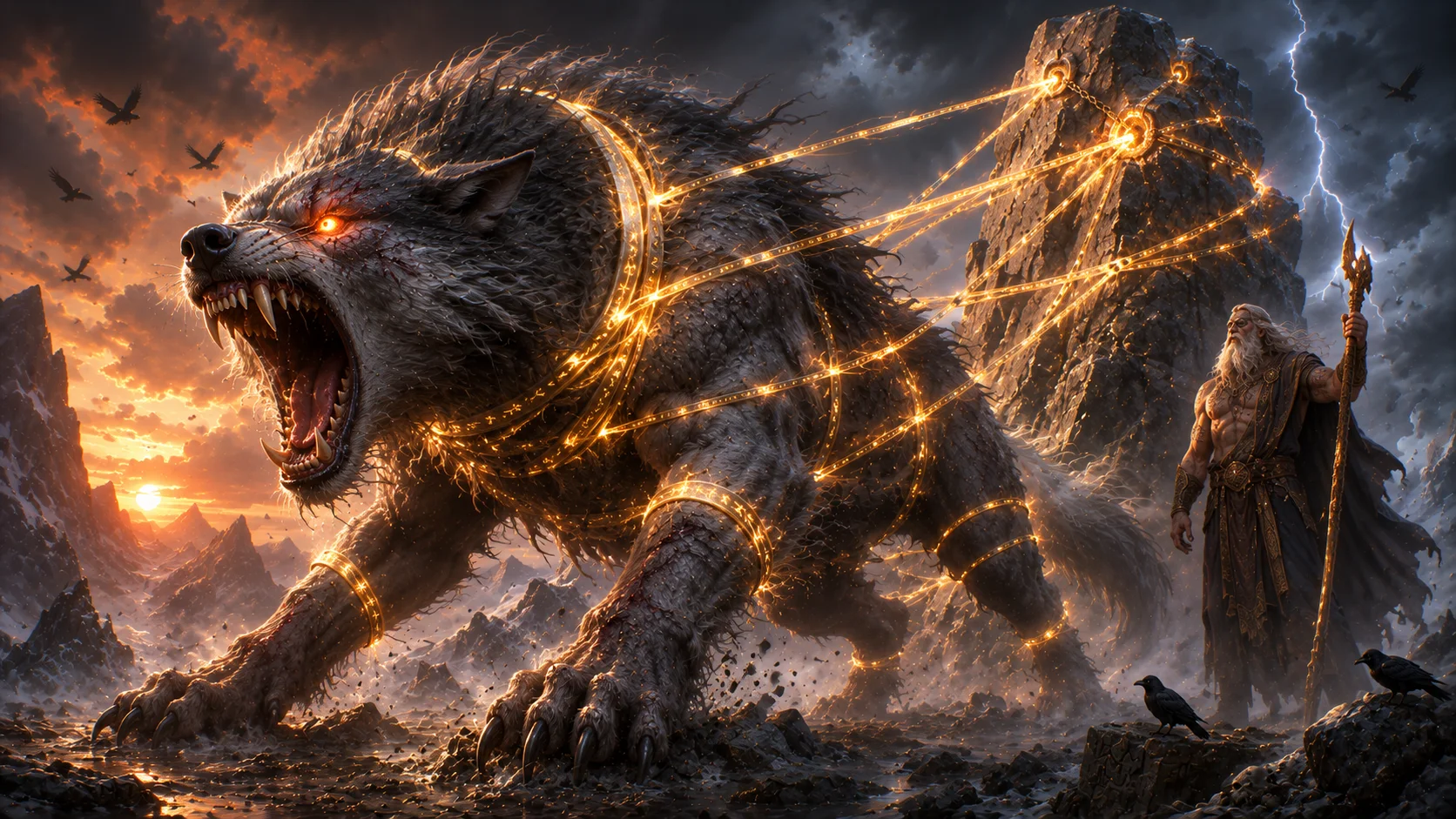
With Fenrir finally secured, the gods were not content to leave the matter to Gleipnir alone. They fastened the ribbon to a great boulder known as Thviti, driving it deep into the earth so that no amount of straining could shift it, and chained the whole binding further to a rock called Gjöll for good measure. A sword was wedged upright into the wolf's jaws, propping his mouth open so that he could neither close it nor rest, and there he was left — bound, gagged, and pinned to stone far from Asgard's halls, condemned to wait out the long years until the one day prophecy had already named for his release.
Sons Who Hunt the Sky
Fenrir's own line did not end with his binding. He fathered sons of his own — the wolves Sköll and Hati — who are prophesied to give chase across the heavens themselves, pursuing the sun and the moon through their courses until, at the end of days, they catch and devour what they have hunted for so long. Their fate runs alongside their father's rather than through it: where Fenrir waits bound to a rock until Ragnarök breaks his fetter, Sköll and Hati are already running, and their hunt across the sky belongs to them and not to him, even where later retellings have sometimes blurred father and sons into a single howling shape.
The Fetter Breaks
When Ragnarök finally comes, the binding that held for so long gives way at last, and Fenrir is loose in the world for the first time since his youth in Asgard. He advances across the earth grown to a scale that dwarfs even his monstrous youth, his lower jaw dragging along the ground and his upper jaw scraping the sky, so that his stride alone seems to swallow the space between heaven and earth. Fire is said to blaze from his eyes and his nostrils as he comes, and everything in his path passes into that vast, gaping mouth.
The Fall of the All-Father
On the battlefield where the gods make their final stand, Fenrir comes face to face with Odin, the All-Father himself, leader of the gods who had once fed and raised him and later bound him to a rock for the rest of an age. What prophecy foretold since before Fenrir had done anything to earn it is fulfilled in that meeting: the wolf swallows Odin whole, and the chief of the Norse gods is devoured in the same jaws that once closed on Týr's hand. It is the single act the whole of Fenrir's story has been building toward — the harm the gods feared from the moment they first laid eyes on him, arriving exactly as it was always going to.
Vengeance in a Single Shoe
Fenrir does not survive his triumph for long. Odin's son Víðarr, silent among the gods until this moment, steps forward to avenge his father. Wearing a shoe built and saved for this purpose alone, he sets his foot against the wolf's lower jaw and, bracing against it, tears Fenrir's mouth apart, ending the wolf's life in the same battle that claimed Odin's. Where Fenrir's death is fulfilled, some tellings place a blade rather than bare strength as the final stroke, but the outcome is unchanged either way: the wolf that could not be killed while bound is killed the moment he is finally free.
A Wolf the World Still Remembers
Fenrir survives in the sources that carry the Norse myths — chiefly the Poetic Edda, where Völuspá lays out his role in the gods' final doom and Lokasenna gestures toward Loki's monstrous brood, and Snorri Sturluson's Prose Edda, whose Gylfaginning tells the fuller story of his raising, his binding, and Týr's lost hand. Beyond these attested tellings, Fenrir has gone on to a long afterlife in modern storytelling — wolves bearing his name and shape have turned up in comics, games, and films across the decades — but those later appearances belong to reception and adaptation rather than to the myth itself, borrowed images built on a figure whose original story was fixed long before any of them existed.
The gods could chain him but never kill him — and they knew it: the bound wolf waited, jaws propped open on a sword, for the day the fetter broke and he swallowed the All-Father whole.
Sources & traditions
- EncyclopediaWikipedia — Fenrir
- TraditionNorse texts, inscriptions and later retellings (Scandinavia)
Myths change from area to area and from time to time. This chronicle follows the most widely told versions; tellings in other villages, regions and eras may differ.