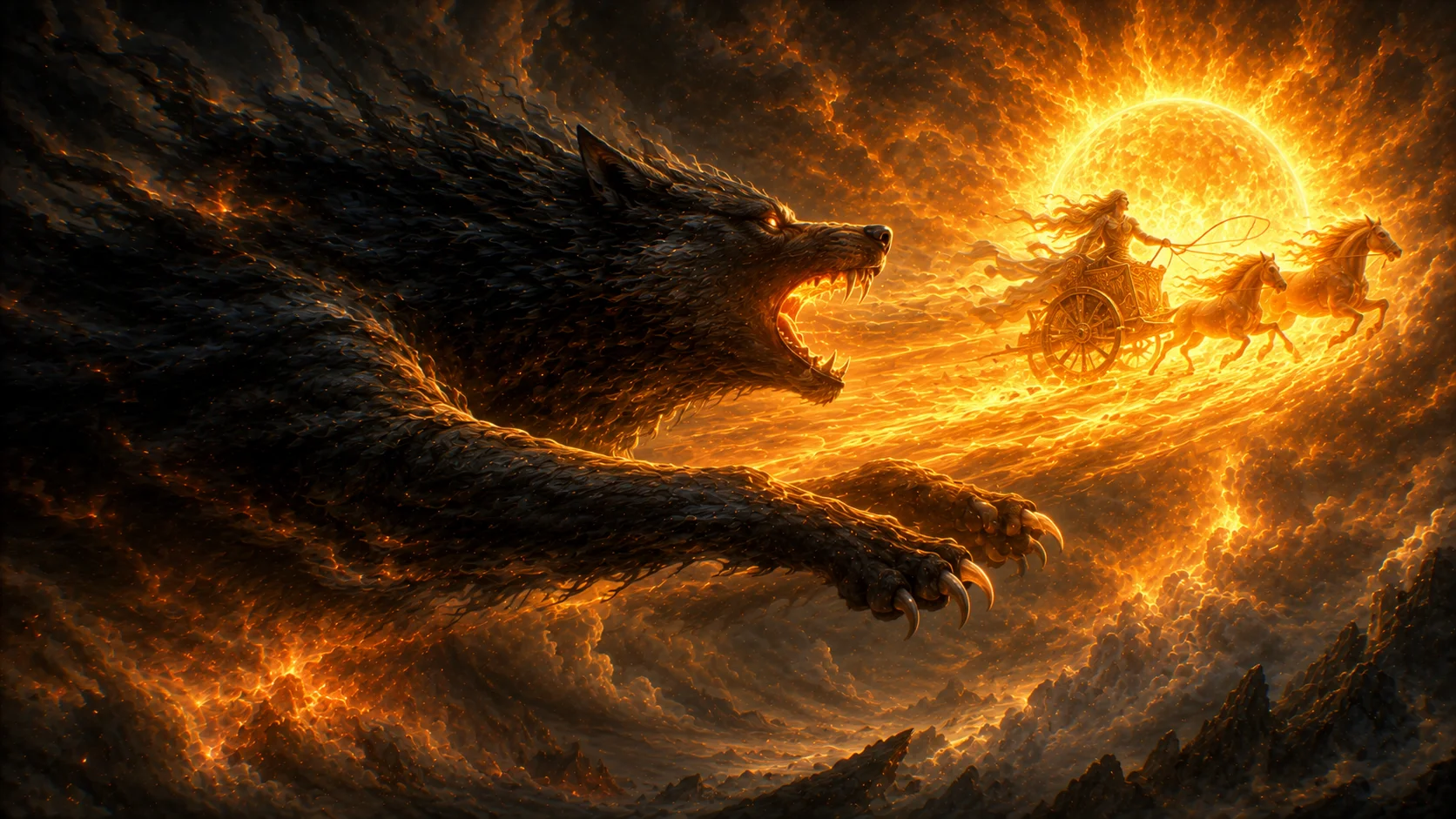
Sköll was the great wolf that chases the sun across the sky — pursuing the sun-goddess Sol in her chariot day after day, and fated, at Ragnarök, to catch and devour her, plunging the world into darkness. He is the hunger that drives the sun across the heavens, the wolf at the heels of the light.
The Wolf at the Sun's Heels
Sköll (Old Norse Sköll, “treachery” or “mockery”) was a monstrous wolf who pursues the sun across the sky. Each day, as the sun-goddess Sol drives her chariot across the heavens, Sköll races close behind her, hungering to catch and swallow the sun — and it is precisely this pursuit that drives the sun ever onward, never slowing, fleeing across the sky for fear of the jaws at her back. (His counterpart is the wolf Hati, who likewise chases the moon.) The wolves are sometimes said to be the offspring of a giantess in the Iron Wood, born to hunt the heavenly lights.
The Eternal Chase
The image of Sköll forever chasing the sun is the Norse explanation for the sun's ceaseless motion across the sky: the sun does not simply travel, she flees, racing always ahead of the wolf that hungers to devour her. The Norse saw in the occasional darkening of the sun — a solar eclipse — the terrible moment when Sköll drew near and seemed about to seize his prey, and people would make noise to frighten the wolf away and save the sun. Day after day, year after year, the chase goes on, the wolf at the sun's heels, the light always fleeing.
The Devouring at Ragnarok
The chase has a foreordained and terrible end. At Ragnarök, the doom of the gods, Sköll at last catches the sun and devours her — the wolf finally seizes the fleeing light and swallows it, and the sun is extinguished, plunging the world into darkness. This is one of the great signs that the end has come: the sun eaten by the wolf, the light gone out, the world cast into the long night before the final battle. (His brother Hati likewise swallows the moon.) Yet even here the Norse vision holds a thread of hope: before she is devoured, the sun-goddess bears a daughter as bright as herself, who will rise to light the new world after the old has ended.
The Hunger That Hunts the Light
Sköll endures as the wolf that chases the sun — the relentless hunger at the heels of the light, the pursuer whose chase drives the sun across the sky and whose final triumph at Ragnarök extinguishes it. He embodies the Norse vision of the heavens as a place of flight and pursuit rather than serene order, of the precious light forever hunted by devouring darkness, and of the deep truth their myths so often told: that the light is beautiful precisely because it is pursued, and that even the sun, at the end of all things, will be swallowed by the wolf at her heels.
The sun does not cross the sky in peace but in flight, a wolf forever at her heels — and at the end of the world, Sköll catches her at last and swallows the light.
What the Poems Actually Say
Strip away eight centuries of retelling and Sköll shrinks to a startlingly small thing: a single stanza of a single poem. He is named in Grímnismál, one of the mythological poems of the Poetic Edda, where the disguised Odin recites the furniture of the cosmos from a seat between two fires. There the poem says only this — that a wolf called Sköll follows the skírleita goði, the “bright-faced god,” toward the shelter of the woods; and that another wolf, Hati, son of Hróðvitnir, runs before the “bright bride of heaven.”
Read that carefully and a problem opens up. Neither the sun nor the moon is named outright. The “bright-faced god” is almost certainly the sun — one stanza earlier the same poem calls her the “shining god” while naming the shield that stands in front of her, and the Norse imagined the sun as female. But so, most naturally, is the “bright bride of heaven” — which would mean both wolves are running at the sun, one behind her and one ahead of her, so that the light is not merely chased but surrounded. It was Snorri Sturluson, writing his handbook of the old poetry in Iceland in the thirteenth century, who tidied the arrangement into the pairing everyone now knows. Even Snorri keeps a trace of the difficulty: in his telling both wolves run with the sun, Sköll behind her and Hati out in front — but Hati, he says, is the one who means to take the moon. One wolf per light. Whether Snorri was preserving an older understanding or quietly rationalising an obscure stanza is not something the surviving verse can settle. The tidy version is the famous one. The ragged version is the older one.
The Name Has Teeth In It
Old Norse sköll is not a grand or heroic word. It means mockery, derision, a loud jeering noise — the sound of being laughed at. To name the wolf at the sun's heels “Mockery” is a very Norse piece of grimness: the pursuit is not merely lethal, it is humiliating. The greatest light in the sky spends every day of its existence being jeered along.
A related word survives in Icelandic in a quieter place. Skolli — the skulker — is one of the old poetic words for the fox, the animal that laughs at you from the treeline, and it later became a polite way of saying the devil without saying it. The wider Norse vocabulary for wolves carries a moral charge that English loses entirely: vargr means both “wolf” and “outlaw.” A man declared vargr í véum, a wolf in the sanctuary, had put himself outside law and kinship and could be killed without penalty. When Völuspá announces the coming of a vargöld, a wolf-age, it is describing brothers killing brothers as much as beasts in the sky. Sköll is not just an animal. He is what happens when the bonds come off.
Bred in the Iron Wood
Where do sky-wolves come from? Both Eddas point east, to Járnviðr, the Iron Wood, a forest beyond the edge of the settled world where an ancient giantess sits and breeds the brood of Fenrir in wolf shape. Völuspá says one of that litter, in troll's form, will be the tungls tjúgari, the snatcher of the heavenly body — and the lines that follow are among the most physically horrifying in Norse verse. He gorges himself on the life-blood of doomed men; he reddens the seats of the gods with gore; and then, in a detail that lands harder than any battle, the sunshine turns black in the summers after, and all weather turns treacherous.
That is not an eclipse. That is a failed summer — the sky gone the colour of ash, the crops refusing, the season simply not arriving. Whatever the poet had seen or been told about, it was worse than a moment of darkness at noon.
Snorri, retelling this, gives the blood-drinking wolf a third name again: Mánagarmr, Moon-hound. Whether Mánagarmr is Hati under another name, or Sköll's third brother, or a separate tradition Snorri could not reconcile and so wrote down twice, remains genuinely unresolved. The patronymic in Grímnismál is the one firm thread: Hróðvitnir, “famous wolf,” is generally taken as a byname of Fenrir. The wolves that hunt the sky are the sky-born cousins of the wolf chained beneath the earth.
Fenrir, Not Sköll, Eats the Sun
Here is the detail most retellings quietly drop. When the Eddic poem Vafþrúðnismál stages Odin's riddle-contest with a giant and puts the crucial question — where will a sun come from, once the old one has been taken? — the poem names the devourer as Fenrir. Not Sköll. The giant's answer is the famous consolation: Álfröðull, the elf-disc, will bear a daughter before the wolf takes her, and that daughter will ride her mother's roads when the gods are dead.
So the plainest surviving statement of the sun's death does not use Sköll's name at all. What the poems agree on is the shape of the event: a wolf, the light, the swallowing, and a daughter. The distribution of names across specific wolves is looser than the story itself. Sköll is best understood not as a fixed character with a biography but as one face of a single, wider Norse idea — that the wolf and the sun are locked together, and only one of them can win.
The Machinery of a Frightened Sky
The chase makes far more sense once you see the rest of the apparatus the Norse built around the sun, because almost all of it is designed for a light in distress. Two horses, Árvakr (Early-waker) and Alsviðr (All-swift), draw her chariot, and the gods have set ísarnkol — iron-coolness — beneath their shoulders to stop them burning up from the effort. A shield named Svalinn stands between the sun and the world; if it ever slipped, sea and mountain would catch fire.
This is not a serene cosmos of wheeling spheres. It is a rescue in progress: overheating animals, an emergency heat-shield, a driver who cannot slow down. Sól and her brother Máni were, in Snorri's account, ordinary children of a man called Mundilfœri who named them so arrogantly after the lights that the gods took them and set them to work driving the very things they were named for. Even the moon has passengers — the two children Bil and Hjúki, snatched up as they carried a pail home from a well, still visible up there. The whole sky is staffed by the conscripted and the abducted, and the wolf is simply the reason none of them are allowed to rest.
The Wolf Nobody Carved
For a figure so vivid in the retellings, Sköll leaves almost nothing in stone. Viking-age monuments do carry wolves at the end of the world: the tenth-century Gosforth Cross in Cumbria bundles Ragnarök imagery into a Christian monument; a slab at Kirk Andreas on the Isle of Man shows a spear-bearing man with a great beast at his leg; the Ledberg stone in Östergötland shows a figure with a wolf-like animal at his foot. All of them are normally read as Fenrir taking Odin, not as a wolf taking the sun.
No surviving carving can be securely identified as Sköll. That absence is worth sitting with rather than filling in. It suggests that the sun-wolf lived where he is best attested — in recited verse, in the part of the tradition that was spoken rather than made permanent.
A Sun Genuinely Worth Hunting
Every culture has a story about the sun. Very few make it prey. The reason this one is Scandinavian is written into the latitude: at the top of the Norse world the winter sun is not a fixture but a fugitive, hauling itself barely above the horizon around midday, throwing long shadows for an hour or two, and going down again. For weeks at the far north it does not come up at all. Then the whole thing reverses and the light refuses to leave.
A people who watched that every year did not need to be told the sun could lose. They watched her losing ground for half the year, then clawing it back, an annual near-miss. Sköll is the honest myth of a place where the light is visibly, measurably in trouble — and where the answer given is not that the sun is safe, but that she is fast. It is the difference between a cosmos that guarantees the morning and one that merely keeps outrunning the alternative.
And it is why the ending refuses to be simply bleak. The Norse never promised that the wolf could be beaten — only that the road would still be there to be run. The chase is not survivable. The light is.
Where the Wolves Ran Next
The pair outlived the religion that made them. Sköll and Hati survive as the standard Norse shorthand for pursuit — two names that arrive together, requiring no explanation, in fantasy fiction, in games built on the Eddas, and across the whole modern revival of Norse imagery in music and design. They are one of the very few mythological details that everyone reaches for at once.
They also, fittingly, ended up in the sky again. Astronomers naming the small, distant, retrograde outer moons of Saturn drew on Norse giants and wolves for that family of objects, and two of those tiny worlds now officially carry the names Skoll and Hati: specks of rock a few kilometres across, circling a long way out, in orbits that run backwards against everything else. A pair of wolves, still out at the dark edge, still going the wrong way round the light.
Sources & traditions
- EncyclopediaWikipedia — Sköll
- TraditionNorse texts, inscriptions and later retellings (Scandinavia)
Myths change from area to area and from time to time. This chronicle follows the most widely told versions; tellings in other villages, regions and eras may differ.