Odin was the All-Father, the one-eyed king of the Norse gods and the ruler of Asgard — god of war and death, of wisdom and poetry, of magic and prophecy, and of the frenzy that gives him his name. Restless, terrible and unfathomable, he is the most complex deity in all of Norse myth: a god who sacrificed his eye for wisdom, hanged himself to win the runes, and raises the slain into his hall to fight beside him at the end of the world.
The All-Father
Odin (Old Norse Óðinn, from a root meaning “fury,” “frenzy,” “inspiration”) was the chief of the Aesir, the foremost of the gods, and was called All-Father because he was reckoned the father of gods and, in a sense, of mankind. He was the son of the giantess Bestla and of Borr, and with his brothers Vili and Vé he slew the primordial giant Ymir and shaped the world from his body. His wife was Frigg, with whom he is paired as the chief divine couple of the Aesir.
A House of Many Sons
Odin fathered a wide and consequential line. By Frigg he had Baldr, the best-loved of the gods; by the giantess Jörd (also called Fjörgyn) he had Thor, the thunderer; and by the giantess Gríd he had Vidar, the silent god fated to survive the world’s ending and avenge his father. Odin also sent the god Hœnir to live among the Vanir as part of the hostage exchange that ended the Aesir–Vanir War, binding the two divine tribes together in an uneasy peace. Each of these threads — fatherhood, alliance, doom foreseen and doom avenged — runs back to Odin himself.
The Price of Sight
What set Odin apart from every other king of gods was his insatiable, sacrificial hunger for knowledge, and nowhere is that hunger more starkly told than at the well of the wise being Mimir, called Mimisbrunnr. To drink from its waters was to gain wisdom beyond any god’s reach, and Mimir demanded a price no other god would pay: an eye. Odin tore out one of his own eyes and let it sink into the well, then drank, and so the All-Father is forever afterward pictured as one-eyed — a god who literally gave up half his sight of the world in order to see further into it than anyone else. The Poetic Edda’s Voluspa records the bargain as a settled fact of the cosmos.
Hanged Upon the World-Tree
Greater still was the sacrifice he made for the runes. Odin hanged himself upon the world-tree Yggdrasil for nine full nights, wounded by his own spear, taking neither food nor drink, given — in the words of Havamal — “to Odin, myself to myself.” No one fed him, no one gave him aid; he hung alone over the abyss beneath the tree’s roots, until on the ninth night the runes revealed themselves to him and he seized them up. It is a self-sacrifice with no parallel elsewhere in the mythology — a god sacrificing himself to himself, to no other power, purely to wring secret knowledge out of the structure of the universe itself.
The Mead Won by Guile
Odin’s pursuit of wisdom was not always paid for in pain; sometimes it was won by cunning and disguise. The Mead of Poetry — brewed, in the fuller telling, from the blood of the wise being Kvasir and known also as Odrerir — had passed into the keeping of the giant Suttung, who set his daughter Gunnlod to guard it. Odin stayed with her three nights, winning her trust, and in three great draughts he drained the mead entirely, then turned himself into an eagle and fled for Asgard — and so poetry itself, the gift of verse and eloquence among gods and mortals alike, is Odin’s theft, smuggled home in his own body.
Ravens Over Every World
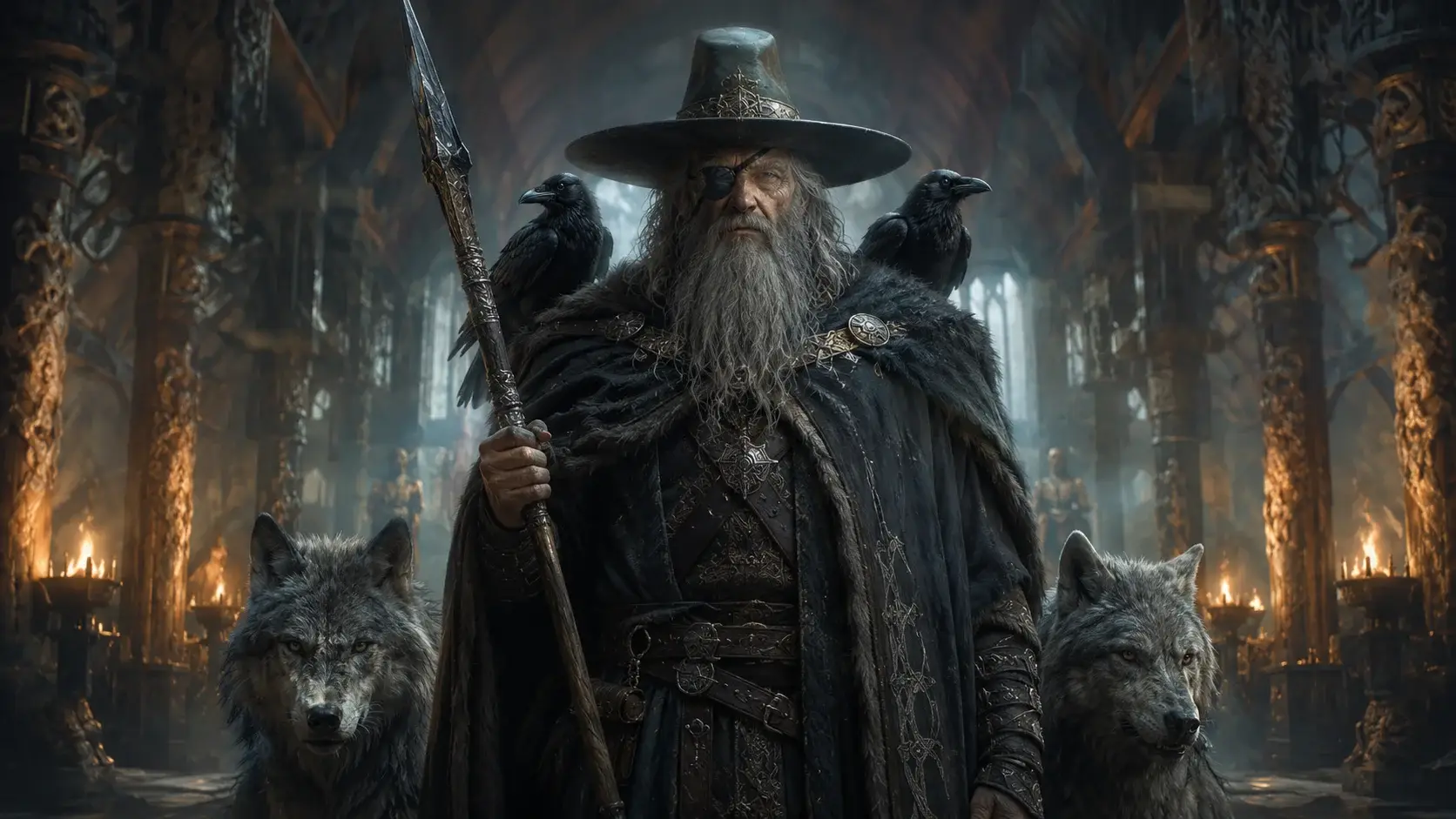
Even with an eye given away, Odin’s knowledge of the Nine Worlds was ceaseless, because he did not rely on sight alone. Two ravens, Huginn and Muninn — “Thought” and “Memory” — flew out across the whole of creation each day and returned to report to him everything they had seen. Between the ravens that watched the world for him and the eye he had already spent to know it more deeply, Odin built himself into something closer to an all-seeing intelligence than a warrior-king, gathering intelligence the way a spymaster gathers reports.
Steed, Spear, and Ring
Odin’s possessions were as strange as the god himself. He rode Sleipnir, an eight-legged horse born when Loki, in the form of a mare, was covered by the stallion Svadilfari — a horse swifter and surer-footed than any other in the Nine Worlds, able to carry its rider between them. He carried the spear Gungnir, and he possessed the ring Draupnir, from which eight rings of equal weight dripped every ninth night. Together with his ravens, these were the instruments of a god equally prepared for war, for wandering, and for wisdom.
Lord of the Slain
Odin was a god of war, but not of the honest, open battle-fury that belonged more to his son Thor; his was the war of cunning, of frenzy, and above all of choosing who would die. He presided over Valhalla, the “hall of the slain,” where his valkyries gathered half of all warriors killed in battle to prepare for a war still to come. The other half of the battle-dead went instead to Freya’s hall, Folkvangr, a division that Grimnismal and Gylfaginning both preserve without explaining. Valhalla was not a reward for a life well lived so much as a levy: Odin was building an army, and every fallen warrior was a conscript into it.
The Wanderer in the Broad Hat
Among his nearly fifty recorded names — Grimnismal alone lists close to that number, including Grimnir, Harr, Thridi (“Third”), Bolverk, and Sigfadir, “father of victory” — is a portrait of a god who preferred disguise to declaration. Odin moved through the Nine Worlds again and again as an old, one-eyed traveler in a broad hat and cloak, testing kings, guiding heroes, and withholding his true name until the moment it mattered. The saga literature returns to this figure repeatedly: in the Volsunga saga a mysterious one-eyed stranger appears at the decisive moments of the story, offering a sword, a warning, or a doom, and vanishing again before he can be questioned. To meet an old traveler on a Norse road was, in the logic of the mythology, always to risk meeting Odin himself.
Beyond the Mythological Corpus
The euhemerized tradition preserved in the Ynglinga saga recasts Odin as a legendary king and priest-leader who led his people out of the East — from Asgard in Tyrkland — and settled them in Scandinavia. It is a different register from Havamal’s hanging god or Grimnismal’s raven-keeper, but it belongs to the same figure: a leader whose wisdom, magic, and hard-won authority were remembered as having shaped a people, not merely a pantheon.
The Skalds’ Patron
Because the Mead of Poetry was his to steal and his alone to give, Odin was remembered by the skalds — the court poets of the Norse world — as the ultimate source of their craft. To compose skillful verse was, in this understanding, to have received a portion of the mead Odin carried home from Suttung’s hall; poetry was quite literally god-given, and the god in question was Odin rather than any other member of the pantheon. Snorri Sturluson’s Prose Edda, itself a skald’s handbook of myth and metaphor for composing verse, draws its material from exactly this well: kennings for poetry recall Odin’s theft in figures such as “Odin’s mead” and “the ship of the dwarfs,” encoding the myth directly into the language poets used to praise kings and gods alike. A skald invoking Odin was not merely naming a god among many; he was naming the patron of his own art.
The God Who Knows His Doom
Odin’s deepest characteristic is that he knows the future and knows it to be hopeless. He has foreseen Ragnarok, the doom of the gods, and knows that he himself is fated to be devoured by the great wolf Fenrir on that last day. Voluspa lays out the sequence in stark order: Fenrir breaks free, the sea surges as the World Serpent comes ashore, and in the chaos Odin rides out to meet the wolf and is swallowed whole — the greatest of the gods brought down by the very monster his own kin had bound and could not hold forever. His son Vidar avenges him at once, prising the wolf’s jaws apart and tearing it in two, but the vengeance does not undo the death; Odin does not survive to see the new world that rises, green and repeopled, from the wreck of the old one. And yet Odin spends all his cunning and all his sacrifice preparing for a battle he knows he will lose: gathering his Einherjar in Valhalla, sending his ravens out for every scrap of intelligence, trading an eye and hanging from a tree for knowledge that cannot save him, only arm him better for a fight already decided against him. This tragic, clear-eyed defiance is the heart of the Norse spirit that the god embodies most completely: to fight on with full knowledge of defeat, because the fighting itself is what is owed.
A God Still Summoned
Odin is the most extensively adapted Norse deity in popular culture, from Wagner’s Ring Cycle to modern film, television, and games, and he remains central to modern Ásatrú and Heathen religious practice as the Allfather figure — a god whose myths, seventeen centuries old, are still being retold.
One-eyed, spear in hand, ravens on his shoulders, the All-Father gathers his fallen army for a war he has already seen himself lose — and arms anyway.
Sources & traditions
- EncyclopediaWikipedia — Odin
- TraditionNorse texts, inscriptions and later retellings (Scandinavia)
Myths change from area to area and from time to time. This chronicle follows the most widely told versions; tellings in other villages, regions and eras may differ.