Mimir was the wisest of all beings in Norse myth — the keeper of the well of wisdom beneath the world-tree, the counsellor of the gods, whose severed head Odin preserved and consulted as an oracle. To gain even a single drink from Mimir's well, the All-Father gave up an eye; and so Mimir stands at the very source of divine wisdom in the Norse cosmos.
The Keeper of the Well
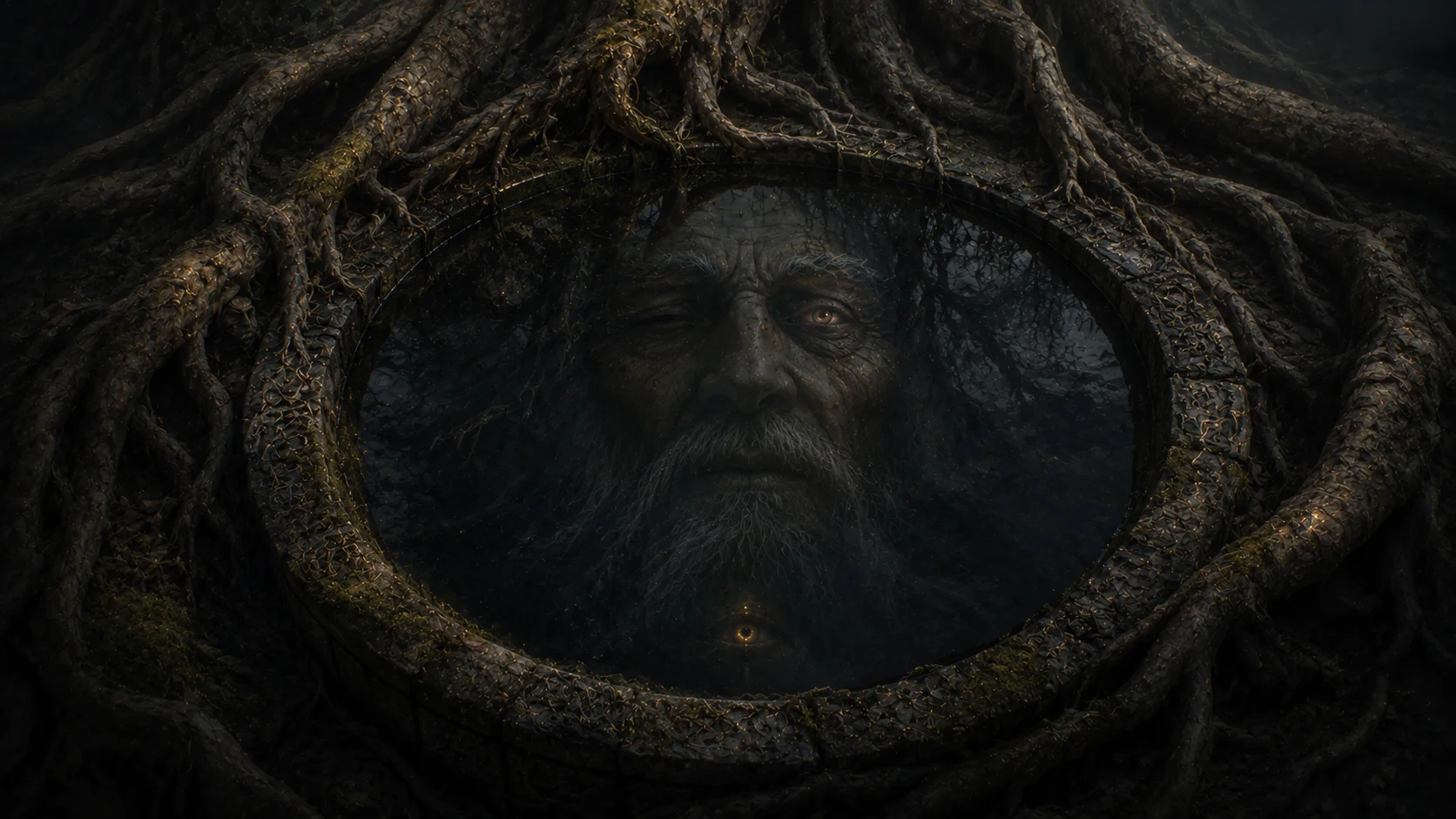
Mimir (Old Norse Mímir, “the rememberer”) was renowned above all for his wisdom and knowledge, the deepest and most learned of all beings. He was the guardian of Mimir's Well (Mímisbrunnr), a spring that lay among the roots of the world-tree Yggdrasil and whose waters held wisdom and understanding. Mimir drank from the well each day and was filled with all knowledge, and the well itself was a source of cosmic insight — the very fountain of wisdom welling up from beneath the structure of the worlds.
The Eye in the Well
Odin's endless hunger for wisdom brought him to Mimir's well, where he asked for a drink of its waters. Mimir demanded a price worthy of the gift, and Odin paid it without hesitation: he plucked out one of his own eyes and dropped it into the well. For that single eye, Odin won a drink of the waters of wisdom — and so the All-Father is forever one-eyed, his missing eye resting in Mimir's well as the price of his understanding. The image is one of the most profound in all of myth: that true wisdom must be paid for in sacrifice, that to truly see, one must give up an eye.
The Severed Head
Mimir's fate was bound up with the war between the Aesir and the Vanir. When the two divine races made peace by exchanging hostages, the Aesir sent Mimir (with the god Hœnir) to the Vanir. But the Vanir, feeling cheated when they realised Hœnir was useless without Mimir to advise him, beheaded Mimir and sent his head back to the Aesir. Odin, unwilling to lose the wisest of counsellors, took the severed head, embalmed it with herbs and sang charms over it so that it would not rot, and gave it the power of speech. Ever after, Odin kept Mimir's head and consulted it in times of need, drawing on its wisdom and its knowledge of hidden things — an oracle that whispered counsel to the All-Father from beyond death.
The Voice of Wisdom at the World's End
As Ragnarök approaches, it is told that Odin will ride to Mimir's well and take counsel with Mimir's head one last time, seeking wisdom for the final battle. Mimir endures as the very embodiment of wisdom in Norse myth — the keeper of the well, the price of Odin's eye, the severed head that speaks. He stands for the deepest truth of the Norse way of knowing: that wisdom dwells at the roots of things, beneath the world, in a well whose waters cost an eye to drink, and that even death cannot silence true counsel.
For one drink from his well, the king of the gods gave an eye — and even when the wisest of beings was beheaded, Odin would not let his counsel die, and keeps his whispering head to this day.
A God Assembled from Fragments
There is no myth of Mímir. There are only pieces of one — a name in a verse, a well in a list of wells, a head that speaks without anyone explaining how it came to be speaking. Almost every other major figure in the Norse corpus arrives with a narrative attached; Mímir arrives as a set of allusions that the poets clearly expected their audience to already understand. What survives is the shape of a story that has itself been beheaded.
Even his name will not sit still. The Poetic Edda uses two forms of it — Mímir when he is at his well in Völuspá, but Míms höfuð, Mím's head, whenever the head itself is meant — while Snorri Sturluson writes Mímir throughout. The name is usually connected to the Indo-European root that also gives Latin memor and English memory — not the one who knows, but the one who remembers. That distinction matters more than it first appears. In a culture without writing at the scale of Rome or Byzantium, wisdom was not stored in libraries. It was stored in heads. A being whose entire function is remembrance, and who survives as nothing but a head, is not a coincidence of imagery; it is the metaphor made literal.
The most revealing thing about the sources is that they contradict each other and nobody in the Middle Ages seems to have minded. In Gylfaginning, Snorri's Mímir is alive beneath the tree, drinking from his spring each morning. In Ynglinga saga — written by the same man, in the same century — Mímir is beheaded by the Vanir and reduced to a preserved oracle. Snorri never reconciles the two. Older still, the Eddic poems already know a talking head and never bother to say who cut it off. The famous beheading narrative rests on Snorri alone; the speaking head is far older than the explanation given for it.
A Pledge, Not a Payment
The Old Norse for what Odin left in the water is veð — a pledge, the word used for surety and collateral, the thing you hand over against a debt. He did not spend his eye. He deposited it. A pledge, by definition, is something that can be redeemed, and the fact that the eye is never redeemed hangs over the whole cosmology like an unpaid loan.
Völuspá makes it stranger. The seeress tells Odin she knows exactly where his eye is hidden, and then adds that Mímir drinks mead every morning from Valfather's pledge. Read plainly, the wisest being in the cosmos raises Odin's eye to his lips as a drinking vessel each dawn. Whether the poet meant the eye as a literal cup or as the interest paid on the loan, the image is merciless: the god's sacrifice is not a single dramatic moment but a daily transaction he is not present for, happening under the roots of the world, forever.
Note too that the water is called mead, not water. Norse wisdom is almost always a liquid you have to drink and almost always something you have to trade for — the mead of poetry brewed from a murdered man's blood, the spring beneath the tree bought with an eye. Knowledge in this cosmos is never given. It is bartered, stolen, or paid for in flesh.
Three Wells Beneath the Tree
Snorri sets three roots under Yggdrasil, and beneath each root a water. One root reaches the Aesir, and under it lies Urðarbrunnr, the Well of Fate, where the Norns sit and the gods hold their court. One root plunges into Niflheim, and under it seethes Hvergelmir, the roaring cauldron from which the venomous rivers run, and there the serpent Níðhöggr gnaws at the root from below. And one root goes out among the frost-giants, into the void where Ginnungagap yawned before the world existed — and there is Mímisbrunnr.
The placement is the point. Fate belongs to the gods' own ground. Decay and poison belong to the underworld. But wisdom is filed with the giants, in the emptiness that predates creation. To learn anything worth knowing, Odin has to leave his own territory and go bargain with the old powers on their soil. The Norse cosmos does not keep its wisdom in heaven. It keeps it in the dark, at the frontier, in the hands of something that is not a god.
Giant, God, or Something Older
Nothing in the sources ever states plainly what Mímir is. He is counted among the Aesir when he is sent as a hostage, yet his well sits in giant country, and the pattern of Norse myth is unambiguous about who holds deep knowledge: the jötnar do. Vafthrúðnir the riddling giant knows the fates of worlds. The seeress Odin raises for answers is one of the old dead. The giantess Hyndla keeps the genealogies that Freyja cannot recite for herself. Wisdom in Scandinavia is consistently the property of the beings the gods displaced — which is a chillingly honest theology, because it admits that the ruling order is younger than the truth it depends on.
There is a further, tantalising thread. In Hávamál, Odin says he learned nine mighty charms from the famous son of Bölþorn — and Bölþorn is the father of Bestla, Odin's own mother. The teacher is therefore Odin's maternal uncle, a giant, and the poem never names him. Readers have wanted that unnamed uncle to be Mímir for a very long time, and the fit is seductive: a giant kinsman, on the mother's side, who teaches Odin the words that matter. But the text does not say so, and honesty requires leaving it as what it is — a gap in the verse shaped remarkably like Mímir, and no more than that.
The Head That Speaks the First True Word
The oracle is not merely a curiosity of the Ragnarök narrative. In Sigrdrífumál, in a passage about the origin of runic knowledge, Mím's head speaks the first word wisely and utters true staves. This is the head functioning as the fountainhead of literacy itself — the source not of predictions but of letters, the technology by which memory outlives the person carrying it. Odin hangs himself on the tree to seize the runes; the head beneath the tree pronounces them. The two images are versions of one another.
The severed speaking head is not unique to Scandinavia, and the closest famous cousin lies west across the sea. In the Welsh tale of Branwen, the head of Brân the Blessed is cut from his body at his own command and remains cheerful company for his followers through decades of feasting before it is finally buried in London, facing the continent, as a protective talisman. Head and hospitality, head and prophecy, head and the defence of the land: the same complex surfaces in Irish and Gaulish material, and in the classical commentary on Celtic warriors keeping the heads of the notable dead. Whether the Norse image is inherited, borrowed, or independently arrived at, the underlying conviction is shared — that the person is in the head, and that the head does not necessarily stop being a person when the body does.
There is a landscape reason the story lands, too. Iron Age and Migration Period Scandinavia was a place where wealth went into water on purpose: weapons, gold, tools and human remains deposited in bogs, lakes and springs, sometimes ritually destroyed first, and placed beyond recovery. To an audience that grew up beside water into which valuable things were deliberately and permanently sunk, a god dropping his eye into a spring as surety was not surreal. It was the recognisable grammar of dealing with a power you cannot see.
Hoddmímir's Wood, Where the Human Race Survives
One detail is routinely stepped over, and it may be the most consequential thing attached to Mímir's name. When Ragnarök comes and the sun goes black and the world burns, two humans live through it — Líf and Lífþrasir — and they survive by hiding in Hoddmímis holt, "Hoard-Mímir's wood", feeding on the morning dew. From them the world is repopulated.
Hoard-Mímir is widely taken to be the same Mímir, and the wood to be Yggdrasil itself, whose trunk endures the fire. Elsewhere the world-tree is called Mímameiðr, "Mímir's tree", which points the same way. If the reading holds, the architecture of the myth is extraordinary: the tree is named after the rememberer, the well of memory feeds its root, and when everything else is annihilated, humanity comes through the apocalypse inside the thing that carries his name. Memory is not just what Odin consults. It is the shelter the species hides in while the world ends.
Mímir Under Other Names
The name refuses to stay in one story, and tracking its scatter says something about how these traditions actually travelled.
- Sökkmímir — in Grímnismál, Odin recites the names he went by at Sökkmímir's hall and boasts of having deceived that ancient giant. The stanza is knotted enough that readers still disagree over exactly who is killed in it, but the name-element sits where it always sits: fastened to an old giant, out on the far side of the gods' world.
- Mimingus — in Saxo Grammaticus's Latin Gesta Danorum, a being of the woods dwelling in a cold cave, holder of a sword and a bracelet that Høther must obtain. Saxo strips the cosmology out and leaves a treasure-guarding wood-spirit, which is roughly what happens to any god processed through a Christian historian.
- Mímir the smith — in the Low German-influenced Þiðreks saga af Bern, the man who fosters the young Sigurd is a smith named Mímir. The Eddas give that role to Reginn. Whether this is the same being demoted to an artisan or simply a common Germanic name, it is the branch with the longest afterlife, because it runs directly into Wagner: the scheming dwarf smith Mime of the Ring cycle descends from this line, not from the head in the well.
Why We Still Carry the Head
Modern audiences have met Mímir in surprising numbers without always knowing it — as Wagner's Mime, as a figure in Neil Gaiman's retellings, and most vividly as the talking head strapped to Kratos's belt in God of War, wisecracking and dispensing lore across a Norse landscape. That last version is far freer with the sources than it pretends, but it is faithful to the one thing that matters: the head is a companion, not a trophy. You take it with you. You ask it things.
The reason the figure endures is that he answers a fear nobody has ever solved. Every generation watches the people who knew things die, and every generation discovers that some of what they knew went into the ground with them. Mímir is the refusal of that. He is what a culture invents when it cannot bear the thought that counsel ends at death — the elder embalmed, charmed, kept, and consulted, so that the accumulated understanding of the world does not have to be rebuilt from nothing every eighty years.
And the price attached to him is the other half of the truth. Odin does not receive wisdom; he mutilates himself for a mouthful of it, and afterwards he is permanently, visibly diminished — a one-eyed god who cannot look at anything again without the evidence of what understanding cost. That is a startlingly unsentimental account of knowledge. It says that seeing clearly requires giving something up, that the trade is irreversible, and that even after paying it you will still be riding down to the well at the end of the world, hoping the head has one more answer left.
Sources & traditions
- EncyclopediaWikipedia — Mímir
- TraditionNorse texts, inscriptions and later retellings (Scandinavia)
Myths change from area to area and from time to time. This chronicle follows the most widely told versions; tellings in other villages, regions and eras may differ.