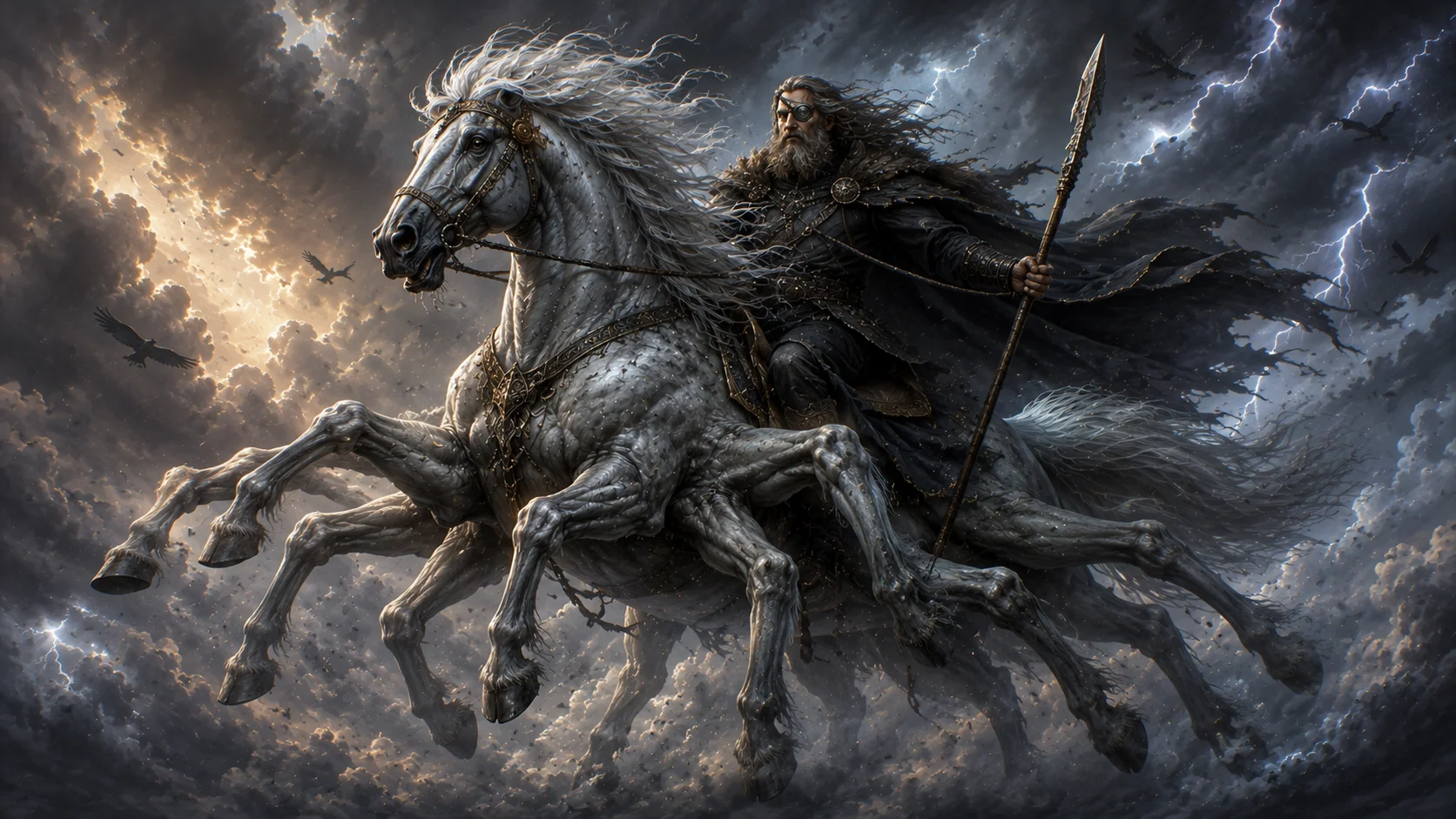
Sleipnir was the eight-legged horse of Odin — the swiftest and finest of all steeds, able to gallop over land, sea and sky and to carry his rider even into the realm of the dead, and the strange offspring of the trickster Loki. The greatest of all horses in Norse myth, he is the All-Father's mount, bearing Odin between the worlds on his eight tireless legs.
The Eight-Legged Steed
Sleipnir (Old Norse Sleipnir, “the slipper” or “the gliding one”) was the horse of Odin, and the finest horse among gods and men — grey, mighty, and uniquely possessed of eight legs, which made him faster and surer than any ordinary steed. He could gallop across the land, over the sea, and through the air, and he could carry his rider into any of the Nine Worlds, even down the long dark road to Hel, the realm of the dead. He bore runes carved upon his teeth, and he was the swiftest creature in all the worlds, the steed worthy of the king of the gods.
The Strange Birth
Sleipnir's origin is one of the most curious tales in Norse myth. When a giant builder offered to build the great wall of Asgard in exchange for the goddess Freya, the sun and the moon — a price the gods would never willingly pay — the gods agreed only on the impossible condition that he finish in a single winter with no help but his stallion, Svadilfari. But the mighty stallion hauled stone so swiftly that the builder neared completion in time, and the gods, facing disaster, blamed Loki, who had advised the bargain. To undo it, Loki transformed himself into a mare and lured the stallion Svadilfari away into the woods, so that the builder could not finish his work and lost the wager. And from that union — Loki the mare and the stallion Svadilfari — Loki later gave birth to a foal: the grey, eight-legged Sleipnir, whom he gave to Odin. Thus the trickster, in mare-form, was the mother of the All-Father's great steed.
The Ride to Hel
Sleipnir's ability to cross between the worlds made him essential to the gods' dealings with death. When the shining god Baldr was slain and the gods sought his return, it was upon Sleipnir that the messenger Hermod rode — galloping for nine nights down the dark road to the realm of Hel, leaping clean over the towering gates of the dead, to beg for Baldr's release. No other horse could have made that journey; only the eight-legged steed could carry a rider living into death and back. Odin too rode Sleipnir on his many journeys across the worlds, and into battle.
The Greatest of Steeds
Sleipnir endures as the most famous horse in all of myth — the eight-legged grey steed of Odin, swift beyond all others, able to cross land, sea, sky and the boundary of death itself, born of the shape-shifting Loki. He embodies the Norse vision of Odin as the rider between the worlds, the god who travels everywhere and sees everything, and he remains one of the most striking and beloved images of Norse mythology: the eight-legged horse galloping through the sky with the All-Father on his back.
Born of the trickster in mare-form, the eight-legged grey horse carries the All-Father across land, sea and sky — and is the only steed that can gallop living into the realm of the dead and back.
Eight Legs in Stone, Three Centuries Before the Books
The oldest surviving picture of what is almost certainly Sleipnir is not in a book at all. It is cut into limestone on the Baltic island of Gotland. On the carved memorial slab from Tjängvide the scene is unmistakable: a rider on a horse with eight clearly carved legs, and a standing figure meeting him, holding out a drinking horn. Below, a ship under sail crosses the stone. The picture stone known as Ardre VIII, from the same island, carries an eight-legged horse of its own. Both were raised in the eighth or ninth century, and both are now in Stockholm.
This matters more than it might seem. The Eddic poems were written down in Iceland in the thirteenth century; Snorri Sturluson's prose retellings are of the same period. The Gotland stones are some three hundred years older. Whatever the eight-legged horse meant, it was already fixed and recognisable in the Viking Age imagination — carved on stones that stood over the dead, in a scene of arrival and welcome. The horse and the drinking horn belong to the same picture. Long before anyone wrote the word Sleipnir down, people were already carving a rider who arrives somewhere else.
Where the Poems Actually Name Him
Sleipnir turns up in the sources less often than his fame suggests, but always in company that flatters him. In Grímnismál, Odin recites a list of the best of every kind of thing — the ash Yggdrasil is best of trees, Skíðblaðnir best of ships, Bifröst best of bridges, Bragi best of poets, Garmr best of hounds — and among them, plainly, Sleipnir is best of horses. He is not described. He does not need to be. He is a superlative in a catalogue of superlatives, the fixed point against which every other horse is measured.
In Hyndluljóð, the giantess reciting Loki's monstrous brood puts it with brutal economy: Loki got the wolf on Angrboða, and begot Sleipnir on Svaðilfari. The same breath that names Fenrir names Sleipnir. This is worth sitting with. The Norse did not file the greatest of horses under “wonders” and the wolf who will swallow Odin at the end of the world under “monsters”; they are siblings, out of the same untrustworthy parent, and the gods rode one and chained the other.
The Runes Carved on His Teeth
One of the strangest details in Norse myth is the list in Sigrdrífumál, where the valkyrie teaches Sigurd where the runes were first carved. They were cut on a bear's paw and on Bragi's tongue, on the wolf's claws and the eagle's beak, on the point of Odin's spear, on bloody wings, on the far end of a bridge — and on Sleipnir's teeth.
Then the poem does something odder still. All of those runes were scraped off the surfaces that bore them, stirred into the sacred mead, and sent out into the wide world — some among the Æsir, some among the elves, some among the Vanir, and some among mortal men. Knowledge in this tradition is not taught; it is shaved off a divine body and drunk. Sleipnir's mouth, in that scene, is a page. The horse who carries Odin between the worlds also carries part of the alphabet that lets a human being work magic, and every rune-carver who ever cut a stave into wood was, by this account, using something rinsed off the teeth of a horse.
Odin's Own Ride to the Grave
Hermóðr's errand to Hel is the ride everyone remembers. But Odin makes the same journey himself, and it is colder.
In Baldrs draumar, Baldr is troubled by dreams and the gods cannot read them. Odin gets up, lays a saddle on Sleipnir and rides down to Niflhel. On the road he meets a hound coming up out of the realm of the dead, its breast bloody, and it howls at him as he passes — and he simply rides on. He comes to Hel's high hall, and east of its doors, where he knows a seeress lies buried, he chants corpse-magic over her grave until she is forced up out of the earth. She does not want to be there. She tells him what he came for — the mead is already brewed for Baldr, a bright drink with a shield laid over it — and then she looks at him properly. He is not the wandering stranger he claimed to be, she says. He is Odin. And she will answer nothing more.
Sleipnir's role here is quiet and total. He is the reason the scene is possible at all: a god who wants an answer no living thing possesses must go and take it from the dead in person, at their own door, and be back among the Æsir in time for it to matter. Sleipnir is not a decoration on Odin's authority. He is Odin's access.
Gullfaxi, and the Race That Got a Giant Killed
The one story in which Sleipnir is the direct cause of everything begins as a boast about horses and ends with a giant's skull broken.
Odin rides Sleipnir into Jötunheim, and the giant Hrungnir looks at the horse and asks who owns such an animal. Odin wagers his head that no horse in all of Jötunheim can match it. Hrungnir, insulted, says his own Gullfaxi — Golden-Mane — is far better-paced, and hurls himself into the saddle to prove it. Odin gallops. Hrungnir chases in a fury so complete that he does not notice where he is going, and by the time he comes back to himself he has ridden clean through the gates of Asgard.
The gods, bound by hospitality, invite him in to drink. He drinks enormously, and grows enormous with it: he announces he will pick up Valhalla and carry it home to Jötunheim, sink Asgard, kill every god, and keep Freyja and Sif for himself. This is how Þórr finds him, and the duel that follows at Grjótúnagarðar ends with Hrungnir dead and his leg lying across Þórr's neck, immovable, until Þórr's three-year-old son Magni lifts it off. Magni is given Gullfaxi as his reward — and Odin, who started all of it with a horse-boast, complains that so fine a horse should not have gone to a giantess's son.
It is a very human story to find inside a myth. A god shows off his horse; a giant cannot let it stand; the argument escalates through drink into a threat against creation itself, and the last word is Odin sulking that somebody else got the good horse.
Grani, and the Bloodline of the Best Horse
Sleipnir has descendants, and one of them carries the greatest hero of the northern tradition.
In Völsunga saga, the young Sigurd goes to choose a horse for himself and meets a long-bearded old man on the way — the audience knows exactly who this is even though Sigurd does not. On the stranger's advice they drive the whole herd into a deep river. Every horse but one turns back. The one that swims across is a grey, and the old man tells Sigurd to take him and tend him well, because he is descended from Sleipnir and will be better than any other horse alive. That grey is Grani, who carries Sigurd to the dragon and stands with him through everything that follows.
The detail is a small masterpiece of narrative economy. Odin does not give Sigurd a weapon or a prophecy here; he gives him a bloodline. And it tells you what the Norse thought a great horse actually was — not a machine but a lineage, something inherited, testable by putting it in a river and seeing what it does. The inheritance runs deeper than speed, too: the same rune-catalogue in Sigrdrífumál that names Sleipnir's teeth also names Grani's breast among the surfaces the runes were cut into.
Why a Horse, and Not Something Stranger
It is easy to read Sleipnir as pure fantasy, but the Viking Age took horses seriously in ways that are hard to overstate. Horses were wealth, status and inheritance. Stallion fights — hestavíg — were a genuine public entertainment in Iceland, and the sagas treat them as flashpoints where a bad temper at the horse-ground becomes a feud and then a killing. Horses could be consecrated: in Hrafnkels saga, the chieftain-priest Hrafnkell dedicates the stallion Freyfaxi to the god Freyr and swears to kill any man who rides him without leave — and the entire tragedy of the saga proceeds from a shepherd who rides him anyway.
Horses were also buried. Excavated Scandinavian ship-burials have been found with sacrificed horses laid in them, and the pattern is widespread enough to be unmistakable: a person of consequence went into the ground with the animal that would move them. And when Iceland accepted Christianity around the year 1000, the compromise recorded in the Íslendingabók allowed the old practices of eating horseflesh and sacrificing in private to continue for a time. Whatever else the new faith carried off immediately, the horse was not part of it.
Against that background, Sleipnir stops looking like an invention and starts looking like an intensification. Odin has the best of the thing everybody already valued most, and it does the thing everybody already half-believed a horse could do: take you somewhere you cannot walk.
Why Eight?
Nobody can say with certainty why the horse has eight legs, and it is more honest to lay out the readings than to pick one.
- Speed made visible. The simplest reading: eight legs are what a galloping horse looks like — the doubled, blurred limbs of an animal moving faster than the eye resolves, frozen into a carving.
- A bier and its bearers. A long-standing folkloric reading counts four men carrying a coffin, two legs each: the “horse” that carries a body to the grave has eight legs. It fits uncomfortably well with a horse whose defining route is the road to Hel, and with picture stones raised over the dead.
- The shaman's mount. Scholars have long compared Odin's journeys with the spirit-travel described in northern Eurasian shamanic traditions, where a specialist rides an animal helper between the world of the living and the world of the dead. That is a comparison rather than a proven borrowing — but the idea of a horse as the vehicle of a soul-journey is not confined to Scandinavia.
These are not mutually exclusive, and the myth is probably richer for being all three at once: a horse so fast the legs multiply, a bier that walks, and a vehicle for the one god who insists on going where the living are not permitted.
The Hoofprint in Iceland
In the north of Iceland there is a canyon called Ásbyrgi: a vast horseshoe of sheer rock walls, some three and a half kilometres long and roughly a kilometre across, closed at one end, with a wooded floor and a rock island rising in the middle of it. Geology explains it as the scar of catastrophic glacial floods down the Jökulsá á Fjöllum. Icelandic tradition explains it more directly: it is where Sleipnir put his foot down. The old story is still the first thing most visitors are told about the place, and it is a good illustration of how myth actually survives — not as doctrine, but as the explanation attached to a landscape people have to walk through anyway.
The Horse That Outlived Its Gods
Almost everything else in Norse myth needed reintroducing to the modern world. Sleipnir did not. The eight-legged horse is one of the very few images from the tradition that is instantly legible with no explanation at all: you see the extra legs, and you understand that this animal is not bound by the rules the rest of us live under. He has been carried into fantasy art, comics, novels and games essentially unchanged, and Scandinavians have gone on attaching his name to ships and to gas fields and platforms in the North Sea — for much the same reason the skalds called a ship a horse of the waves, because the thing that carries you across water you cannot walk on is a horse, whatever it is actually made of.
What keeps him alive is not the eight legs on their own. It is the job they do. Every culture builds a story about the gap between the living and the dead, and most of them make it one-way. The Norse imagined a creature that could cross it and come back — not by magic words, not by a bargain, but by being ridden. That is a peculiarly practical kind of hope, and it is why a grey horse born of a trickster in the shape of a mare is still the first thing many people picture when they hear the word Odin.
Sources & traditions
- EncyclopediaWikipedia — Sleipnir
- TraditionNorse texts, inscriptions and later retellings (Scandinavia)
Myths change from area to area and from time to time. This chronicle follows the most widely told versions; tellings in other villages, regions and eras may differ.