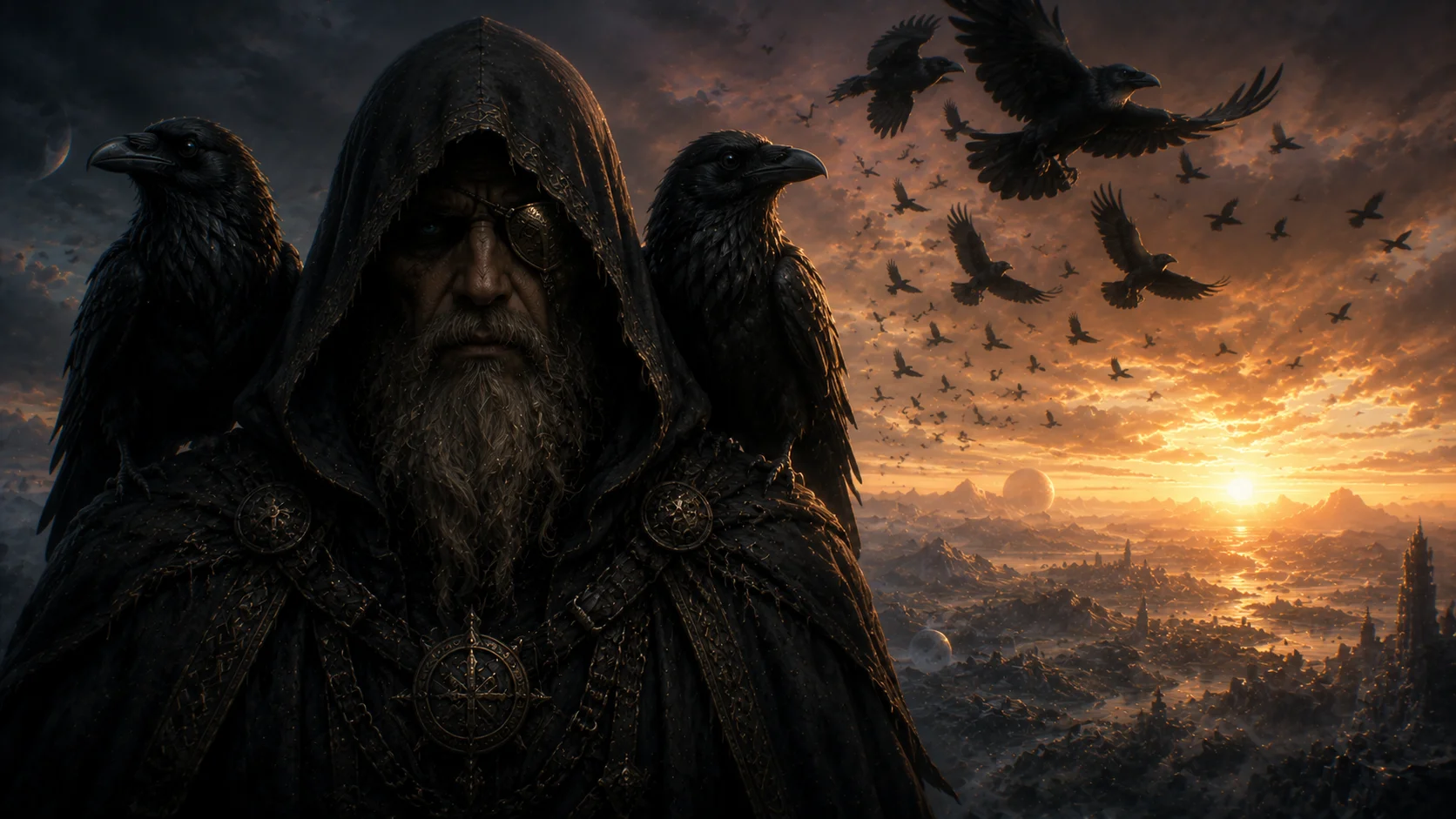
Huginn and Muninn were the two ravens of Odin — the birds named “Thought” and “Memory” who flew across all the worlds each day and returned to whisper into the All-Father's ears all that they had seen and heard. Through them Odin knew everything that happened in the Nine Worlds, and they are among the most iconic emblems of the god of wisdom, gracing his shoulders in image after image.
Thought and Memory
Huginn and Muninn (Old Norse Huginn, “thought”; Muninn, “memory” or “mind”) were a pair of ravens belonging to Odin, who perched upon his shoulders. Their names reveal their deep meaning: they are Thought and Memory, the two faculties of the mind, the powers by which knowledge is gathered and held. As the god of wisdom, Odin was fittingly attended by these two birds, the living embodiments of the mental faculties through which all understanding comes.
The Daily Flight
Each day at dawn, Odin sent Huginn and Muninn flying out from Asgard, and the two ravens soared across the entire world — over all the Nine Worlds, over Midgard and the lands of men, over the realms of giants and the dead — observing everything that happened. Then, at day's end, they returned to Odin and perched again upon his shoulders, and there they whispered into his ears all the news of all the worlds, everything they had seen and heard in their flight. By this means the All-Father, though seated in Asgard, knew all that passed everywhere — the ravens were his eyes and ears across the whole cosmos, the source of his vast and constant knowledge of the world.
Odin's Fear
So bound up was Odin's wisdom with his ravens that he expressed, in one famous verse, a poignant fear about them: he sends Huginn and Muninn out each day over the wide world, and he confesses that he fears for Huginn, that he may not return — but he fears even more for Muninn. That is, he fears the loss of Thought, but fears still more the loss of Memory. The verse is a profound meditation: even the god of wisdom dreads, above all, the failure of memory — for a mind that loses its thoughts is impaired, but a mind that loses its memory loses itself. Odin's greatest fear is the loss of Muninn, of Memory.
The Eyes of the All-Father
Huginn and Muninn endure as among the most iconic images in all of Norse myth — the two ravens upon Odin's shoulders, Thought and Memory, the birds that fly across the world and bring all knowledge back to the god of wisdom. They earned Odin one of his many names, “raven-god,” and the raven became one of his great emblems and a bird of omen and battle in the Norse world. They embody the Norse vision of wisdom as something gathered from the whole world and held in mind — thought ranging far and memory bringing it home — and the deep truth, voiced by Odin's own fear, that of all the mind's powers, memory is the one we can least bear to lose.
Thought and Memory fly out over all the worlds each dawn and return at dusk to whisper everything into the god's ears — and Odin fears, above all, the day Memory does not come back.
Older Than the Written Myth
The idea of Odin flanked by two ravens is older than any manuscript that names them. Helmet plates from the boat graves of Vendel-period Sweden — and the bronze dies used to stamp such plates — carry a recurring figure: a spear-bearing rider or standing warrior, marked out from the ordinary men around him, with birds set at his head rather than flying loose elsewhere in the scene. Archaeologists have long read this as an early rendering of Odin and his ravens. If that reading is right, and it remains an interpretation rather than a certainty, the pairing belongs to a Germanic visual tradition centuries older than the Icelandic manuscripts and older than the Viking Age proper. The texts that finally give the birds their names and their most famous verse — the Poetic Edda's Grímnismál and Snorri Sturluson's Prose Edda, both committed to parchment long after the conversion — are best understood as the last stage of a much older tradition rather than its beginning.
Snorri also preserves the exact form of the by-name the birds won for their master: Hrafnaguð, raven-god. He sets it down immediately after his account of the daily flight, as the explanation for the title rather than an ornament on it. The god is called raven-god because the ravens are how he knows anything at all.
Geri and Freki: The Other Pair
Odin kept a second pair of animals besides his ravens, and the contrast between the two pairs is exact. Two wolves attended him, Geri and Freki — names that both mean roughly “the greedy one” or “the ravenous one.” Where Huginn and Muninn range over the whole world and bring back something with no substance at all, the wolves stay close and consume something entirely physical. The detail is not incidental: the wolves and the ravens appear in adjacent stanzas of the same poem, Grímnismál, which says that Odin hands Geri and Freki every scrap of meat set before him and lives on wine alone himself. One pair is aerial, roving and cerebral; the other is grounded, loyal and appetitive. Set side by side they sketch the whole god the Norse imagined — a mind that reaches to the ends of the earth for knowledge, attached to a lord who still keeps fierce, hungry animals fed and close at hand. It is the same doubleness that makes Odin the patron of poets and of armies at once.
Other Voices of the World Tree
Huginn and Muninn were not the only creatures in Norse cosmology whose task was to carry words across impossible distances, and setting them beside their counterparts sharpens what makes them different. Up and down the trunk of Yggdrasil ran the squirrel Ratatoskr, ceaselessly relaying malice between an unnamed eagle perched in the tree's highest branches and the serpent gnawing at its roots — a messenger, but a spiteful one, whose whole function is to keep a quarrel burning rather than settle it. Further out, at the northern end of the sky, tradition places a giant in eagle's shape named Hræsvelgr, “corpse-swallower,” from whose beating wings every wind in the world was said to come. Both are old, both are strange, and neither does what Odin's birds do. Ratatoskr carries rumour and Hræsvelgr carries weather; only Huginn and Muninn carry information to a mind capable of using it. The World Tree is crowded with creatures in motion. The ravens are the ones whose motion becomes knowledge.
The Raven Banner
The bond between ravens and Odin was not confined to myth; it shaped how real war-leaders went into battle. Medieval chroniclers describe a woven raven banner carried by Scandinavian commanders and treated as an oracle for the coming fight: if the raven on the cloth seemed to stand out and beat its wings as the standard was raised, victory was promised, and if it hung slack and still, the omen was bad. The Anglo-Saxon Chronicle's entry for 878 records a Scandinavian force destroyed in Devon and its war-banner taken; the accounts that give that banner a name call it Raven. Later Scandinavian leaders in England, Orkney and Ireland are credited with raven banners of their own. The belief worked because it was grafted onto something warriors already knew at first hand: real ravens gather wherever the dead are left in the open, so a flock circling before an engagement would have looked, to Odin's own worshippers, exactly like his birds arriving early to watch. Skaldic praise-poetry made the link a formula, honouring a victorious lord as one who fed the ravens — who left enough enemies on the field for the birds to eat.
Recognising the Raven-God
Norse art rarely labels its gods. It expects the viewer to read them from what they carry, and because the ravens were Odin's most portable attribute they became one of the surest ways to pick him out of a crowded scene. The convention is worth stating precisely, because it is a rule about placement rather than about birds: a raven flying somewhere in a picture is a raven, while a bird set at a figure's head or shoulder belongs to him. That is the difference between a scene containing a bird and a portrait of a man who owns one. Icelandic manuscript paintings of the Eddas — made centuries after the conversion, by artists illustrating a religion nobody around them still practised — make the arrangement fully literal, seating one bird on each shoulder exactly as the text describes. The shorthand outlived the belief by so long that it now reads instantly to people who have never opened either Edda.
The Afterlife of Thought and Memory
Huginn and Muninn have outlived the religion that produced them by roughly a thousand years, and they have done it largely intact. Modern Heathenry and Ásatrú, living faiths that draw directly on the Eddas, still treat the ravens as a central image of Odin's wisdom-seeking, worn as jewellery and inked as tattoos by practitioners as a statement about the value of watchfulness and memory rather than as costume. Popular culture has kept the pair nearly as legible. The 2018 video game God of War hid Odin's ravens across its entire map as collectibles for the player to hunt down, turning the god's surveillance network into something the player dismantles piece by piece. Assassin's Creed Valhalla built an entire scouting system around a raven the player sends up to survey the ground ahead — Odin's arrangement converted into a game control. Marvel's Thor comics keep ravens at Odin's shoulder for no reason other than that everyone recognises them there. What survives in every version is the original idea, unchanged from a millennium ago: a mind extended past the limits of one body by two birds sent out to look and to remember on its behalf.
Why Two Birds, and Not One
The power could have been given to Odin as a single all-seeing raven, and the language itself suggests why it was not. Old Norse hugr, the root behind Huginn's name, does not mean thought in the passive sense of an idea one happens to have. It means active mind — intention, disposition, even courage — the faculty that goes out and seeks. Munr, behind Muninn's name, belongs to the word-family of remembering and desiring: the faculty that holds on to what it finds and keeps wanting it. One bird could have brought Odin information. It took two to give him a mind that both reaches outward and keeps what it reaches for, which is a fair working definition of wisdom as distinct from mere knowledge. The Norse did not describe the mind as one thing with a memory attached. They described it as two hungers, sent out together every morning, and never entirely certain of coming home.
Sources & traditions
- EncyclopediaWikipedia — Huginn and Muninn
- TraditionNorse texts, inscriptions and later retellings (Scandinavia)
Myths change from area to area and from time to time. This chronicle follows the most widely told versions; tellings in other villages, regions and eras may differ.