Baldr was the god of light, beauty, joy and purity — the most beloved and radiant of all the Norse gods, the shining son of Odin and Frigg whose death was the first great sorrow of the Aesir and the first sign that the doom of the gods had begun. His murder, engineered by Loki, is the most poignant and important tragedy in all of Norse myth: the moment the light went out of the world, and Ragnarök drew near.
The Shining God
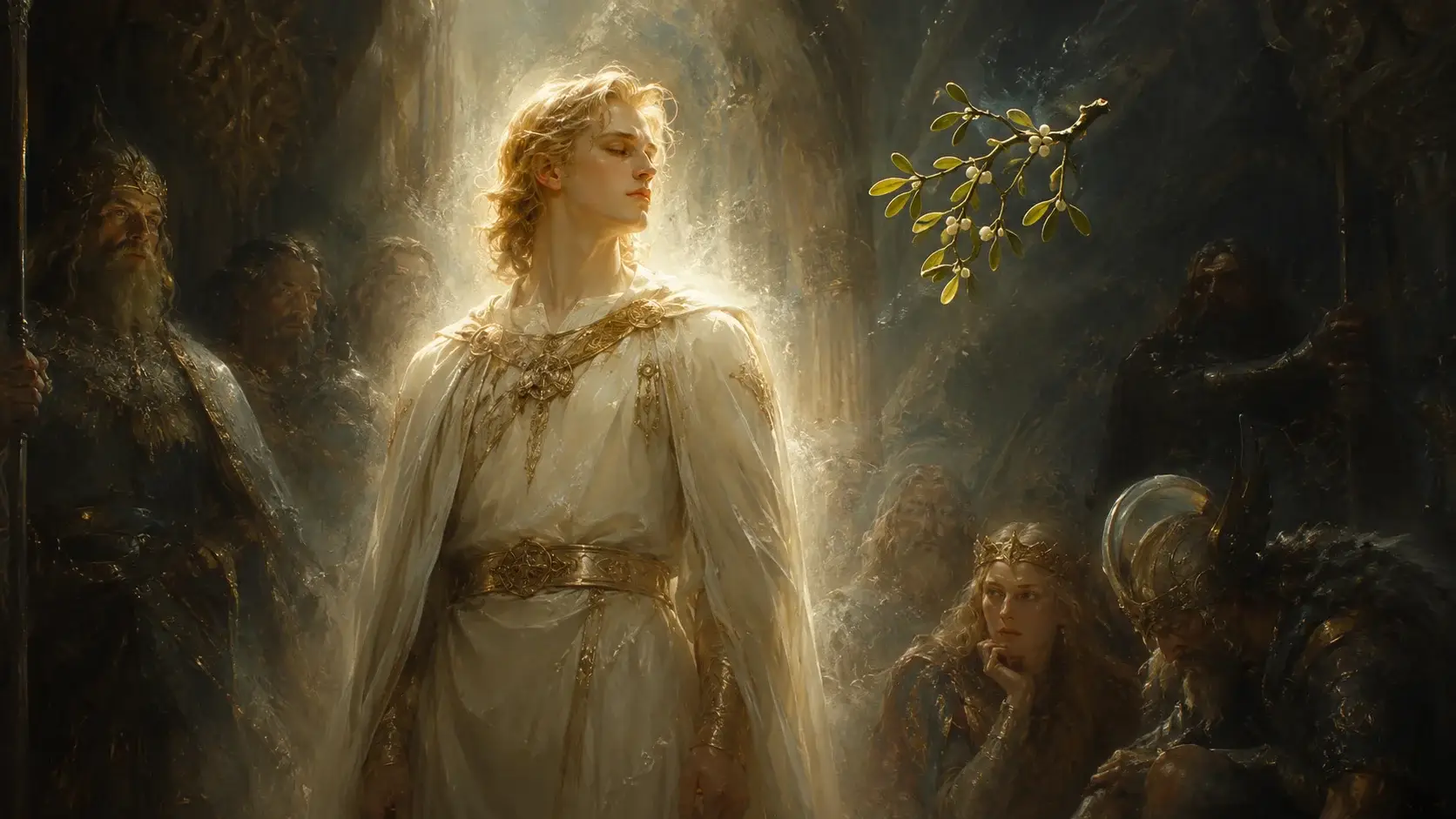
Baldr (Old Norse Baldr) was a son of the All-Father Odin and the queen Frigg, and the husband of the gentle goddess Nanna. He was described as so fair and bright that light shone from him, the most beautiful of the gods, the wisest, the gentlest and the most merciful, beloved by all the Aesir and by all living things. He dwelt in the hall Breidablik, “the broad-gleaming,” into which nothing impure could come. He was, in short, the best of the gods — goodness and beauty made divine — which made his loss all the more terrible.
The Dreams of Death
Baldr's doom announced itself in ominous dreams that foretold his death. Alarmed, his mother Frigg traveled through all the world and made every thing — fire, water, metal, stone, trees, beasts, sicknesses, poisons — swear an oath never to harm him. Believing him now invulnerable, the gods made a joyful game of throwing weapons and stones at Baldr, delighting as everything bounced harmlessly away from the shining god. But Frigg had passed over one plant as too young and harmless to bother with: the mistletoe.
The Murder by Mistletoe
The trickster Loki, consumed by malice, learned of this single overlooked plant. He fashioned a dart (or arrow) of mistletoe and brought it to the blind god Hodr, Baldr's own brother, who stood apart from the game because he could not see to take part. Loki offered to guide his hand — and Hodr, unknowing, hurled the mistletoe dart, which pierced Baldr through and killed him instantly. The bright god fell dead, and a grief beyond words fell upon the Aesir, for the best and most beloved of them all was gone, slain by a brother's hand and a trickster's spite.
The Failed Rescue from Hel
Baldr went down to Hel, the realm of the dead. The gods sent the messenger Hermod riding down the long dark road to beg for his return, and Hel agreed to release him on one condition: that every single thing in all the world, living and dead, weep for Baldr. And so it nearly was — all things wept, gods and men, beasts and stones and trees, all the world in tears for the shining god. All but one: a giantess named Thokk (in truth Loki in disguise) sat in a cave and refused to weep, saying “let Hel keep what she has.” And so, because of one dry-eyed refusal, Baldr was doomed to remain among the dead until the world should end.
The Light That Returns After the End
Baldr's death was the turning point of Norse myth — the first death among the gods, the beginning of the end, the sign that even the divine order was now mortal and doomed. Yet his story holds the one great promise of hope in the Norse vision: for it was foretold that after Ragnarök, when the old world has burned and drowned and the old gods have fallen, Baldr will return from the dead, rising into the new and cleansed world to rule in peace. He endures as the god of light and resurrection, the beauty that is lost and the hope that it will, one day, come again.
The brightest of the gods was killed by the one plant his mother forgot, kept in the realm of death by one refusal to weep — yet of all the gods, he alone is promised a return after the end of the world.
Two Baldrs: The Martyr and the Rival
Almost everything the world knows about Baldr comes from one Christian Icelander writing two centuries after the last heathen altar went cold. Snorri Sturluson tells the story of the blameless shining god so well that it has all but smothered the alternative — and there is an alternative, and it is startling.
The Danish chronicler Saxo Grammaticus, writing in Latin at almost the same moment, tells it as a war over a woman. His Balderus is no gentle martyr but a demigod warlord, a son of Odin who wants Nanna and cannot have her, because Nanna loves a mortal prince named Høtherus — a swimmer, an archer and a harper, and by every measure of Saxo's book the hero of the tale. Balderus is proof against ordinary steel, so Høther must go and take a particular sword from a woodland being called Miming, who keeps it in a cave in a bitter northern country. There are battles and reversals; Balderus is tormented by phantoms in the likeness of Nanna until he wastes away and can no longer walk, and has to be carried to war in a cart. When the sword finally finds him he lingers three days and dies, and the Danes raise him a royal burial mound. Odin then fathers a son on Rinda to avenge him, and the avenger kills Høther and dies of his own wounds the next day.
No mistletoe. No weeping world. No Loki at all. Two learned men in the thirteenth century, working from the same body of northern story, produced a saint and a bully. Which of them the heathen Norse actually told is a question the sources will not settle — and any honest reader of Baldr should carry both versions at once.
The Greatest Funeral Ever Held
The largest ship in the world would not move.
Baldr's body was carried down to his vessel Hringhorni, and the gods meant to build his pyre on its deck and push it out to sea — and they could not shift it. All the strength of Asgard failed against a hull, so they sent to Jotunheim for help, which is the measure of their humiliation. What came was the giantess Hyrrokkin, riding a wolf with live vipers for reins. Four of Odin's berserks were set to hold her mount and could not manage it until they wrestled it to the ground. She put one hand to the prow and shoved, and fire sprang from the rollers and every land in the world shook. Thor lost his temper, raised his hammer to break her skull, and had to be talked out of it by the assembled gods — a small ugly moment over the body of the best of them, and very true to life.
Then Nanna, watching her husband carried aboard, burst with grief and died where she stood, and was laid on the pyre beside him. Baldr's horse was led up in full harness and burned with its master. Odin bent over the flames and laid on them Draupnir, the arm-ring that dropped eight rings of its own weight every ninth night — the most productive object in the Norse world, given away to a corpse. Thor hallowed the fire with Mjolnir, and a dwarf named Litr blundered across his path at the wrong instant and was kicked into the blaze; whether that is comic relief or something a good deal darker, the text declines to say.
The guest list is the real astonishment. Odin came with Frigg, his valkyries and his ravens; Freyr in a wagon drawn by his golden boar; Heimdall on the horse Gulltopp; Freyja driving her cats. And with them, uninvited but unopposed, came frost-giants and mountain-giants — the enemy, standing at the graveside. For the length of one fire, the war of the worlds simply stopped.
The Gifts That Came Back
Hermod's ride is usually told as a failure, and it is, but it is a failure that brings things home.
Nine nights he rode down through valleys so dark that he saw nothing at all, until he reached the river Gjoll and the bridge across it, thatched with shining gold and kept by a maiden called Modgudr. Five whole companies of the dead had crossed the day before, she told him, and the bridge had rung no louder under all of them than it did under him alone — and besides, he had not the colour of a dead man. What was he doing on this road? Sleipnir cleared the gate of Hel in a single leap, and Hermod found his brother seated in the high seat of that hall: honoured, comfortable, entirely unreachable.
In the morning Baldr sent Draupnir back up to Odin as a keepsake, and Nanna sent Frigg a linen smock and the goddess Fulla a gold finger-ring. This is the strangest and most human detail in the entire cycle: the dead cannot come back, but they can send presents. Northern grief was not consoled with a promise of reunion. It was answered with an object in your hand that used to be theirs.
And the name of the one creature in all the world who would not weep is a joke told through clenched teeth. Thokk is simply the Old Norse word for thanks.
What Odin Whispered
Before the fire was lit, Odin bent down and said something into his dead son's ear. Nobody heard it. Nobody ever learns it.
That whisper then becomes, of all things, a weapon. In Vafthrudnismal, Odin walks into a wisdom-contest with an ancient giant, staking his head against the giant's, and the two of them trade the deepest lore in creation until neither can be caught out. So Odin ends it with a question no living being can answer: what did Odin say into the ear of his son, before he was borne onto the pyre? The giant understands instantly that he has been contending with Odin himself, and that he has lost. The same unanswerable riddle closes a second contest elsewhere in the tradition, with a king in place of the giant and the same disguised god asking it.
Two separate texts reach for that whisper as the one thing in the universe that cannot be known — and neither of them tells us what it was. A father's last private sentence to a son who cannot hear it, deliberately withheld from the record. It is the single most effective silence in Norse literature.
Baldr's Dreams, and the Corpse Odin Woke
There is a whole short Eddic poem, Baldrs draumar, devoted to the days before the killing — and it is a piece of necromancy.
Odin rides down towards the realm of the dead, passing a hound bloodied about the chest, to a grave east of the door where a volva lies buried. He sings corpse-magic over the mound until the dead woman is forced up out of it, unwilling, complaining that snow had snowed on her and rain had beaten her and that she had lain dead a long time. He gives a false name — Vegtam, son of Valtam — and asks who the hall below is decked out for, with its benches strewn and its floor flooded with gold. Her answer is the coldest line in the poem: the mead already stands brewed for Baldr, the shining drink, with a shield laid over it. The dead are expecting him. He is still alive and laughing in Asgard, and downstairs the drink is poured.
She tells him more than he wants. Hodr will bear the branch, and will be Baldr's bane. And vengeance will come from a son who does not yet exist: Vali, whom Rind will bear in the western halls, who will fight when he is one night old, and who will neither wash his hands nor comb his hair until he has carried Baldr's adversary to the pyre. That grim little detail is not decoration — it is the Norse law of feud pushed to its limit. Vengeance is so absolute a duty that a newborn takes it up before he can be groomed.
Then Odin asks one question too many, about the maidens who weep at will and cast their neck-veils to the sky, and the dead woman recognises the only man alive who would ask such a thing: he is no Vegtam, she tells him, he is Odin. He retorts that she is no seeress either, but the mother of three giants — and she dismisses him. Ride home and be pleased with yourself, she says; no one else will come to visit her until Loki slips his bonds and the doom of the gods comes on.
It leaves a hard question hanging over the whole tragedy. Odin knew. He rode into the earth and dragged the answer out of a corpse, and he came home and said nothing, and let the game with the darts go on.
The Law That Spared Hodr
The instant Baldr fell, the gods should have torn Hodr apart. They did not, and Snorri gives the reason plainly: the place where they were standing was a sanctuary, a ground on which no vengeance might be taken. So the Aesir stood over the corpse of the best of them with the man who threw the dart within arm's reach, and were stopped by their own law. They could not even speak; every one of them tried, and grief came out where the words should have been.
That is why the vengeance has to be outsourced to a child not yet conceived, and why Loki's punishment arrives so late and so strangely. The gods are not merely grieving in this story. They are bound — by oath, by sanctuary, by prophecy — and every rule that makes them a civilisation is, at this moment, working for the killer.
The Son Who Ended Quarrels
Baldr and Nanna had a son, and the mythology gives him a role that reads like an answer to his father's death: Forseti, named in the poem Grimnismal as the keeper of a hall called Glitnir, pillared in gold and roofed in silver, where he sits settling lawsuits. Every dispute brought before him — god or man — leaves reconciled. Set that against a mythology this soaked in feud and blood-debt: the child of the murdered god is given, by the storytellers, the one power his father's death could have used and never had — the power to end a quarrel before anyone has to die for it.
The Name, and the Missing Cult
The name itself is a puzzle. Old English has bealdor, a poetic word simply meaning lord or prince, and a Germanic root meaning bold has also been proposed as its source. So “Baldr” may not have started as a name at all, but as a title — the Lord — which is an unsettling thing to hold in your hand when every surviving account of him was written down by Christians.
He turns up once outside Scandinavia, in a German healing charm preserved in a manuscript at Merseburg, in which Wodan and others ride into a wood, a horse belonging to balder wrenches its foot, and a series of goddesses and finally Wodan himself sing the bone back to bone, blood to blood, limb to limb. Whether that balder is our god or just a word for “the lord” has been argued for well over a century without resolution.
And here is the fact that ought to be more famous than it is: there is almost no trace of anyone actually worshipping him. Thor and Freyr are stamped all over the map and all over the names of ordinary people — farms, fjords, children. Baldr is nearly absent. No reliable source describes a temple of Baldr, a sacrifice to Baldr, a festival of Baldr, a priest of Baldr. The sacred enclosure called Baldrshagi that appears in a late legendary saga is literature, not evidence of practice. It may be that he was a god people told stories about rather than one they prayed to; it may be that the evidence simply did not survive. Either way, the best-loved god in the mythology is the one who left the fewest fingerprints on the ground.
The Mistletoe Problem
Mistletoe is a soft, sprawling parasite of a shrub — an unlikely-looking murder weapon by any measure. It is also not native to Iceland, where the fullest version of the story was written down, and it grows only patchily across the rest of Scandinavia, which has left scholars asking for well over a century whether “mistletoe” is really what the oldest tellers meant. The word itself, mistilteinn, means “mistletoe-twig” — but the very same word turns up in a later Icelandic legendary saga as the proper name of a magic sword. Whether the oldest layer of the story involved a plant that later tellers took literally, or a named blade that drifted into being read as one, is a genuine, unresolved question. It does not weaken the myth to admit that. If anything it fits: even scholars cannot pin down the one detail the story insists was too small for anyone to have noticed.
What is not in doubt is the shape of the idea, and it is a shape everyone recognises. Frigg's failure is not carelessness — it is the failure of comprehensiveness itself. She asked the entire world and the entire world consented; the flaw was in her definition of everything. Somewhere in every complete precaution there is a thing too small, too young or too harmless to be worth including, and that is the thing that kills you.
Loki Says It Out Loud
The murder is not what finishes Loki. The boast is.
In Lokasenna, Loki gatecrashes a feast in the sea-god's hall and works his way round the benches insulting every god in turn. When he reaches Frigg, she tells him that if she had a son like Baldr there in the hall, he would not walk out of it. His answer is to take the credit: he is the reason she will never again see Baldr ride home to the halls. He is not denying anything. He is boasting. Shortly afterwards he flees, is run down and caught in a river in the shape of a salmon, and is bound beneath a serpent that drips venom onto his face until the end of the world.
Watch the machinery. Baldr's death is the crime; Loki's confession is the moment the gods stop being a family and become a court. And the sentence they pass — a body chained under poison, a wife holding a bowl over him — is exactly the thing that will break loose and burn them all. The murder generates the punishment, the punishment generates the hatred, and the hatred arrives at Ragnarök. On the mythology's own logic, Baldr does not merely die before the end of the world. He sets it moving.
After the Fire: The Brothers in the Grass
The prophecy of the world's rebirth contains one image that outlives everything around it. The land rises green again out of the sea, crops come up in fields nobody sowed, and the surviving gods walk out onto the grass and find lying there the golden gaming pieces they had owned in the first morning of the world, before any of it went wrong.
And Baldr comes back — but not alone. He comes back with Hodr. The killed and the killer return together and dwell together in the victory-halls of their father. No poem explains this, and the refusal to explain is the strongest thing about it. Hodr was blind, and someone put the dart in his hand and aimed him. In the world before the fire, that counted for nothing and he was killed for it by a one-night-old child. In the world after, it finally counts. Norse myth almost never forgives anybody. It forgives Hodr.
The Long Argument About Christ
A luminous, blameless, universally beloved son of the highest god is killed through treachery, descends into the realm of the dead, and is promised to return when the world is remade. Every source we possess for this was written by Christians, in countries converted generations earlier. The resemblance has been argued over for well over a century and the argument has not been won: some read Baldr as a heathen figure recoloured by monastic scribes, others as genuinely old, with dying gods enough elsewhere in the world to need no borrowing. The soberest position is that the story is old, that the men who wrote it down were not heathen, and that the layers can no longer be cleanly pulled apart.
But notice what the ending actually says, because it does not behave like a gospel. Baldr's return redeems nobody. It is not offered as anyone's salvation, it saves not one of the gods who die at Ragnarök, and it prevents nothing. He simply comes back afterwards, into a world that has already burned, and sits down in the grass with his brother and a set of golden playing pieces. Whatever that is, it is not resurrection as a doctrine. It is resurrection as consolation — the quieter and, arguably, the sadder idea.
Baldr Since
He has always attracted poets more than novelists, because his story is essentially an elegy. The Danish poet Johannes Ewald put Balder's death on the stage in Balders Død in 1775; the Victorian poet Matthew Arnold gave him a long, mournful English poem, Balder Dead, in 1855, in which the whole cold apparatus of Hel and the failed embassy is worked through in blank verse. Modern prose retellings have been kinder to him than the medieval sources, which tend to treat his goodness as a fact rather than a character.
The most interesting modern reworking is a video game. God of War (2018) takes the single strangest feature of the myth — the invulnerability — and asks what it would actually do to a person. Its Baldur cannot be hurt because a spell was cast on him without his consent, and the spell also took away his ability to feel anything at all: no pain, no warmth, no touch, no taste, for over a hundred years. He is not good. He is a cruel, half-mad man starving for sensation, and the mistletoe that finally breaks the enchantment is the first thing he has felt in a century, and he is grateful for it. That is a genuinely sharp reading of the original: the gift that made him safe is the thing that ruined him, and the plant everyone forgot is the only mercy in the story.
Why the Story Will Not Let Us Go
Every element of it is a shape that grief actually takes. The bad dreams that nobody could act on. The mother who did absolutely everything and missed one thing. The death by accident, delivered by a hand that loved him. The bargain that almost worked. And afterwards the long useless arithmetic that anyone who has lost someone will recognise instantly: if the plant had been asked; if his brother had stayed away from the game; if that one refusal had gone the other way.
The Norse did not put this at the centre of their mythology because it was sad. They put it there because it is the moment their gods discover that they can lose. Everything in the mythology after it runs downhill, and every listener knew where it was running to. Baldr's funeral is the day the gods finally learn the thing that every person telling the story already knew.
Sources & traditions
- EncyclopediaWikipedia — Baldr
- TraditionNorse texts, inscriptions and later retellings (Scandinavia)
Myths change from area to area and from time to time. This chronicle follows the most widely told versions; tellings in other villages, regions and eras may differ.