Hermóðr, called Hermod, was a son of Odin whose name survives in the Norse record chiefly for a single deed: the ride he made into the realm of the dead to beg for the life of Baldr. He is not counted among the frequently-listed Æsir of the formal god-catalogues, and almost nothing is preserved of him outside this one mission — but that mission is among the most vivid underworld-descent narratives to survive from Norse tradition, and it is enough to have kept his name alive.
A Name Defined by One Errand
Hermóðr is attested primarily in the Prose Edda, in the section called Gylfaginning, where Snorri Sturluson tells the story of Baldr's death and its aftermath. A possible further reference appears in the Poetic Edda's Hyndluljóð, though this mention is disputed among scholars and may concern a legendary hero of the same name rather than the god who rides to Hel. Some manuscript traditions, read alongside the fragmentary Sögubrot, associate a Hermóðr with being sent to earth by Odin bearing a helmet and mail-coat — but this too is uncertain territory, and it should be held apart from the far better attested Baldr narrative rather than folded into it as settled fact.
What is clear is this: Hermóðr is Odin's son, and in the one story that names him at length, he acts as a herald and messenger — the one who is sent, and the one who volunteers to be sent, into the deepest danger the gods can imagine.
Grief in the Halls of the Æsir
The tale begins in sorrow. Baldr, beloved among the gods, has been killed, and the Æsir are plunged into a grief that Gylfaginning describes as beyond words. Out of that grief comes a desperate plan: someone must ride down into the realm of the dead and ask the goddess Hel herself whether Baldr might be ransomed back to the living. It is Hermóðr who takes up this errand. Nothing in the source suggests hesitation on his part; he is simply the one who goes, and the mission is his alone.
The Loan of Sleipnir
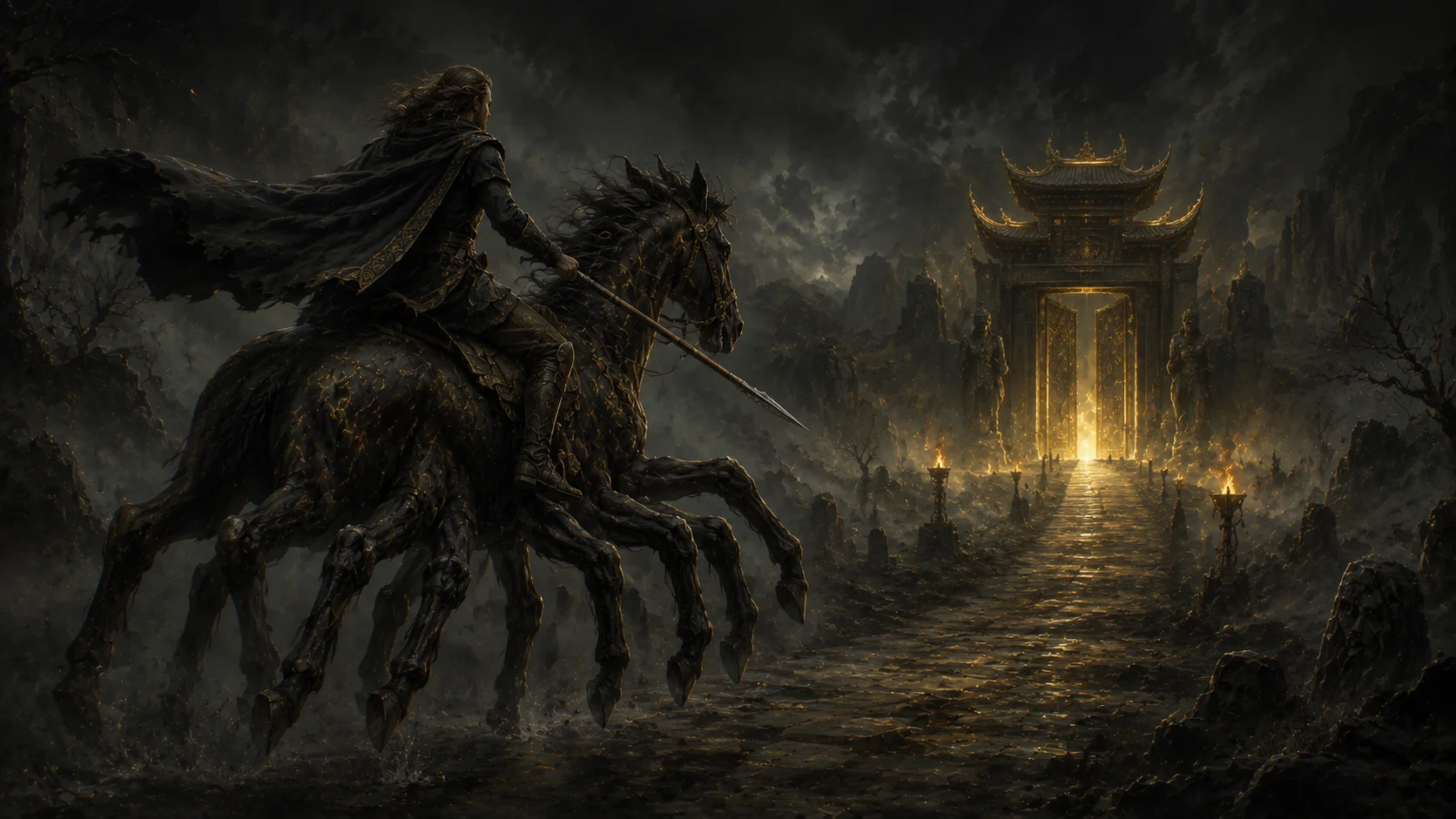
For a journey no living rider had reason to expect to survive, Odin lends Hermóðr the one mount equal to it: Sleipnir, his own eight-legged horse. The loan is significant in itself — Sleipnir is Odin's, and entrusting him to Hermóðr marks the ride as a mission sanctioned and enabled at the highest level of the Æsir, not a private venture. Whatever else is uncertain about Hermóðr, this detail is not: he does not make this journey on an ordinary horse, because no ordinary horse could carry a rider into the land of the dead and, perhaps, back out again.
Nine Nights Into the Dark
Gylfaginning is specific about the shape of the ride: Hermóðr travels for nine nights, through valleys so deep and dark that he cannot make out the way ahead of him. There is no description of rest, of doubt, or of turning back — only the steady, grinding passage downward, night after night, deeper than the world of the living reaches. Nine nights is not a casual figure in the Norse cosmological imagination, and the text lets the duration itself do the work of conveying how far beneath the world of men Hel's realm lies.
The River Gjöll and Its Golden Bridge
At the end of that descent, Hermóðr comes to the river Gjöll, spanned by a bridge roofed in glittering gold. The bridge is guarded by a maiden named Móðguðr, who challenges him as he crosses. She tells him something strange and telling: that the bridge resounded more loudly beneath him alone than it had beneath five whole bands of dead men who had crossed it recently. It is a small detail, but a pointed one — a living man, still weighted with the substance of life, makes more noise on the bridge to the dead than the dead themselves do. Móðguðr confirms that Baldr has indeed passed this way before him, and lets him ride on.
The Leap Over Helgrindr
Hermóðr's road ends at the gate of Hel's hall, called Helgrindr, and here the text gives him one more feat worthy of Sleipnir's reputation: rather than seek entry by any ordinary means, Hermóðr sets his horse at the gate and leaps it clean, clearing the barrier that separates the world of the dead from any further approach. It is a small, sharp image of defiance in the middle of a journey otherwise defined by patient endurance — the gate of death cleared in a single bound, on a horse that belongs to the king of the gods.
Baldr in the High Seat
Once inside, Hermóðr finds Baldr seated in the place of honour within Hel's hall. The text does not dwell long on this reunion, but its placement matters: Baldr has not been reduced to some formless shade among the dead. He is honoured even in death, seated as befits him, and it is this Baldr — recognisable, dignified, still himself — that Hermóðr must now try to bring home.
The Terms Hel Sets
Hermóðr puts his plea to Hel directly: he asks that Baldr be released and allowed to ride back with him to the world above, telling her of the grief that has fallen on the Æsir. Hel's answer is not a refusal, but a test framed as a condition, and one that reveals something of how death itself is imagined to work in this cosmology: if everything in the world, living and dead alike, will weep for Baldr, then he will be given back. But if even a single thing refuses to weep, he remains with her. It is a bargain that puts the outcome not in Hermóðr's hands, nor even fully in Hel's, but in the hands of the entire world.
The Ride Home, and the Gifts from Nanna
Before Hermóðr leaves, the hall gives him two things to carry back. From Baldr himself comes the ring Draupnir, to be returned to Odin — a ring bound up with Odin's own story, now passing back into his hands by way of his son's journey into death. And Baldr's wife, Nanna, sends gifts of her own back with Hermóðr for Frigg and for others among the Æsir. These are not the tokens of a mission that has failed; they are the tokens of a household still intact in the halls of the dead, still capable of sending word and gift to the living, even if its master cannot yet follow.
One Refusal Among All Things
Hermóðr carries Hel's condition back to the Æsir, and word goes out through all the worlds asking every living and dead thing to weep for Baldr. By every account, the response is overwhelming: stones weep, trees weep, every creature answers the call — all but one. A giantess, who gives her name as Þökk, refuses, and is widely understood within the text itself to be Loki in disguise. Her single refusal is enough. Hel's condition was absolute, and it is not met. Baldr remains among the dead, and Hermóðr's ride, for all that it accomplished — the nine nights, the bridge, the leap, the bargain struck and honoured on Hel's side — ends in the one outcome it was meant to prevent.
What the Failure Does Not Undo
It is worth being precise about what this ending does and does not mean for Hermóðr himself. The mission fails, but not through any fault in the ride, the plea, or the bargain he secured. Hel's terms are met by every last thing in creation except one, and that one exception belongs to Loki's treachery, not to any shortcoming of Hermóðr's. He reaches the world of the dead, is received in its hall, negotiates directly with its ruler, and returns — carrying proof of his errand in the ring and the gifts pressed into his hands by Baldr's own household. Few figures in the surviving myth travel so far into death and come back at all.
A Rider Remembered for the Road, Not the Outcome
Because so little else is recorded of Hermóðr, his identity in the tradition is inseparable from this single ride. He is not listed among the well-catalogued gods of Gylfaginning's formal enumeration, and the disputed references in Hyndluljóð and Sögubrot add little that can be relied upon. What remains solid is the mission itself: a son of Odin, mounted on Odin's own horse, descending nine nights through the dark, crossing a bridge that rang louder under him than under the dead, clearing the gate of Hel's hall in a single leap, and standing before the ruler of the dead to bargain — on behalf of grief itself — for a god's return. Norse myth offers few descents into the underworld with this much specificity of geography and incident, and scholars examining underworld-journey narratives across traditions have long taken Hermóðr's ride as one of the clearest examples the corpus provides. In later retellings of the Baldr myth, and in occasional modern fiction and games that cast him as Odin's messenger, it is this ride — not any office or title — that keeps Hermóðr present in the story at all.
Sources & traditions
- EncyclopediaWikipedia — Hermóðr
- TraditionNorse texts, inscriptions and later retellings (Scandinavia)
Myths change from area to area and from time to time. This chronicle follows the most widely told versions; tellings in other villages, regions and eras may differ.