Hodr was the blind god of the Norse — a son of Odin and brother of the radiant Baldr, whose hand, guided by the malice of Loki, threw the mistletoe dart that killed the best of the gods. A tragic, unwitting instrument rather than a villain, Hodr is the blind brother whose unknowing act set in motion the doom of the gods, and whose story does not end at his own death but reaches, astonishingly, past the end of the world itself.
A God Set Apart by Darkness
Hodr (Old Norse Höðr, sometimes rendered in English as Hod or Hoder) was counted among the Aesir, a son of Odin and thus brother to Baldr. The single trait that defines him in the surviving sources is his blindness — he is described plainly as unable to see, a god of strength without sight. Where his kin were marked by radiance, wisdom, or craft, Hodr was marked by an absence: the game and glitter of Asgard's halls played out around him rather than through him, and it is precisely that exclusion which Loki would later turn into a weapon. Nothing in the old accounts paints Hodr as bitter or resentful about his blindness; he is simply, quietly apart from the others, a figure whose entire mythic identity rests on the one sense he lacked.
Kin to the Shining God
As Odin's son, Hodr stood among the innermost circle of the Aesir, brother to Baldr, whose beauty and goodness were said to shine so brightly that light itself seemed to gather around him. The bond between the brothers is never elaborated at length in what survives, but its weight is felt entirely in its rupture — the sources take for granted that Hodr and Baldr belonged to one another as kin, so that what follows lands not as one god harming a stranger but as the closest possible tragedy within a single family of gods.
The Oaths Sworn for Baldr
When dreams and portents warned that Baldr's life was in danger, the gods moved to protect him absolutely: every thing in creation — every stone, every metal, every beast, every plant, every disease and poison — was made to swear an oath never to harm him. Baldr became, in effect, invulnerable, proof against the world entire. But in securing every oath, one small and seemingly harmless growing thing was passed over: the mistletoe, deemed too slight and too young to bother swearing. That single oversight, unnoticed by the gods in their care, would prove to be the only door through which harm could still reach Baldr.
Sport at Baldr's Expense
Made confident by Baldr's newfound invulnerability, the gods turned his protection into entertainment. It became their sport to hurl objects and strike at him with weapons in their assemblies, delighting each time a blade turned aside or a stone fell harmless at his feet — a game that flattered Baldr's safety even as it treated his body as a target. Hodr stood at the margins of this game as he stood at the margins of most gatherings, for he was blind and had no way to see where to aim, and so, it seems, no natural way to take part in the amusement everyone else enjoyed.
Loki's Question in the Crowd
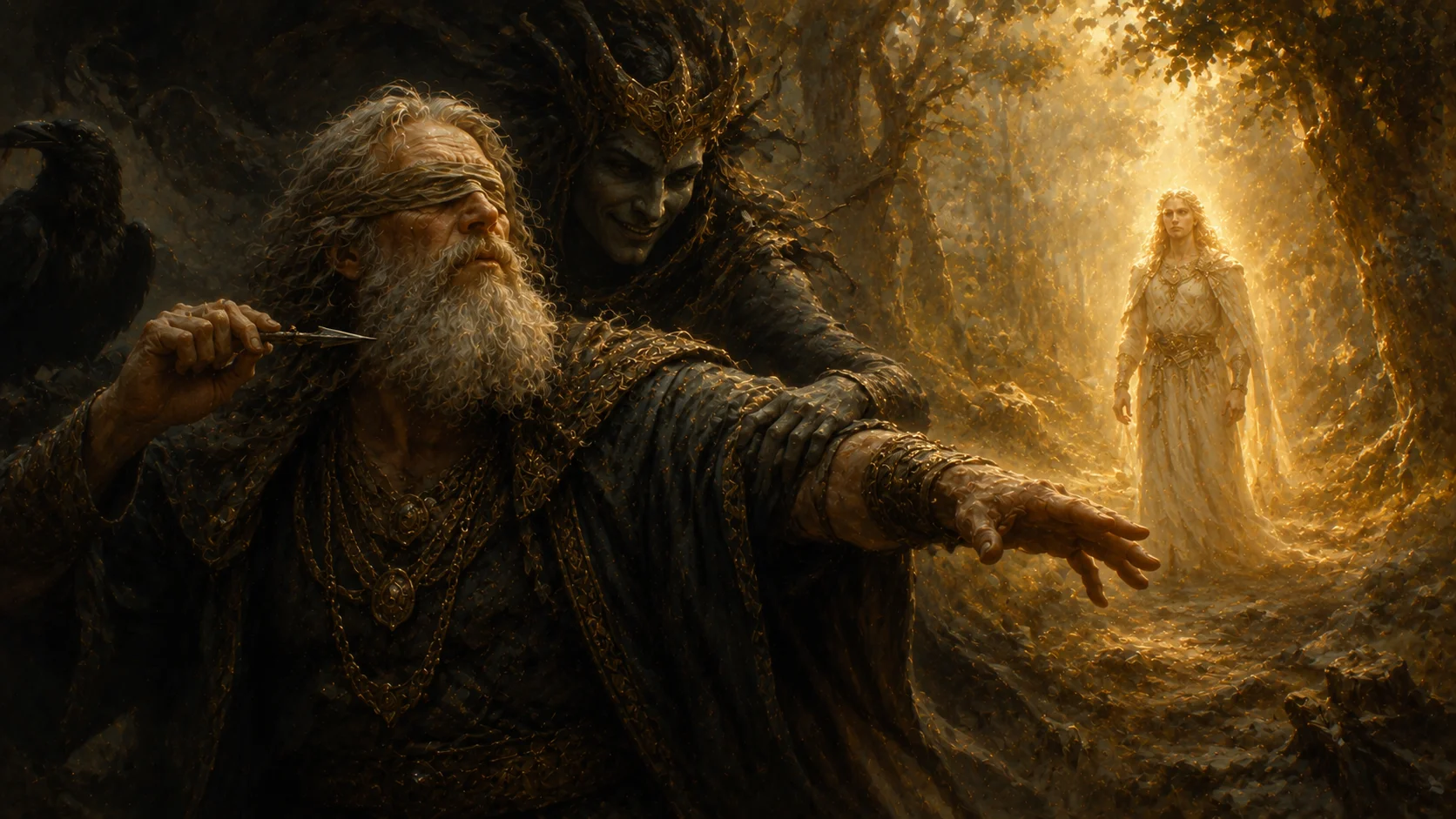
It was Loki who noticed the one flaw in the gods' precautions and Loki who noticed, too, that Hodr stood apart from the game. The trickster went to the blind god and asked, with feigned concern, why he did not join in honoring his brother as the others did. Hodr answered honestly: he could not see where Baldr stood, and in any case he had no weapon to throw. Loki's reply supplied both — he pressed a dart or shaft cut from mistletoe into Hodr's hand, and offered, as if performing a small kindness, to guide the blind god's arm and aim it truly.
The Cast That Could Not Miss
Trusting the offer as one more gesture of the game, Hodr let Loki direct his hand and threw the mistletoe shaft where he was guided. It struck Baldr and killed him instantly — the one thing in all creation that had never sworn its oath finding, at last, the one gap in his protection. The god who could not be harmed by sword, stone, fire, or poison was undone by a plant no one had thought worth asking, thrown by the one god in the hall who could not see what his own hand had done.
The Unwitting Hand
What separates Hodr from Loki in this telling is intention. Hodr did not know the mistletoe could kill; he did not know Loki's purpose in guiding his arm; he could not even see the brother he struck down. He is remembered not as Baldr's murderer in any willing sense but as the instrument through which Loki's malice was carried out — the blind brother whose hand was used, rather than a schemer who chose to harm. The Poetic Edda's account of the world's fate names Hodr directly as the one whose deed brought Baldr down, a terser corroboration of the same event, though it is the fuller prose account that supplies the detail of his blindness and his innocence of purpose.
A Grief Without a Rival
Baldr's death was reckoned the single greatest tragedy ever to befall gods and men — a sorrow so total that it could not be answered with anything as simple as anger at Hodr alone, since Hodr himself had acted without knowledge or will. The sources reflect this: Hodr's part in the killing is described as catastrophe rather than crime, an act whose horror lay less in malice than in its very unavoidability once Loki had set it in motion. Some accounts speak of Hodr being cast out from the world of the gods in the aftermath, a mark of how heavily the deed weighed even on one judged blameless in spirit.
A Son Born to Answer for Him
Vengeance for Baldr could not fall on Loki alone, nor could it easily fall on a brother who had acted as an unknowing tool — and yet fall it did. Odin fathered a son expressly for the purpose of avenging Baldr's death: Vali, born to Odin by Rindr. Vali grew to his full strength with unnatural speed and, still no more than a single night old, killed Hodr in payment for the killing of Baldr. The blind god who had never meant to harm anyone died all the same, the debt of blood settled by a brother who had been brought into being for no other reason.
A Seeress Foretells the Blow
Odin himself is said to have ridden to the underworld before any of this came to pass, seeking a dead seeress and compelling her to speak of what was to come. In that grim dream-journey she foretold plainly that Hodr would bring about Baldr's death, and that Vali would in turn avenge it — the whole chain of killing and answering-killing laid out in advance, known to Odin before his sons ever moved to fulfill it. That Odin heard this prophecy and could not prevent it, only watch it unfold exactly as spoken, adds a particular bleakness to Hodr's story: even the father of the gods was powerless to spare either son.
A Different Hodr in Later Telling
Several centuries after these poems and prose accounts were set down, the Danish historian Saxo Grammaticus told a very different version of the same names in his Latin history of the Danes. There, a human hero called Høtherus and a rival named Balderus contend as suitors rather than as brothers bound by fate and mistletoe, in a story reshaped into the conventions of legendary history rather than myth. Scholars treat this euhemerized tale as its own distinct literary tradition, not a variant record of the same divine Hodr — the blind son of Odin belongs to the Eddic accounts alone, and his story should not be folded into Saxo's very different invention.
Reunion in the World Reborn
Yet the story the Eddic sources tell of Hodr does not close on his death at Vali's hand. It was foretold that when the final battle of the gods has passed and the old world has burned away, the survivors would gather in a renewed and cleansed world — and that Baldr and Hodr, the slain brother and the brother whose hand slew him, would both return from the dead to dwell there together, reconciled at last. The killing that could not be undone in life is answered, in this final vision, not by further vengeance but by the return of both brothers side by side in the world made new.
The blind god threw the dart that killed the best of the gods, never seeing what his hand was made to do, and paid for it with his own life at his young avenger's hand — yet the same prophecy that foretold his crime also promised that, when the world ends and begins again, he and the brother he struck down would return together, and be brothers still.
Sources & traditions
- EncyclopediaWikipedia — Höðr
- TraditionNorse texts, inscriptions and later retellings (Scandinavia)
Myths change from area to area and from time to time. This chronicle follows the most widely told versions; tellings in other villages, regions and eras may differ.