Frigg was the queen of the Norse gods and the highest of the goddesses — the wife of Odin, mistress of the hall Fensalir, goddess of marriage, motherhood, the household and foreknowledge. She alone among the gods shared Odin's gift of seeing all fates, and yet, knowing the future, she could not save her beloved son Baldr from his doom — a tragedy that lies at the heart of her story.
The Queen of Asgard
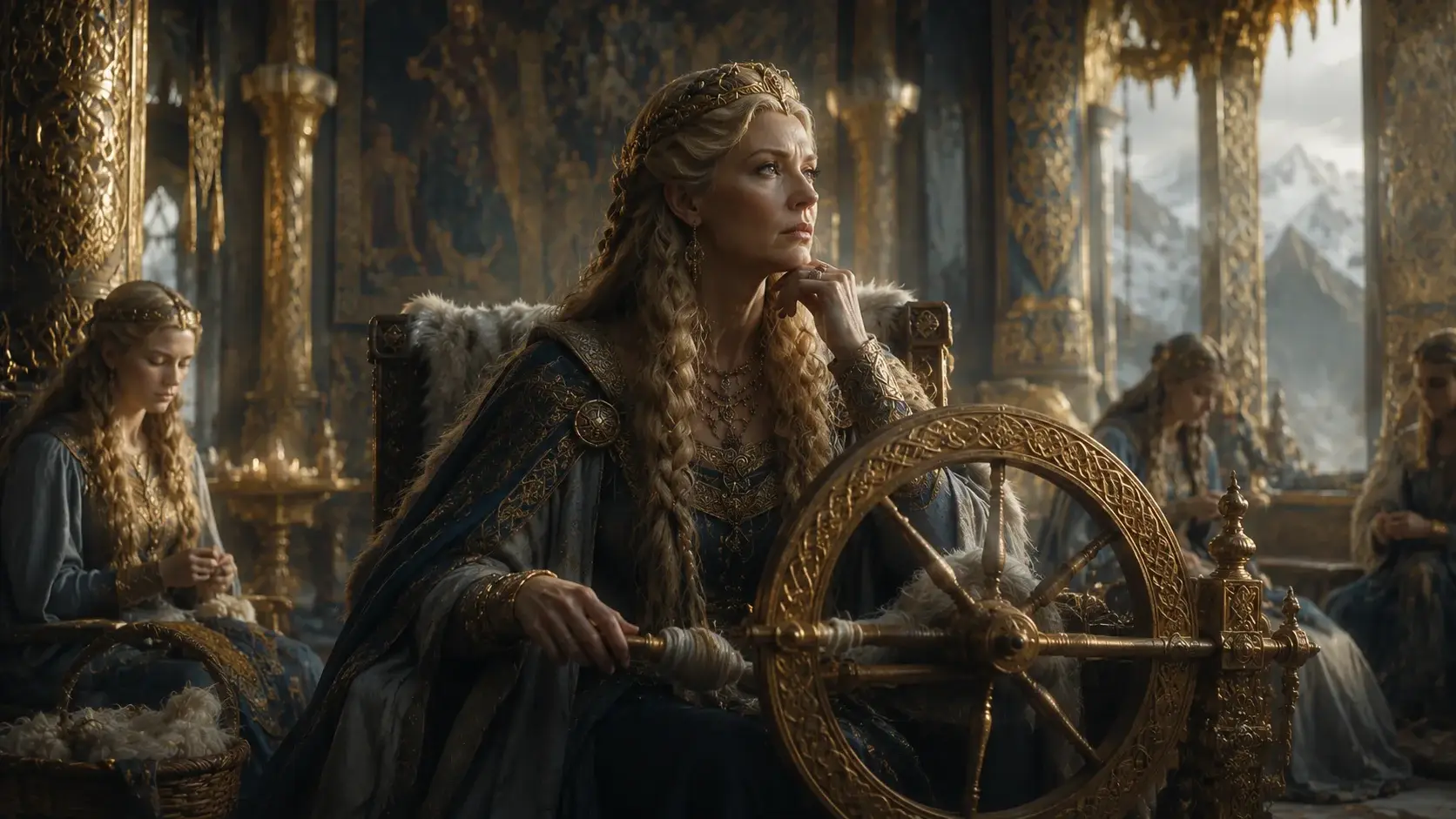
Frigg (Old Norse Frigg, from a root meaning “beloved”) was the foremost of the Aesir goddesses and the wife of the All-Father, and so the queen of Asgard and the highest lady of heaven. She presided over marriage, the bonds of the household, childbirth and motherhood, and she was attended by handmaidens including Fulla (who kept her casket of treasures), Gna (her messenger) and Hlin (her protector of those she wished to shield). A dignified and powerful figure, she was the one goddess permitted to sit upon Odin's high seat Hlidskjalf and gaze out over all the worlds.
The Goddess Who Knew All Fates
Frigg shared with her husband the deepest and most terrible of gifts: she knew the fate of every being, the whole course of what was to come. Yet, like Odin, she kept her knowledge silent, “though she herself says it not.” This foreknowledge made her wise and serene, but it also bound her to a fate she could see but not change — for she knew, before all others, the doom that was coming for her son.
The Death of Baldr
When her son Baldr, the most beloved and radiant of all the gods, began to dream of his own death, Frigg set out to save him with a mother's desperate love. She traveled through all the world and exacted an oath from every thing — fire and water, iron and stone, beasts and birds, sicknesses and poisons — that none would ever harm her son. So thorough was her work that the gods made a game of hurling weapons at the now-invulnerable Baldr, which all bounced harmlessly away. But Frigg had overlooked one small, seemingly harmless plant: the mistletoe, which she thought too young to swear. The trickster Loki learned of this single gap, fashioned a dart of mistletoe, and guided the hand of the blind god Hodr to throw it — and Baldr fell dead. Frigg's boundless love had been undone by one overlooked exception, and the goddess who knew all fates was made to watch the one she most wished to prevent.
The Grieving Mother of Heaven
Frigg endures as the great mother-goddess and queen of the Norse pantheon — the patroness of wives, mothers and the home, and the tragic figure whose perfect foresight and perfect love together could not save her child. She gives her name, with the goddess Freya, to our weekday Friday. She embodies the deep pathos at the center of Norse myth: that even the wisest love, even the queen of heaven who knows all that is to come, cannot turn aside a fate that is fixed.
She made all the world swear never to harm her son, and forgot only the mistletoe — and so the goddess who saw every fate had to watch the one she dreaded most come true.
The Earliest Voice: Frija in the Merseburg Charm
Centuries before Icelandic poets set down the Eddas, a cleric — most probably at the monastery of Fulda — copied two pagan charms onto a blank page of a Latin devotional manuscript that later came to rest in the cathedral library at Merseburg, from which they take their modern name. The first looses a captive's fetters; the Second Merseburg Charm, composed in Old High German, heals a horse. Between them they are almost the only Germanic heathen verse to survive in its own words rather than through a Christian retelling. The second charm sets Wodan and a companion called Phol — a figure many scholars identify with Baldr — riding into a wood, where Baldr's foal wrenches its foot. A chain of goddesses then chants over the injury in turn: Sinthgunt, and Sunna the sun her sister; then Frija, the Continental form of Frigg's name, and Volla her sister; and last Wodan himself, binding bone to bone, blood to blood and limb to limb until the leg is sound. It is a small, homely miracle, worked on a lamed horse rather than a dying god, and it puts Frigg exactly where her later Norse portrait promises she belongs: at Odin's side, working a cure. It also quietly contradicts the household the Prose Edda gives her three centuries afterwards. There, Volla appears as Fulla, Frigg's attendant and the keeper of her casket; in the older German charm she is Frigg's sister outright.
The Bearded Trick: How Frigg Named the Lombards
Long before she became the grieving mother of the Baldr story, an entirely different tradition remembered Frigg as a schemer clever enough to outwit her own husband. The seventh-century Origo Gentis Langobardorum and Paul the Deacon's eighth-century Historia Langobardorum both preserve a founding legend of the Lombards in which a small people called the Winnili face annihilation by the more powerful Vandals. The Vandals ask the god Godan — the Continental Odin — for victory, and Godan swears he will grant it to whichever side he lays eyes on first at sunrise. Desperate, the Winnili matriarch Gambara appeals instead to Godan's wife, Frea. Frea's counsel is pure trickery: she tells the Winnili women to comb their hair forward over their faces like beards and stand where Godan's window faces — then quietly turns her sleeping husband's bed so that when he wakes, he is looking straight at them. Godan opens his eyes, sees the strange long-bearded host, and asks who these long-beards are. Frea answers at once that as he has given them a name, he must now give them the victory too. Bound by his own oath, Godan grants it — and the Winnili become the Langobardi, the Lombards, a people who went on carrying into history the name Frigg's cunning won for them.
A Marriage Twice Tested
The devoted wife of the Baldr story is not the only Frigg the sources remember. In the flyting poem Lokasenna, Frigg tries to silence Loki before he can say aloud what he knows about Odin; Loki turns on her instead, calls her Fjorgynn's daughter, and accuses her of taking Odin's own brothers, Vili and Ve, into her bed while her husband was away. It is not an idle slander invented for the insult. The Ynglinga saga tells much the same story as plain history, recording that during one of Odin's long absences from Asgard his brothers Vili and Ve divided the realm between them and shared Frigg as a wife, until Odin returned and reclaimed both his throne and his queen. The Danish historian Saxo Grammaticus, writing around 1200 and retelling the same pantheon in a harsher, more moralising key, goes further still: in his account Odin's wife has the gold stripped from a statue raised in her husband's own honour so that she can wear it, shaming him into a self-imposed exile. Set beside one another, these episodes complicate the serene queen of Fensalir. They preserve a Frigg who acts on her own judgement, for good or ill, the moment Odin is out of the hall — a far more independent figure than the sorrowing mother alone would suggest.
The Distaff and the Keys of the Hall
Long after the conversion, Scandinavian country tradition was still pointing at the sky and naming a constellation for her. The three bright stars of Orion's Belt were known in Sweden as Friggerock, Frigg's distaff: the queen of Asgard spinning thread across the winter sky exactly as a mortal housewife spun wool beside the hearth-fire. Tellingly, the same three stars are also recorded as Freyja's distaff — a small piece of evidence for the confusion set out below. The image is not merely decorative, either. In the Viking Age a married woman's authority over her household was carried literally at her waist: keys to the store-chests holding a hall's provisions, cloth and treasure are a recurring find in the graves of women of standing throughout the period, and are conventionally read as the badge of the mistress of the house, though how literally to take that is still argued. Frigg, goddess of marriage and mistress of her own hall at Fensalir, is the divine pattern of that authority. A household holds together while its men are away at war, at sea, or wandering the nine worlds — and it holds together because she is in it.
Called On in Childbed
Frigg's foreknowledge and her grief over Baldr were not the only reasons Norse women had to think of her. In the poem Oddrunargratr, a woman named Borgny lies trapped in a labour she cannot finish, and Oddrun comes to her and chants bitra galdra — biting, cutting charms — until the children are born. What follows is the detail worth keeping. The delivered mother, giving thanks, calls down a blessing on the woman who saved her: may the gracious powers help you, she says, “Frigg and Freyja and more of the gods,” as you have lifted this danger from me. It is one of the few moments in the surviving corpus where a goddess is not the subject of a myth but a name spoken by ordinary women at the most physically dangerous hour of their lives — and it is spoken not as a plea but as a reward. A goddess of marriage is, almost inevitably, also a goddess of the children marriage produces, and of the mothers who might not survive bringing them into the world.
Frigg or Freyja?
No question in Norse studies is more persistent than whether Frigg and Freyja were once, in the deep past, a single goddess. The case for it is circumstantial and stubborn: both preside over love, marriage and fertility in overlapping ways, both weep for a lost man, and Freyja's husband bears the name Odr — which is, to a syllable, Odin's own name stripped of its ending. Freyja weeping golden tears for a wandering Odr sits uncomfortably close to Frigg waiting out the absences of a wandering Odin. The case against is just as stubborn, and it begins with the names, which are not related at all: Frigg descends from a word meaning “beloved,” while Freyja is simply “the Lady,” the feminine of the title carried by her brother Freyr, “the Lord.” They do not even belong to the same family — Frigg is Aesir, Freyja Vanir, brought to Asgard out of the war between them.
The clearest fossil of the confusion is sitting in the calendar. English Friday and German Freitag both descend from Frigg's Continental name, chosen by early translators to render the Roman dies Veneris, Venus's day — yet popular memory reassigns the day to Freyja again and again, because her character now fits a love-goddess so much more comfortably. Iceland dealt with the ambiguity by deleting it. Around 1110 the bishop Jon Ogmundsson, set on scouring the last heathen residue out of ordinary speech, renamed the entire week: Odin's day became midvikudagur, “mid-week day,” the days of Tyr and Thor became the flatly numerical “third day” and “fifth day,” and Frigg's day became fostudagur, “fast day.” Those are still the names Icelanders use. The reform worked on the calendar and failed everywhere else: within a century of Jon's death, Icelandic scribes were busy writing down the Eddas.
Looking outside Scandinavia sharpens the puzzle rather than solving it. Greek Hera and Roman Juno occupy the same structural seat — queen of heaven, wife of the sky-father, patroness of marriage — but they are counterparts, not relatives, and what each culture does with the role is the interesting part: Hera's myths turn on jealousy and revenge, Frigg's on foresight and grief. Even Frigg's parentage keeps the ambiguity alive. Lokasenna names her father as a shadowy Fjorgynn, a name that is the exact masculine twin of Fjorgyn, an old byname for Jord, the earth, who is Thor's mother by Odin. Frigg's father and Thor's mother therefore carry what is effectively one name in two genders, and nothing in the surviving sources explains why. It is one more thread the Norse poets left hanging on a figure who was already, in her own century, half-merged with her nearest neighbour.
After the Conversion
Frigg outlived the religion that worshipped her by becoming a character rather than a goddess to petition. Richard Wagner rebuilt her as Fricka in the Ring cycle, the moral conscience of Das Rheingold and Die Walküre, who holds Wotan to the oaths he has broken and forces him to abandon the son he loves. It is a magnificent role and a nineteenth-century invention: the Frigg of Lokasenna does the reverse, trying to hush Loki before he can name aloud what Odin has done. Modern fiction has mostly kept her nearer the sources, and much quieter. Neil Gaiman's Norse Mythology retells the Eddic Frigg of the Baldr story more or less straight; Rick Riordan, in Magnus Chase and the Gods of Asgard, gives the queen of the Aesir a pointedly wordless presence — she appears, and never once speaks. The Marvel films go furthest, recasting her as Frigga, queen and protector, played by René Russo, and giving her a sword: warmer, more active and far more mobile than any source allows, yet still assembled around the trait the Eddas gave her first. She is a mother who would bargain with the whole created world to keep her son alive, and a queen wise enough to know, long before anyone else, exactly what that would cost her.
Sources & traditions
- EncyclopediaWikipedia — Frigg
- TraditionNorse texts, inscriptions and later retellings (Scandinavia)
Myths change from area to area and from time to time. This chronicle follows the most widely told versions; tellings in other villages, regions and eras may differ.