Freya was the great goddess of love, beauty, fertility, war and death — the most prominent and powerful of the Norse goddesses, foremost of the Vanir, mistress of magic, owner of a falcon cloak and a chariot drawn by cats, and the keeper of a hall to which fall half of all those slain in battle. Sensual and fierce, generous and grasping, she is a goddess of vast scope: desire and warfare, gold and sorcery, life and the dead all fall within her domain. Across the Poetic Edda and the Prose Edda alike, no goddess of the North is attested more extensively, or given a wider reach across the concerns of gods and mortals both.
The Lady Sent Among Strangers
Freya (Old Norse Freyja, “the Lady”) was a daughter of the sea-god Njord and the twin sister of the god Frey — one of the Vanir, the gods of fertility and prosperity who had fought the Aesir to a standstill in the great Aesir–Vanir War. When the two divine races made peace, the settlement was sealed by an exchange of hostages, and Freya crossed over to dwell among the Aesir together with her father and her brother. She arrived, in other words, not as a conqueror but as a pledge of peace between two families of gods — and she remained among the Aesir ever after, the most honored stranger in their halls. The Ynglinga saga and the Prose Edda both preserve this same account of her coming: a settlement struck in the aftermath of war, and a goddess handed over as its living proof.
A Marriage of Absence and Golden Tears
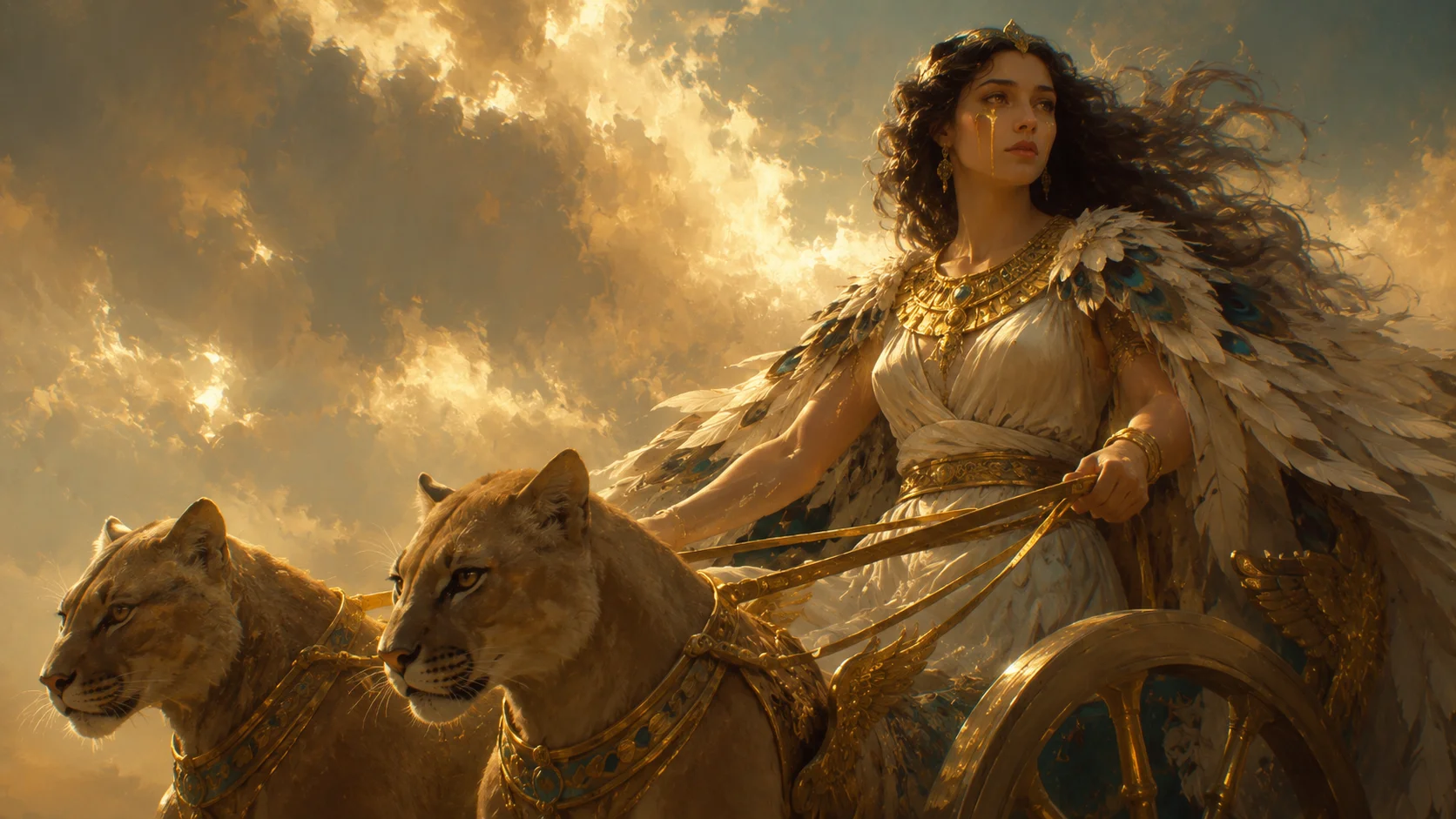
Freya was married to a god named Óðr, and theirs was a union shadowed by distance: Óðr went on long journeys and was often away from her for great stretches of time. In her longing for him, Freya wept, and where her tears fell they turned to red gold. Some who have studied the old tales have wondered whether Óðr might be another face of Odin himself, wandering under a different name — but this is a scholar’s guess laid over the story, not a thing the old sources say outright. What the sources do say, plainly, is a goddess who loved and grieved and whose grief itself turned to treasure. It is one of the stranger images the mythology offers: sorrow that does not simply pass but leaves behind something bright and lasting, wealth wept rather than mined or won.
The Necklace Brisingamen
Freya’s most famous possession was the necklace Brísingamen, a marvel of golden craftsmanship. A later saga — the Sörla þáttr, younger and less certain than the great poems of the Elder Edda, and treated with some caution by those who study these things — tells that she won it from four dwarves by spending a night with each of them in turn. Because this account comes from a comparatively late source outside the core Eddic corpus, scholars are careful to flag it as a story of uncertain antiquity rather than settled tradition. Whatever the truth of its making, the necklace became the very emblem of Freya’s beauty and her power, so bound up with her person that when she was seized by fury in the tale of Thor’s stolen hammer, it was said to break apart from the force of her rage.
The Falcon Cloak and the Chariot of Cats
Among Freya’s treasures was a cloak of falcon feathers — a fjaðrhamr — that let whoever wore it take the shape of a falcon and fly between the worlds. She lent this cloak to other gods when the need arose: the Þrymskviða and the Skáldskaparmál both preserve moments where it was Freya’s falcon-shape that Loki borrowed, including the flight into giant country to win back the goddess Idun after she and her golden apples had been carried off by the giant Thiazi. When Freya herself traveled, she rode in a chariot pulled by two great cats, a strange and stately team fitting for a goddess who was at once tender and untamable, as Gylfaginning records it.
The Boar and the Borrowed Name
Freya also kept, or rode, a boar named Hildisvíni, “battle-swine.” In the poem Hyndluljóð, she disguised her lover Óttar as this very boar and rode with him to the giantess Hyndla, seeking from her the deep knowledge of Óttar’s ancestry and lineage. It is one of the tale’s clearest glimpses of Freya not as a distant, iconic beauty but as an active, resourceful patroness — using disguise and cunning on behalf of someone she loved, much as she used disguise for herself under her many other names. The episode also shows her operating in a register few other Norse deities occupy: as a keeper and broker of genealogical knowledge, willing to trade cleverness for information that mattered to someone she favored.
Mardoll, Horn, Gefn, and Syr
Freya went by more names than any other deity of her kind: she was called Mardöll, Hörn, Gefn, and Sýr, among others, all recorded in Gylfaginning. These names, the old sources explain, were the ones she took when she traveled in disguise among different peoples of the world. A goddess of her stature could not always move openly; the many names were the many faces she wore when she chose not to be known, a fittingly mysterious habit for a deity who was, above all others, the mistress of hidden things. Later tradition would sometimes tangle these epithets with those belonging to other goddesses, but within the old sources themselves each name is given plainly as one more mask Freya wore at will.
Teacher of Seidr
Freya was the great mistress of seiðr, the powerful and unsettling Norse magic of prophecy, fate-shaping, and hidden sight. More than a practitioner, the Ynglinga saga names her its very first teacher among the Aesir: it was Freya who taught this magic to the gods of her adopted family, and most notably to Odin himself, the All-Father who would go on to become seiðr’s other great master. That the highest of the gods learned his deepest magic from a goddess of the Vanir says something of how the two divine families, once enemies, ultimately completed each other — each supplying the other with a power it had lacked.
Her Half of the Battle-Slain
Though she is remembered first as a goddess of love, Freya was equally and just as truly a goddess of war and of the dead. Per Grímnismál, she presided over the afterlife-field Fólkvangr, “the field of the host,” and over the hall that stood upon it, Sessrúmnir. There she received half of all warriors who died in battle — the other half going to Odin in Valhalla. This was no minor honor: Freya stood as Odin’s equal in the reckoning of the war-dead, a goddess with the authority to claim souls from the field of slaughter in her own right, and one of the clearest signs in the mythology that death among the Norse gods was never Odin’s province alone.
Fury at Thrym’s Demand
When the giant Thrym stole Thor’s hammer Mjölnir and sent word, in the Þrymskviða, that he would return it only if Freya were given to him as his bride, the gods brought the demand to Freya herself. Her refusal was immediate and violent: she was overcome with such fury that her famous necklace shattered from the force of her rage, and the hall of the gods itself was said to shake. Freya would not be traded away as ransom for anyone’s weapon. In the end it was Thor who was dressed in bridal veil and sent to Thrym’s hall in her place, retrieving his hammer by trickery rather than by any surrender of Freya.
A Disputed Accusation
In the poem Lokasenna, where Loki turns on the assembled gods one by one with insults at a feast, he accuses Freya of having slept with every god and elf present, her own brother included. The accusation is delivered in the heat of an insult-contest meant to wound and provoke, not as a sober telling of events, and nowhere else in the old sources is it confirmed as literal fact. It is best understood as one of Loki’s barbed provocations rather than settled myth — a slander flung in anger, not a chronicle of what actually occurred, and the surrounding poem itself frames Loki as an unreliable, malicious speaker rather than a narrator to be trusted.
The Prize the Giants Could Not Stop Wanting
Freya’s beauty made her, again and again, the great prize that the giants of the old tales schemed to possess. Thrym’s demand for her hand as ransom for the stolen hammer was only the most famous instance of a pattern that ran throughout the mythology: to the giants, Freya represented the one treasure among the gods worth risking everything to win, and to the gods, she was a treasure worth refusing to give up at any cost. That refusal, sustained across the tales that survive, marks her as something closer to a boundary the gods would not cross than a passive object of desire.
The Great Goddess of the North
Freya endures as one of the most vividly remembered deities of Norse myth — a figure of extraordinary range, encompassing love and desire, beauty and gold, magic and prophecy, war and the claiming of the dead. She is among the most popular Norse deities in modern storytelling, in games such as God of War, and in neopagan practice today, often remembered above all as a goddess of love bound inseparably to war. Modern retellings sometimes blur her together with the goddess Frigg, since later folklore let their epithets overlap in ways scholars regard as inaccurate — but in the old sources themselves, Freya of the Vanir stands as her own distinct and formidable goddess, whose falcon cloak, chariot of cats, golden tears, and claim on half the battle-slain belong to her and to no one else in the Norse pantheon.
Half the battle-slain are hers before ever Odin chooses — for Freya is love and war in one, the most beautiful of the goddesses and the most dangerous to cross.
Sources & traditions
- EncyclopediaWikipedia — Freyja
- TraditionNorse texts, inscriptions and later retellings (Scandinavia)
Myths change from area to area and from time to time. This chronicle follows the most widely told versions; tellings in other villages, regions and eras may differ.