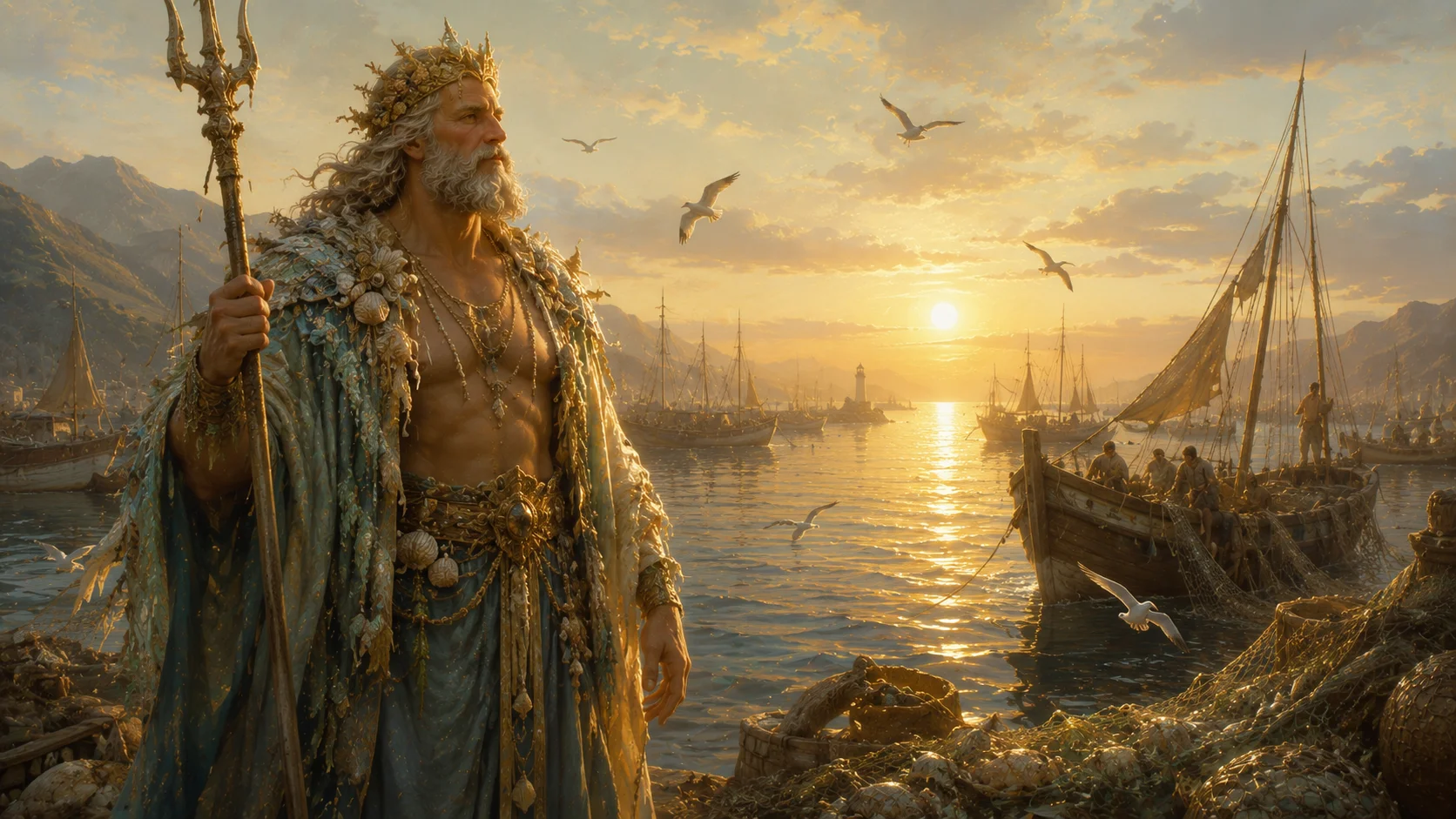
Njord was a god of the sea, seafaring, wind, fishing, and prosperity among the Norse gods — a member not of the Aesir by birth but of the Vanir, the older family of powers bound up with fertility, wealth, and the natural world. He is attested in both the Poetic Edda and Snorri Sturluson's Prose Edda, and across those sources he appears less as a god of the raging deep than as a patron of the calm harbour, the favourable wind, and the riches the sea and the land alike could yield to those who called on him. Wealth, in Njord's case, was not a side detail attached to a sea-god but a defining trait in its own right, named alongside the sea and the wind wherever the sources describe him.
A Hostage Between Two Families of Gods
Njord's place among the Aesir was not his by birthright but by treaty. After the Aesir–Vanir War, the two divine families exchanged hostages to seal their peace: the Vanir sent Njord to live among the Aesir, together with his children Freyr and Freya, while the Aesir sent Hoenir and Mimir to dwell among the Vanir. This arrangement, recorded in the Prose Edda and in the Ynglinga saga account of Heimskringla, is how a Vanir sea-god came to be counted among the gods of Asgard, honoured there rather than merely tolerated. The exchange fixed Njord permanently among the Aesir; nothing in the surviving accounts suggests he ever returned to live among his own people during the mythic present, whatever his fate was said to be once the world itself came to an end.
The Hall Called Noatun
Njord's dwelling was Noatun, "the ship-enclosure" or "ships' haven," a hall set by the sea. The Poetic Edda's Grimnismal names it directly, describing it as his home, and Snorri's Gylfaginning repeats the detail: a lord of the shore living where the ships themselves could be drawn up and sheltered, fitting for a god whose whole domain was bound to safe harbours and successful voyages. The name itself is a kind of description rather than an ornament — a place built around ships, for a god whose business was the safety and success of those who sailed them.
A Marriage of the Old Vanir Custom
Before his adoption among the Aesir, Njord had already been married — to his own sister, left unnamed in the surviving sources. Snorri reports this as a reflection of Vanir custom: marriage between siblings, permitted among the Vanir, was not lawful among the Aesir. The union does not continue once Njord takes his place in Asgard, and the surviving prose accounts do not name the mother of his two children, leaving the parentage of Freyr and Freya less than fully certain in the texts even as their father is not in doubt. The detail survives mainly as an explanation of custom — a marker of how the Vanir differed from the Aesir in their own household law — rather than as a story developed with any incident or event attached to it.
Father of Freyr and Freya
Whatever the full truth of their mother's identity, Njord is named without question as the father of Freyr and Freya, the two Vanir deities who would themselves become central figures among the gods of Asgard. Through them Njord stands as the founding figure of the Vanir line as it continued among the Aesir — the hostage-god whose children outgrew the terms of the exchange that brought them north. Njord's own renown in later ages rests in part on theirs: a sea-god remembered as the father of two of the most prominent Vanir gods to settle permanently among the Aesir.
Chosen by Her Eye for a Foot
Njord's best-known story is the marriage arranged with the giantess Skadi, daughter of the giant Thiazi. When the gods killed Thiazi, Skadi came to Asgard in arms to demand compensation, and among the terms offered to settle the matter was her right to choose a husband from among the gods — but by their feet alone, with the rest of them hidden from view. Skadi chose the fairest feet she could see, believing they belonged to Baldr; they were Njord's. The match was made not by affection or courtship but by the terms of a settlement and the choice of a single glimpsed foot, and Gylfaginning and Skaldskaparmal both preserve the episode as the origin of their marriage. It is a marriage built, from its very first moment, on a mistaken guess rather than a chosen partner — a detail the sources let stand without comment, as if the irony needed none.
Nine Nights at Noatun, Nine at Thrymheim
The marriage foundered on a plain disagreement over where to live. Njord wanted his home at the shore, at Noatun; Skadi wanted hers in the mountains, at Thrymheimr, the home her father had left her. They tried to compromise by living nine nights in one home and nine in the other, alternating between sea and mountain — but Snorri's account makes clear that neither found contentment in the other's country, and implies that in time Njord and Skadi went their separate ways rather than continuing the arrangement. The mismatch is described in entirely domestic terms: not a quarrel of gods, but the ordinary incompatibility of two people who each simply prefer their own home, magnified by the fact that neither home could be shared.
A Name Invoked in the Law-Oath
Njord's standing among the gods is measured in more than myth — it is measured in the formulas people actually swore by. The Prose Edda records that Njord was one of three gods commonly invoked in the old Icelandic law-oath, sworn alongside Freyr and "the almighty Ás," Thor: "so help me Freyr and Njord and the almighty Ás." To be named in that company, beside Freyr and Thor, marks Njord as a god whose word and favour carried real weight in the binding of oaths, and it places him among a very small set of gods whose names were trusted enough to anchor a legal promise.
Lord of Shrines and Giver of Riches
Grimnismal, stanza 16 of the Poetic Edda, credits Njord with dominion over the temples and shrines built by men, naming him lord of a sanctuary connected to the sea and to the giving of wealth. This is consistent with his broader character across the sources: Njord is described as extremely wealthy in his own right, and as a god capable of granting riches, successful fishing, and safe seafaring to those who called on him. He was, in this sense, not simply a god presiding over water but a patron of the prosperity the water could bring — a distinction the sources draw clearly, treating the sea itself and the wealth it made possible as two related but separate gifts within his power.
The King Who Ruled After Odin
The Ynglinga saga, part of Snorri's Heimskringla, gives Njord a second life within the euhemerized history of the Norse gods as legendary kings. There, Njord is remembered as an early king of the Swedes who succeeded Odin, ruling over a reign remembered as peaceful and prosperous. After his death he continued to be worshipped as a god of good harvests and wealth, carrying into this legendary-historical account the same association with abundance that marks him in the mythological sources. The saga's Njord is, in effect, the mythic god retold as a historical figure — the same qualities of peace and plenty simply relocated from Asgard to an early Swedish throne.
An Older Name Behind the God
Scholars have long noted that Njord's name is cognate with that of Nerthus, an earth-goddess whom the Roman historian Tacitus described, in his first-century work Germania, as worshipped among Germanic tribes. The linguistic link between Njörðr and Nerthus is widely accepted as evidence that an older deity, possibly conceived across the two names as both male and female forms of a related figure, stood behind the god later known to the Norse as Njord. The precise nature of that relationship, however, is a matter of scholarly reconstruction rather than something the Norse sources themselves spell out; nothing in the Eddas identifies Njord with Nerthus directly, and the connection rests on the names alone, centuries apart, one recorded by a Roman historian and the other by Icelandic writers of the medieval period.
Remembered by Sailors and Storytellers
Njord's later reception carries his character forward largely unchanged. In modern Ásatrú, the revived Nordic form of heathen practice, he is honoured as a patron of sailors and fishermen, called on in much the spirit the old law-oaths and shrine dedications suggest. He also recurs in modern retellings of Norse myth — in literature, games, and comics — most often through the story that first brought him north: the hostage exchange that placed a Vanir god of the sea permanently among the gods of Asgard. Across these retellings, the throughline is consistent with the old sources themselves: a god defined less by conquest or combat than by safe passage, full nets, and the wealth that a peaceful sea and a peaceful reign could bring.
Sources & traditions
- EncyclopediaWikipedia — Njörðr
- TraditionNorse texts, inscriptions and later retellings (Scandinavia)
Myths change from area to area and from time to time. This chronicle follows the most widely told versions; tellings in other villages, regions and eras may differ.