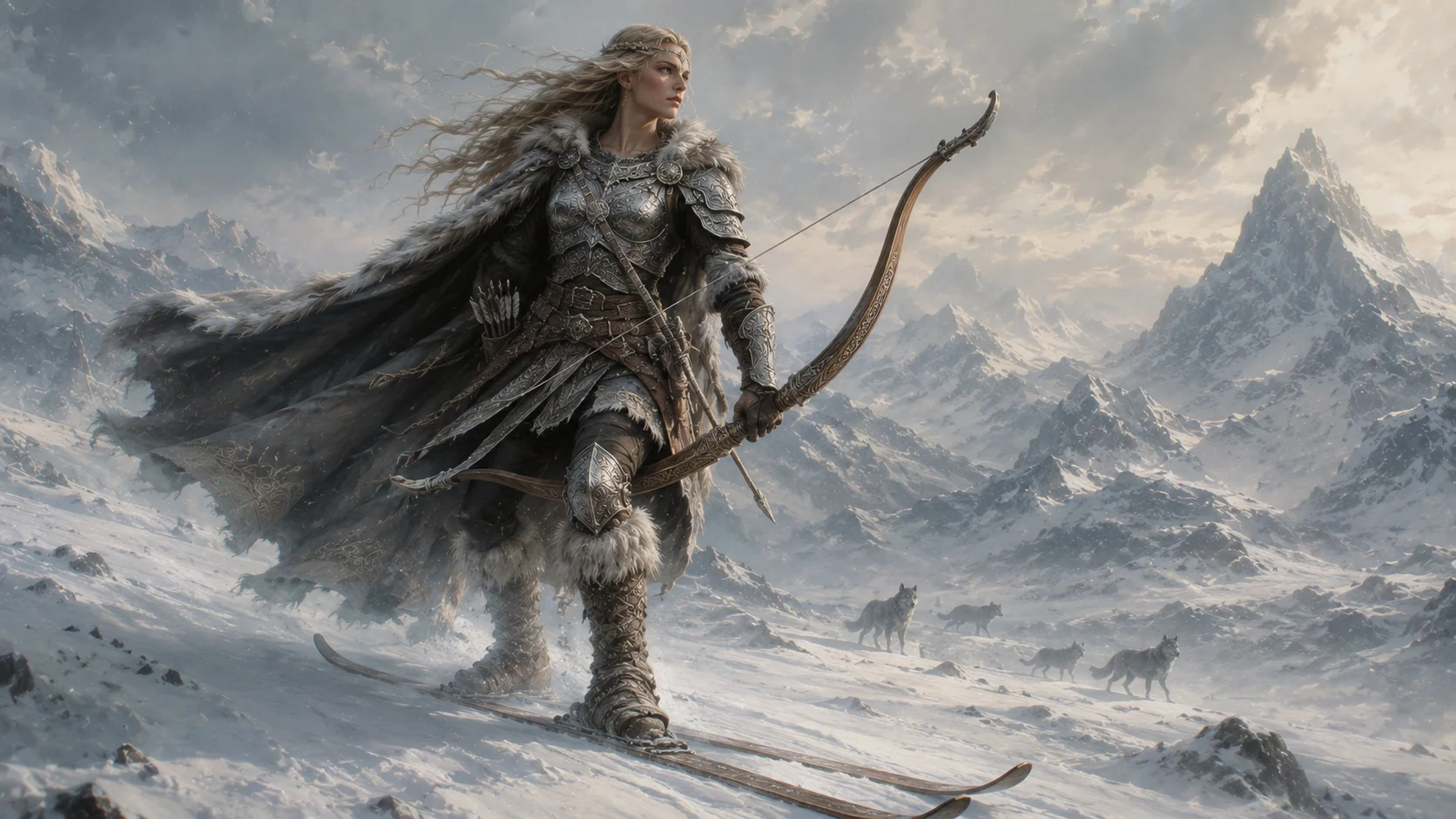
Skadi was the Norse goddess of winter, the mountains, skiing and the hunt — a giantess who became a goddess of the Aesir, striding the high snowy peaks on skis with her bow, a fierce and independent huntress born of the cold. Her story of vengeance, marriage and parting is one of the most vivid in Norse myth, and she remains the very spirit of the frozen northern wilds.
The Snowshoe Goddess
Skadi (Old Norse Skaði) was a jötunn, a giantess, the daughter of the giant Thiazi — yet she came to be counted among the goddesses of Asgard. She was the deity of winter, of the high snow-covered mountains, of bowhunting and of skiing or snowshoeing across the frozen heights; she was often called the “snowshoe goddess” or “ski-goddess.” Strong, self-reliant and warlike, she belonged to the cold uplands and the harsh beauty of the northern winter, a goddess who needed no one and went armed and alone through the snows with her hunting-bow.
The Vengeance for Her Father
Skadi's tale begins in grief and fury. When the gods killed her father Thiazi (the giant who had abducted Idun), Skadi armed herself in full war-gear and marched alone to Asgard to take vengeance on the gods. Rather than fight her, the Aesir offered her recompense — and Skadi, formidable enough to bargain with the gods themselves, set her own terms: she demanded a husband from among the gods, and she demanded that the gods make her laugh, for grief had frozen her heart.
The Marriage by the Feet
The gods agreed to let Skadi choose a husband — but only by looking at the gods' feet, their faces hidden. Hoping to win the radiant Baldr, Skadi chose the most beautiful pair of feet — only to find they belonged to the old sea-god Njord. As for the laughter, Loki won it with a piece of crude buffoonery, tying his beard to the beard of a goat and engaging in an absurd tug-of-war until, shrieking, he tumbled into Skadi's lap — and at last the grim giantess laughed. Her father's death was further atoned when Odin (or Thiazi's eyes) was set among the stars. But the marriage to Njord was doomed: Skadi loved the howling wolves and the snowy peaks, while Njord loved the gulls and the seashore, and neither could bear the other's home. In the end the winter-goddess returned alone to her beloved mountains, to ski and hunt among the snows.
The Spirit of the Winter Wilds
Skadi endures as one of the most striking goddesses of Norse myth — the giantess who bargained with the gods as an equal, the fierce huntress of the winter mountains, independent and unbowed. Some scholars connect her very name to Scandinavia itself, the “land of Skadi.” She embodies the Norse reverence for the harsh, beautiful winter wilderness and the ideal of the strong, self-possessed woman who lives by her own terms, owing nothing, striding the high snows with her bow.
She came to Asgard armed and alone to avenge her father, bargained with the gods as an equal, and in the end chose the silent snowy peaks over any husband — the goddess of winter, who needed no one.
&Thorn;rymheimr and the Bones of the Story
Before Snorri Sturluson sat down in the thirteenth century to work Skadi's tale into the flowing narrative of the Prose Edda, she already existed in scattered lines of older verse — terser and stranger than the story most readers know. The Poetic Edda's Grímnismál names her home outright: &Thorn;rymheimr, “Thunder-Home” or “Din-Home,” the mountain hall where her father Thiazi had lived, and where Skadi settled among his old courts after his death. The poem calls her skír brúðr goða, the bright bride of the gods — a single glancing line that explains nothing, because it does not have to. The verse assumes its listeners already know exactly who she is.
In Lokasenna, the flyting-poem in which Loki works his way around a hall of gods hurling insult after insult, Skadi gets a stanza of her own, and it is not gentle. She warns him that his ease will not last — that the gods will bind him fast with the cold entrails of his own son. Loki, unbowed even here, throws her father's death straight back at her, boasting that he was first and last at the slaying when the gods seized Thiazi. It is a vicious little exchange, but a telling one: by the time this poem took shape, Skadi is already understood as a goddess who does not forget, and whose patience is a kind of weapon.
The Serpent Above Loki's Face
The threat is kept. After the gods finally run Loki down for engineering Baldr's death, Snorri's account turns genuinely horrible: Loki's son Vali is made into a wolf and tears his brother Narfi apart, and Narfi's entrails are used to bind Loki across three upright stones, the bonds hardening into iron. Then — and Snorri is specific about this — it is Skadi, not Odin, not Thor, who fastens a venomous serpent above the bound god's face so that its poison drips onto him without end. Only his wife Sigyn spares him the worst of it, holding a bowl beneath the venom; when she must turn away to empty it, the poison strikes his skin, and his convulsions, the myth says, are what shake the earth.
Snorri never says why she does it, and that silence is worth sitting with. The text gives her the act and withholds the motive, leaving readers to supply one. Most reach for the obvious: she marched on Asgard once already and was talked out of blood with a husband and a forced laugh, and here, with the gods themselves at fault and no bargaining table in sight, nothing is negotiated. Whether or not the myth intends that reading, the skaldic tradition clearly saw her and Loki as fixed opposites — two figures whose stories keep colliding, from Thiazi's death to the last stone in the cave.
Mother of Jarls
Njord was not the last word on Skadi's marriages, and the sources do not agree on how the marriage ended. Snorri's Gylfaginning gives the pair a bargain that reads almost like a custody arrangement — nine nights in &Thorn;rymheimr among the mountains, then nine at Njord's Noatun by the shore — before each retreats to the landscape they cannot live without.
The Heimskringla tradition takes a different road. Snorri's euhemerised history of the Norwegian kings, opening with Ynglinga saga, treats the gods as early rulers rather than deities, and there Skadi leaves Njord and takes Odin himself as a husband, bearing him many sons. Among them was Sæmingr, and Snorri's prologue records that the Hlaðajarlar — the Earls of Lade, who ruled the Trondheim district and, at their height, most of Norway — traced their line back to him.
It is a detail that looks like folklore and functions as politics. A ruling house that could run its ancestry back through Sæmingr to Odin and the winter-goddess was a house whose right to rule needed no further argument — myth doing the quiet work of legitimising a real dynasty. Whether genuine cult tradition stood behind the claim, or it was assembled later to flatter a patron, cannot be known. What is certain is that Skadi's name was still being put to work underwriting earthly power centuries after her story was first sung.
A Name That Means Harm
Skadi's name is not neutral. It is identical in form to the Old Norse noun skaði, meaning harm or damage — the same root that survives in English scathe and unscathed. A goddess whose name is a word for injury, who arrives at Asgard armed for war and leaves having forced terms out of the gods, is a goddess whose name is doing narrative work before the story even starts.
Skaldic poets kept her in circulation long after the myths had settled into their final shape. Snorri's handbook for poets records the standard ways to name her: Öndurguð and Öndurdís — the “ski-deity” and the “ski-lady” — along with Thiazi's daughter, Njord's wife, and stepmother of Freyr and Freyja. The same handbook teaches that a woman may be named in verse by pairing a goddess's name with a word for gold or treasure, so that divine names stayed in working circulation as raw material for compliment and riddle. It is a strange kind of afterlife — not worship exactly, but a name kept useful inside somebody else's sentence, long after whatever cult once surrounded her had gone quiet.
From Kenning to Cold Moon
Her domain sits close to that of Ullr, Sif's son, whom Snorri describes as an archer and skier so accomplished that no one could rival him — the two are natural doubles in the mythology's own logic. It is worth saying plainly that no surviving source pairs them as husband and wife, however often modern retellings do; the resemblance is thematic, not marital.
She has since skied into contemporary pop culture, most visibly as a bow-armed huntress in the game SMITE. More improbably, she has a namesake far from any mountain. When astronomers surveying Saturn's outer moons in the year 2000 found a small, icy body tumbling backwards around the ringed planet on a retrograde orbit, they named it — along with a whole cluster of its neighbours — from Norse myth: Skathi, a fragment of the winter goddess flung out into the dark, still moving alone, still keeping her distance.
Sources & traditions
- EncyclopediaWikipedia — Skaði
- TraditionNorse texts, inscriptions and later retellings (Scandinavia)
Myths change from area to area and from time to time. This chronicle follows the most widely told versions; tellings in other villages, regions and eras may differ.