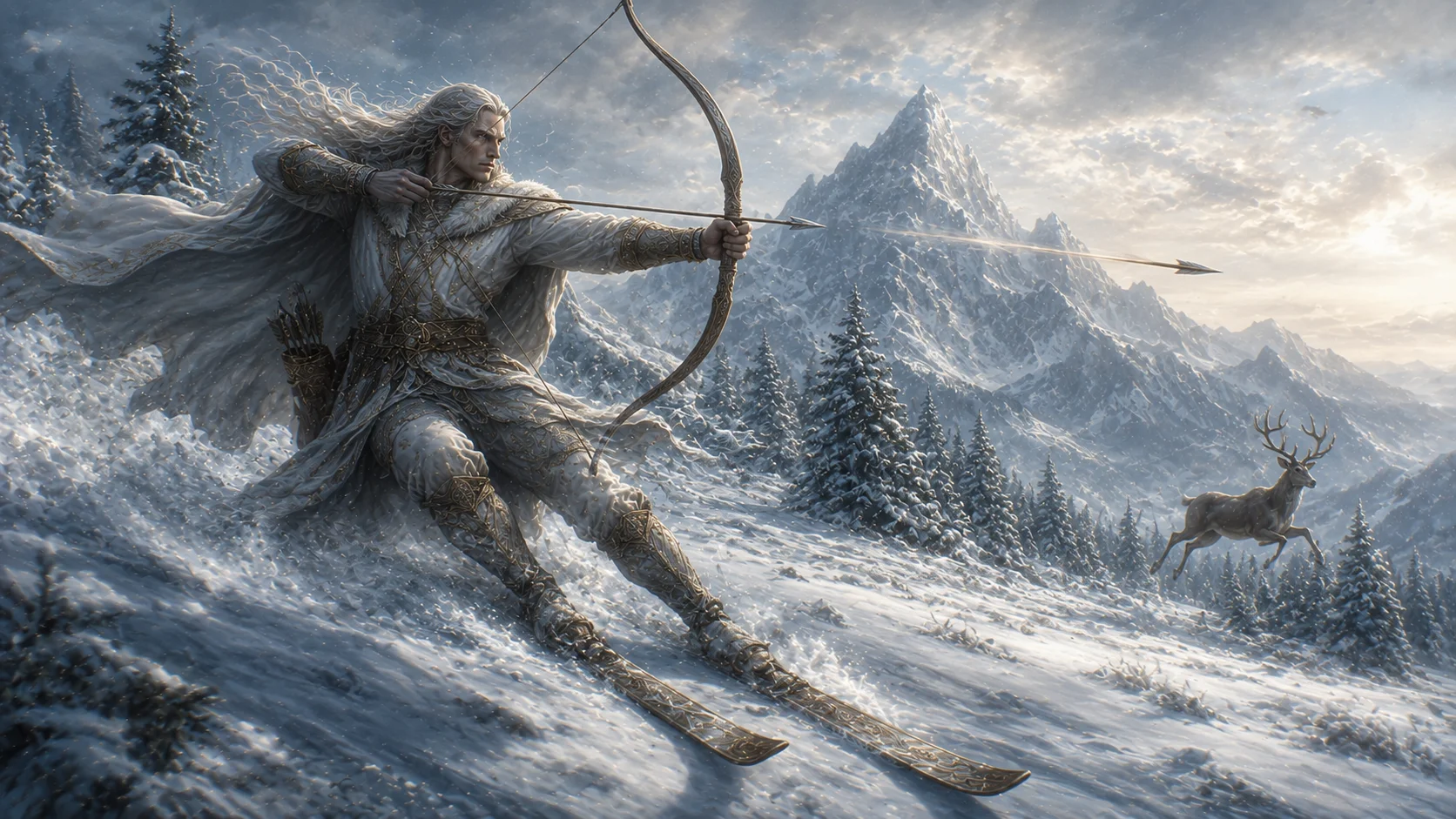
Ullr was the Norse god of archery, skiing, the hunt and single combat — an ancient and once highly important deity of the winter wilds, the divine bowman and skier who glided over the snow and was invoked for victory in the duel. Stepson of Thor, master of bow and ski, he is a god whose worship was clearly once great, though the surviving myths preserve only glimpses of his glory.
The God of the Bow and Ski
Ullr (Old Norse Ullr, a name connected to glory) was the god of archery and skiing — the supreme bowman of the gods and the master of travelling over snow on skis and snowshoes. He was the son of the golden-haired goddess Sif (and thus a stepson of Thor), and he dwelt in a hall called Ýdalir, “the yew-dales” — fitting for an archer, since the yew was the wood from which the finest bows were made. He was a god of the winter and the hunt, gliding swiftly over the frozen landscape with his bow, the divine huntsman of the snowbound north.
The Forgotten Greatness
There are strong signs that Ullr was once a far more important god than the surviving myths suggest. His name appears in a great many Scandinavian place-names — more than almost any other god — indicating that he was widely worshipped across the north, with many sacred sites dedicated to him. An old verse even calls upon “the favour of Ullr and all the gods,” placing him at the head of the pantheon, and another source hints that he ruled in Asgard during a period when Odin was exiled. Yet the detailed stories of his deeds have largely been lost, leaving us a god whose former greatness we can sense but whose myths we can no longer fully read — a tantalising shadow of a once-mighty deity.
The God of the Duel
Ullr was especially associated with single combat: men called upon him for aid in the holmgang, the formal duel by which the Norse settled disputes of honour. To swear an oath upon Ullr's ring was a solemn and binding act. As a god of the bow, the ski and the duel, he embodied the skills and the courage of the individual warrior in the harsh northern world — the hunter who could feed himself in the snow, the marksman whose arrow flew true, the fighter who could win his own combats. He was a god to invoke when a man stood alone and needed skill and victory.
The Glory of the Winter Hunt
Ullr endures as the Norse god of archery, skiing and the hunt — the divine bowman of the winter wilds, a deity of clearly ancient and once-great importance whose worship spread across the north. He is honoured to this day as a patron of skiers and hunters, and he embodies the Norse mastery of the frozen wilderness: the skill to glide over the snow, to bring down game with the bow, and to stand and win in single combat — the glory (which his very name means) of the lone hunter and warrior in the white silence of the northern winter.
Master of the bow and the ski, glory's own god, once worshipped across all the north — Ullr glides over the snow with his yew-bow, a great god whose fullest stories the centuries have carried away.
A Name Older Than the Sagas
Long before a single line of the Eddas was written down, someone cut a name into a bronze scabbard-chape and let it fall, with hundreds of other war-spoils, into the bog at Thorsberg in what is now northern Germany. The runes are Elder Futhark, cut around the year 200, and they read owlþuþewaz — normally understood as Wolþuþewaz, “servant of Wolþuz,” the god-name that would later harden into Ullr. If the reading holds, a fighting man was already carrying Ullr's name into battle roughly a thousand years before Snorri Sturluson picked up a pen, and some six centuries before the first Viking Age rune-stones were raised.
The name is a fossil of something larger. Wolþuz means simply “glory,” and its cognates survive as the Gothic wulþus and the Old English wuldor, both carrying that same plain sense. The English word had a strange afterlife. Anglo-Saxon poets, writing Christian verse generations after their ancestors had let the old gods go, kept reaching for wuldor to praise their own God: wuldres Wealdend, the Ruler of Glory; wuldorcyning, the King of Glory. The word that had once set into a northern god's name outlived the conversion by quietly changing masters.
The Shield That Was a Ship
Two writers who never read each other, working in different languages and different countries, each preserved a fragment of the same lost story. In Iceland, Snorri's Skáldskaparmál catalogues the poetic ways a shield may be named in verse, and among them sits a phrase that makes no sense on its own: Ullar skip, “Ullr's ship.” A shield is not a ship. Kennings like this one are riddles resting on stories every listener was assumed to know already — and this story has not survived, except as the hollow it left behind in the language.
In Denmark, writing in Latin, Saxo Grammaticus filled that hollow without knowing he was doing it. His Gesta Danorum hands Odin's ten years of exile to a magician called Ollerus — Ollerus being nothing more than Ullr's name in Latin dress — and adds one detail no Norse source keeps: he was so accomplished in the magic arts that he could cross open water on a single bone carved with spells, using it as another man would use a boat. Snorri's ship-shield and Saxo's spell-cut bone look like two badly worn coins struck from the same vanished mint — separate, garbled memories of a myth in which Ullr crossed water without a hull. Saxo finishes him off, too: when Odin came back, Ollerus fled east into Sweden, and there the Danes hunted him down and killed him.
For all the ground that carries his name, no surviving source anywhere names Ullr's father. His mother is on record and his stepfather is one of the most famous gods in the north, but the god who fathered him is a blank in every text that mentions him — an odd gap in a literature that is otherwise obsessive about who begat whom.
The Shrine at Lilla Ullevi
In 2007, ahead of construction work north-west of Stockholm, archaeologists opened a low ridge at Lilla Ullevi and found a cult site that had lain undisturbed since roughly the two centuries before the Viking Age began. The name had been pointing at it the whole time: Ullevi is Ullr's vé, his sanctuary, and Sweden carries a scatter of the same element — Ullevi, Ulleråker, Ultuna — ground set aside in his name and still labelled with it a thousand years after anyone stopped meaning it.
What came out of the soil matched the name with unsettling precision. There was a stone platform, post-holes from a small timber structure raised on it, and around sixty-five iron rings of a type the excavators connected with the ring-oaths sworn at Norse sanctuaries. The rings prove no particular story, and no honest account of them should claim otherwise. What they do is turn a literary formula into an object a person could pick up: this is what it looked like, in cold iron on consecrated ground, when men and women came to Ullr's own soil to bind themselves to a promise.
A God Without a Face
Thor left hammers by the thousand. Odin left ravens, spears, and a one-eyed profile unmistakable on picture stones from Gotland to the Isle of Man. Ullr, whose name is stamped on sanctuary ground the length of Sweden and across Norway, left nothing of the kind. No amulet, no carving, no stone has ever been confidently identified as him. The closest thing to a candidate is a figure on skis with a bow, hunting across the face of the Böksta stone in Uppland; whether that is the god himself or simply a man after game has never been settled. For a deity sworn by, prayed to and written all over the map, it is a striking silence — and not for want of looking.
Ullr in the Snow Today
Since 1963 the ski town of Breckenridge, Colorado, has given over a week each January to Ullr Fest: a parade down Main Street, costumes, and a communal bonfire, held expressly to ask a Norse god for snow. Six decades on it still draws thousands of skiers, most of whom could tell you nothing else whatever about Norse mythology but know exactly whose favour they are courting when the snowpack runs thin. It is a strange kind of survival — not scripture, not saga, but a working suspicion that the god of skiing ought to be asked nicely — and it sits oddly well with a deity whose oldest trace is a fighting man's name scratched onto a scabbard-fitting. Ullr's worshippers have generally been practical people asking for practical help. He turns up more lightly elsewhere too, reborn as a playable hunter in the online game Smite, bow and skis still doing in pixels roughly what they once did in the snow of the old north.
Sources & traditions
- EncyclopediaWikipedia — Ullr
- TraditionNorse texts, inscriptions and later retellings (Scandinavia)
Myths change from area to area and from time to time. This chronicle follows the most widely told versions; tellings in other villages, regions and eras may differ.