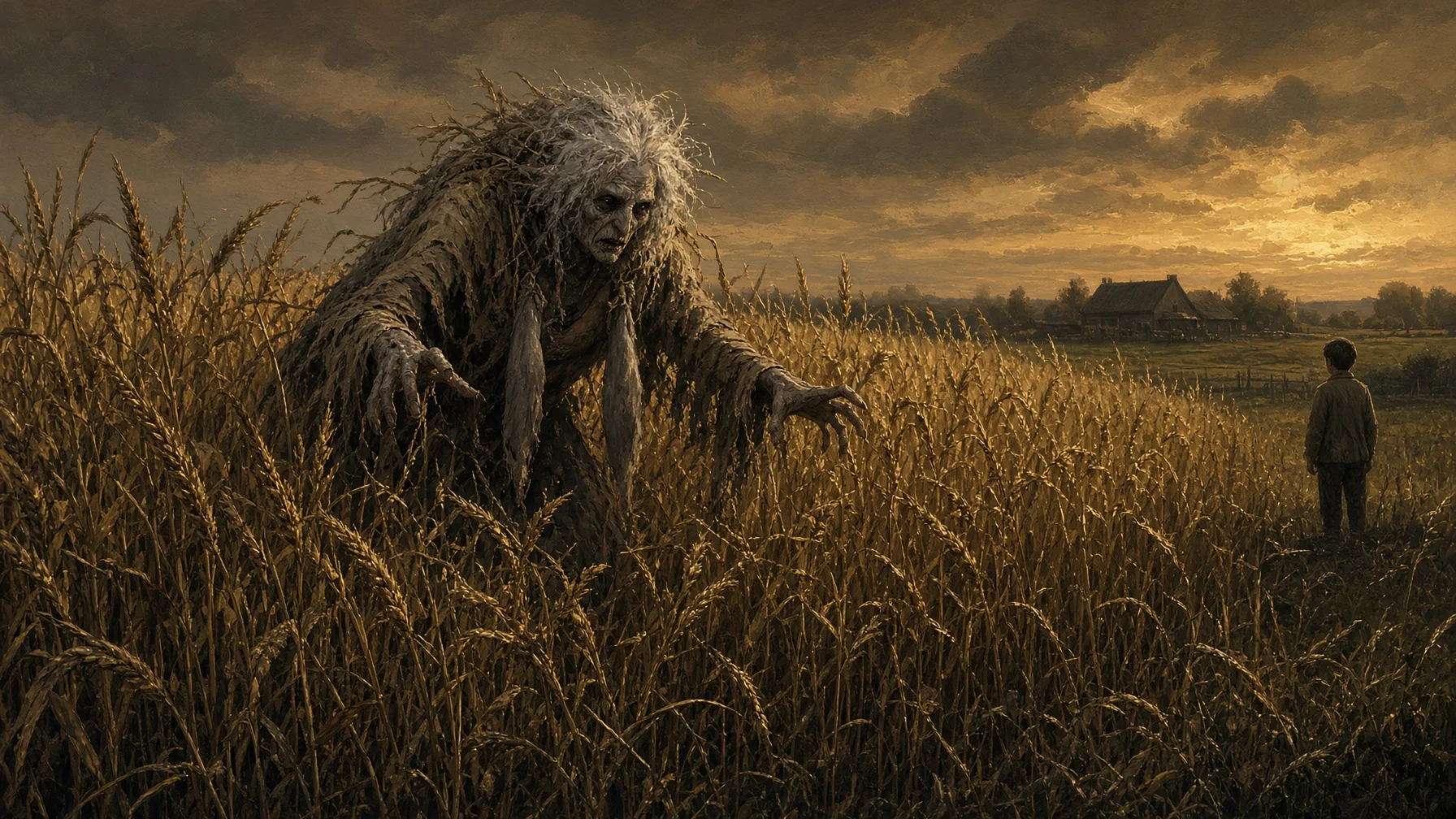
Sif was the Norse goddess of the harvest and the earth's golden grain — the wife of mighty Thor, famed above all for her long, beautiful hair of pure gold, the loss and replacement of which gave rise to the forging of the gods' greatest treasures. A goddess of fertility, family and the ripe golden fields, she is best remembered through one of Loki's most consequential pranks.
The Golden-Haired Goddess
Sif (Old Norse Síf, a word related to the bonds of kinship and marriage) was an Aesir goddess and the wife of the thunder-god Thor. Her defining feature was her hair: long, flowing and made of real gold, gleaming and beautiful, which is widely understood to symbolise the golden fields of ripe grain — making Sif a goddess of the harvest, of the earth's fertility and abundance, the golden bounty that Thor's rains helped to grow. She was the mother of the goddess Thrud by Thor, and of the god Ullr (the archer and skier) by a father unnamed.
The Theft of the Hair
Sif's most famous myth begins with a cruel prank: the trickster Loki, out of pure malice, crept up on the sleeping Sif and sheared off all of her golden hair, leaving her shorn and shamed. When Thor discovered the outrage, his fury was terrible, and he seized Loki and threatened to break every bone in his body unless he made it right. To save himself, Loki swore to replace Sif's hair with something even finer.
The Treasures of the Gods
And so Loki went down to the dwarves, the master-smiths of the underworld, and there set in motion the forging of the greatest treasures the gods would ever own. The dwarf sons of Ivaldi forged new hair for Sif — real gold that would grow from her head like natural hair — along with Odin's spear Gungnir and Frey's magical folding ship Skidbladnir. Then Loki, in a wager, goaded the dwarves Brokkr and Eitri into forging three more wonders: Frey's golden boar Gullinbursti, Odin's self-multiplying ring Draupnir, and — greatest of all — Thor's hammer Mjölnir itself. Thus from the theft of Sif's hair came, indirectly, the hammer that defends the gods, the spear of the All-Father and the other great treasures — one of Loki's pranks turned, despite itself, into the gods' greatest gain.
The Goddess of the Golden Fields
Sif endures as the golden-haired goddess of the harvest and the faithful wife of Thor — her gleaming hair the very image of the ripe grain bowing in the fields, her story the origin of the gods' mightiest treasures. She embodies the Norse vision of the cultivated earth's fertility wedded to the storm-god's rains: the golden bounty of the harvest, watched over by the goddess whose hair is spun of gold.
Loki sheared off the golden hair of Thor's wife for spite — and to undo it, the dwarves forged the very hammer that guards the gods, and gold that grows like living hair.
A Name Older Than the Myth
Sif's name comes from the plain vocabulary of kinship, and it is worth pressing on how blunt that word is. Old Norse sif — used far more often in the plural, sifjar — is the ordinary term for relationship by marriage: the web of in-laws and obligations a wedding creates between two households. It descends from the same Germanic root that gives English sib and sibling. A goddess called, in effect, "Affinity" sounds strange to modern ears, but it matches how the sources handle her. Snorri Sturluson brings her into Gylfaginning almost entirely through her relations — Thor's wife, Ullr's mother — rather than through any deed of her own. Her one great narrative survives largely because a later generation of poets needed it explained: in Skáldskaparmál, "the language of poetry", the shearing of her hair is told as the answer to a technical question — why is gold called Sif's hair? Without a skald somewhere needing that answer, the myth might never have been written down at all.
A Kenning Built to Test the Listener
Court poets rarely said "gold" outright. They built riddling compounds called kennings, which worked only if the listener already carried the underlying story in his head, and gold attracted more of them than almost anything else: it is Freyja's tears, wept for her vanished husband; it is Ægir's fire, the glowing gold that lit the sea-giant's hall in place of torches; and it is Sif's hair. Each folds a whole narrative into two words, so a verse thick with them is quietly testing its audience. The traffic ran the other way too — Thor could be named simply "Sif's husband", his own identity borrowed for a moment from hers. Skáldskaparmál survives in part as a glossary for exactly this problem, keeping compressed allusions legible for poets working generations after the stories behind them had begun to fade from common memory.
The Accusation Nobody Quite Presses Home
The faithful wife of the popular retelling sits uneasily beside two older and stranger scenes. In the flyting-poem Lokasenna, Loki works his way around a hall of gods insulting each in turn; when Sif steps forward with a cup of mead to placate him, he turns on her too, announcing that he knows of one lover she took besides Thor — himself. In Hárbarðsljóð, a ferryman the audience is meant to recognise as Odin in disguise refuses to carry Thor across a sound and needles him stanza after stanza; among the taunts is the flat remark that Sif has a lover waiting at home. Neither poem lets the charge settle into fact. Both belong to a genre built on abuse traded for its own sake, where every speaker's word is suspect and the gods answer Loki's accusations with accusations of their own. But it is worth noticing that this particular insult reaches Sif twice, in two unrelated poems, and that the second is not even Loki's doing. Somewhere behind the treasure-myth there seems to have run a needling counter-tradition in which Thor's marriage was a good deal less settled than it looks.
A Goddess the Record Never Pictured
Thor left his mark all over the physical record of the Viking age: hammer-shaped amulets by the hundred, carved stones — the Altuna stone in Sweden among them — showing him hauling the World Serpent up on a fishing line, and farms and place-names built on his cult across Scandinavia. Sif left nothing comparable. No excavated object has been securely identified as an image of her: no pendant, no charm, no carved scene that scholars agree shows the golden-haired wife rather than some other goddess entirely. Everything known about her arrives through a single narrow channel — poems and prose set down in Christian Iceland two and three centuries after the conversion, by men who no longer worshipped anyone in them. It is a useful reminder of how lopsided the evidence for Norse religion really is. Some figures reach us in bronze, stone and place-names; others, Sif among them, reach us only in words.
The Wife Who Became a Warrior
Nothing has reshaped Sif as thoroughly as twentieth-century comics did. When Marvel built its version of Thor in the 1960s it gave him a companion named Sif and discarded the single detail that had defined the goddess for a thousand years: the new Sif has black hair, and she is a sword-carrying warrior of Asgard rather than a harvest goddess defined by her marriage. The films fixed that image for an audience the medieval poems never came close to reaching — Jaimie Alexander has played her across several Marvel Cinematic Universe entries — so that most people who now recognise the name have never heard of the golden hair. The name itself has proved oddly portable: it turns up again in Dark Souls, attached to a great grey wolf with no connection to Asgard whatsoever, borrowed purely for the weight the syllable still carries. A goddess whose entire surviving myth is about hair now lives in the popular imagination as someone with none of the hair that made her famous — as fair a measure as any of how completely a name can outlast its contents.
Sources & traditions
- EncyclopediaWikipedia — Sif
- TraditionNorse texts, inscriptions and later retellings (Scandinavia)
Myths change from area to area and from time to time. This chronicle follows the most widely told versions; tellings in other villages, regions and eras may differ.