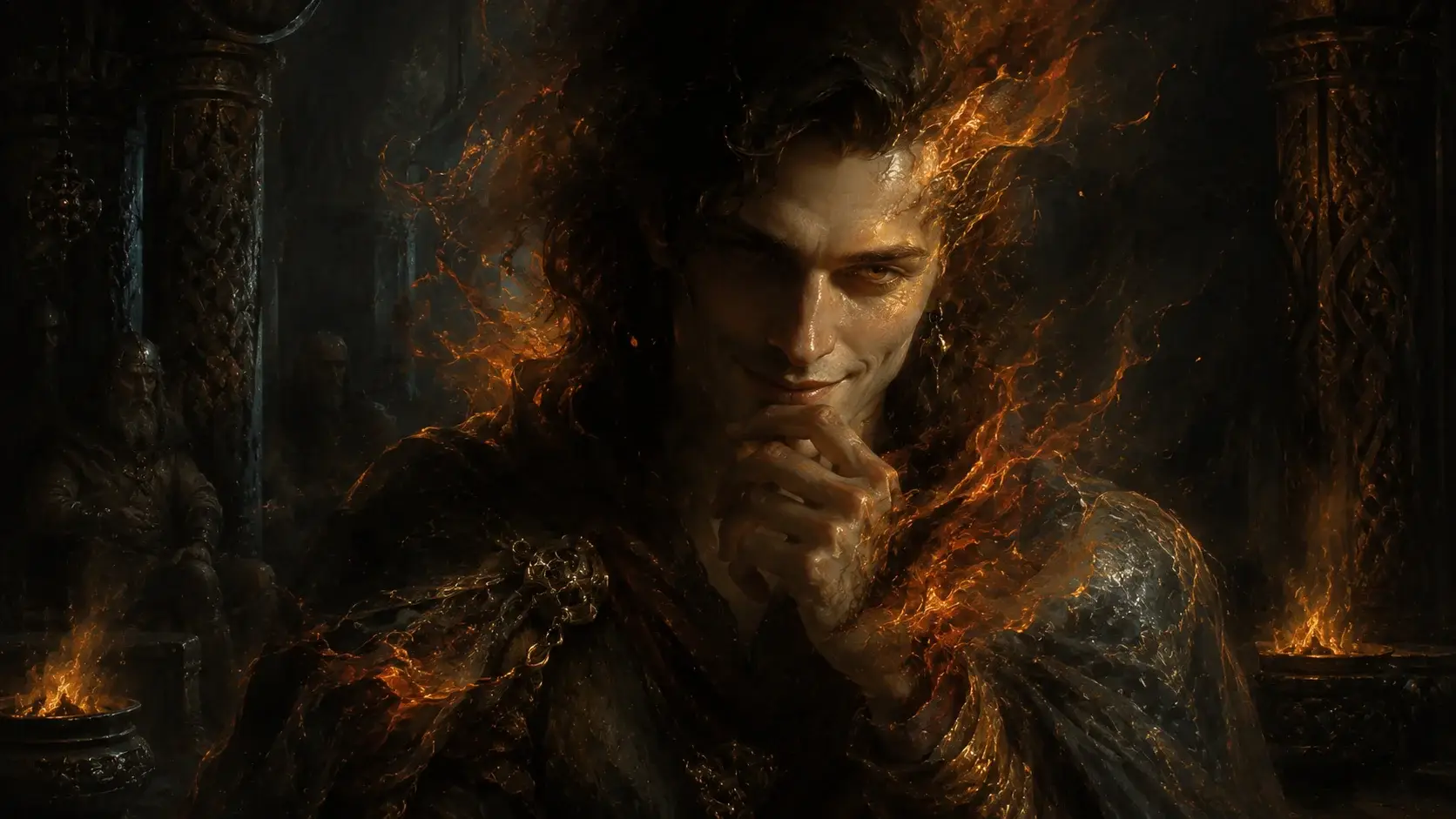
Loki was the trickster of the Norse gods — a shape-shifting, silver-tongued being of giant blood who lived among the Aesir as Odin's blood-brother, at once their cleverest helper and their most dangerous enemy. Charming, cunning and utterly amoral, he is the spark of mischief that drives half the myths and the engine of catastrophe that brings about the end of the world. No figure in Norse myth is more fascinating or more impossible to pin down.
The Trickster Among the Gods
Loki (Old Norse Loki) was the son of the giant Farbauti and Laufey, and so by blood one of the jötnar, the giants who were the enemies of the gods — yet he dwelt in Asgard as a sworn blood-brother of Odin and a companion of the gods, especially of Thor. He was a being of contradictions: handsome and persuasive, brilliant and resourceful, but faithless, malicious and ruled by his own whims. He had the power to change his shape into anything — a salmon, a mare, a fly, an old woman — and his cleverness repeatedly got the gods both into and out of trouble.
Helper and Schemer
Much of the time Loki's tricks served the gods, or at least repaired the damage his own mischief had caused. When he cut off the golden hair of Thor's wife Sif as a cruel joke, it was his scheming that won from the dwarves not only new golden hair but the gods' greatest treasures — Odin's spear Gungnir, Thor's hammer Mjölnir, Frey's ship and golden boar. When a giant builder threatened to claim Freya, the sun and the moon as payment, it was Loki who, transforming into a mare, lured away the builder's mighty stallion — and so gave birth, himself, to Odin's eight-legged horse Sleipnir. Time and again he was the gods' problem-solver, even when the problem was his own making.
The Father of Monsters
By the giantess Angrboda, Loki fathered three terrible children who would become the doom of the gods: the great wolf Fenrir, fated to devour Odin; the world-serpent Jörmungandr, fated to kill Thor; and Hel, the goddess who rules the realm of the dead. Through these monstrous offspring, Loki is the ancestor of the very forces that will destroy Asgard — the enemy bred within the household of the gods.
The Murder of Baldr
Loki's mischief darkened into true evil with the death of Baldr. Out of envy and malice, he discovered the one thing that could harm the invulnerable god — the mistletoe — fashioned it into a dart, and guided the blind god Hodr's hand to kill Baldr with it. Then, when all the world wept to bring Baldr back from the dead, Loki alone — disguised as the giantess Thokk — refused to weep, and so doomed Baldr to remain among the dead forever. With this, Loki passed from troublesome trickster to the murderer of the best of the gods.
The Binding and Ragnarok
For his crimes, and for the cruel mockery he heaped on the gods at a final feast, the Aesir hunted Loki down (catching him in salmon form) and bound him in a cave with the entrails of his own son, with a venomous serpent dripping poison onto his face. His faithful wife Sigyn holds a bowl to catch the venom, but when she turns to empty it, the poison falls and Loki writhes so violently that the earth quakes. There he is fated to remain until Ragnarök — when he will break free, steer the ship of the dead, and lead the giants and monsters against the gods, meeting his old foe Heimdall in a battle where each slays the other. Loki endures as one of mythology's great tricksters, the necessary chaos within the divine order, the friend who becomes the destroyer.
Blood-brother to Odin, father of the wolf that eats him — Loki was the chaos the gods kept close, until the day it broke its bonds and brought the world down.
A Name With No Temple
Search Scandinavia for a place named after Loki and you will find almost nothing. Thor gave his name to farms and headlands the length of the north — Thorsness, Thorshavn, Thorsager — and Odin to Odense and a dozen settlements besides. Frey left his name on islands and fields, from Frosö in Sweden to Frøyland in Norway. Loki left nothing. For a figure who appears in nearly every major story in Norse myth, fathers the wolf that will kill Odin, and murders the best-loved of the gods, this absence is striking, and it has shaped how scholars read him: not as a god anyone prayed to or built an altar for, but as a purely narrative figure — a character the myths could not do without, yet apparently no community ever worshipped. Even his name resists a settled meaning. Proposals connect it to words for a knot or a tangle, to a root meaning “to close” or “to end” — fitting for a being who brings the story of the gods to its close — and to lopt, “air,” which may explain why the Poetic Edda also calls him Loptr, a name that suits a god who is forever a falcon, a fly, or a mare mid-flight. None of these derivations has won the field. Loki, characteristically, will not be pinned down even by his own name.
He is considerably older than the manuscripts that preserve him. The Norwegian skald Thjodolf of Hvinir, composing around the turn of the tenth century, built a poem called Haustlong around the scenes depicted on a shield he had been given — and one of them is Loki's part in the theft of Idun and her apples. Later in the same century, at a wedding feast at Hjardarholt in Iceland in the 980s, Ulfr Uggason recited Husdrapa, a poem describing the carved panels of his host's new hall; among them was Loki grappling with Heimdall in the shape of seals over Freyja's necklace, the Brisingamen. Both poems survive only because Snorri Sturluson quoted fragments of them in the thirteenth century; the shield and the carvings are long gone. Loki was already a fully formed, image-worthy figure in the Viking Age — worth painting, worth carving into a rich man's wall — long before anyone set his stories down in prose.
The Wager That Sewed His Mouth Shut
The tale of Sif's shorn hair is usually remembered for what the dwarves made. What gets left out is the bet, and what the bet cost. The replacement hair was forged by the dwarves called the sons of Ivaldi, and Loki, carrying their work home, could not resist wagering his own head with the dwarf Brokkr that Brokkr's brother could not match it. He lost. The brother forged three treasures: the ring Draupnir, which drips eight more gold rings every ninth night; the boar Gullinbursti, whose bristles throw light into the darkest place; and the hammer Mjölnir. Loki, watching the wager slip away, turned himself into a biting fly and stung Brokkr's eyelid as he worked the forge-bellows — blood ran into the dwarf's eye, his hand left the bellows for an instant, and that, said the Norse, is why Mjölnir's handle came out too short. It was not enough. The gods judged the hammer the finest thing ever made, and Brokkr came to collect Loki's head.
Loki, cornered, found the loophole that defines him: he had wagered his head, not his neck, and Brokkr could not take one without cutting the other. Furious at being cheated a second time, the dwarf did the only thing the bargain still allowed — he pierced Loki's lips and sewed them shut with a thong called Vartari. It is a strange, almost comic punishment for a god whose entire power is his mouth, and it may be the most recognisable image of him to survive from the Viking Age: a soapstone bellows-shield from about the year 1000, found at Snaptun in Denmark and now in the Moesgaard Museum, shows a moustached face whose lips are marked with scars exactly where the thread would have passed. It sat in a forge — the very place the bet was lost.
A Fire That Cannot Lose
Not every contest Loki entered was against gods or dwarves. Travelling with Thor into Jotunheim, the pair took shelter in the hall of the giant king Utgarda-Loki, who mocked his guests as too feeble for the games played there and challenged them to prove otherwise. Loki, never one to pass up a boast, claimed he could out-eat anyone in the hall. He was set against a figure named Logi at opposite ends of a long trough of meat. Loki ate fast and well, clearing his half to the bone. But when the two met in the middle, Logi had eaten his meat, his bones, and the wooden trough itself. Loki had lost, and lost badly. Only afterwards, when the illusions of the hall dissolved, did the truth come out: Logi had never been a man at all, but wildfire given a shape at the table, and against wildfire even the trickster who had talked his way out of a dwarf's knife could not win. It is one of the few myths in which Loki is not the cleverest thing in the room, and Norse storytellers seem to have relished putting him there.
The Bride Who Ate an Ox
When Thor woke to find Mjölnir gone, it was Loki, again, who went looking for it — borrowing Freyja's cloak of falcon feathers to fly into Jotunheim, where the giant Thrym admitted he had buried the hammer eight leagues under the earth and would return it only in exchange for Freyja's hand in marriage. Freyja refused with a fury that shook the halls of Asgard. It was Heimdall who proposed the fix, and Loki who carried it out: dress Thor himself as the bride, veil and bridal jewellery and all, with Loki at his side disguised as a serving-maid. At the wedding feast in Jotunheim, the “bride” ate an entire ox, eight salmon, and drank three measures of mead — and when Thrym stared, it was Loki's quick tongue that explained it away, claiming the bride had not eaten for eight nights from sheer longing to be married. When the hammer was finally laid across the disguised Thor's knee to hallow the union, as custom required, Thor's hand closed around it and the wedding ended in slaughter. The story is one of Norse myth's few genuinely comic set-pieces, and it depends entirely on Loki: without his improvised lies at the high table, the disguise collapses in the first minute.
The Apples That Kept the Gods Young
Loki did not only fix his own messes; sometimes the danger was his fault from the very start. Seized by the giant Thiazi in eagle form and forced under threat to betray his own kind, Loki lured the goddess Idun — keeper of the apples that kept the gods from ageing — out of Asgard's walls with a lie about finer fruit growing in a nearby wood. Thiazi, waiting, snatched her up and carried her, apples and all, back to his home in Jotunheim. Deprived of the apples, the gods began to grey and stoop, and they turned on Loki at once, threatening him with death unless he undid what he had done. He borrowed Freyja's falcon shape again, flew to Thiazi's hall, turned Idun into a nut to carry her more easily, and fled with the giant close behind him. The Aesir, watching from the walls of Asgard, lit a heap of kindling the instant Loki cleared the ramparts; Thiazi, unable to stop, flew straight through the flames, and his burning feathers dropped him among the gods to be killed. It is the clearest example of the pattern that runs through Loki's whole career: he creates the catastrophe, and he alone has the cunning to reverse it.
Reading Loki in Stone
Loki left barely a mark on the landscape of worship, but he left more than one mark in stone. Beyond the scar-lipped face at Snaptun, a tenth-century cross at Gosforth in Cumbria, England — carved in a region thick with Norse settlers — bears a panel widely identified as Loki's binding: a bound figure lying beneath a serpent, with a woman before him holding up a vessel, matching the description of Sigyn catching the venom almost detail for detail. If the identification is right, it means the image of Loki chained beneath the earth, and the wife who never leaves his side, had already travelled from Scandinavia to Viking-settled Britain — and had been cut, of all places, into the shaft of a Christian cross, standing a few feet from scenes of the crucifixion.
Cousins in Mischief
Every mythology seems to need a figure who breaks the rules the other gods live by, and Loki's nearest relatives are the Greek Hermes and Prometheus — though the resemblance only goes so far. Hermes steals a herd of cattle and lies about it on the day he is born, and is still folded back into the Olympian order as its messenger; he never turns on it. Prometheus is punished the way Loki is — bound to a rock, torn at by a bird, left to it — but he is chained for a single act of generosity toward humankind, stealing fire to give it to mortals, and even that sentence is eventually lifted when Heracles frees him. Loki's binding has no such mercy and no such motive. He is not punished for helping anyone. He is punished for killing a god he had no quarrel with, for no better reason than that it galled him to watch Baldr come to no harm, and nothing in the sources suggests his chains will loosen before the world itself ends. Where Prometheus suffers for humanity, Loki suffers only for himself — which may be why, of the three, he is the hardest to forgive and the hardest to look away from.
Why the Trickster Never Truly Dies
A pantheon of purely lawful, predictable powers has nothing to say about the parts of life that are not lawful or predictable: luck, wit, betrayal, the joke that goes too far. Loki survives retelling after retelling because the Norse never resolved him into a simple villain and refused every opportunity to do so. He wins the gods their finest treasures before he costs them their finest son; the same cunning that talks Asgard out of paying a giant builder is what dresses Thor in a wedding veil and, later, aims a sprig of mistletoe. Modern versions — on screen, on the page, in games — tend to pull him one way or the other, into charming rogue or straightforward villain, because a figure this unresolved is hard to sustain across a franchise. The medieval sources felt no such pressure. They left him exactly as uncomfortable as he needed to be: not a devil safely outside the walls, but the one guest at the table whose next move nobody could predict — and whose worst move, when it finally came, nobody saw arriving.
Sources & traditions
- EncyclopediaWikipedia — Loki
- TraditionNorse texts, inscriptions and later retellings (Scandinavia)
Myths change from area to area and from time to time. This chronicle follows the most widely told versions; tellings in other villages, regions and eras may differ.