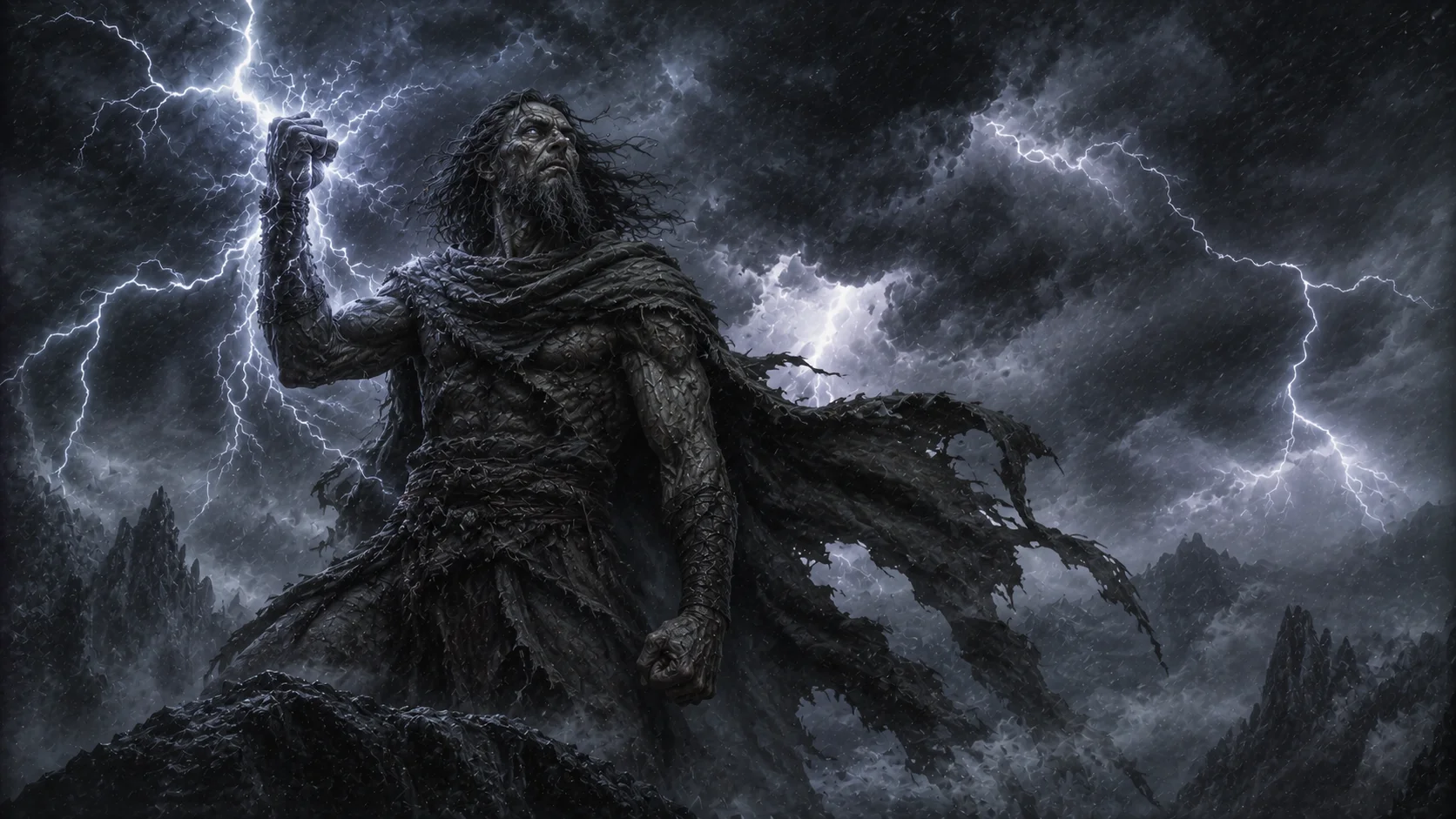
Farbauti was the giant who fathered Loki — a jötunn whose name means "cruel-striker" or "dangerous-hitter," and who, in a striking interpretation, may represent the lightning that strikes the earth to kindle fire. As the father of the trickster, he stands at the giant-blooded root of one of the most important and dangerous beings in all of Norse myth, even though he himself steps onto the page for only a single sentence.
The Cruel-Striker
Farbauti (Old Norse Fárbauti, "cruel striker," "dangerous beater," or "one who strikes forcibly") was a giant of the jötunn kindred. His name is preserved in a single terse notice in Snorri Sturluson's Prose Edda, in the chapter of Gylfaginning that catalogues Loki's kin: "Loki's father is Fárbauti the giant." That sentence is, in the surviving record, the whole of him. No poem names him independently. No skald builds a kenning from his name. He does not speak, act, travel, or fight anywhere in the corpus that has come down to us. Scholars have long debated the exact shade of his name's meaning — "cruel striker" and "dangerous hitter" are the two glosses that recur most often — but even the etymology carries a note of uncertainty, since no attested deed tells us what, if anything, he ever struck.
Last updated .
A Name Without a Story
What makes Farbauti unusual among the giants of Norse myth is not what is said of him but how little is. Figures like Þrymr or Hrungnir are narratively active — they steal hammers, duel Thor, drink themselves into boasting matches with the gods. Farbauti does none of this. He is not counted among the giants who march against the Æsir at Ragnarök, nor does he appear in any of the þulur, the versified name-lists in which the poets catalogued jötnar for memory's sake. His single attested function is genealogical: he exists in the sources to answer the question of where Loki came from, and nothing more. No epithet beyond the name itself survives for him, no title, no by-name earned through action. He is, in the strictest reading of the evidence, a father and only a father.
Laufey, and the Unusual Silence of a Patronymic
Farbauti's consort — and Loki's mother — was Laufey, also called Nál. The pairing itself is unremarkable by the standards of jötunn genealogy: a giant father, a giant or semi-giant mother, a notable child. What is unusual is what happens to Farbauti's name afterward. Loki is repeatedly called Loki Laufeyjarson — "Loki, son of Laufey" — a matronymic rather than the patronymic that would be expected by the normal conventions of Old Norse naming, where a son is ordinarily identified through his father. Scholars have puzzled over this reversal for a long time without reaching a settled explanation. The sources offer no reason for it; they simply preserve the pattern. Whatever drove the choice to name Loki after his mother rather than his father, the effect on Farbauti himself is to push him even further into the background — the son bears the mother's name, and the father is left as little more than a line in a genealogy that does not even carry his name forward.
The Lightning and the Leaf
Because the textual record is so thin, later interpreters have looked to the name itself for meaning. Some scholars — Rudolf Simek among them — have speculated that Farbauti may personify a storm or lightning figure, reading "striker" as a description of the lightning-bolt rather than a warrior's title. In this reading, Farbauti the striking force meets Laufey — whose name may mean "leafy isle" or "full of leaves," and whose other name, Nál, means "needle," as in pine-needle — the dry foliage of the forest. Their child, Loki, so persistently associated with fire and mischief throughout the mythology, becomes in this scheme the flame that is born when lightning strikes dry tinder. It is a beautiful reading, and an old one, but it is important to be precise about its status: this is scholarly speculation built on etymology, not a myth stated anywhere in the sources. No surviving text describes Farbauti striking anything, kindling anything, or embodying weather in any explicit way. The interpretation illuminates the name; it does not extend the story.
The Father of the Trickster
Whatever his own nature, Farbauti's significance within the mythology lies entirely in his fatherhood. Through him, Loki was of giant blood — a jötunn by birth even while he moved among the Æsir as one of their own. Loki's dual nature, his standing between the world of the gods and the world of the giants, his long career of helping and harming by turns, all trace one root back to this giant father glimpsed only once in the sources. It is worth being exact here about what does and does not belong to Farbauti's line: Loki's most fearsome offspring — the wolf Fenrir, the world-serpent Jörmungandr, and Hel — were born not of Laufey's line but of Loki's union with the giantess Angrboða. Farbauti's genealogical weight is upstream of that brood, not entangled with it; he is grandfather to none of them by blood, only the giant father whose lineage let Loki himself carry jötunn blood into Asgard.
A Genealogy Without a Catalogue Entry
The absence of Farbauti from the þulur is worth dwelling on, because it marks him as a different kind of figure from most named giants in the tradition. The þulur exist precisely to preserve names that might otherwise be lost — rosters of giants, dwarfs, and other beings, versified so that a poet could call any of them to mind. Farbauti's exclusion from these lists is not proof that he was forgotten; Snorri clearly knew the name and used it exactly where it mattered, in Loki's genealogy. But it does confirm that Farbauti was never treated by the tradition as one of the "active" giants worth cataloguing alongside beings who fought, boasted, or schemed. He belongs to a smaller class of jötnar who exist in the record purely to explain someone else's ancestry.
No Kin But Two
The sources record no siblings for Farbauti, no other children beyond Loki, and no encounters — friendly or hostile — with any member of the Æsir or Vanir. This is a genuinely narrow attestation, narrower than almost any other named giant in the corpus. Where other jötnar accumulate genealogical branches, feuds, and appearances across multiple sources, Farbauti's entire recorded existence consists of two relationships: Laufey as consort, and Loki as son. Nothing else is claimed for him anywhere in the eddic or skaldic material, and no independent episode gives him a voice, a location, or an action of his own.
The Single Sentence That Carries Him
It is worth pausing on how much weight one clause in Gylfaginning is made to bear. Snorri's genealogical notices are often brief, but Farbauti's is among the barest — a name, a kinship term, and the label "giant," with nothing appended. There is no Poetic Edda verse that independently names him, no skaldic kenning built on his name, no secondary manuscript tradition that expands his role. Every later account of Farbauti, including the storm-and-lightning reading discussed above, is built on interpreting that single sentence rather than on any additional primary evidence. This is not a case of a rich tradition that has been lost to time and survives only in fragments; so far as the textual record shows, the tradition was always this narrow.
What the Medieval Sources Chose Not to Say
Modern popular culture — certain comics and games among them — has at times invented expanded roles, personalities, or storylines for Farbauti that go well beyond anything in the medieval material. Those inventions belong to their own modern works and are not part of the attested mythology; nothing in the eddic or skaldic corpus supports giving Farbauti a personality, a voice, or a plot of his own. The medieval silence around him is itself a kind of information: within the world of Norse giant-lore, some jötnar were remembered as actors and some were remembered only as ancestors, and Farbauti falls unambiguously into the second category. His importance was never in what he did, because nothing records him doing anything at all.
The Striking Force at the Root
Farbauti endures as the giant father of Loki and, in careful scholarly interpretation, as a possible echo of the lightning that kindles fire — a figure glimpsed only in his parentage but weighted with meaning because of whom that parentage produced. He embodies, in the barest possible form, the deep entanglement of gods and giants that runs through Norse myth: the giant blood that ran in the trickster's veins traces to this one, otherwise silent, jötunn. He is not remembered for a deed, a battle, or a word of his own. He is remembered because he stood, for one sentence, at the beginning of Loki's story.
The cruel-striker who fathered the trickster left no other trace in the sources — only a name, a consort called Laufey, and a son whose fame would eclipse him entirely.