Surtr was the great fire-jötunn of Norse myth — the primordial guardian of the burning realm of Muspelheim, who stands at the world's southern edge with a flaming sword brighter than the sun, and who is fated, at Ragnarök, to lead the sons of Muspell against the gods, to slay Freyr, and to fling fire across the whole of creation. Attested in both the Poetic Edda, notably Völuspá, and Snorri Sturluson's Prose Edda (Gylfaginning), he is one of the few beings named as present both before the ordered cosmos and at its ending — the black flame that brackets the world from its first shaping to its last burning.
The Black One at the World's Southern Edge
His name, Old Norse Surtr, is generally understood as directly descriptive: "the black one" or "the swarthy one," from svartr, most likely referring to a being blackened or scorched by fire, though scholars note some nuance in the term remains debated. Gylfaginning's fourth chapter places him at the southern end of the world, guarding the fiery realm of Muspelheim, wielding his flaming sword, and states plainly that he existed there before the ordered cosmos came into being at all — and that he will remain at his post until Ragnarök calls him forth. He is not a wanderer or a raider of the border-lands the way many jötnar are; he is a fixed point, a sentinel who has held one place since before there was a world to have an edge.
Last updated .
Muspelheim, Realm Before the World
Muspelheim — sometimes called simply Muspell — is named in Gylfaginning as one of the primordial realms that existed even before the world's creation, standing alongside the icy realm of Niflheim on the far side of the vast emptiness of Ginnungagap. It was the meeting of fire flowing out of Muspelheim with ice flowing out of Niflheim, within that void, that gave rise to the primordial being Ymir and, through him, to the cosmos itself. Surtr's domain is therefore not merely his own kingdom but one of the two elemental sources from which everything else was made. He guards a realm that did not need the world to exist, and that will not need it to continue existing once it is gone.
A Sword Brighter Than the Sun
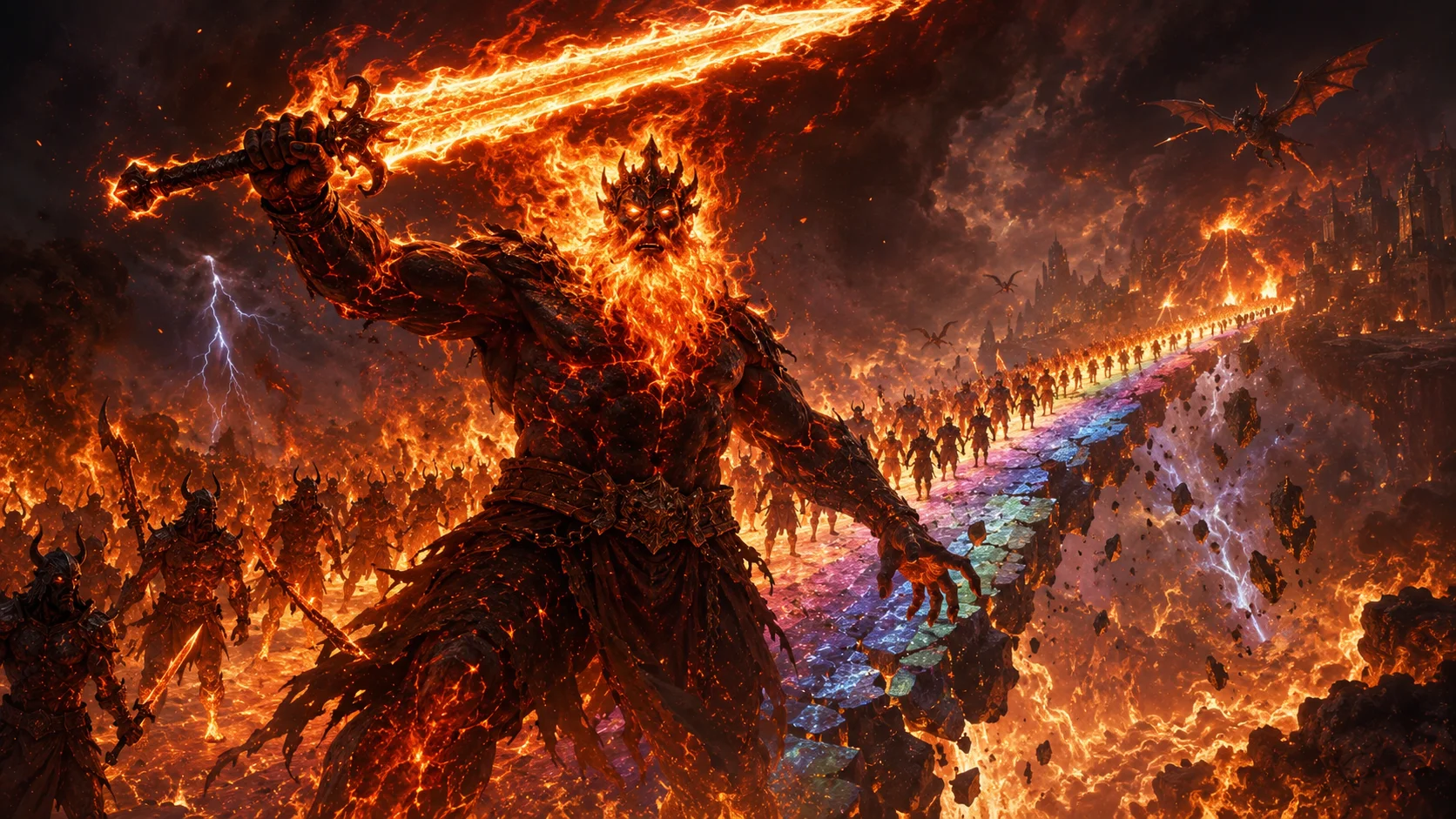
Surtr's most distinctive attribute is his flaming sword, described in Völuspá as shining "like the sun" — and by the time of Ragnarök, understood to outshine it. It is generally read in scholarship as the very weapon with which he will set the world alight after his battle with Freyr is done. Unlike a warrior's blade taken up for a single fight, this sword is bound to Surtr's whole nature and his whole span of existence: he is described holding it in his vigil at the border of Muspelheim long before the gods walked, and he will still be holding it when the Nine Worlds are consumed. It is less a weapon carried than a fire given a shape a hand can close around.
The March Out of the Burning South
Völuspá's fifty-second stanza states that at Ragnarök Surtr comes from the south "with the switch of destruction," his sword blazing like the sun, leading the sons of Muspell — Muspells synir — into the final battle. This detail matters: Surtr does not act alone. He commands a host of fire-beings drawn from his own realm, and it is this host, not a single wrathful giant, that rides against the gods. Both Völuspá and Gylfaginning agree that Surtr and his forces cross the rainbow bridge Bifröst to reach the field of the last battle — and that the bridge, built to bear gods and their horses, breaks and collapses beneath the weight of the fire-host's crossing. The road between worlds does not survive the army that ends the worlds.
The Debt Freyr Could Not Pay
Among the fated pairings of Ragnarök, Surtr's duel with the god Freyr carries a particular weight, because Snorri ties it directly to an earlier story. Freyr once possessed a magic sword that could fight on its own — a weapon suited to a god of his stature — but gave it away to his servant Skírnir as part of the wooing of the giantess Gerð, recounted in Skírnismál. That gift, made in pursuit of a marriage, leaves Freyr disarmed of his greatest weapon by the time Ragnarök comes. Facing Surtr and his blazing sword with no equal blade of his own, Freyr is at a stated disadvantage from the opening of the fight, and it is Surtr who cuts him down. The myth draws a straight line from a wedding gift to a god's death on the last battlefield — cause and consequence separated by an age of the world, but never severed.
The Battlefield Falls Silent
Freyr's death at Surtr's hand is one thread among the many pairings of Ragnarök — the mutual slayings of gods and their great enemies that empty the field by the battle's end. The fact-pack does not detail Surtr's own fate in that final exchange, only what he does once the fighting among the combatants has run its course: with the gods and giants and monsters spent, Surtr remains, sword still burning, and turns from the battle to the world itself.
Fire Flung Over the Earth
Völuspá states that Surtr "flings fire over the earth" — an act that consumes the whole of creation in flame as part of the world's destruction. This is not described as a lingering blaze but as a single sweeping act, the fire-giant casting his flame across everything that remains standing after the battle. Every realm the myths name — the homes of gods, of giants, of men, of the dead — falls within its reach. It is the closing gesture of Surtr's long vigil: the sword he held unused at the edge of Muspelheim since before the world's shaping is finally put to the one purpose the myths ever give it.
Guardian at Both Ends of Time
What sets Surtr apart from the wider ranks of jötnar in the sources is this doubled position in the story of the cosmos: he is named as present before the current world existed, holding the border of a realm whose fire helped make that world possible in the first place, and he is named again as the one who ends it, striding out of that same realm with the same sword to bring the ending about. Few figures in the surviving material are given both bookends. Most beings in Norse myth belong to the world's middle span — born into it, acting within it, dying within it. Surtr's attested role runs from before the beginning to after the end, with the entire age of gods and men passing in between while he simply waits at his post.
A Fire Without Motive Given
The primary sources are notably sparse on anything resembling Surtr's temperament, reasoning, or feeling — Völuspá and Gylfaginning record what he does and where he stands, not why, beyond the plain fact that his hour is fixed to arrive at Ragnarök. He is not given speech, grievance, or rivalry with any particular god beyond the fated meeting with Freyr. This restraint is itself part of what the surviving texts convey: Surtr reads less as a character with a personal quarrel than as an inevitability, a fire that was always going to be flung the moment its appointed time came, regardless of what any god had done to provoke or avert it.
Held in the Later Imagination
Of the many jötnar named across the Eddas, Surtr is among the most prominently carried forward into modern retellings — games and films reaching for a fire-and-destruction figure at the end of the world tend to reach for him specifically, drawing on his attested Ragnarök role as bearer of the final flame. Such portrayals commonly add invented specifics — personalities, expanded storylines, motivations the old poems never supply — that go beyond what Völuspá and Gylfaginning actually record. The core the sources do give him is narrower and starker than most modern versions allow: a guardian who was there before the world, who waited through the whole of its history without leaving his post, and who was always going to be the one to set it burning.
The Black Flame Remembered
Strip away everything later ages have added, and what the Eddas leave of Surtr is a small number of fixed, weighted facts: a realm older than the world, a sword that outshines the sun, a host of fire-beings led out of the south, a bridge broken under their crossing, a god cut down for a sword he had given away in love, and a final flame flung wide enough to take every realm at once. He does not act until the story's very close, and when he finally does, nothing that follows is left standing. That is the whole of his attested shape — a guardian whose entire recorded purpose was one act, held ready for the whole span of the world's existence, and loosed only once.