Ymir was the primordial frost-giant of Norse myth — the first living being, born of the meeting of fire and ice at the dawn of creation, the ancestor of all the giants, and the being from whose slain body the gods fashioned the entire world. He is the raw, chaotic matter of the cosmos given form: the giant who was the universe before the universe, and whose death gave birth to everything that is.
Born of Fire and Ice
In the beginning, says the Norse creation myth, there was only Ginnungagap, the great yawning void, with the realm of fire (Muspelheim) to the south and the realm of ice (Niflheim) to the north. Where the heat of the one met the rime of the other, the ice melted and dripped, and from those drops the first being quickened into life: Ymir, the primordial frost-giant, vast beyond measure. As Ymir slept, he sweated, and from the sweat of his armpits were born the first other giants, a male and a female, while his two legs begot a son between them — and so from Ymir alone sprang the whole race of the jötnar, the giants. He was nourished by the milk of the primeval cow Audhumla, who had also formed from the melting ice.
Last updated .
The First Gods
The cow Audhumla licked the salty rime-stones, and from them she freed another being: Búri, the first of the gods, the grandfather of Odin. Buri's son Borr married the giantess Bestla, and their sons were Odin and his brothers Vili and Ve. Thus the gods and the giants shared a common origin in the primordial dawn, both descended from the first beings of fire and ice — cousins and enemies from the very start.
The Slaying and the Making of the World
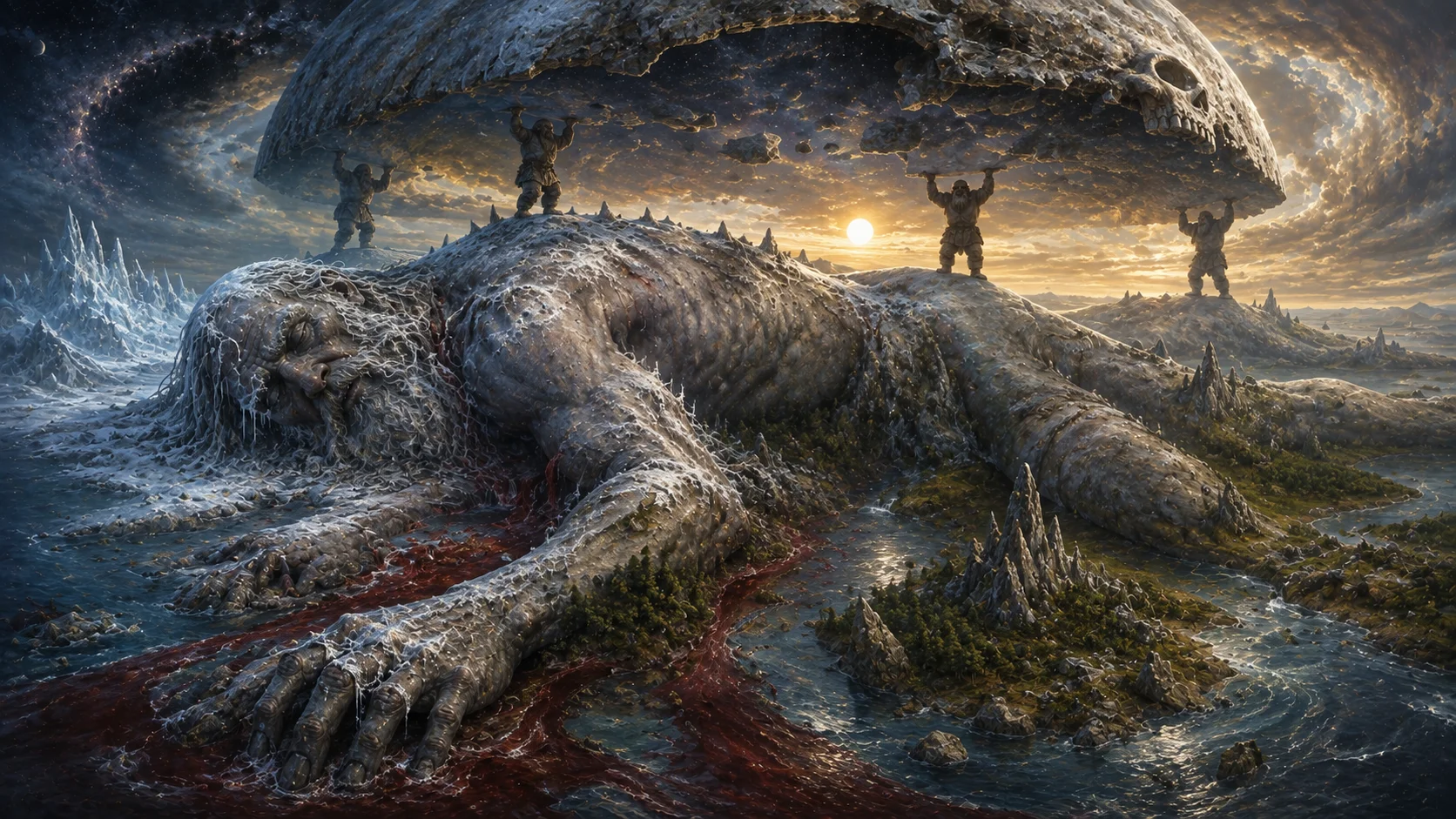
Odin and his brothers, the first gods, rose up and slew the giant Ymir. So vast was the primordial being that his blood gushed out in a flood that drowned almost all the other giants. Then the gods took Ymir's enormous body and built the world from it, piece by piece: from his flesh they made the earth; from his blood, the seas and lakes; from his bones, the mountains; from his teeth and shattered bones, the rocks and stones; from his skull, the dome of the sky, held up at its four corners by four dwarves; from his brains, the clouds; and from his hair, the trees. The sparks of fire from Muspelheim they set in the sky as the sun, moon and stars. Thus the entire ordered world — earth, sea, mountains, sky — was made from the body of the slain primordial giant.
The World That Was a Giant
Ymir endures as one of the most profound figures in all of world mythology — the primordial being whose body became the cosmos, an image of creation found, in kindred forms, across many cultures. He embodies the deep Norse vision that the world itself is made of the stuff of an ancient, chaotic, giant being — that the very earth beneath our feet is the flesh of Ymir, the mountains his bones, the sea his blood, the sky his skull. We live, in the Norse imagination, inside the body of the first giant.
The earth is his flesh, the mountains his bones, the sea his blood and the sky his skull — for the gods built the whole world from the body of the first giant they slew.
The Poems Behind the Prose
Almost everything told about Ymir survives because one Icelandic Christian, writing two centuries after his country's conversion, cared enough about the old poetry to explain it. Ymir appears first, scattered and allusive, in the anonymous verses of the Poetic Edda — above all in Völuspá, the seeress's prophecy of the world's beginning and end, and in Vafþrúðnismál, a wisdom-contest in which Odin, travelling in disguise, duels the giant Vafþrúðnir with cosmological riddles. It is Vafþrúðnir, not Odin, who recites how the earth was fashioned out of the giant's flesh and the mountains from his bones. Only around 1220 did Snorri Sturluson gather these fragments into the connected story most readers now know, in the section of his Prose Edda called Gylfaginning, "The Deluding of Gylfi". Much of what feels most vivid in the popular telling turns out to be Snorri's prose rather than the older verse: the cow Audhumla appears nowhere in the Poetic Edda, surfacing only in Gylfaginning and in a list of names for cows appended to the same book. The eddaic account is starker and colder. Vafþrúðnir says simply that venom-drops sprang from the rivers called the Élivágar and grew until a giant came from them — no cow, no fire meeting ice, only poison thickening in the dark until it was alive. The tidy symmetry of Muspelheim's heat against Niflheim's rime is Snorri's framing of a much rougher image.
The Giant Who Survived the Flood
The eddaic poems give Ymir a genealogy stranger than the familiar war of gods against giants. The children who grew beneath his arm and the son begotten between his legs are only the first generation; Vafþrúðnismál carries the line further, naming Þrúðgelmir as Ymir's son and Bergelmir as his grandson. The poem separately describes a six-headed son begotten foot upon foot, whom Rudolf Simek and others identify with Þrúðgelmir — though the verse never says so outright, and John Lindow has suggested the poet may have invented the name simply to fill out a genealogy. Bergelmir is the one who matters. When Ymir's opened veins drowned nearly the whole race of giants, he alone came through — laid, the poem says, upon a lúðr, a word so obscure that translators have rendered it ark, coffin, cradle, chest, and the wooden housing of a hand-mill, with no certainty which the poet meant. Snorri, reading it as a vessel and hearing Noah behind it, adds a wife and has the pair climb aboard and save themselves. Whatever the lúðr was, it held: every jötunn born after the flood — the giants who scheme against the gods, intermarry with them, father Loki and gather at Ragnarök — descends not from Ymir directly but from this one survivor, two generations after the world's first killing.
A Corpse Big Enough to Be a World
Norse myth was not alone in imagining the world as a body, but the resemblances fall into two very different classes. In the Rigveda of ancient India, the gods sacrifice the thousand-headed primordial being Purusha and build the cosmos and human society alike from the pieces: his eye becomes the sun, his mind the moon, his breath the wind, his feet the earth, and from his mouth, arms, thighs and feet come the different orders of people. That parallel is not coincidence. Comparative scholars reconstruct a shared Proto-Indo-European cosmogony behind both, in which a primordial being is dismembered to make the world. Ymir and Purusha are cousins — inherited from the same lost ancestral myth rather than borrowed one from the other.
The other resemblances are a different matter, and genuinely independent. In China, the giant Pangu holds heaven and earth apart for eighteen thousand years and dies of the effort, his breath becoming wind and cloud, his voice thunder, his left eye the sun and his right the moon, his blood the rivers, his hair the stars. In Mesopotamia, Marduk kills the primeval sea-goddess Tiamat in the Enuma Elish and splits her corpse in two, raising the vault of the sky from one half of her. No line of descent connects these to the Norse. They are separate cultures reaching for the same solution to the same problem — how do you build an ordered world out of something, rather than out of nothing — and each grasping for the largest material anyone could imagine: a body.
The Oldest Twin
The name itself may point further back than any of the poems. Ymir — and Aurgelmir, the name the frost-giants use for him in Vafþrúðnismál — is connected by philologists to a Proto-Indo-European root meaning "twin": the same root behind the Vedic Yama, lord of the dead and, in the oldest layer of Indian myth, the first mortal ever to die, and behind the Avestan Yima of ancient Iran. Latin geminus and Old Irish emuin, both plainly "twin", belong to the same family. Continental Germanic tradition preserves what may be a cousin of the figure under another name: the Roman historian Tacitus, writing in 98 CE, records that the Germanic peoples sang of an earth-born god called Tuisto, whose son Mannus fathered the ancestors of their tribes. Tuisto's name is usually derived from the Germanic root for "two" and read as something like "the double" or "the twofold one" — a being already two things at once. Whether or not the two figures are ultimately the same, a doubled or self-paired being standing at the root of creation is among the oldest and most widely scattered images in the Indo-European mythological family, and Ymir — producing a son and a daughter from one armpit while his own legs get children between themselves — wears that doubleness more openly than almost any surviving version of it.
No Temple, No Priest, No Prayer
For all his cosmic importance, nothing in the record suggests that anyone in the Viking Age prayed to Ymir, carved his likeness, or raised him a shrine. Set that against Thor, Odin and Freyr, whose names are stamped across the Norse world in cult sites, farm and settlement names, personal names and votive deposits. Ymir belongs to a different category of being altogether: not a power to be petitioned for a good harvest or a safe crossing, but the raw material the gods themselves worked with, already dead before any worship we can trace begins. He answers "what is the world made of?" rather than "who do we ask for help?" — a cosmological premise more than a deity. The absence of cult is not a gap in the evidence; it is the evidence.
The Kenning That Kept Him Alive
Yet Ymir was no antiquarian curiosity by the time the Eddas were written down, because the poets still needed him. Skaldic verse names things by allusion, and a poet who wanted to say "sky" could instead say Ymis haus — Ymir's skull. Snorri lists it in Skáldskaparmál among the accepted ways to name the heavens, and quotes the eleventh-century Icelandic skald Arnórr jarlaskáld using it in a praise-poem for a king. That is a small but telling piece of evidence: to compose such a line, or even to follow it, a listener had to know the creation story well enough to decode a two-word reference to it in passing. Ymir had no altar, but he had something arguably more durable — a place in the working technical vocabulary of the court poets, where a myth has to stay current or the poetry stops making sense.
Made Out Of, Not Made For
What sets this myth apart from most creation stories is not its violence but its economy: nothing is discarded. Every part of the giant becomes some part of the world a Norse farmer or fisherman actually stood on, drank from, or sheltered under. And the account withholds the consolation that most cosmogonies offer. There is no benevolent maker here and no purpose declared. The world is not made for anyone, only out of someone, and the making begins with a killing the gods commit before there is anybody in existence to judge them for it. Odin and his brothers do not shape the world out of care for its future inhabitants; they shape it because a body was what there was. It is a cold theology, and an unusually honest one about the terms on which anything at all gets built.
After the Edda
Ymir's afterlife outside Iceland is thinner than Thor's or Loki's, but it is real. Stan Lee and Jack Kirby put a version of him into Marvel Comics in Journey into Mystery #97 in 1963 — a frost giant of Niflheim and a recurring adversary of their Thor. Manga has reached for the name too: in Hajime Isayama's Attack on Titan, the founding titan from whom every later titan descends is called Ymir, the name attached once again to the single body that all other bodies come out of. And the name left Earth altogether in 2000, when a small, distant moon of Saturn was picked out from La Silla in Chile and catalogued as S/2000 S 1; astronomers named it Ymir three years later. It belongs to the Norse group of Saturnian moons, which all travel backwards around the planet, far out in the cold. One of its neighbours there, found four years after it, is named Bergelmir — the survivor of the flood, still keeping his distance from the giant he came from.