Ice does not usually give birth. But in the beginning, before there was a beginning, heat drifted out of the fire-realm and met frost drifting out of the ice-realm, and where they touched in the great emptiness of Ginnungagap, the rime began to drip and quicken. Two shapes rose out of that thaw. One was a giant. The other was a cow.
What the Void Produced
Norse cosmology places the first act of creation not in a word or a divine will but in temperature: Muspelheim's heat working on Niflheim's ice across the void of Ginnungagap. Snorri Sturluson set this account down around 1220 CE in the Gylfaginning section of his Prose Edda, and it is there, and only there, that the cow appears. Her name was Audhumla — Old Norse Auðhumla — generally understood, though not certainly, to mean something like “hornless cow rich in milk.”
She and the frost-giant Ymir came into being together, out of the same melting rime, in the same nameless gap between fire and ice. Neither was made by a god, because there were not yet any gods to do the making. Before her there was only the void itself: Ginnungagap, a word that points at a yawning, formless emptiness, with nothing in it to eat, breathe, or stand on. Audhumla is what that emptiness produced the moment heat and cold finally met inside it.
Four Rivers From One Udder
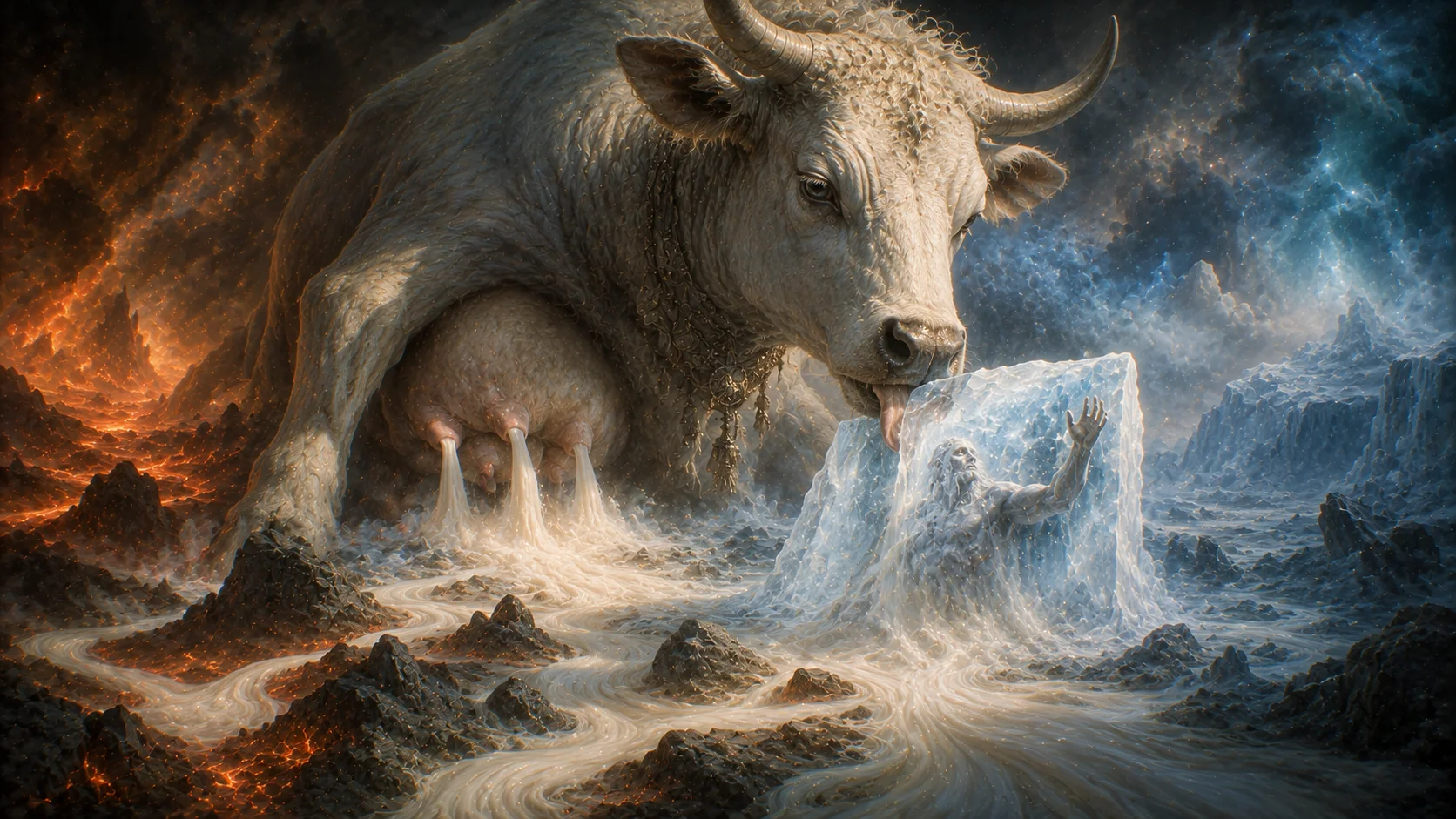
Ymir needed to eat, and the world provided the only thing it had: Audhumla. Four rivers of milk ran from her udder, and on them the first giant fed and grew. It is a strange image to sit with — the very first meal in existence was milk, drawn from a cow who had appeared moments before out of thawing frost, in a universe that otherwise contained nothing but ice, fire, and empty space.
Ymir is the ancestor of all the giants who would follow him, the entire jotun lineage tracing back through him to this one act of nourishment. Whatever violence and conflict fills the later Norse cosmos, its very first transaction was a mother-beast feeding a newborn giant. There is no combat in this opening scene, no rivalry, no contest of power — only an animal doing what animals do, and a giant growing because of it.
Her Own Hunger, and What It Uncovered
Audhumla needed sustenance too, and she found it the only way available to her: by licking the ice. Not plain ice, but rime-stones crusted with salt, and she worked at them with her tongue the way any cow works at a salt lick. It was an ordinary animal behavior, ordinary in every way except for where and when it was happening.
Because as she licked, the ice did not just melt. It gave something up.
Three Days, One Body
On the first day of her licking, hair appeared in the ice where her tongue had passed. On the second day, a head. On the third day, the whole figure came free at last: a man, whole and living, drawn out of frozen rime by nothing more than a cow's patient tongue.
This was Búri — the first of the gods, and the grandfather of Odin, Vili, and Vé. No thunderclap accompanied his arrival, no divine proclamation. He simply emerged, over three unhurried days, because Audhumla was hungry and the salt was in the ice and she kept licking.
Hair on the first day. A head on the second. On the third day, the whole man stood free of the ice.
The pacing of it is worth noticing on its own terms: three days, marked out one at a time, each one revealing a little more of what was underneath the frost. Nothing in the text explains why it took three days rather than one, or why hair came before a face and a face before a body. The account simply reports the sequence as it happened, the way an eyewitness might describe watching a shape slowly surface from beneath snow.
One Cow, Two Lineages
Look at what this means structurally: everything that follows in Norse myth — every giant, every god, every conflict between them — traces back through two separate threads, and Audhumla sits at the root of both. Her milk raised Ymir, father of the giants. Her tongue freed Búri, grandfather of the gods who would one day kill Ymir and build the world from his body.
She did not choose sides. She could not have; the gods and giants did not yet exist as opposing forces when she fed one and freed the other. She simply did what a cow does — ate, and gave milk — and the entire architecture of Norse cosmology rests on those two acts. The later killing of Ymir and the shaping of the world from his flesh, blood, and bone belongs to a much later chapter of Gylfaginning, one step removed from Audhumla herself, but it only becomes possible because she raised the giant who would be killed and freed the line that would do the killing. Every subsequent quarrel between god and giant in the wider mythology inherits that same double ancestry, one cow standing behind both parties at the very start of things.
A Story Told Once
It is worth sitting with how little text actually carries this story. The Poetic Edda, the older collection of anonymous verse gathered into the Codex Regius manuscript around 1270 CE, never mentions Audhumla at all — not once, in any of its poems. She belongs entirely to Snorri's prose retelling, written some two to three centuries after Scandinavia's conversion to Christianity. There is no second telling to compare against, no variant version, no other saga or verse that so much as names her.
Snorri was not writing scripture. His stated purpose was closer to a handbook, a resource to help skaldic poets understand the old kennings and allusions well enough to keep using them. Audhumla survives because a 13th-century Icelandic chieftain needed to explain where the world's first bodies came from, for readers who might otherwise miss a reference in a poem.
After the Ice, Nothing More
And then she is gone from the record. Gylfaginning does not follow her onward into any further adventure, does not marry her to anyone, does not give her a fate or a death or additional offspring. She feeds Ymir, she licks Búri free, and the text moves on to what Búri's line will do next. Her entire attested existence is contained in that one passage.
This is unusual even among Norse mythological figures. Most named beings in the corpus turn up more than once — in a kenning, in a genealogy, in a later saga reference — even if only in passing. Audhumla does not. Snorri's paragraph is the whole of her.
A Name That Points at Milk
The name itself leans into what she is. Auðr carries a sense of riches or abundance; the rest of the name gestures toward hornlessness. Put together, scholars read it as something close to “hornless cow rich in milk” — a description of function as much as a proper name. She is named for what flows out of her.
That the etymology is a scholarly reading rather than a certainty fits her generally: so much of what can be said about Audhumla rests on a single interpreted source, closely studied but never corroborated. A name built from abundance and hornlessness is also, in a small way, a complete description of her one scene: nothing about horns or aggression, everything about plenty and nourishment. The name and the story tell the same story twice, once in language and once in action.
Cattle at the Root of the World
Cattle were not incidental to the Norse world; they were wealth, sustenance, and status, central to how a household measured its standing. That a cow — not a bird, not a serpent, not a giant tree — stands at the very origin point of the cosmos says something about what the culture that told this story valued as foundational. Before there were gods to worship or giants to fear, there was a cow, doing what cows do, and the world followed from it.
It is a gentler image than most creation accounts allow themselves. The Norse cosmos that follows is full of oaths, feuds, and eventual apocalypse, but its opening scene is an animal feeding a newborn and licking salt from stones. For an audience that measured a family's fortune partly in the size of its herd, placing a cow at the beginning of everything was not a whimsical choice of imagery; it was reaching for the most self-evidently life-sustaining thing that audience knew, and setting it down before anything else existed.
A Familiar Shape, Elsewhere
A nourishing world-creature standing at the threshold of creation is not an idea unique to any one tradition; many mythologies reach for some version of a primal, life-giving animal or mother-figure at the start of things. Audhumla's particular form — an actual cow, licking a god free from ice while feeding a giant on her milk — belongs distinctly to the Norse telling, but the underlying instinct, to place nourishment rather than combat at the very beginning, recurs well beyond it.
What sets the Norse version apart is not the instinct itself but how literally it plays out: no metaphorical mother-of-all, no abstract life-force, just an actual animal, doing an actual animal's actual work, with consequences that ripple through the rest of the cosmology. The strangeness of the image is part of what has kept it memorable across eight centuries of retelling.
Borrowed and Expanded, Far From the Ice
Modern media has occasionally reached back for her. Video games and other popular adaptations have built Audhumla into a fuller character, giving her a presence and a role well beyond her one paragraph in Gylfaginning. These retellings are worth noting precisely because of how far they travel from the source: Snorri's Audhumla never speaks, never acts beyond feeding and licking, and never appears again after Búri stands free. Anything more elaborate belongs to invention layered on afterward, not to the medieval text.
What Remains
Strip away everything but what the Prose Edda actually says, and Audhumla is still remarkable: a cow formed from thawing rime in the first moment of the universe, whose milk fed the ancestor of the giants and whose tongue, licking salt from ice over three patient days, freed the ancestor of the gods. Two lineages, one origin, and a single act of ordinary animal hunger sitting underneath the whole architecture of the world that came after.
Sources & traditions
- EncyclopediaWikipedia — Auðumbla
- TraditionNorse texts, inscriptions and later retellings (Scandinavia)
Myths change from area to area and from time to time. This chronicle follows the most widely told versions; tellings in other villages, regions and eras may differ.