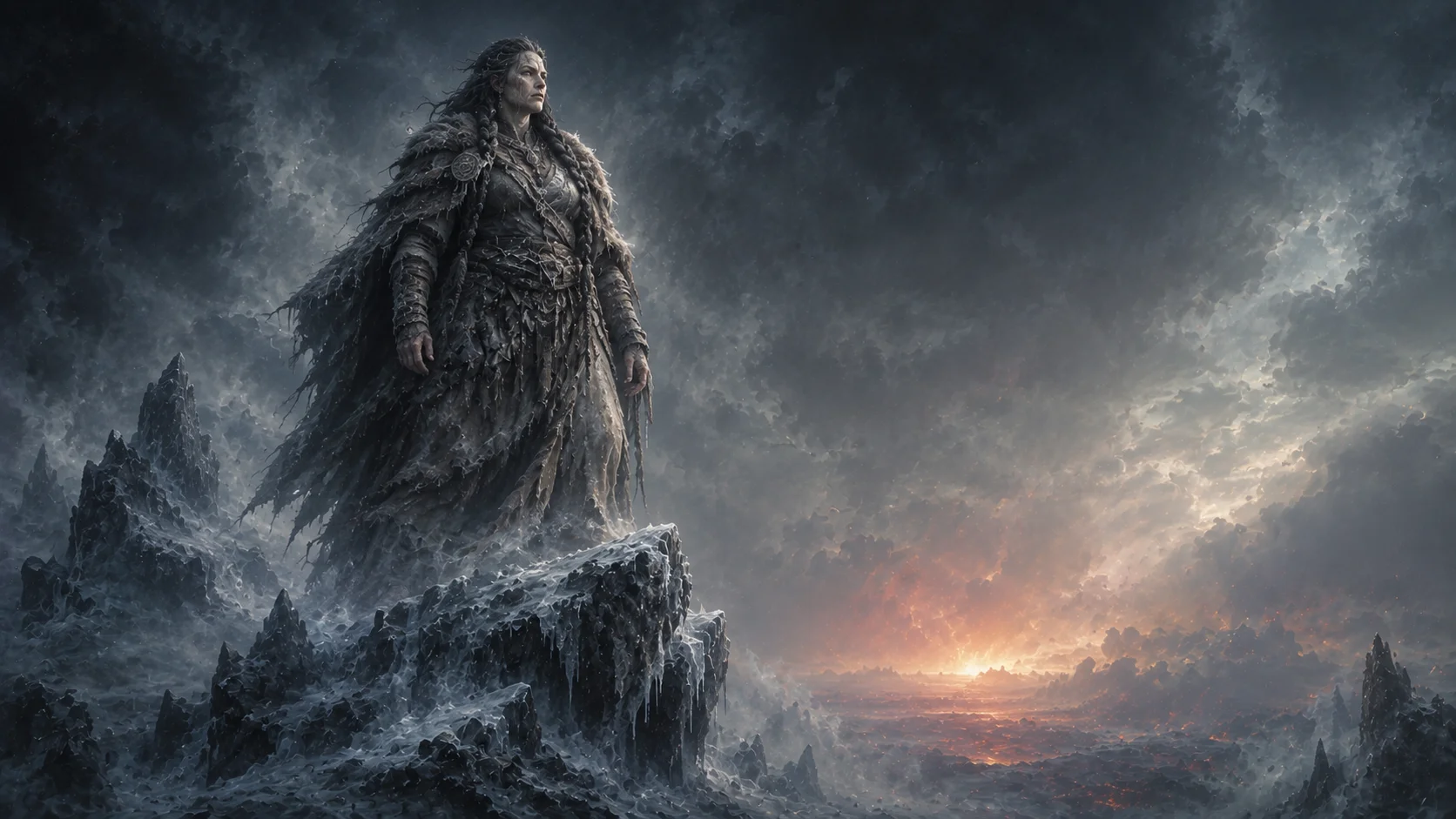
Bestla was a primordial giantess of Norse myth — the wife of the god Borr and the mother of Odin and his brothers, making her the giant ancestress of the chief gods and the grandmother of the entire Aesir line. Through her, the All-Father himself was half giant, and the deep kinship of gods and jötnar was sealed at the very root of the divine family tree.
The Giant Mother of the Gods
Bestla (Old Norse Bestla) was a giantess, a jötunn, the daughter of a giant named Bölþorn (Bolthorn), whose name suggests something like "evil-thorn" or "baleful-thorn." The Prose Edda names her plainly in this way, tracing her line back to a father who was himself unambiguously of giant stock — there is no ambiguity or later softening of her origin in the surviving texts. She belonged to the primordial world before the gods had fully shaped the cosmos, and she became the wife of the god Borr, son of the first god Buri. From this marriage of a god and a giantess came three sons: Odin, Vili, and Vé — the trio credited in the Prose Edda with slaying the primordial giant Ymir and building the world from his body. Bestla was thus the mother of the All-Father and his brothers, the giant ancestress standing at the very head of the line of the Aesir.
Last updated .
A Lineage Recorded, Not a Life
What survives of Bestla is genealogical rather than narrative. No independent myth gives her a voice, a deed, or even a single recorded episode of her own. She is named as a daughter, a wife, and a mother, and the sources stop there. This is not unusual for the women who stand at the root of Norse cosmogony — figures known only through the briefest of mentions, present because the story needs to account for where the gods came from, not because their own actions were preserved. Bestla's entire attested presence in the mythology rests on those few genealogical lines in the Prose Edda, and on the single reference to her family in the Poetic Edda discussed below. She carries no recorded epithets or titles of her own; she is known simply as Bestla, daughter of Bölþorn.
The Marriage That Bridged Two Kinds
The pairing of Borr, an early Aesir ancestor figure, with Bestla, a giantess, is one of the foundational unions of Norse cosmogony. It was not an isolated exception — the gods and giants intermarried repeatedly throughout the mythology — but it is the first and most consequential instance, because it produced Odin himself. Through this marriage, the line of the Aesir was, from its very first generation after Buri, already mixed with jötunn blood. The Prose Edda's account in Gylfaginning treats this plainly, without editorial comment on the mixing of kinds; it is simply how the genealogy runs. Bestla's role here is foundational rather than active — she is the vessel and origin point of a lineage, not a participant in any recorded conflict or deed.
Mother of the Three Who Made the World
The sons Bestla bore to Borr — Odin, Vili, and Vé — are together credited with one of the central acts of Norse cosmogony: the slaying of Ymir, the primordial giant from whose body the world was made. Odin became the chief of the Aesir; Vili and Vé are rarely mentioned elsewhere in the surviving sources, appearing mainly in this single creation account before receding from the narrative entirely. This means that Bestla's lasting significance is bound up almost entirely with one of her sons — she is remembered because she was Odin's mother, and the cosmogonic act her sons performed together is the reason the family line she began is remembered at all. She is not present at the slaying of Ymir herself; the deed belongs to her sons, and her role is the quieter one of having borne them.
The Giant Blood at the Root of the Aesir
Bestla's significance lies above all in what her motherhood means for the nature of the gods themselves. Because Odin, king of the Aesir, was the son of a giantess, the chief god of the Norse pantheon was himself half giant by blood, and through him, so was much of the divine line that followed. The Aesir and the jötnar were not utterly separate and opposed kinds in this mythology, but deeply intertwined kin: gods descended from giant mothers, took giant wives in later generations, and shared blood with the very beings they so often fought. Bestla stands at the root of this entanglement — the giantess whose sons became gods, and whose blood therefore runs through the entire line that follows from Odin.
Bölþorn's Son and the Nine Mighty Spells
A single, tantalising fragment outside the Prose Edda hints at more to Bestla's family than the bare genealogy suggests. In the Poetic Edda poem Hávamál, stanza 140, Odin speaks of having learned nine mighty spells from "Bölþorn's son" — that is, from Bestla's own brother, his giant uncle on his mother's side. The spell-teaching itself is attributed to this unnamed brother, not to Bestla, and the poem gives him no name of his own beyond his patronymic. Even so, the reference matters for what it implies about Bestla's family: her father's line was evidently associated with esoteric or magical knowledge significant enough that the chief god of the Aesir sought it out and credited it directly. Bestla herself performs no magic and teaches nothing in the surviving texts, but the household she came from — her father Bölþorn, her unnamed brother — carried a reputation for lore that reached all the way to Odin.
Wisdom Drawn From the Giant Side
Taken together with the Gylfaginning genealogy, the Hávamál reference suggests that some portion of Odin's deep and famous hunger for wisdom had its roots on his mother's side of the family, among the giants rather than the gods. The All-Father is elsewhere associated with wisdom won through ordeal and sacrifice, but here the poem places one specific, named source of that wisdom squarely within Bestla's own kin. It is a small detail, and the poem does not dwell on it, but it reinforces the same point the genealogy makes: the giants, for all the enmity the mythology elsewhere records between gods and jötnar, were also remembered as a source of the gods' deepest and most valued knowledge. Bestla's family, on this reading, was not merely a source of blood but of learning — even though Bestla herself is not shown teaching or knowing anything in particular.
A Name Read for Its Shadow
Some later interpreters have drawn attention to the meaning of her father's name, Bölþorn, and what it might suggest about the character of Bestla's family within the wider cosmology. "Bale-thorn" or "evil-thorn" is a harsh name for a lineage, and some scholars have connected it to an idea of primeval, chaotic forces that predate the fuller order the gods later impose on the cosmos. This is an interpretive reading of the name rather than something the Prose Edda or Poetic Edda states outright — the texts themselves never characterise Bölþorn, his son, or Bestla as sinister or chaotic in any explicit way. It remains a point worth noting precisely because it is speculative: the name invites the association, but Bestla's own portrayal, such as it is, is entirely neutral. She is a wife and a mother, nothing more and nothing less, in every line that actually mentions her.
No Cult, No Saga, No Place of Her Own
Unlike many figures of Norse mythology who left a trace in place-names, later folk tradition, or an independent saga of their own adventures, Bestla has none of these. There is no medieval cult attached to her name, no location named for her, and no saga in which she appears as an active character. Her entire medieval attestation consists of the genealogical notice in Gylfaginning and the single allusion to her brother in Hávamál. This absence is itself informative: it marks Bestla as belonging to the small class of foundational genealogical figures — ancestors whose function in the mythology is to explain where someone else came from, rather than to be remembered for what they themselves did.
An Ancestress Remembered in Later Retellings
In the centuries since, Bestla has occasionally reappeared in modern retellings of Norse creation mythology, and in some fiction and games that draw on that mythology, generally in her one attested role: as the mother of Odin. These later appearances do not, on the whole, add attested detail to what the medieval sources preserve — they draw on the same handful of lines in Gylfaginning and Hávamál that constitute her entire documented presence. Her afterlife in modern imagination is therefore an extension of the same single fact that defined her in the medieval texts: she is Odin's mother, the giantess through whom the chief of the gods carried giant blood.
The Root of the Family Tree
Bestla endures as the primordial giantess who was the mother of the gods — the giant ancestress of the Aesir, the mother of Odin, Vili, and Vé, and the grandmother of the divine race that followed from them. Though no stories of her own deeds survive, and though she herself performed no recorded act beyond bearing her sons, her place in the mythology is foundational precisely because of that absence: she is remembered not for what she did but for what she made possible. She is the giant blood in the veins of the gods, the mother through whom the All-Father was born, and the proof, at the very root of the family tree, that the gods and the giants of the Norse cosmos were, from the first generation onward, one kindred.
The king of the gods was the son of a giantess — for at the very root of the Aesir line stands Bestla, the giant mother of Odin and his brothers, and the daughter of a house whose name still carries the shadow of the primeval world it came from.