Bor (Borr) was a primordial Norse god — the son of Buri, the husband of the giantess Bestla, and the father of Odin and his brothers, the gods who would slay Ymir and create the world. He is the crucial link in the genealogy of the gods, the bridge between the first divine being and the All-Father, and the father of the creators of the world.
The Son of the First God
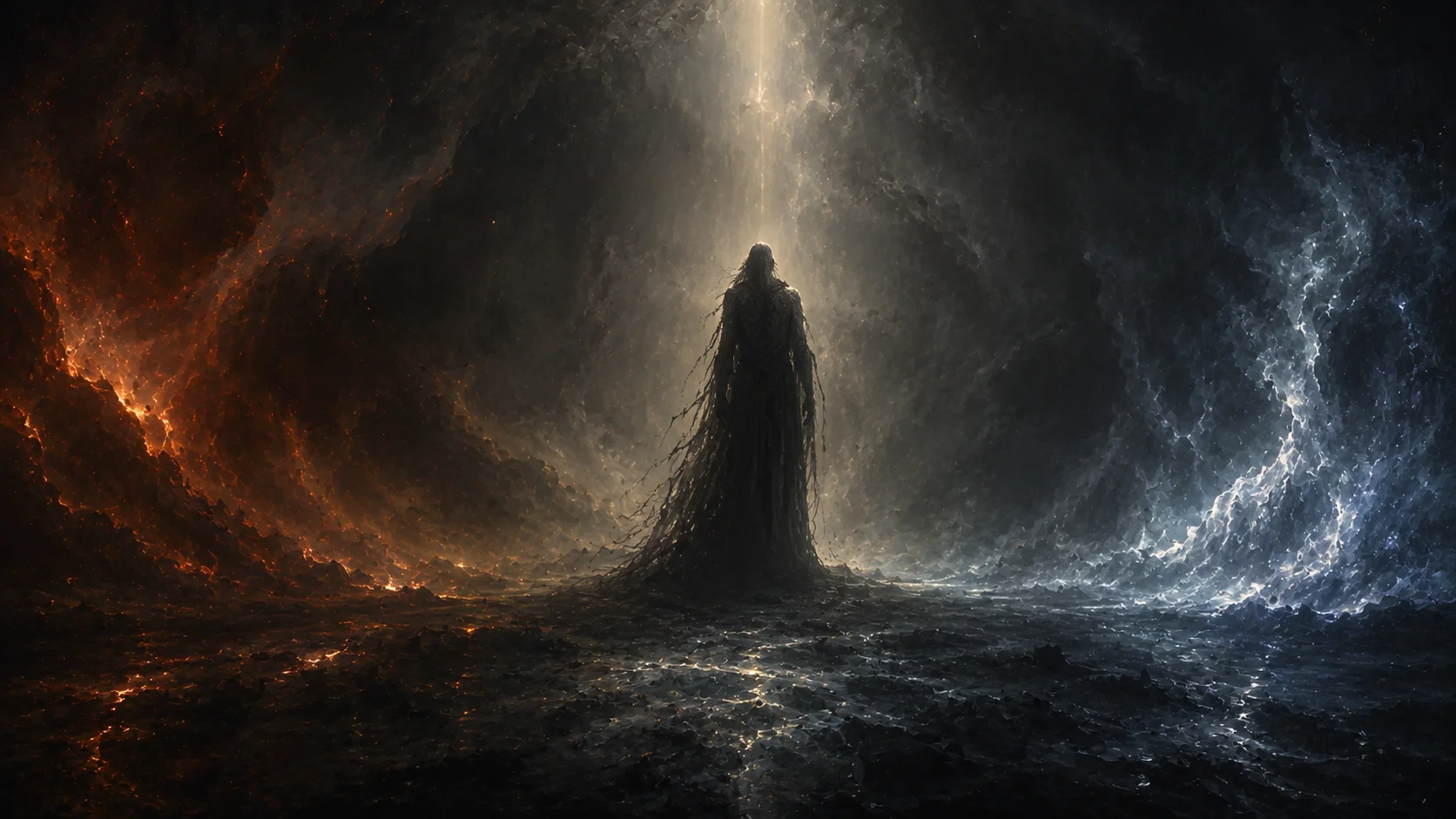
Bor (Old Norse Borr or Burr) was the son of Buri, the first of the gods who had been licked free of the primordial ice by the cow Audhumla. As Buri's son, Bor belonged to the second generation of the divine race, in the earliest dawn of the cosmos when the world had not yet been made and only the giants, the first gods, and the primordial beings existed in and around the great void of Ginnungagap.
Last updated .
The Marriage to Bestla
Bor took as his wife the giantess Bestla, the daughter of a giant named Bölþorn. This union of a god with a giantess was deeply significant: it mingled the line of the gods with the line of the jötnar at the very root of the Aesir family tree, so that Odin himself — the All-Father — was half giant by descent, born of a divine father and a giant mother. The deep kinship and entanglement of gods and giants in Norse myth begins here, in the marriage of Bor and Bestla.
The Father of the Creators
From Bor and Bestla came three sons: Odin, Vili and Ve. These three brothers were the gods who rose up and slew the primordial giant Ymir, and who then took his vast body and fashioned from it the entire world — the earth from his flesh, the sea from his blood, the sky from his skull. They also created the first humans from two tree-trunks on the shore. Thus Bor was the father of the creator-gods, the sire of the three brothers who made the cosmos and humankind. Everything that exists in the ordered world was made by the sons of Bor.
The Bridge of the Generations
Bor endures as the essential link in the Norse genealogy of the gods — son of the first god Buri, husband of the giantess Bestla, father of Odin and the creators of the world. Though he has no myths of his own, his place is foundational: he is the father of the All-Father, the generation through which the divine line passed from its primordial origin to the gods who would shape the cosmos. In him the line of gods and the line of giants joined, and from him sprang the makers of the world.
Son of the first god and husband of a giantess, he fathered the three brothers who slew Ymir and built the world — the bridge between creation's dawn and the All-Father himself.
The Only Text That Names Him
Strip away everything Snorri Sturluson wrote about Bor in the thirteenth century, and the older poetic tradition leaves him almost nothing to stand on. His only appearance in the Poetic Edda is a half-line in Völuspá, the seeress's prophecy that opens the collection: before “Bur's sons” lifted up the lands and shaped glorious Midgard, there was only the yawning void of Ginnungagap. The poem never pauses on him as an individual. He exists in the oldest surviving Norse cosmogony purely as a genitive — a possessive tag fastened to the sons who did the actual work. Völuspá is generally dated to somewhere around the tenth century, but its wording was not fixed in writing until the thirteenth, in manuscripts such as the Codex Regius. It is Snorri, in Gylfaginning — the mythological section of the prose handbook for poets he compiled around 1220, half a century before that manuscript was copied — who takes the bare genitive and builds an entire household out of it: a father, Buri; a wife, Bestla; three named sons. Almost everything a reader now knows about Bor as a distinct figure is Snorri's systematisation of a fragment the older poetry never bothered to unpack.
A Name That Means “Son”
There is a quiet joke buried in the name itself. The form Völuspá uses — Burr — is not only a proper name in Old Norse; it is also the ordinary poetic word for “son,” built from the same root as the verb bera, “to bear, to carry, to bring forth,” and distantly related to the English word born. Skalds reached for burr whenever a verse needed to say “the son of” somebody, in the same way mær served for “maiden” or gramr for “prince.” So the figure whose entire mythological function is to be a link in a chain — son of Buri, father of Odin — carries a name that simply means the son. Whether the poets who first sang of “Bur's sons” heard the pun or merely grabbed the nearest word for offspring, the effect on the surviving text is identical: the name refuses to let him be anything but relational, a position in a genealogy rather than a person in a story.
The Kinsman Who Taught Odin Magic
Bor's marriage to Bestla did more than mingle divine and giant blood at the root of the world — it gave Odin an uncle, and that uncle surfaces in one of the strangest passages in the Poetic Edda. In Hávamál, in the same run of stanzas where Odin hangs on the windswept tree and takes up the runes, the god says he learned nine mighty songs from a figure named only as the son of Bölþorn, Bestla's father. That makes his teacher Bestla's brother: Odin's own maternal uncle, reached through the very marriage that made Bor the bridge between generations. It is a small, easily missed detail, but it means the giant side of Bor's household was not a one-off act of world-founding kinship that the mythology then forgot. It stayed live, resurfacing a generation later as the source of Odin's occult knowledge. The family Bor married into quietly supplies one of the Eddas' most consequential inheritances — and it reaches Odin through his mother's line, not his father's.
A God Without a Single Deed
Norse mythology is unusually generous with incidental action: even background figures tend to get a verb. Buri is licked free of the salt ice by the cow Audhumla, an image vivid enough that illustrators still reach for it. Bestla is at least the fixed point by which the verse identifies Odin's mysterious teacher. Odin, Vili and Ve kill, dismember, and build. Bor does none of it. No surviving source shows him performing an action, speaking a line, or standing in a scene; he marries and he fathers, and both are stated rather than dramatised. Nor does he carry a by-name of his own, the way almost every other figure of consequence does — he is named, and then immediately positioned as somebody's son and somebody's father, because no story was ever attached to him that could have earned him anything else. He is, in the strictest sense, the most passive figure in the genealogy of the Aesir: present at the hinge of creation, responsible for nothing that happens there beyond having been born and having bred.
No Temple, No Prayer
Thor has a weekday. Odin has a weekday, and towns across Scandinavia and England still carry his name; Thor had, by the account of the eleventh-century chronicler Adam of Bremen, a great carved image standing in the temple at Uppsala. Bor has none of this. No place name in Scandinavia is securely attributed to him, no amulet or carved stone has ever been identified as depicting him, and nothing in the written or archaeological record suggests that anyone in the Viking Age poured a libation or swore an oath in his name. That absence is not simply an accident of survival; it is consistent with what the texts themselves show. A god who is worshipped tends to accumulate stories, because worshippers want him to have done something worth invoking. Bor accumulated none, and so he accumulated no cult. He belongs to the mythographer's genealogy chart rather than to the farmer's household ritual — a distinction the sources seem to preserve on their own, whether or not the poets who first sang of “Bur's sons” ever thought about it in those terms.
Bor After the Vikings
When Bor resurfaces centuries later, it is almost always as exactly what he was in Snorri's text: a name to fill a gap in a family tree. Modern retellings of Norse mythology — encyclopedic compendia, the genealogical diagrams printed in fantasy sourcebooks and role-playing supplements — reliably include him for the same reason Snorri did, because Odin's ancestry needs somebody standing in that slot. The most visible afterlife by far belongs to Marvel Comics, which for decades has used Bor as the name of Odin's father and a king of Asgard in his own right, a warrior-ancestor referenced across the run of Thor titles and carried onto film, where Odin invokes his father's memory. It is a fitting fate for a figure whose entire textual existence was already genealogical scaffolding: a name too structurally necessary to drop, too undramatised to become anything more than a name, picked up by each new generation of storytellers for precisely the function Snorri first gave him — not a character, but the reason Odin has an ancestry at all.